Bhagavad Gita 10.2: meaning and translation
Chapter 10: Vibhuti Yoga. Krishna says
Krishna says that neither the hosts of gods nor the great sages (maharṣis) know his origin (prabhava), for he is in every way the beginning of the gods and the great sages.
Click or tap a word for its meaning and its dictionary page.
Text and layers
Text and layers
These choices stay in this browser.
Bhagavad Gita 10.2
न मे विदुः सुरगणाः प्रभवं न महर्षयः ।अहमादिर्हि देवानां महर्षीणां च सर्वशः ॥
Na me viduh suraganah prabhavam na maharshayahAhamadirhi devanam maharshinam cha sarvashah
na me viduḥ suragaṇāḥ prabhavaṃ na maharṣayaḥ |ahamādirhi devānāṃ maharṣīṇāṃ ca sarvaśaḥ ||
Our explanation Krishna says that neither the hosts of gods nor the great sages (maharṣis) know his origin (prabhava), for he is in every way the beginning of the gods and the great sages. The commentators read prabhava differently (see the views).
हिंदी अर्थ कृष्ण कहते हैं कि न देवताओं के समूह उनके प्रभव (उत्पत्ति) को जानते हैं, न महर्षि; क्योंकि वे ही हर प्रकार से देवताओं और महर्षियों के आदि हैं। टीकाकार “प्रभव” शब्द को अलग-अलग ढंग से समझते हैं।
Word by word
Every word, with its dictionary page
Word by word
- न na · not (indeclinable) Dictionary: 2. na, Monier-Williams 1899, p. 523, col. 1 “not, no, nor, neither”
- मे me · "my" (Krishna's) (pronoun, genitive singular) Dictionary: 1. mad, Monier-Williams 1899, p. 777, col. 2 “base of the first pers. pron. in the sg. number (esp. in comp.)”
- विदुः viduḥ · know (perfect with present sense, 3rd person plural) Dictionary: 1. vid, Monier-Williams 1899, p. 963, col. 2 “to know, understand, perceive, learn”
- सुरगणाः suragaṇāḥ · the hosts of gods (compound (masculine), nominative plural) Dictionary: sura, Monier-Williams 1899, p. 1234, col. 2 “a god, divinity, deity”; gaṇa, Monier-Williams 1899, p. 343, col. 1 “a flock, troop, multitude, number, tribe, series, class”
- प्रभवम् prabhavam · origin (noun (masculine), accusative singular) Dictionary: pra-bhava, Monier-Williams 1899, p. 684, col. 2 “m. production, source, origin, cause of existence”
- न na · nor (indeclinable) Dictionary: 2. na, Monier-Williams 1899, p. 523, col. 1 “not, no, nor, neither”
- महर्षयः maharṣayaḥ · the great sages (compound (masculine), nominative plural) Dictionary: maharṣi, Monier-Williams 1899, p. 794, col. 2 “a great Ṛishi, any great sage or saint”
- अहम् aham · "I" (Krishna) (pronoun, nominative singular) Dictionary: aham, Monier-Williams 1899, p. 124, col. 2 “nom. sg. ‘I,’”
- आदिः ādiḥ · the beginning, source (noun (masculine), nominative singular) Dictionary: 1. ādi, Monier-Williams 1899, p. 136, col. 3 “beginning, commencement”
- हि hi · for (indeclinable) Dictionary: 2. hi, Monier-Williams 1899, p. 1297, col. 3 “for, because, on account of”
- देवानाम् devānām · of the gods (noun (masculine), genitive plural) Dictionary: deva, Monier-Williams 1899, p. 492, col. 2 “a deity, god”
- महर्षीणाम् maharṣīṇām · of the great sages (compound (masculine), genitive plural) Dictionary: maharṣi, Monier-Williams 1899, p. 794, col. 2 “a great Ṛishi, any great sage or saint”
- च ca · and (indeclinable) Dictionary: 2. ca, Monier-Williams 1899, p. 380, col. 1 “and, both, also, moreover, as well as”
- सर्वशः sarvaśaḥ · in every way (indeclinable) Dictionary: sarvaśas, Monier-Williams 1899, p. 1189, col. 2 “wholly, completely, entirely, thoroughly, collectively, altogether”
Old translations
Kashinath Trimbak Telang, 1882. Public domain. Page 86.
Not the multitudes of gods, nor the great sages know my source; for I am in every way1 the origin of the gods and great sages.
Footnotes (the translator’s own) - As creator, as moving agent in workings of the intellect, &c. ↩
Compare 3 translations
Kashinath Trimbak Telang, 1882. Public domain. Page 86.
Not the multitudes of gods, nor the great sages know my source; for I am in every way1 the origin of the gods and great sages.
Footnotes (the translator’s own) - As creator, as moving agent in workings of the intellect, &c. ↩
You are reading this one
Annie Besant, 1895. Public domain. Page 95.
The multitude of the Gods, or the great Rishis, know not My forthcoming, for I am the beginning of all the Gods and the great Rishis.
You are reading this one
Swami Swarupananda, 1909 (first printed 1907). Public domain. Page 194.
Neither the hosts of Devas, nor the great Rishis, know My origin, for in every way I am the source of all the Devas and the great Rishis.
You are reading this one
Cite this verse
The translation: K. T. Telang, The Bhagavadgîtâ (The Sacred Books of the East, vol. VIII, Oxford: Clarendon Press, 1882), p. 86. Bhagavad Gita 10.2.
The translation: Annie Besant, The Bhagavad Gîtâ, or The Lord's Song (London: Theosophical Publishing Society, 1895), p. 95. Bhagavad Gita 10.2.
The translation: Swami Swarupananda, Srimad-Bhagavad-Gita (Mayavati: Prabuddha Bharata Press, 1909; first printed in Prabuddha Bharata, 1907–1909), p. 194. Bhagavad Gita 10.2.
Our explanation: “Bhagavad Gita 10.2: meaning and translation.” Pujadeep. Updated October 25, 2026. https://pujadeep.com/bhagavad-gita/10/2/
Pujadeep’s explanations are free to quote with credit: name Pujadeep and link to the page. How to credit
Classical readings, by school
Each reading is named by its school. None is presented as the only meaning.
What Advaita, Vishishtadvaita and Dvaita teach, in short
Shankara Advaita
Shankara says prabhava may mean either origin or great lordly power. No one can know a source of Krishna's being, because he is himself the source of the gods and sages.
Source: The Bhagavad-Gita, with the commentary of Sri Sankaracharya, translated by A. Mahadeva Sastri (2nd ed., Mysore: G. T. A. Printing Works, 1901), commentary on 10.2, p. 234. Summarised in our own words; none of its text is reproduced.
Ramanuja Vishishtadvaita
Ramanuja reads prabhava as the Lord's high nature: his names, deeds, essence and qualities. The gods and sages have only the limited knowledge he has given them, so they cannot measure him.
Source: Sri Bhagavad-Gita with Sri Ramanujacharya's Visishtadvaita commentary, translated by A. Govindacharya (Madras, 1898), commentary on 10.2, p. 320. Summarised in our own words; none of its text is reproduced.
Share
Show the ways to share
Send one picture or the text to one chat. The picture names its source and the address of this page.
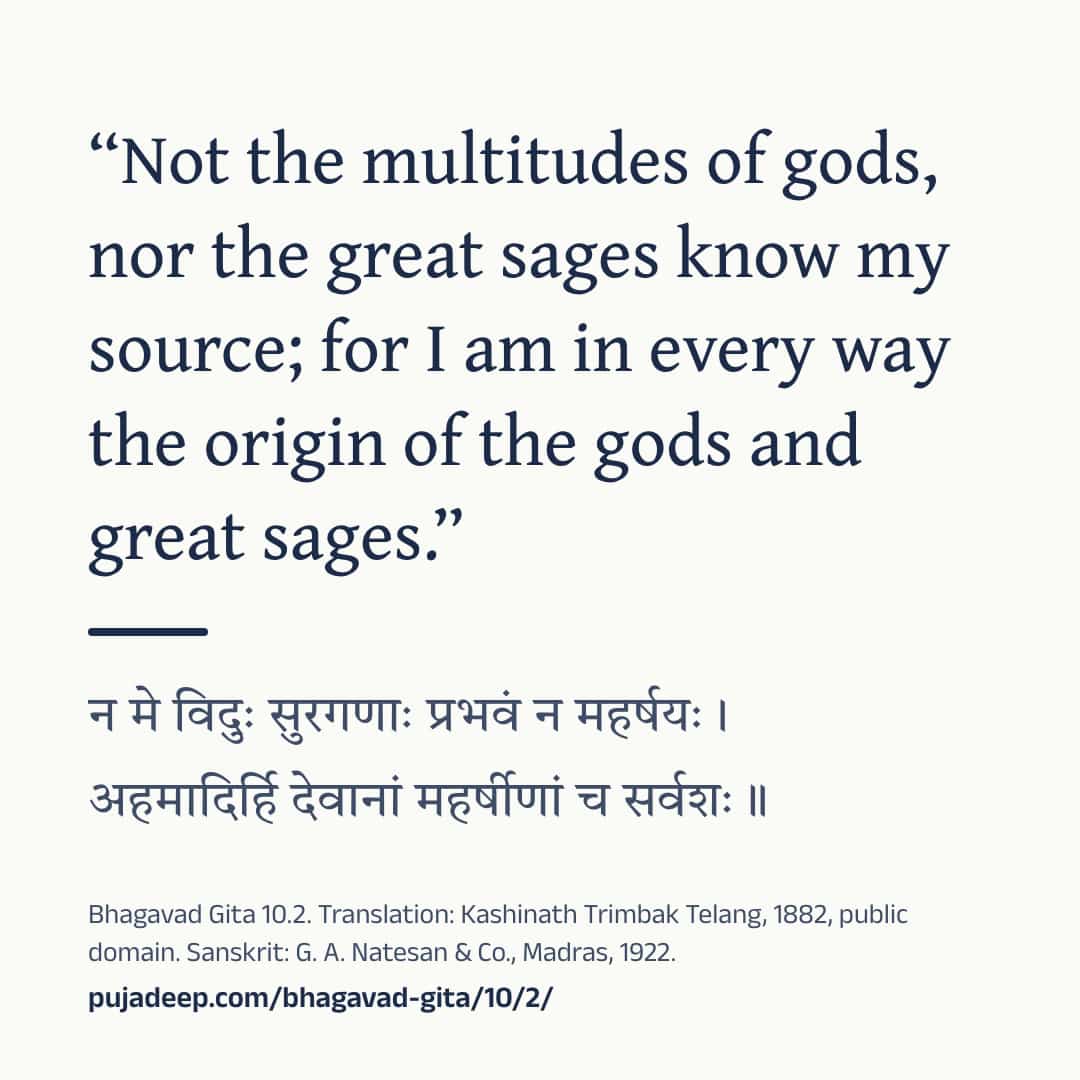
Drawing the picture
See the words
Bhagavad Gita 10.2

न मे विदुः सुरगणाः प्रभवं न महर्षयः ।
अहमादिर्हि देवानां महर्षीणां च सर्वशः ॥

“Not the multitudes of gods, nor the great sages know my source; for I am in every way the origin of the gods and great sages.”
(K. T. Telang, The Bhagavadgîtâ (The Sacred Books of the East, vol. VIII, Oxford: Clarendon Press, 1882), p. 86, public domain)

“The multitude of the Gods, or the great Rishis, know not My forthcoming, for I am the beginning of all the Gods and the great Rishis.”
(Annie Besant, The Bhagavad Gîtâ, or The Lord's Song (London: Theosophical Publishing Society, 1895), p. 95, public domain)

“Neither the hosts of Devas, nor the great Rishis, know My origin, for in every way I am the source of all the Devas and the great Rishis.”
(Swami Swarupananda, Srimad-Bhagavad-Gita (Mayavati: Prabuddha Bharata Press, 1909; first printed in Prabuddha Bharata, 1907–1909), p. 194, public domain)

Sanskrit: G. A. Natesan & Co., Madras, 1922.
https://pujadeep.com/bhagavad-gita/10/2/ Nothing is sent from this site. Your own app sends it, to the chat you choose. The picture quotes the translation you chose on this page, with its name and year.
Sanskrit text: The Bhagavad-Gita, or The Lord's Song, with the text in Devanagari and an English translation, 1922. Meanings: written for Pujadeep and checked against the cited edition. Source and changes
Questions families ask
Who speaks Bhagavad Gita 10.2?
Krishna speaks this verse, in chapter 10 (Vibhuti Yoga).
Where does the Sanskrit text come from?
Sanskrit text: The Bhagavad-Gita, or The Lord's Song, with the text in Devanagari and an English translation, 1922. Meanings: written for Pujadeep and checked against the cited edition. See the source
Is the meaning on this page a translation?
Explanation written for this site from the sources listed here, and checked against the cited edition. It is not a translation and not the only way to read the text. Free to quote with credit.
Source and licence
- Sanskrit text
- The Bhagavad-Gita, or The Lord's Song, with the text in Devanagari and an English translation (Annie Besant, G. A. Natesan & Co., Madras, 1922). Public domain. The Sanskrit on these pages was read from this printing’s page images.
- Translation
- The Bhagavadgîtâ with the Sanatsugâtîya and the Anugîtâ, translated by Kâshinâth Trimbak Telang (The Sacred Books of the East, vol. VIII, ed. F. Max Müller) (Kashinath Trimbak Telang, F. Max Müller, Clarendon Press, Oxford, 1882). Public domain. Shown verbatim, as printed.
- Translation
- The Bhagavad Gîtâ, or The Lord's Song, translated by Annie Besant (Annie Besant, Theosophical Publishing Society, London, 1895). Public domain. Shown verbatim, as printed.
- Translation
- Srimad-Bhagavad-Gita, with Sanskrit Text; Paraphrase with Word-by-word Literal Translation; English Rendering and Comments, Index, &c., by the Swami Swarupananda (Himalayan Series, No. XX) (Swami Swarupananda, The Editors and Publishers, Advaita Ashrama, Mayavati, Prabuddha Bharata Press, Mayavati, Almora, Himalayas, 1909). Public domain. Shown verbatim, as printed.
- Commentary
- The Bhagavad-Gita, with the commentary of Sri Sankaracharya, translated by A. Mahadeva Sastri (2nd ed., Mysore: G. T. A. Printing Works, 1901) (Public-domain scan, University of California Libraries). Summarised in our own words; none of its text is reproduced.
- Commentary
- Sri Bhagavad-Gita with Sri Ramanujacharya's Visishtadvaita commentary, translated by A. Govindacharya (Madras, 1898) (Scan uploaded to archive.org (folkscanomy collection)). Summarised in our own words; none of its text is reproduced.
- Common wording
- In this text, 32 words follow today's common wording, checked against sanskritdocuments.org; Sanskrit Wikisource; Gita Press, Gorakhpur; GRETIL, Göttingen and Bhaktivedanta Book Trust.
- Our explanation
- Explanation written for this site from the sources listed here, and checked against the cited edition. It is not a translation and not the only way to read the text. Free to quote with credit.
- Checked
- Checked against the cited edition, October 15, 2026.
- Updated
- October 25, 2026