Bhagavad Gita 10.4: meaning and translation
Chapter 10: Vibhuti Yoga. Krishna says
Krishna lists the states of beings: understanding (buddhi), knowledge, freedom from delusion, patience, truth, self-restraint (dama), calm (śama), pleasure, pain, coming into being and passing away (bhava, abhāva), fear and fearlessness.
Click or tap a word for its meaning and its dictionary page.
Text and layers
Text and layers
These choices stay in this browser.
Bhagavad Gita 10.4
बुद्धिर्ज्ञानमसम्मोहः क्षमा सत्यं दमः शमः ।सुखं दुःखं भवोऽभावो भयं चाभयमेव च ॥
Buddhirjnanamasammohah kshama satyam damah shamahSukham duhkham bhavobhavo bhayam chabhayameva cha
buddhirjñānamasammohaḥ kṣamā satyaṃ damaḥ śamaḥ |sukhaṃ duḥkhaṃ bhavo’bhāvo bhayaṃ cābhayameva ca ||
Our explanation Krishna lists the states of beings: understanding (buddhi), knowledge, freedom from delusion, patience, truth, self-restraint (dama), calm (śama), pleasure, pain, coming into being and passing away (bhava, abhāva), fear and fearlessness. The list continues in the next verse.
हिंदी अर्थ कृष्ण प्राणियों के भावों की सूची देते हैं: बुद्धि, ज्ञान, असम्मोह (मोह न होना), क्षमा, सत्य, दम (इंद्रियों का संयम), शम (मन की शांति), सुख, दुःख, भव और अभाव (होना और न होना), भय और अभय। सूची अगले श्लोक में आगे चलती है।
Word by word
Every word, with its dictionary page
Word by word
- बुद्धिः buddhiḥ · understanding (noun (feminine), nominative singular) Dictionary: buddhi, Monier-Williams 1899, p. 733, col. 3 “intelligence, reason, intellect, mind”
- ज्ञानम् jñānam · knowledge (noun (neuter), nominative singular) Dictionary: jñāna, Monier-Williams 1899, p. 426, col. 1 “knowing, becoming acquainted with, knowledge”
- असम्मोहः asammohaḥ · freedom from delusion (noun (masculine), nominative singular) Dictionary: a-sammoha, Monier-Williams 1899, p. 119, col. 3 “calmness, composure, deliberateness”
- क्षमा kṣamā · patience, forbearance (noun (feminine), nominative singular) Dictionary: kṣama, Monier-Williams 1899, p. 326, col. 2 “patience, forbearance, indulgence”
- सत्यम् satyam · truth (noun (neuter), nominative singular) Dictionary: satya, Monier-Williams 1899, p. 1135, col. 3 “true, real, actual, genuine”
- दमः damaḥ · self-restraint (noun (masculine), nominative singular) Dictionary: dama, Monier-Williams 1899, p. 469, col. 2 “self-command, self-restraint”
- शमः śamaḥ · calm of mind (noun (masculine), nominative singular) Dictionary: śama, Monier-Williams 1899, p. 1053, col. 3 “tranquillity, calmness, rest, equanimity, quietude or quietism, absence of passion”
- सुखम् sukham · pleasure, happiness (noun (neuter), nominative singular) Dictionary: sukha, Monier-Williams 1899, p. 1221, col. 1 “ease, easiness, comfort, prosperity, pleasure, happiness”
- दुःखम् duḥkham · pain, sorrow (noun (neuter), nominative singular) Dictionary: duḥkha, Monier-Williams 1899, p. 483, col. 2 “uneasiness, pain, sorrow, trouble, difficulty”
- भवः bhavaḥ · coming into being (noun (masculine), nominative singular) Dictionary: bhava, Monier-Williams 1899, p. 748, col. 3 “coming into existence, birth, production, origin”
- अभावः abhāvaḥ · ceasing to be (noun (masculine), nominative singular) Dictionary: a-bhāva, Monier-Williams 1899, p. 60, col. 3 “non-existence, nullity, absence”
- भयम् bhayam · fear (noun (neuter), nominative singular) Dictionary: bhaya, Monier-Williams 1899, p. 747, col. 1 “fear, alarm, dread, apprehension”
- च ca · and (indeclinable) Dictionary: 2. ca, Monier-Williams 1899, p. 380, col. 1 “and, both, also, moreover, as well as”
- अभयम् abhayam · fearlessness (noun (neuter), nominative singular) Dictionary: a-bhaya, Monier-Williams 1899, p. 60, col. 3 “absence or removal of fear, peace, safety, security”
- एव eva · also (indeclinable) Dictionary: 1. eva, Monier-Williams 1899, p. 232, col. 2 “just, exactly, very, same, only, even, alone, merely”
- च ca · and (indeclinable) Dictionary: 2. ca, Monier-Williams 1899, p. 380, col. 1 “and, both, also, moreover, as well as”
1 printing differs
Edition differences. Another printing or text reads this place differently.
- Spelling A digital text reads Same word. Another digital text writes anusvara (asaṃmohaḥ); the 1922 edition and another digital text write the class nasal (असम्मोहः).
Old translations
Kashinath Trimbak Telang, 1882. Public domain. Page 86.
Intelligence, knowledge, freedom from delusion, forgiveness, truth, restraint of the senses, tranquillity, pleasure, pain, birth, death, fear, and also security, harmlessness, equability, contentment, penance, (making) gifts, glory, disgrace, all these different tempers1 of living beings are from me alone.
This sentence covers verses 10.4 to 10.5.
Footnotes (the translator’s own) - The names are not always names of 'tempers,' but the corresponding 'temper' must be understood. ↩
Compare 3 translations
Kashinath Trimbak Telang, 1882. Public domain. Page 86.
Intelligence, knowledge, freedom from delusion, forgiveness, truth, restraint of the senses, tranquillity, pleasure, pain, birth, death, fear, and also security, harmlessness, equability, contentment, penance, (making) gifts, glory, disgrace, all these different tempers1 of living beings are from me alone.
This sentence covers verses 10.4 to 10.5.
Footnotes (the translator’s own) - The names are not always names of 'tempers,' but the corresponding 'temper' must be understood. ↩
You are reading this one
Annie Besant, 1895. Public domain. Page 95–96.
Buddhi, wisdom, non-illusion, endurance, truth, passionlessness, calmness, pleasure, pain, birth, existence1, fear and also courage,
This sentence goes on in 10.5.
Footnotes (the translator’s own) - Madhusudana thus translates bhava, abhâva. ↩
You are reading this one
Swami Swarupananda, 1909 (first printed 1907). Public domain. Page 195.
Intellect, knowledge, non-delusion, forbearance, truth, restraint of the external senses, calmness of heart, happiness, misery, birth, death, fear, as well as fearlessness, non-injury, even-ness, contentment, austerity, benevolence, good name, (as well as) ill-fame;—(these) different kinds of qualities of beings, arise from Me alone.
This sentence covers verses 10.4 to 10.5.
You are reading this one
Cite this verse
The translation: K. T. Telang, The Bhagavadgîtâ (The Sacred Books of the East, vol. VIII, Oxford: Clarendon Press, 1882), p. 86. Bhagavad Gita 10.4–5.
The translation: Annie Besant, The Bhagavad Gîtâ, or The Lord's Song (London: Theosophical Publishing Society, 1895), pp. 95–96. Bhagavad Gita 10.4.
The translation: Swami Swarupananda, Srimad-Bhagavad-Gita (Mayavati: Prabuddha Bharata Press, 1909; first printed in Prabuddha Bharata, 1907–1909), p. 195. Bhagavad Gita 10.4–5.
Our explanation: “Bhagavad Gita 10.4: meaning and translation.” Pujadeep. Updated October 25, 2026. https://pujadeep.com/bhagavad-gita/10/4/
Pujadeep’s explanations are free to quote with credit: name Pujadeep and link to the page. How to credit
Classical readings, by school
No readings by school on this verse yet.
Share
Show the ways to share
Send one picture or the text to one chat. The picture names its source and the address of this page.
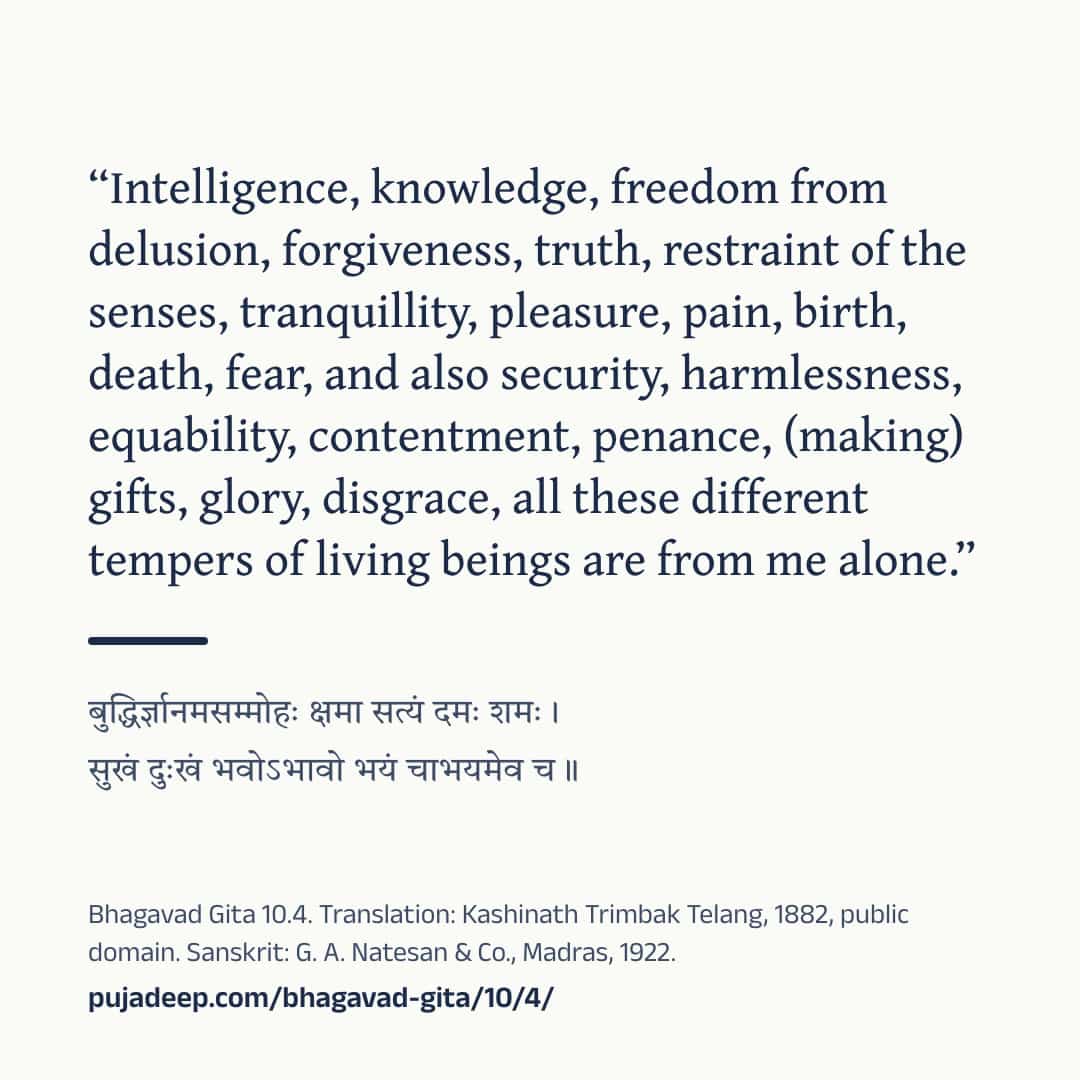
Drawing the picture
See the words
Bhagavad Gita 10.4

बुद्धिर्ज्ञानमसम्मोहः क्षमा सत्यं दमः शमः ।
सुखं दुःखं भवोऽभावो भयं चाभयमेव च ॥

“Intelligence, knowledge, freedom from delusion, forgiveness, truth, restraint of the senses, tranquillity, pleasure, pain, birth, death, fear, and also security, harmlessness, equability, contentment, penance, (making) gifts, glory, disgrace, all these different tempers of living beings are from me alone.”
(K. T. Telang, The Bhagavadgîtâ (The Sacred Books of the East, vol. VIII, Oxford: Clarendon Press, 1882), p. 86, public domain)
This sentence covers verses 10.4 to 10.5.

“Buddhi, wisdom, non-illusion, endurance, truth, passionlessness, calmness, pleasure, pain, birth, existence, fear and also courage,”
(Annie Besant, The Bhagavad Gîtâ, or The Lord's Song (London: Theosophical Publishing Society, 1895), pp. 95–96, public domain)
This sentence goes on in 10.5.

“Intellect, knowledge, non-delusion, forbearance, truth, restraint of the external senses, calmness of heart, happiness, misery, birth, death, fear, as well as fearlessness, non-injury, even-ness, contentment, austerity, benevolence, good name, (as well as) ill-fame;—(these) different kinds of qualities of beings, arise from Me alone.”
(Swami Swarupananda, Srimad-Bhagavad-Gita (Mayavati: Prabuddha Bharata Press, 1909; first printed in Prabuddha Bharata, 1907–1909), p. 195, public domain)
This sentence covers verses 10.4 to 10.5.

Sanskrit: G. A. Natesan & Co., Madras, 1922.
https://pujadeep.com/bhagavad-gita/10/4/ Nothing is sent from this site. Your own app sends it, to the chat you choose. The picture quotes the translation you chose on this page, with its name and year.
Sanskrit text: The Bhagavad-Gita, or The Lord's Song, with the text in Devanagari and an English translation, 1922. Meanings: written for Pujadeep and checked against the cited edition. Source and changes
Questions families ask
Who speaks Bhagavad Gita 10.4?
Krishna speaks this verse, in chapter 10 (Vibhuti Yoga).
Where does the Sanskrit text come from?
Sanskrit text: The Bhagavad-Gita, or The Lord's Song, with the text in Devanagari and an English translation, 1922. Meanings: written for Pujadeep and checked against the cited edition. See the source
Is the meaning on this page a translation?
Explanation written for this site from the sources listed here, and checked against the cited edition. It is not a translation and not the only way to read the text. Free to quote with credit.
Source and licence
- Sanskrit text
- The Bhagavad-Gita, or The Lord's Song, with the text in Devanagari and an English translation (Annie Besant, G. A. Natesan & Co., Madras, 1922). Public domain. The Sanskrit on these pages was read from this printing’s page images.
- Translation
- The Bhagavadgîtâ with the Sanatsugâtîya and the Anugîtâ, translated by Kâshinâth Trimbak Telang (The Sacred Books of the East, vol. VIII, ed. F. Max Müller) (Kashinath Trimbak Telang, F. Max Müller, Clarendon Press, Oxford, 1882). Public domain. Shown verbatim, as printed.
- Translation
- The Bhagavad Gîtâ, or The Lord's Song, translated by Annie Besant (Annie Besant, Theosophical Publishing Society, London, 1895). Public domain. Shown verbatim, as printed.
- Translation
- Srimad-Bhagavad-Gita, with Sanskrit Text; Paraphrase with Word-by-word Literal Translation; English Rendering and Comments, Index, &c., by the Swami Swarupananda (Himalayan Series, No. XX) (Swami Swarupananda, The Editors and Publishers, Advaita Ashrama, Mayavati, Prabuddha Bharata Press, Mayavati, Almora, Himalayas, 1909). Public domain. Shown verbatim, as printed.
- Common wording
- In this text, 32 words follow today's common wording, checked against sanskritdocuments.org; Sanskrit Wikisource; Gita Press, Gorakhpur; GRETIL, Göttingen and Bhaktivedanta Book Trust.
- Our explanation
- Explanation written for this site from the sources listed here, and checked against the cited edition. It is not a translation and not the only way to read the text. Free to quote with credit.
- Checked
- Checked against the cited edition, October 15, 2026.
- Updated
- October 25, 2026