Bhagavad Gita 10.6: meaning and translation
Chapter 10: Vibhuti Yoga. Krishna says
Krishna says that the seven great sages of old and the four Manus were born from his mind and share his nature, and that all the creatures of the world descend from them.
Click or tap a word for its meaning and its dictionary page.
Text and layers
Text and layers
These choices stay in this browser.
Bhagavad Gita 10.6
महर्षयः सप्त पूर्वे चत्वारो मनवस्तथा ।मद्भावा मानसा जाता येषां लोक इमाः प्रजाः ॥
Maharshayah sapta purve chatvaro manavastathaMadbhava manasa jata yesham loka imah prajah
maharṣayaḥ sapta pūrve catvāro manavastathā |madbhāvā mānasā jātā yeṣāṃ loka imāḥ prajāḥ ||
Our explanation Krishna says that the seven great sages of old and the four Manus were born from his mind and share his nature, and that all the creatures of the world descend from them. The translators read 'the four' differently: Telang has 'the four ancient Manus', while Besant has 'the four Ancients, and also the Manus'.
हिंदी अर्थ कृष्ण कहते हैं कि प्राचीन सात महर्षि और चार मनु उनके मन से उत्पन्न हुए और उनके भाव वाले हैं, और संसार के सब प्राणी उन्हीं से उत्पन्न हुए। अनुवादक “चार” को अलग-अलग पढ़ते हैं: तेलंग के अनुसार “चार प्राचीन मनु”, बेसेंट के अनुसार “चार प्राचीन (ऋषि) और मनु भी”।
Word by word
Every word, with its dictionary page
Word by word
- महर्षयः maharṣayaḥ · the great sages (compound (masculine), nominative plural) Dictionary: maharṣi, Monier-Williams 1899, p. 794, col. 2 “a great Ṛishi, any great sage or saint”
- सप्त sapta · seven (numeral, nominative plural) Dictionary: saptan, Monier-Williams 1899, p. 1149, col. 1 “seven”
- पूर्वे pūrve · of old, ancient (adjective (masculine), nominative plural) Dictionary: pūrva, Monier-Williams 1899, p. 643, col. 1 “former, prior, preceding”
- चत्वारः catvāraḥ · four (numeral (masculine), nominative plural) Dictionary: catur, Monier-Williams 1899, p. 384, col. 1 “4”
- मनवः manavaḥ · the Manus (noun (masculine), nominative plural) Dictionary: manu, Monier-Williams 1899, p. 784, col. 2 “the Man par excellence or the representative man and father of the human race”
- तथा tathā · and also (indeclinable) Dictionary: tathā, Monier-Williams 1899, p. 433, col. 3 “in that manner, so, thus”
- मद्भावाः madbhāvāḥ · sharing "my" (Krishna's) nature (compound (masculine), nominative plural) Dictionary: 1. mad, Monier-Williams 1899, p. 777, col. 2 “base of the first pers. pron. in the sg. number (esp. in comp.)”; bhāva, Monier-Williams 1899, p. 754, col. 2 “manner of being, nature, temperament, character”
- मानसाः mānasāḥ · born of the mind (adjective (masculine), nominative plural) Dictionary: mānasa, Monier-Williams 1899, p. 810, col. 1 “belonging to the mind or spirit, mental, spiritual”
- जाताः jātāḥ · born (past participle (masculine), nominative plural) Dictionary: jāta, Monier-Williams 1899, p. 417, col. 2 “born, brought into existence”
- येषाम् yeṣām · from whom, whose (relative pronoun (masculine), genitive plural) Dictionary: yad, Monier-Williams 1899, p. 844, col. 2 “who, which, what, whichever, whatever, that”
- लोके loke · in the world (noun (masculine), locative singular) Dictionary: loka, Monier-Williams 1899, p. 906, col. 1 “the wide space or world”
- इमाः imāḥ · these (pronoun (feminine), nominative plural) Dictionary: 1. idam, Monier-Williams 1899, p. 165, col. 2 “this, this here, referring to something near the speaker”
- प्रजाः prajāḥ · creatures, offspring (noun (feminine), nominative plural) Dictionary: prajā, Monier-Williams 1899, p. 658, col. 2 “offspring, children, family, race, posterity, descendants”
Old translations
Kashinath Trimbak Telang, 1882. Public domain. Page 86–87.
The seven great sages, and likewise the four ancient Manus1, whose descendants are (all) these people in the world, were all born from my mind2, (partaking) of my powers.
Footnotes (the translator’s own) Compare 3 translations
Kashinath Trimbak Telang, 1882. Public domain. Page 86–87.
The seven great sages, and likewise the four ancient Manus1, whose descendants are (all) these people in the world, were all born from my mind2, (partaking) of my powers.
Footnotes (the translator’s own) You are reading this one
Annie Besant, 1895. Public domain. Page 96.
The seven great Rishis, the four Ancients, and also the Manus, were born of My Nature and Mind; of them this race was generated.
You are reading this one
Swami Swarupananda, 1909 (first printed 1907). Public domain. Page 195.
The seven great Rishis of old, as well as the four Manus, possessed of powers like Me, (due to their thoughts being fixed on Me) were born of (My) mind; from whom are these creatures in the world.
You are reading this one
Cite this verse
The translation: K. T. Telang, The Bhagavadgîtâ (The Sacred Books of the East, vol. VIII, Oxford: Clarendon Press, 1882), pp. 86–87. Bhagavad Gita 10.6.
The translation: Annie Besant, The Bhagavad Gîtâ, or The Lord's Song (London: Theosophical Publishing Society, 1895), p. 96. Bhagavad Gita 10.6.
The translation: Swami Swarupananda, Srimad-Bhagavad-Gita (Mayavati: Prabuddha Bharata Press, 1909; first printed in Prabuddha Bharata, 1907–1909), p. 195. Bhagavad Gita 10.6.
Our explanation: “Bhagavad Gita 10.6: meaning and translation.” Pujadeep. Updated October 25, 2026. https://pujadeep.com/bhagavad-gita/10/6/
Pujadeep’s explanations are free to quote with credit: name Pujadeep and link to the page. How to credit
Classical readings, by school
No readings by school on this verse yet.
Share
Show the ways to share
Send one picture or the text to one chat. The picture names its source and the address of this page.
Drawing the picture
See the words
Bhagavad Gita 10.6

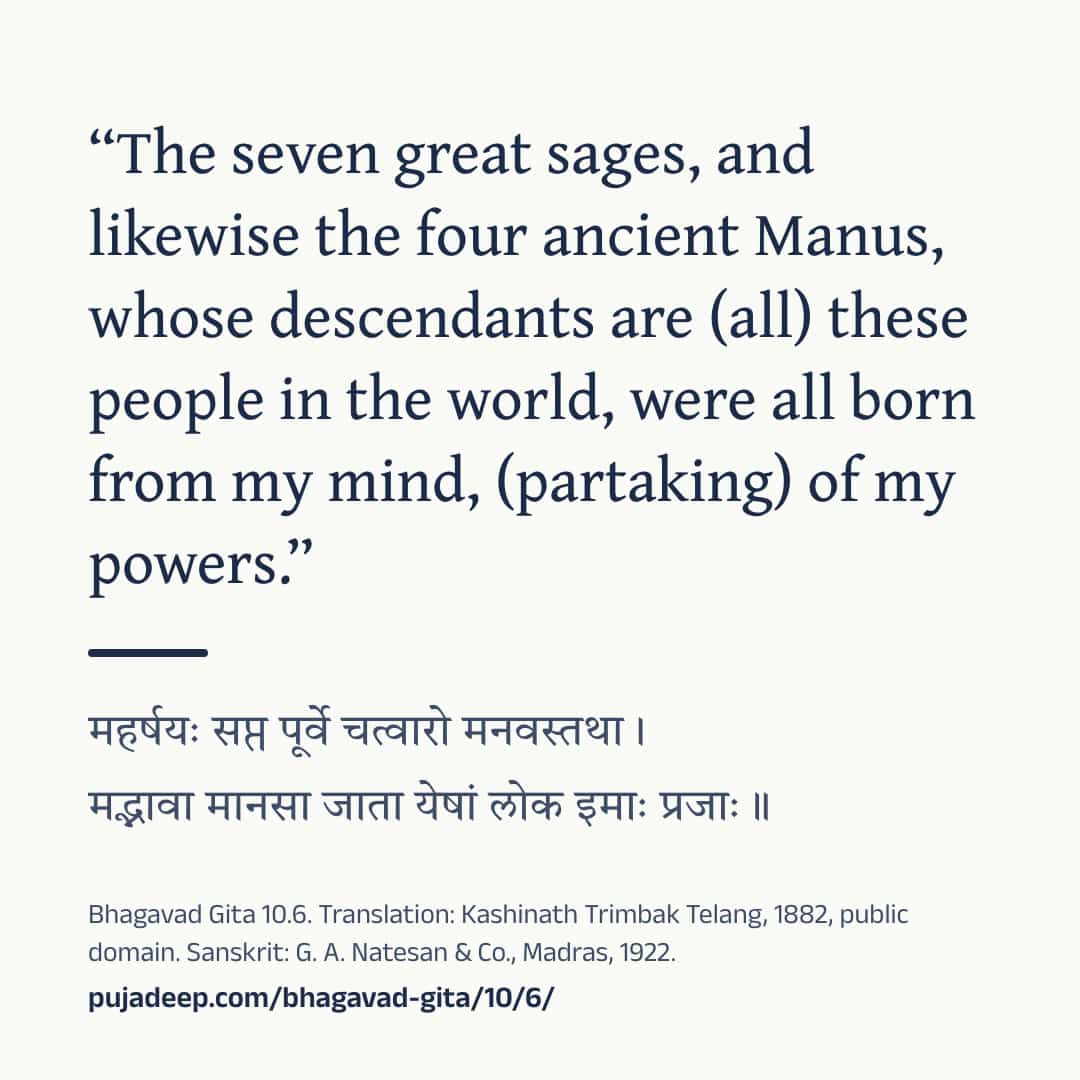
महर्षयः सप्त पूर्वे चत्वारो मनवस्तथा ।
मद्भावा मानसा जाता येषां लोक इमाः प्रजाः ॥

“The seven great sages, and likewise the four ancient Manus, whose descendants are (all) these people in the world, were all born from my mind, (partaking) of my powers.”
(K. T. Telang, The Bhagavadgîtâ (The Sacred Books of the East, vol. VIII, Oxford: Clarendon Press, 1882), pp. 86–87, public domain)

“The seven great Rishis, the four Ancients, and also the Manus, were born of My Nature and Mind; of them this race was generated.”
(Annie Besant, The Bhagavad Gîtâ, or The Lord's Song (London: Theosophical Publishing Society, 1895), p. 96, public domain)

“The seven great Rishis of old, as well as the four Manus, possessed of powers like Me, (due to their thoughts being fixed on Me) were born of (My) mind; from whom are these creatures in the world.”
(Swami Swarupananda, Srimad-Bhagavad-Gita (Mayavati: Prabuddha Bharata Press, 1909; first printed in Prabuddha Bharata, 1907–1909), p. 195, public domain)

Sanskrit: G. A. Natesan & Co., Madras, 1922.
https://pujadeep.com/bhagavad-gita/10/6/ Nothing is sent from this site. Your own app sends it, to the chat you choose. The picture quotes the translation you chose on this page, with its name and year.
Sanskrit text: The Bhagavad-Gita, or The Lord's Song, with the text in Devanagari and an English translation, 1922. Meanings: written for Pujadeep and checked against the cited edition. Source and changes
Questions families ask
Who speaks Bhagavad Gita 10.6?
Krishna speaks this verse, in chapter 10 (Vibhuti Yoga).
Where does the Sanskrit text come from?
Sanskrit text: The Bhagavad-Gita, or The Lord's Song, with the text in Devanagari and an English translation, 1922. Meanings: written for Pujadeep and checked against the cited edition. See the source
Is the meaning on this page a translation?
Explanation written for this site from the sources listed here, and checked against the cited edition. It is not a translation and not the only way to read the text. Free to quote with credit.
Source and licence
- Sanskrit text
- The Bhagavad-Gita, or The Lord's Song, with the text in Devanagari and an English translation (Annie Besant, G. A. Natesan & Co., Madras, 1922). Public domain. The Sanskrit on these pages was read from this printing’s page images.
- Translation
- The Bhagavadgîtâ with the Sanatsugâtîya and the Anugîtâ, translated by Kâshinâth Trimbak Telang (The Sacred Books of the East, vol. VIII, ed. F. Max Müller) (Kashinath Trimbak Telang, F. Max Müller, Clarendon Press, Oxford, 1882). Public domain. Shown verbatim, as printed.
- Translation
- The Bhagavad Gîtâ, or The Lord's Song, translated by Annie Besant (Annie Besant, Theosophical Publishing Society, London, 1895). Public domain. Shown verbatim, as printed.
- Translation
- Srimad-Bhagavad-Gita, with Sanskrit Text; Paraphrase with Word-by-word Literal Translation; English Rendering and Comments, Index, &c., by the Swami Swarupananda (Himalayan Series, No. XX) (Swami Swarupananda, The Editors and Publishers, Advaita Ashrama, Mayavati, Prabuddha Bharata Press, Mayavati, Almora, Himalayas, 1909). Public domain. Shown verbatim, as printed.
- Common wording
- In this text, 32 words follow today's common wording, checked against sanskritdocuments.org; Sanskrit Wikisource; Gita Press, Gorakhpur; GRETIL, Göttingen and Bhaktivedanta Book Trust.
- Our explanation
- Explanation written for this site from the sources listed here, and checked against the cited edition. It is not a translation and not the only way to read the text. Free to quote with credit.
- Checked
- Checked against the cited edition, October 15, 2026.
- Updated
- October 25, 2026