Bhagavad Gita 10.20: meaning and translation
Chapter 10: Vibhuti Yoga. Krishna says
Krishna says he is the self (ātman) seated in the hearts of all beings, Gudakesha, and he is the beginning, the middle and the end of beings.
Click or tap a word for its meaning and its dictionary page.
Text and layers
Text and layers
These choices stay in this browser.
Bhagavad Gita 10.20
अहमात्मा गुडाकेश सर्वभूताशयस्थितः ।अहमादिश्च मध्यं च भूतानामन्त एव च ॥
Ahamatma gudakesha sarvabhutashayasthitahAhamadishcha madhyam cha bhutanamanta eva cha
ahamātmā guḍākeśa sarvabhūtāśayasthitaḥ |ahamādiśca madhyaṃ ca bhūtānāmanta eva ca ||
Our explanation Krishna says he is the self (ātman) seated in the hearts of all beings, Gudakesha, and he is the beginning, the middle and the end of beings. From the next verse he names the foremost in each class of things. The schools read 'the self in all beings' in different ways (see the views).
हिंदी अर्थ कृष्ण कहते हैं कि हे गुडाकेश, वे सब प्राणियों के हृदय में स्थित आत्मा हैं, और प्राणियों के आदि, मध्य और अंत भी वही हैं। अगले श्लोक से वे हर वर्ग की सबसे श्रेष्ठ वस्तु का नाम लेते हैं। “सब प्राणियों में आत्मा” को परंपराएँ अलग-अलग ढंग से समझती हैं।
Word by word
Every word, with its dictionary page
Word by word
- अहम् aham · "I" (Krishna) (pronoun, nominative singular) Dictionary: aham, Monier-Williams 1899, p. 124, col. 2 “nom. sg. ‘I,’”
- आत्मा ātmā · the self (noun (masculine), nominative singular) Dictionary: ātman, Monier-Williams 1899, p. 135, col. 1 “the individual soul, self”
- गुडाकेश guḍākeśa · O Gudakesha (Arjuna) (noun (masculine), vocative singular) Dictionary: guḍā-keśa, Monier-Williams 1899, p. 356, col. 3 “the hero Arjuna”
- सर्वभूताशयस्थितः sarvabhūtāśayasthitaḥ · seated in the hearts of all beings (compound (masculine), nominative singular) Dictionary: sarva-bhūta, Monier-Williams 1899, p. 1186, col. 2 “all beings”; ā-śaya, Monier-Williams 1899, p. 157, col. 3 “the seat of feelings and thoughts, the mind, heart, soul”; sthita, Monier-Williams 1899, p. 1264, col. 1 “standing, staying, situated, resting or abiding or remaining in”
- अहम् aham · "I" (Krishna) (pronoun, nominative singular) Dictionary: aham, Monier-Williams 1899, p. 124, col. 2 “nom. sg. ‘I,’”
- आदिः ādiḥ · the beginning (noun (masculine), nominative singular) Dictionary: 1. ādi, Monier-Williams 1899, p. 136, col. 3 “beginning, commencement”
- च ca · and (indeclinable) Dictionary: 2. ca, Monier-Williams 1899, p. 380, col. 1 “and, both, also, moreover, as well as”
- मध्यम् madhyam · the middle (noun (neuter), nominative singular) Dictionary: madhya, Monier-Williams 1899, p. 781, col. 3 “the middle, midst, centre, inside, interior”
- च ca · and (indeclinable) Dictionary: 2. ca, Monier-Williams 1899, p. 380, col. 1 “and, both, also, moreover, as well as”
- भूतानाम् bhūtānām · of beings (noun (neuter), genitive plural) Dictionary: bhūta, Monier-Williams 1899, p. 761, col. 3 “that which is or exists, any living being (divine, human, animal, and even vegetable)”
- अन्तः antaḥ · the end (noun (masculine), nominative singular) Dictionary: anta, Monier-Williams 1899, p. 42, col. 3 “end, limit, boundary, term”
- एव eva · also (indeclinable) Dictionary: 1. eva, Monier-Williams 1899, p. 232, col. 2 “just, exactly, very, same, only, even, alone, merely”
- च ca · and (indeclinable) Dictionary: 2. ca, Monier-Williams 1899, p. 380, col. 1 “and, both, also, moreover, as well as”
Old translations
Kashinath Trimbak Telang, 1882. Public domain. Page 88.
I am the self, O Gudâkesa! seated in the hearts of all beings1. I am the beginning and the middle and the end also of all beings.
Footnotes (the translator’s own) - P. 129 infra. ↩
Compare 3 translations
Kashinath Trimbak Telang, 1882. Public domain. Page 88.
I am the self, O Gudâkesa! seated in the hearts of all beings1. I am the beginning and the middle and the end also of all beings.
Footnotes (the translator’s own) - P. 129 infra. ↩
You are reading this one
Annie Besant, 1895. Public domain. Page 98–99.
I, O Gudâkesha, am the SELF, seated in the heart of all beings; I am the beginning, the middle, and also the end of all beings.
You are reading this one
Swami Swarupananda, 1909 (first printed 1907). Public domain. Page 202.
I am the Self, O Gudàkesha, existent in the heart of all beings; I am the beginning, the middle, and also the end of all beings.
You are reading this one
Cite this verse
The translation: K. T. Telang, The Bhagavadgîtâ (The Sacred Books of the East, vol. VIII, Oxford: Clarendon Press, 1882), p. 88. Bhagavad Gita 10.20.
The translation: Annie Besant, The Bhagavad Gîtâ, or The Lord's Song (London: Theosophical Publishing Society, 1895), pp. 98–99. Bhagavad Gita 10.20.
The translation: Swami Swarupananda, Srimad-Bhagavad-Gita (Mayavati: Prabuddha Bharata Press, 1909; first printed in Prabuddha Bharata, 1907–1909), p. 202. Bhagavad Gita 10.20.
Our explanation: “Bhagavad Gita 10.20: meaning and translation.” Pujadeep. Updated October 25, 2026. https://pujadeep.com/bhagavad-gita/10/20/
Pujadeep’s explanations are free to quote with credit: name Pujadeep and link to the page. How to credit
Classical readings, by school
Each reading is named by its school. None is presented as the only meaning.
What Advaita, Vishishtadvaita and Dvaita teach, in short
Shankara Advaita
Shankara says one should think of the Lord as the innermost Self in the heart of all beings. Whoever cannot do so should think of him in the things named next, because he is the source, the support and the end of all beings.
Source: The Bhagavad-Gita, with the commentary of Sri Sankaracharya, translated by A. Mahadeva Sastri (2nd ed., Mysore: G. T. A. Printing Works, 1901), commentary on 10.20, pp. 241–242. Summarised in our own words; none of its text is reproduced.
Ramanuja Vishishtadvaita
Ramanuja says all beings form the Lord's body and he dwells in them as their soul, which means their support, ruler and master. For this reason the names in the list can all point to him, as the word for a body points to the soul within it.
Source: Sri Bhagavad-Gita with Sri Ramanujacharya's Visishtadvaita commentary, translated by A. Govindacharya (Madras, 1898), commentary on 10.20, pp. 333–334. Summarised in our own words; none of its text is reproduced.
Share
Show the ways to share
Send one picture or the text to one chat. The picture names its source and the address of this page.
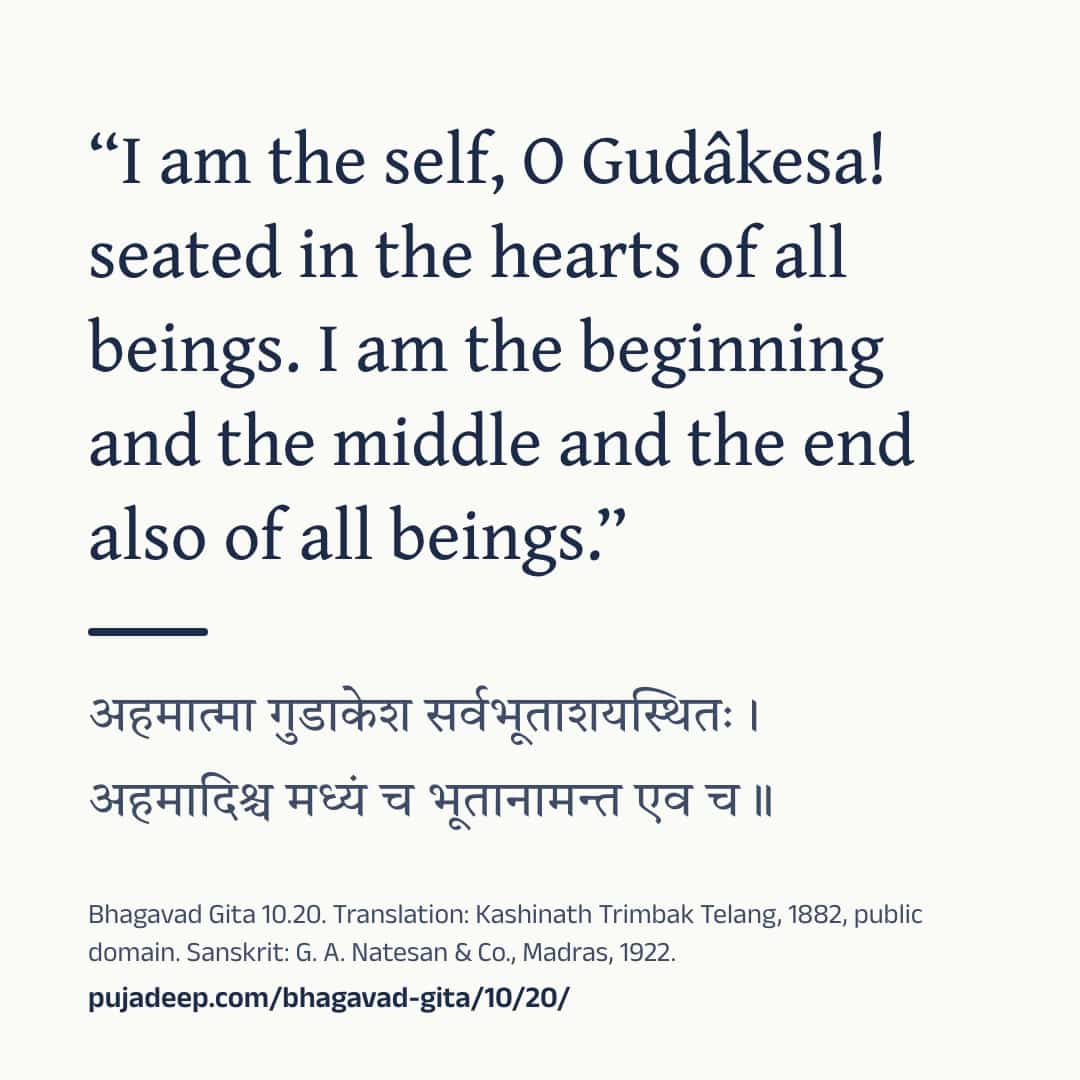
Drawing the picture
See the words
Bhagavad Gita 10.20

अहमात्मा गुडाकेश सर्वभूताशयस्थितः ।
अहमादिश्च मध्यं च भूतानामन्त एव च ॥

“I am the self, O Gudâkesa! seated in the hearts of all beings. I am the beginning and the middle and the end also of all beings.”
(K. T. Telang, The Bhagavadgîtâ (The Sacred Books of the East, vol. VIII, Oxford: Clarendon Press, 1882), p. 88, public domain)

“I, O Gudâkesha, am the SELF, seated in the heart of all beings; I am the beginning, the middle, and also the end of all beings.”
(Annie Besant, The Bhagavad Gîtâ, or The Lord's Song (London: Theosophical Publishing Society, 1895), pp. 98–99, public domain)

“I am the Self, O Gudàkesha, existent in the heart of all beings; I am the beginning, the middle, and also the end of all beings.”
(Swami Swarupananda, Srimad-Bhagavad-Gita (Mayavati: Prabuddha Bharata Press, 1909; first printed in Prabuddha Bharata, 1907–1909), p. 202, public domain)

Sanskrit: G. A. Natesan & Co., Madras, 1922.
https://pujadeep.com/bhagavad-gita/10/20/ Nothing is sent from this site. Your own app sends it, to the chat you choose. The picture quotes the translation you chose on this page, with its name and year.
Sanskrit text: The Bhagavad-Gita, or The Lord's Song, with the text in Devanagari and an English translation, 1922. Meanings: written for Pujadeep and checked against the cited edition. Source and changes
Questions families ask
Who speaks Bhagavad Gita 10.20?
Krishna speaks this verse, in chapter 10 (Vibhuti Yoga).
Where does the Sanskrit text come from?
Sanskrit text: The Bhagavad-Gita, or The Lord's Song, with the text in Devanagari and an English translation, 1922. Meanings: written for Pujadeep and checked against the cited edition. See the source
Is the meaning on this page a translation?
Explanation written for this site from the sources listed here, and checked against the cited edition. It is not a translation and not the only way to read the text. Free to quote with credit.
Source and licence
- Sanskrit text
- The Bhagavad-Gita, or The Lord's Song, with the text in Devanagari and an English translation (Annie Besant, G. A. Natesan & Co., Madras, 1922). Public domain. The Sanskrit on these pages was read from this printing’s page images.
- Translation
- The Bhagavadgîtâ with the Sanatsugâtîya and the Anugîtâ, translated by Kâshinâth Trimbak Telang (The Sacred Books of the East, vol. VIII, ed. F. Max Müller) (Kashinath Trimbak Telang, F. Max Müller, Clarendon Press, Oxford, 1882). Public domain. Shown verbatim, as printed.
- Translation
- The Bhagavad Gîtâ, or The Lord's Song, translated by Annie Besant (Annie Besant, Theosophical Publishing Society, London, 1895). Public domain. Shown verbatim, as printed.
- Translation
- Srimad-Bhagavad-Gita, with Sanskrit Text; Paraphrase with Word-by-word Literal Translation; English Rendering and Comments, Index, &c., by the Swami Swarupananda (Himalayan Series, No. XX) (Swami Swarupananda, The Editors and Publishers, Advaita Ashrama, Mayavati, Prabuddha Bharata Press, Mayavati, Almora, Himalayas, 1909). Public domain. Shown verbatim, as printed.
- Commentary
- The Bhagavad-Gita, with the commentary of Sri Sankaracharya, translated by A. Mahadeva Sastri (2nd ed., Mysore: G. T. A. Printing Works, 1901) (Public-domain scan, University of California Libraries). Summarised in our own words; none of its text is reproduced.
- Commentary
- Sri Bhagavad-Gita with Sri Ramanujacharya's Visishtadvaita commentary, translated by A. Govindacharya (Madras, 1898) (Scan uploaded to archive.org (folkscanomy collection)). Summarised in our own words; none of its text is reproduced.
- Common wording
- In this text, 32 words follow today's common wording, checked against sanskritdocuments.org; Sanskrit Wikisource; Gita Press, Gorakhpur; GRETIL, Göttingen and Bhaktivedanta Book Trust.
- Our explanation
- Explanation written for this site from the sources listed here, and checked against the cited edition. It is not a translation and not the only way to read the text. Free to quote with credit.
- Checked
- Checked against the cited edition, October 15, 2026.
- Updated
- October 25, 2026