Bhagavad Gita 10.24: meaning and translation
Chapter 10: Vibhuti Yoga. Krishna says
Krishna tells Arjuna, son of Pritha, to know him as Bṛhaspati, the chief of household priests (Bṛhaspati is the priest of the gods); among army leaders he is Skanda; among bodies of water, the ocean.
Click or tap a word for its meaning and its dictionary page.
Text and layers
Text and layers
These choices stay in this browser.
Bhagavad Gita 10.24
पुरोधसां च मुख्यं मां विद्धि पार्थ बृहस्पतिम् ।सेनानीनामहं स्कन्दः सरसामस्मि सागरः ॥
Purodhasam cha mukhyam mam viddhi partha brihaspatimSenaninamaham skandah sarasamasmi sagarah
purodhasāṃ ca mukhyaṃ māṃ viddhi pārtha bṛhaspatim |senānīnāmahaṃ skandaḥ sarasāmasmi sāgaraḥ ||
Our explanation Krishna tells Arjuna, son of Pritha, to know him as Bṛhaspati, the chief of household priests (Bṛhaspati is the priest of the gods); among army leaders he is Skanda; among bodies of water, the ocean.
हिंदी अर्थ कृष्ण अर्जुन (पार्थ) से कहते हैं कि पुरोहितों में उन्हें मुख्य पुरोहित बृहस्पति जानो (बृहस्पति देवताओं के पुरोहित हैं); सेनापतियों में वे स्कंद हैं; और जलाशयों में सागर।
Word by word
Every word, with its dictionary page
Word by word
- पुरोधसाम् purodhasām · among household priests (noun (masculine), genitive plural) Dictionary: puro-dhas, Monier-Williams 1899, p. 635, col. 2 “chief priest of a king, domestic chaplain”
- च ca · and (indeclinable) Dictionary: 2. ca, Monier-Williams 1899, p. 380, col. 1 “and, both, also, moreover, as well as”
- मुख्यम् mukhyam · the chief (adjective (masculine), accusative singular) Dictionary: mukhya, Monier-Williams 1899, p. 820, col. 2 “being at the head or at the beginning, first, principal, chief, eminent”
- माम् mām · "me" (Krishna) (pronoun, accusative singular) Dictionary: 1. mad, Monier-Williams 1899, p. 777, col. 2 “base of the first pers. pron. in the sg. number (esp. in comp.)”
- विद्धि viddhi · know (imperative, 2nd person singular) Dictionary: 1. vid, Monier-Williams 1899, p. 963, col. 2 “to know, understand, perceive, learn”
- पार्थ pārtha · O Partha (son of Pritha) (noun (masculine), vocative singular) Dictionary: 2. pārtha, Monier-Williams 1899, p. 621, col. 3 “metron. of Yudhi-shṭhira or Bhīma-sena or Arjuna”
- बृहस्पतिम् bṛhaspatim · Bṛhaspati (noun (masculine), accusative singular) Dictionary: bṛhas-pati, Monier-Williams 1899, p. 737, col. 1 “'lord of prayer or devotion,' N. of a deity”
- सेनानीनाम् senānīnām · among army leaders (noun (masculine), genitive plural) Dictionary: senā-nī, Monier-Williams 1899, p. 1246, col. 2 “the leader of an army, commander, general, chief”
- अहम् aham · "I" (Krishna) (pronoun, nominative singular) Dictionary: aham, Monier-Williams 1899, p. 124, col. 2 “nom. sg. ‘I,’”
- स्कन्दः skandaḥ · Skanda (noun (masculine), nominative singular) Dictionary: skanda, Monier-Williams 1899, p. 1256, col. 1 “‘Attacker,’ N. of Kārttikeya”
- सरसाम् sarasām · among bodies of water (noun (neuter), genitive plural) Dictionary: saras, Monier-Williams 1899, p. 1182, col. 2 “a lake, large sheet of water, pond, pool, tank”
- अस्मि asmi · am (present, 1st person singular) Dictionary: 1. as, Monier-Williams 1899, p. 117, col. 2 “to be, live, exist, be present”
- सागरः sāgaraḥ · the ocean (noun (masculine), nominative singular) Dictionary: sāgara, Monier-Williams 1899, p. 1198, col. 2 “the ocean”
1 printing differs
Edition differences. Another printing or text reads this place differently.
- The printed edition reads: पुरोधसां च मुख्यं मां बिद्धि पार्थ बृहस्पतिम् ।
सेनानीनामहं स्कन्दः सरसामस्मि सागरः ॥ The print reads बिद्धि, with ब (the stroke inside the loop, as in बृहस्पतिम् on the same line) for व; read as a wrong sort and corrected to विद्धि ('know'), because the same word is printed विद्धि in 10.27 and both proofreading references read विद्धि.
Old translations
Kashinath Trimbak Telang, 1882. Public domain. Page 88–89.
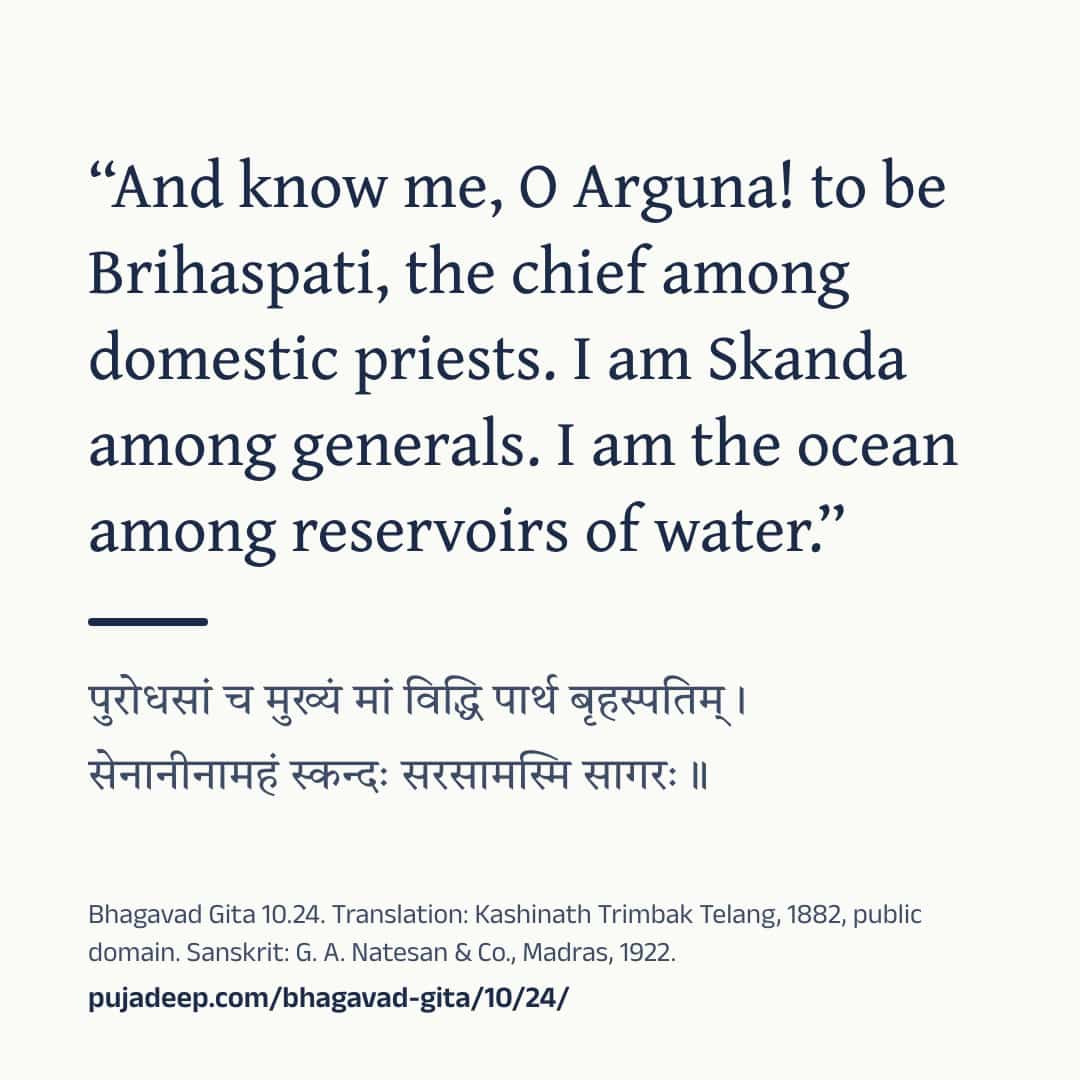
And know me, O Arguna! to be Brihaspati, the chief among domestic priests. I am Skanda among generals. I am the ocean among reservoirs of water1.
Footnotes (the translator’s own) - Cf. Sutta Nipâta, p. 121. ↩
Compare 3 translations
Kashinath Trimbak Telang, 1882. Public domain. Page 88–89.
And know me, O Arguna! to be Brihaspati, the chief among domestic priests. I am Skanda among generals. I am the ocean among reservoirs of water1.
Footnotes (the translator’s own) - Cf. Sutta Nipâta, p. 121. ↩
You are reading this one
Annie Besant, 1895. Public domain. Page 99.
And of household priests the chief, know Me, O Pârtha, Vrihaspati; of generals I am Skanda, of lakes I am the ocean.
You are reading this one
Swami Swarupananda, 1909 (first printed 1907). Public domain. Page 203.
And of priests, O son of Prithà, know Me the chief, Brihaspati; of generals, I am Skanda; of bodies of water, I am the ocean.
You are reading this one
Cite this verse
The translation: K. T. Telang, The Bhagavadgîtâ (The Sacred Books of the East, vol. VIII, Oxford: Clarendon Press, 1882), pp. 88–89. Bhagavad Gita 10.24.
The translation: Annie Besant, The Bhagavad Gîtâ, or The Lord's Song (London: Theosophical Publishing Society, 1895), p. 99. Bhagavad Gita 10.24.
The translation: Swami Swarupananda, Srimad-Bhagavad-Gita (Mayavati: Prabuddha Bharata Press, 1909; first printed in Prabuddha Bharata, 1907–1909), p. 203. Bhagavad Gita 10.24.
Our explanation: “Bhagavad Gita 10.24: meaning and translation.” Pujadeep. Updated October 25, 2026. https://pujadeep.com/bhagavad-gita/10/24/
Pujadeep’s explanations are free to quote with credit: name Pujadeep and link to the page. How to credit
Classical readings, by school
No readings by school on this verse yet.
Share
Show the ways to share
Send one picture or the text to one chat. The picture names its source and the address of this page.
Drawing the picture
See the words
Bhagavad Gita 10.24

पुरोधसां च मुख्यं मां विद्धि पार्थ बृहस्पतिम् ।
सेनानीनामहं स्कन्दः सरसामस्मि सागरः ॥

“And know me, O Arguna! to be Brihaspati, the chief among domestic priests. I am Skanda among generals. I am the ocean among reservoirs of water.”
(K. T. Telang, The Bhagavadgîtâ (The Sacred Books of the East, vol. VIII, Oxford: Clarendon Press, 1882), pp. 88–89, public domain)

“And of household priests the chief, know Me, O Pârtha, Vrihaspati; of generals I am Skanda, of lakes I am the ocean.”
(Annie Besant, The Bhagavad Gîtâ, or The Lord's Song (London: Theosophical Publishing Society, 1895), p. 99, public domain)

“And of priests, O son of Prithà, know Me the chief, Brihaspati; of generals, I am Skanda; of bodies of water, I am the ocean.”
(Swami Swarupananda, Srimad-Bhagavad-Gita (Mayavati: Prabuddha Bharata Press, 1909; first printed in Prabuddha Bharata, 1907–1909), p. 203, public domain)

Sanskrit: G. A. Natesan & Co., Madras, 1922.
https://pujadeep.com/bhagavad-gita/10/24/ Nothing is sent from this site. Your own app sends it, to the chat you choose. The picture quotes the translation you chose on this page, with its name and year.
Sanskrit text: The Bhagavad-Gita, or The Lord's Song, with the text in Devanagari and an English translation, 1922. Meanings: written for Pujadeep and checked against the cited edition. Source and changes
Questions families ask
Who speaks Bhagavad Gita 10.24?
Krishna speaks this verse, in chapter 10 (Vibhuti Yoga).
Where does the Sanskrit text come from?
Sanskrit text: The Bhagavad-Gita, or The Lord's Song, with the text in Devanagari and an English translation, 1922. Meanings: written for Pujadeep and checked against the cited edition. See the source
Is the meaning on this page a translation?
Explanation written for this site from the sources listed here, and checked against the cited edition. It is not a translation and not the only way to read the text. Free to quote with credit.
Source and licence
- Sanskrit text
- The Bhagavad-Gita, or The Lord's Song, with the text in Devanagari and an English translation (Annie Besant, G. A. Natesan & Co., Madras, 1922). Public domain. The Sanskrit on these pages was read from this printing’s page images.
- Translation
- The Bhagavadgîtâ with the Sanatsugâtîya and the Anugîtâ, translated by Kâshinâth Trimbak Telang (The Sacred Books of the East, vol. VIII, ed. F. Max Müller) (Kashinath Trimbak Telang, F. Max Müller, Clarendon Press, Oxford, 1882). Public domain. Shown verbatim, as printed.
- Translation
- The Bhagavad Gîtâ, or The Lord's Song, translated by Annie Besant (Annie Besant, Theosophical Publishing Society, London, 1895). Public domain. Shown verbatim, as printed.
- Translation
- Srimad-Bhagavad-Gita, with Sanskrit Text; Paraphrase with Word-by-word Literal Translation; English Rendering and Comments, Index, &c., by the Swami Swarupananda (Himalayan Series, No. XX) (Swami Swarupananda, The Editors and Publishers, Advaita Ashrama, Mayavati, Prabuddha Bharata Press, Mayavati, Almora, Himalayas, 1909). Public domain. Shown verbatim, as printed.
- Common wording
- In this text, 32 words follow today's common wording, checked against sanskritdocuments.org; Sanskrit Wikisource; Gita Press, Gorakhpur; GRETIL, Göttingen and Bhaktivedanta Book Trust.
- Our explanation
- Explanation written for this site from the sources listed here, and checked against the cited edition. It is not a translation and not the only way to read the text. Free to quote with credit.
- Checked
- Checked against the cited edition, October 15, 2026.
- Updated
- October 25, 2026