Bhagavad Gita 10.34: meaning and translation
Chapter 10: Vibhuti Yoga. Krishna says
Krishna says he is death that seizes all, and the coming into being of all that is yet to be.
Click or tap a word for its meaning and its dictionary page.
Text and layers
Text and layers
These choices stay in this browser.
Bhagavad Gita 10.34
मृत्युः सर्वहरश्चाहमुद्भवश्च भविष्यताम् ।कीर्तिः श्रीर्वाक्च नारीणां स्मृतिर्मेधा धृतिः क्षमा ॥
Mrityuh sarvaharashchahamudbhavashcha bhavishyatamKirtih shrirvakcha narinam smritirmedha dhritih kshama
mṛtyuḥ sarvaharaścāhamudbhavaśca bhaviṣyatām |kīrtiḥ śrīrvākca nārīṇāṃ smṛtirmedhā dhṛtiḥ kṣamā ||
Our explanation Krishna says he is death that seizes all, and the coming into being of all that is yet to be. Among things named in the feminine he is fame (kīrti), fortune (śrī), speech (vāk), memory (smṛti), intelligence (medhā), steadiness (dhṛti) and forbearance (kṣamā).
हिंदी अर्थ कृष्ण कहते हैं कि वे सबको हर लेने वाली मृत्यु हैं, और जो होने वाले हैं उनकी उत्पत्ति भी। स्त्रीलिंग नाम वाली चीज़ों में वे कीर्ति, श्री, वाणी, स्मृति, मेधा, धृति और क्षमा हैं।
Word by word
Every word, with its dictionary page
Word by word
- मृत्युः mṛtyuḥ · death (noun (masculine), nominative singular) Dictionary: mṛtyu, Monier-Williams 1899, p. 827, col. 3 “death, dying”
- सर्वहरः sarvaharaḥ · that seizes all (compound (masculine), nominative singular) Dictionary: sarva, Monier-Williams 1899, p. 1184, col. 3 “whole, entire, all, every”; hara, Monier-Williams 1899, p. 1289, col. 1 “taking away, carrying off, removing, destroying”
- च ca · and (indeclinable) Dictionary: 2. ca, Monier-Williams 1899, p. 380, col. 1 “and, both, also, moreover, as well as”
- अहम् aham · "I" (Krishna) (pronoun, nominative singular) Dictionary: aham, Monier-Williams 1899, p. 124, col. 2 “nom. sg. ‘I,’”
- उद्भवः udbhavaḥ · the coming into being (noun (masculine), nominative singular) Dictionary: ud-bhava, Monier-Williams 1899, p. 190, col. 2 “existence, generation, origin, production, birth”
- च ca · and (indeclinable) Dictionary: 2. ca, Monier-Williams 1899, p. 380, col. 1 “and, both, also, moreover, as well as”
- भविष्यताम् bhaviṣyatām · of those yet to be (future participle (masculine), genitive plural) Dictionary: 1. bhū, Monier-Williams 1899, p. 760, col. 2 “to become, be”
- कीर्तिः kīrtiḥ · fame (noun (feminine), nominative singular) Dictionary: kīrti, Monier-Williams 1899, p. 285, col. 1 “good report, fame, renown”
- श्रीः śrīḥ · fortune, beauty (noun (feminine), nominative singular) Dictionary: 3. śrī, Monier-Williams 1899, p. 1098, col. 3 “prosperity, welfare, good fortune, success”; 3. śrī, Monier-Williams 1899, p. 1098, col. 3 “light, lustre, radiance, splendour, glory, beauty”
- वाक् vāk · speech (noun (feminine), nominative singular) Dictionary: vāc, Monier-Williams 1899, p. 936, col. 1 “speech, voice, talk, language”
- च ca · and (indeclinable) Dictionary: 2. ca, Monier-Williams 1899, p. 380, col. 1 “and, both, also, moreover, as well as”
- नारीणाम् nārīṇām · among the feminine (noun (feminine), genitive plural) Dictionary: nārī, Monier-Williams 1899, p. 537, col. 1 “a woman, a wife”
- स्मृतिः smṛtiḥ · memory (noun (feminine), nominative singular) Dictionary: smṛti, Monier-Williams 1899, p. 1272, col. 2 “remembrance, reminiscence, thinking of or upon”
- मेधा medhā · intelligence (noun (feminine), nominative singular) Dictionary: medhā, Monier-Williams 1899, p. 833, col. 1 “mental vigour or power, intelligence, prudence, wisdom”
- धृतिः dhṛtiḥ · steadiness (noun (feminine), nominative singular) Dictionary: dhṛti, Monier-Williams 1899, p. 519, col. 3 “firmness, constancy, resolution”
- क्षमा kṣamā · forbearance (noun (feminine), nominative singular) Dictionary: kṣama, Monier-Williams 1899, p. 326, col. 2 “patience, forbearance, indulgence”
Old translations
Kashinath Trimbak Telang, 1882. Public domain. Page 90.
I am death who seizes all, and the source of what is to be. And among females, fame1, fortune, speech, memory, intellect, courage, forgiveness.
Footnotes (the translator’s own) - I. e. the deities of fame, &c. ↩
Compare 3 translations
Kashinath Trimbak Telang, 1882. Public domain. Page 90.
I am death who seizes all, and the source of what is to be. And among females, fame1, fortune, speech, memory, intellect, courage, forgiveness.
Footnotes (the translator’s own) - I. e. the deities of fame, &c. ↩
You are reading this one
Annie Besant, 1895. Public domain. Page 101.
And all-devouring Death am I, and the Origin of all to come; and of female things Fame, Prosperity, Speech, Memory, Intelligence, Constancy, Endurance.
You are reading this one
Swami Swarupananda, 1909 (first printed 1907). Public domain. Page 208.
And I am the all-seizing Death, and the prosperity of those who are to be prosperous; of the feminine (I am) Fame, Prosperity (or beauty), and Inspiration, Memory, Intelligence, Constancy, and Forbearance.
You are reading this one
Cite this verse
The translation: K. T. Telang, The Bhagavadgîtâ (The Sacred Books of the East, vol. VIII, Oxford: Clarendon Press, 1882), p. 90. Bhagavad Gita 10.34.
The translation: Annie Besant, The Bhagavad Gîtâ, or The Lord's Song (London: Theosophical Publishing Society, 1895), p. 101. Bhagavad Gita 10.34.
The translation: Swami Swarupananda, Srimad-Bhagavad-Gita (Mayavati: Prabuddha Bharata Press, 1909; first printed in Prabuddha Bharata, 1907–1909), p. 208. Bhagavad Gita 10.34.
Our explanation: “Bhagavad Gita 10.34: meaning and translation.” Pujadeep. Updated October 25, 2026. https://pujadeep.com/bhagavad-gita/10/34/
Pujadeep’s explanations are free to quote with credit: name Pujadeep and link to the page. How to credit
Classical readings, by school
No readings by school on this verse yet.
Share
Show the ways to share
Send one picture or the text to one chat. The picture names its source and the address of this page.
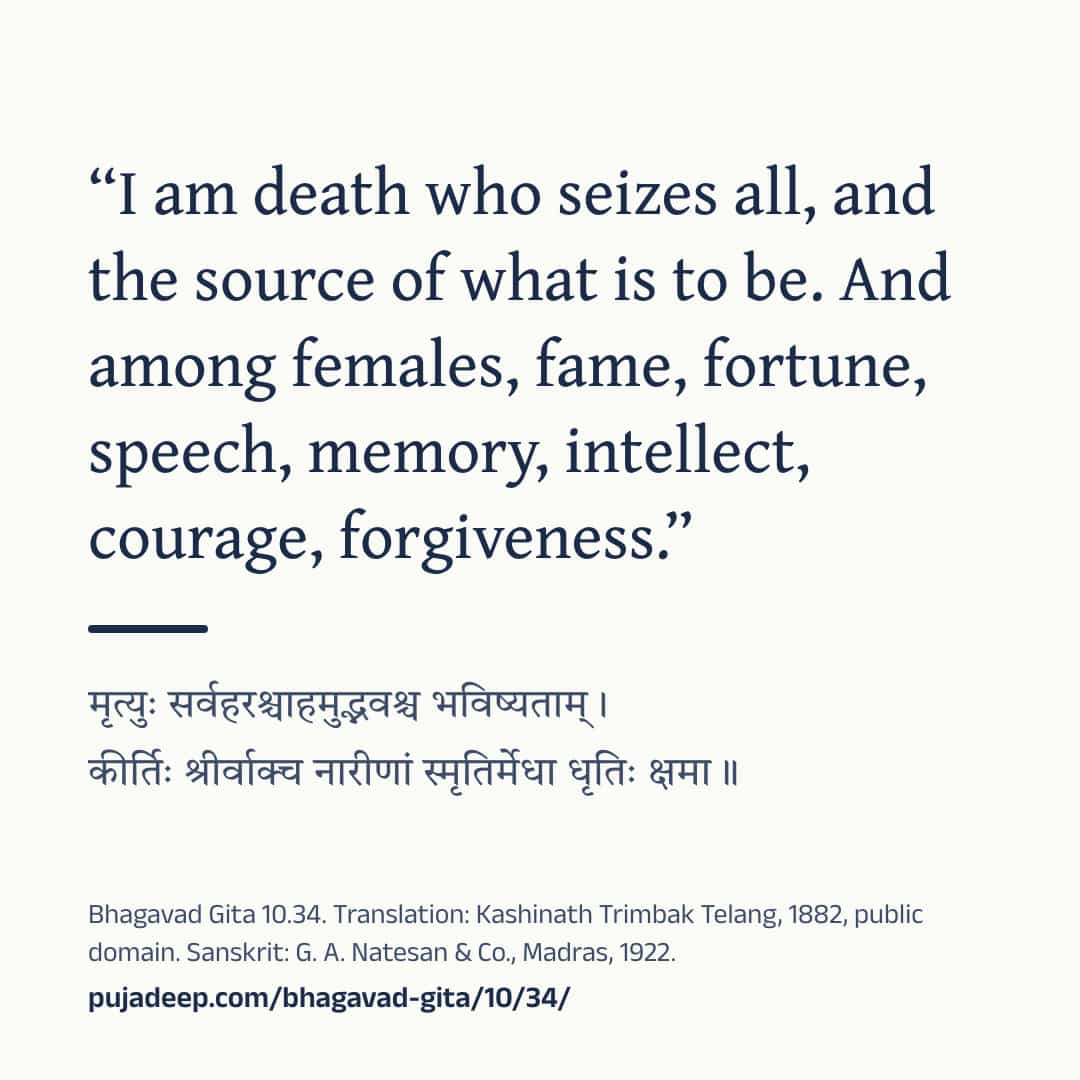
Drawing the picture
See the words
Bhagavad Gita 10.34

मृत्युः सर्वहरश्चाहमुद्भवश्च भविष्यताम् ।
कीर्तिः श्रीर्वाक्च नारीणां स्मृतिर्मेधा धृतिः क्षमा ॥

“I am death who seizes all, and the source of what is to be. And among females, fame, fortune, speech, memory, intellect, courage, forgiveness.”
(K. T. Telang, The Bhagavadgîtâ (The Sacred Books of the East, vol. VIII, Oxford: Clarendon Press, 1882), p. 90, public domain)

“And all-devouring Death am I, and the Origin of all to come; and of female things Fame, Prosperity, Speech, Memory, Intelligence, Constancy, Endurance.”
(Annie Besant, The Bhagavad Gîtâ, or The Lord's Song (London: Theosophical Publishing Society, 1895), p. 101, public domain)

“And I am the all-seizing Death, and the prosperity of those who are to be prosperous; of the feminine (I am) Fame, Prosperity (or beauty), and Inspiration, Memory, Intelligence, Constancy, and Forbearance.”
(Swami Swarupananda, Srimad-Bhagavad-Gita (Mayavati: Prabuddha Bharata Press, 1909; first printed in Prabuddha Bharata, 1907–1909), p. 208, public domain)

Sanskrit: G. A. Natesan & Co., Madras, 1922.
https://pujadeep.com/bhagavad-gita/10/34/ Nothing is sent from this site. Your own app sends it, to the chat you choose. The picture quotes the translation you chose on this page, with its name and year.
Sanskrit text: The Bhagavad-Gita, or The Lord's Song, with the text in Devanagari and an English translation, 1922. Meanings: written for Pujadeep and checked against the cited edition. Source and changes
Questions families ask
Who speaks Bhagavad Gita 10.34?
Krishna speaks this verse, in chapter 10 (Vibhuti Yoga).
Where does the Sanskrit text come from?
Sanskrit text: The Bhagavad-Gita, or The Lord's Song, with the text in Devanagari and an English translation, 1922. Meanings: written for Pujadeep and checked against the cited edition. See the source
Is the meaning on this page a translation?
Explanation written for this site from the sources listed here, and checked against the cited edition. It is not a translation and not the only way to read the text. Free to quote with credit.
Source and licence
- Sanskrit text
- The Bhagavad-Gita, or The Lord's Song, with the text in Devanagari and an English translation (Annie Besant, G. A. Natesan & Co., Madras, 1922). Public domain. The Sanskrit on these pages was read from this printing’s page images.
- Translation
- The Bhagavadgîtâ with the Sanatsugâtîya and the Anugîtâ, translated by Kâshinâth Trimbak Telang (The Sacred Books of the East, vol. VIII, ed. F. Max Müller) (Kashinath Trimbak Telang, F. Max Müller, Clarendon Press, Oxford, 1882). Public domain. Shown verbatim, as printed.
- Translation
- The Bhagavad Gîtâ, or The Lord's Song, translated by Annie Besant (Annie Besant, Theosophical Publishing Society, London, 1895). Public domain. Shown verbatim, as printed.
- Translation
- Srimad-Bhagavad-Gita, with Sanskrit Text; Paraphrase with Word-by-word Literal Translation; English Rendering and Comments, Index, &c., by the Swami Swarupananda (Himalayan Series, No. XX) (Swami Swarupananda, The Editors and Publishers, Advaita Ashrama, Mayavati, Prabuddha Bharata Press, Mayavati, Almora, Himalayas, 1909). Public domain. Shown verbatim, as printed.
- Common wording
- In this text, 32 words follow today's common wording, checked against sanskritdocuments.org; Sanskrit Wikisource; Gita Press, Gorakhpur; GRETIL, Göttingen and Bhaktivedanta Book Trust.
- Our explanation
- Explanation written for this site from the sources listed here, and checked against the cited edition. It is not a translation and not the only way to read the text. Free to quote with credit.
- Checked
- Checked against the cited edition, October 15, 2026.
- Updated
- October 25, 2026