Bhagavad Gita 10.25: meaning and translation
Chapter 10: Vibhuti Yoga. Krishna says
Among the great sages, Krishna says, he is Bhṛgu; among words, the one syllable (Om); among offerings, the offering of silent repetition (japa); among things that do not move, the Himalaya.
Click or tap a word for its meaning and its dictionary page.
Text and layers
Text and layers
These choices stay in this browser.
Bhagavad Gita 10.25
महर्षीणां भृगुरहं गिरामस्म्येकमक्षरम् ।यज्ञानां जपयज्ञोऽस्मि स्थावराणां हिमालयः ॥
Maharshinam bhriguraham giramasmyekamaksharamYajnanam japayajnosmi sthavaranam himalayah
maharṣīṇāṃ bhṛgurahaṃ girāmasmyekamakṣaram |yajñānāṃ japayajño’smi sthāvarāṇāṃ himālayaḥ ||
Our explanation Among the great sages, Krishna says, he is Bhṛgu; among words, the one syllable (Om); among offerings, the offering of silent repetition (japa); among things that do not move, the Himalaya.
हिंदी अर्थ कृष्ण कहते हैं कि महर्षियों में वे भृगु हैं; वाणी में एक अक्षर (ॐ); यज्ञों में जपयज्ञ (मन में दोहराया जाने वाला जप); और अचल वस्तुओं में हिमालय।
Word by word
Every word, with its dictionary page
Word by word
- महर्षीणाम् maharṣīṇām · among the great sages (compound (masculine), genitive plural) Dictionary: maharṣi, Monier-Williams 1899, p. 794, col. 2 “a great Ṛishi, any great sage or saint”
- भृगुः bhṛguḥ · Bhṛgu (noun (masculine), nominative singular) Dictionary: bhṛgu, Monier-Williams 1899, p. 765, col. 1 “N. of a Ṛishi regarded as the ancestor of the Bhṛigus”
- अहम् aham · "I" (Krishna) (pronoun, nominative singular) Dictionary: aham, Monier-Williams 1899, p. 124, col. 2 “nom. sg. ‘I,’”
- गिराम् girām · among words (noun (feminine), genitive plural) Dictionary: 1. gir, Monier-Williams 1899, p. 355, col. 1 “speech, speaking, language, voice, words”
- अस्मि asmi · am (present, 1st person singular) Dictionary: 1. as, Monier-Williams 1899, p. 117, col. 2 “to be, live, exist, be present”
- एकम् ekam · the one (numeral (neuter), nominative singular) Dictionary: eka, Monier-Williams 1899, p. 227, col. 3 “one”
- अक्षरम् akṣaram · syllable (Om) (noun (neuter), nominative singular) Dictionary: a-kṣara, Monier-Williams 1899, p. 3, col. 2 “a syllable; the syllable om”
- यज्ञानाम् yajñānām · among offerings (noun (masculine), genitive plural) Dictionary: yajña, Monier-Williams 1899, p. 839, col. 2 “worship, devotion, prayer, praise; act of worship or devotion, offering, oblation, sacrifice”
- जपयज्ञः japayajñaḥ · the offering of japa (quiet repetition) (compound (masculine), nominative singular) Dictionary: japa-yajña, Monier-Williams 1899, p. 412, col. 1 “muttering prayers as a religious sacrifice”
- अस्मि asmi · am (present, 1st person singular) Dictionary: 1. as, Monier-Williams 1899, p. 117, col. 2 “to be, live, exist, be present”
- स्थावराणाम् sthāvarāṇām · among things that do not move (adjective (neuter), genitive plural) Dictionary: sthāvara, Monier-Williams 1899, p. 1264, col. 1 “standing still, not moving, fixed, stationary, stable, immovable (opp. to jaṅgama, q.v.)”
- हिमालयः himālayaḥ · the Himalaya (noun (masculine), nominative singular) Dictionary: 1. himālaya, Monier-Williams 1899, p. 1299, col. 2 “'abode of snow,' the Himālaya range of mountains”
Old translations
Kashinath Trimbak Telang, 1882. Public domain. Page 89.
I am Bhrigu among the great sages. I am the single syllable (Om1) among words. Among sacrifices I am the Gapa sacrifice2; the Himâlaya among the firmly-fixed (mountains);
This sentence goes on in 10.26.
Footnotes (the translator’s own) Compare 3 translations
Kashinath Trimbak Telang, 1882. Public domain. Page 89.
I am Bhrigu among the great sages. I am the single syllable (Om1) among words. Among sacrifices I am the Gapa sacrifice2; the Himâlaya among the firmly-fixed (mountains);
This sentence goes on in 10.26.
Footnotes (the translator’s own) You are reading this one
Annie Besant, 1895. Public domain. Page 99.
Of the great Rishis Bhrigu I, of speech I am the one syllable1; of sacrifices I am the sacrifice of silent repetitions2, of immovable things Himâlaya.
Footnotes (the translator’s own) You are reading this one
Swami Swarupananda, 1909 (first printed 1907). Public domain. Page 204.
Of the great Rishis I am Bhrigu; of words I am the one syllable "Om"; of Yajnas I am the Yajna of Japa (silent repetition); of immovable things the Himàlaya.
You are reading this one
Cite this verse
The translation: K. T. Telang, The Bhagavadgîtâ (The Sacred Books of the East, vol. VIII, Oxford: Clarendon Press, 1882), p. 89. Bhagavad Gita 10.25.
The translation: Annie Besant, The Bhagavad Gîtâ, or The Lord's Song (London: Theosophical Publishing Society, 1895), p. 99. Bhagavad Gita 10.25.
The translation: Swami Swarupananda, Srimad-Bhagavad-Gita (Mayavati: Prabuddha Bharata Press, 1909; first printed in Prabuddha Bharata, 1907–1909), p. 204. Bhagavad Gita 10.25.
Our explanation: “Bhagavad Gita 10.25: meaning and translation.” Pujadeep. Updated October 25, 2026. https://pujadeep.com/bhagavad-gita/10/25/
Pujadeep’s explanations are free to quote with credit: name Pujadeep and link to the page. How to credit
Classical readings, by school
No readings by school on this verse yet.
Share
Show the ways to share
Send one picture or the text to one chat. The picture names its source and the address of this page.
Drawing the picture
See the words
Bhagavad Gita 10.25

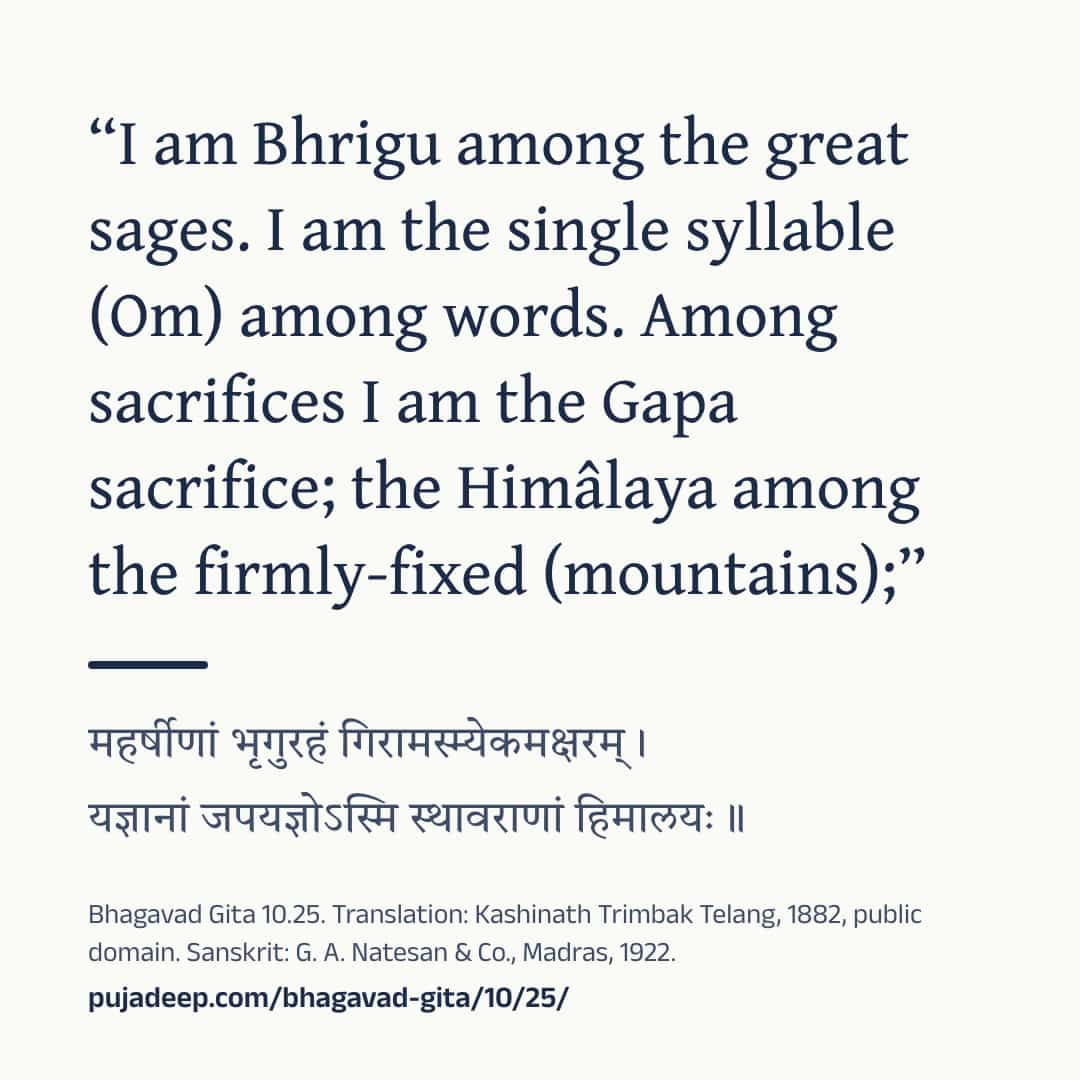
महर्षीणां भृगुरहं गिरामस्म्येकमक्षरम् ।
यज्ञानां जपयज्ञोऽस्मि स्थावराणां हिमालयः ॥

“I am Bhrigu among the great sages. I am the single syllable (Om) among words. Among sacrifices I am the Gapa sacrifice; the Himâlaya among the firmly-fixed (mountains);”
(K. T. Telang, The Bhagavadgîtâ (The Sacred Books of the East, vol. VIII, Oxford: Clarendon Press, 1882), p. 89, public domain)
This sentence goes on in 10.26.

“Of the great Rishis Bhrigu I, of speech I am the one syllable; of sacrifices I am the sacrifice of silent repetitions, of immovable things Himâlaya.”
(Annie Besant, The Bhagavad Gîtâ, or The Lord's Song (London: Theosophical Publishing Society, 1895), p. 99, public domain)

“Of the great Rishis I am Bhrigu; of words I am the one syllable "Om"; of Yajnas I am the Yajna of Japa (silent repetition); of immovable things the Himàlaya.”
(Swami Swarupananda, Srimad-Bhagavad-Gita (Mayavati: Prabuddha Bharata Press, 1909; first printed in Prabuddha Bharata, 1907–1909), p. 204, public domain)

Sanskrit: G. A. Natesan & Co., Madras, 1922.
https://pujadeep.com/bhagavad-gita/10/25/ Nothing is sent from this site. Your own app sends it, to the chat you choose. The picture quotes the translation you chose on this page, with its name and year.
Sanskrit text: The Bhagavad-Gita, or The Lord's Song, with the text in Devanagari and an English translation, 1922. Meanings: written for Pujadeep and checked against the cited edition. Source and changes
Questions families ask
Who speaks Bhagavad Gita 10.25?
Krishna speaks this verse, in chapter 10 (Vibhuti Yoga).
Where does the Sanskrit text come from?
Sanskrit text: The Bhagavad-Gita, or The Lord's Song, with the text in Devanagari and an English translation, 1922. Meanings: written for Pujadeep and checked against the cited edition. See the source
Is the meaning on this page a translation?
Explanation written for this site from the sources listed here, and checked against the cited edition. It is not a translation and not the only way to read the text. Free to quote with credit.
Source and licence
- Sanskrit text
- The Bhagavad-Gita, or The Lord's Song, with the text in Devanagari and an English translation (Annie Besant, G. A. Natesan & Co., Madras, 1922). Public domain. The Sanskrit on these pages was read from this printing’s page images.
- Translation
- The Bhagavadgîtâ with the Sanatsugâtîya and the Anugîtâ, translated by Kâshinâth Trimbak Telang (The Sacred Books of the East, vol. VIII, ed. F. Max Müller) (Kashinath Trimbak Telang, F. Max Müller, Clarendon Press, Oxford, 1882). Public domain. Shown verbatim, as printed.
- Translation
- The Bhagavad Gîtâ, or The Lord's Song, translated by Annie Besant (Annie Besant, Theosophical Publishing Society, London, 1895). Public domain. Shown verbatim, as printed.
- Translation
- Srimad-Bhagavad-Gita, with Sanskrit Text; Paraphrase with Word-by-word Literal Translation; English Rendering and Comments, Index, &c., by the Swami Swarupananda (Himalayan Series, No. XX) (Swami Swarupananda, The Editors and Publishers, Advaita Ashrama, Mayavati, Prabuddha Bharata Press, Mayavati, Almora, Himalayas, 1909). Public domain. Shown verbatim, as printed.
- Common wording
- In this text, 32 words follow today's common wording, checked against sanskritdocuments.org; Sanskrit Wikisource; Gita Press, Gorakhpur; GRETIL, Göttingen and Bhaktivedanta Book Trust.
- Our explanation
- Explanation written for this site from the sources listed here, and checked against the cited edition. It is not a translation and not the only way to read the text. Free to quote with credit.
- Checked
- Checked against the cited edition, October 15, 2026.
- Updated
- October 25, 2026