Bhagavad Gita 10.41: meaning and translation
Chapter 10: Vibhuti Yoga. Krishna says
Whatever is glorious, prosperous or mighty, Krishna says, Arjuna should know that it comes from a fragment of his splendour (tejas).
Click or tap a word for its meaning and its dictionary page.
Text and layers
Text and layers
These choices stay in this browser.
Bhagavad Gita 10.41
यद्यद्विभूतिमत्सत्त्वं श्रीमदूर्जितमेव वा ।तत्तदेवावगच्छ त्वं मम तेजोंऽशसम्भवम् ॥
Yadyadvibhutimatsattvam shrimadurjitameva vaTattadevavagachchha tvam mama tejonshasambhavam
yadyadvibhūtimatsattvaṃ śrīmadūrjitameva vā |tattadevāvagaccha tvaṃ mama tejoṃ’śasambhavam ||
Our explanation Whatever is glorious, prosperous or mighty, Krishna says, Arjuna should know that it comes from a fragment of his splendour (tejas).
हिंदी अर्थ कृष्ण कहते हैं कि जो कुछ भी विभूतियुक्त, श्रीयुक्त या शक्तिशाली है, अर्जुन उसे उनके तेज के एक अंश से उत्पन्न जानें।
Word by word
Every word, with its dictionary page
Word by word
- यत् yat · whatever (relative pronoun (neuter), nominative singular) Dictionary: yad, Monier-Williams 1899, p. 844, col. 2 “who, which, what, whichever, whatever, that”
- यत् yat · (whatever) (relative pronoun (neuter), nominative singular) Dictionary: yad, Monier-Williams 1899, p. 844, col. 2 “who, which, what, whichever, whatever, that”
- विभूतिमत् vibhūtimat · glorious (adjective (neuter), nominative singular) Dictionary: vi-bhūti-mat, Monier-Williams 1899, p. 979, col. 1 “mighty, powerful, superhuman”
- सत्त्वम् sattvam · being, thing (noun (neuter), nominative singular) Dictionary: sat-tva, Monier-Williams 1899, p. 1135, col. 2 “being, existence, entity, reality”
- श्रीमत् śrīmat · prosperous, beautiful (adjective (neuter), nominative singular) Dictionary: śrī-mat, Monier-Williams 1899, p. 1100, col. 2 “possessed of fortune, fortunate, auspicious, wealthy, prosperous, eminent, illustrious”
- ऊर्जितम् ūrjitam · mighty (adjective (neuter), nominative singular) Dictionary: ūrjita, Monier-Williams 1899, p. 221, col. 3 “endowed with strength or power, strong, mighty, powerful”
- एव eva · indeed (indeclinable) Dictionary: 1. eva, Monier-Williams 1899, p. 232, col. 2 “just, exactly, very, same, only, even, alone, merely”
- वा vā · or (indeclinable) Dictionary: 1. vā, Monier-Williams 1899, p. 934, col. 2 “or”
- तत् tat · that (pronoun (neuter), accusative singular) Dictionary: tad, Monier-Williams 1899, p. 434, col. 1 “m. he, f. she, n. it, that, this”
- तत् tat · (that) (pronoun (neuter), accusative singular) Dictionary: tad, Monier-Williams 1899, p. 434, col. 1 “m. he, f. she, n. it, that, this”
- एव eva · indeed (indeclinable) Dictionary: 1. eva, Monier-Williams 1899, p. 232, col. 2 “just, exactly, very, same, only, even, alone, merely”
- अवगच्छ avagaccha · know, understand (imperative, 2nd person singular) Dictionary: ava-gam, Monier-Williams 1899, p. 97, col. 2 “to hit upon, think of, conceive, learn, know, understand”
- त्वम् tvam · you (pronoun, nominative singular) Dictionary: yuṣmad, Monier-Williams 1899, p. 855, col. 3 “the base of the 2nd pers. pron. as used in comp.”
- मम mama · "my" (Krishna's) (pronoun, genitive singular) Dictionary: 1. mad, Monier-Williams 1899, p. 777, col. 2 “base of the first pers. pron. in the sg. number (esp. in comp.)”
- तेजोंऽशसम्भवम् tejoṃ’śasambhavam · born of a portion of splendour (compound (neuter), accusative singular) Dictionary: tejas, Monier-Williams 1899, p. 454, col. 2 “glow, glare, splendour, brilliance, light, fire”; aṃśa, Monier-Williams 1899, p. 1, col. 1 “a share, portion, part, party”; sam-bhava, Monier-Williams 1899, p. 1179, col. 1 “birth, production, origin, source”
Old translations
Kashinath Trimbak Telang, 1882. Public domain. Page 91.
Whatever thing (there is) of power, or glorious, or splendid, know all that to be produced from portions of my energy.
Compare 3 translations
Kashinath Trimbak Telang, 1882. Public domain. Page 91.
Whatever thing (there is) of power, or glorious, or splendid, know all that to be produced from portions of my energy.
You are reading this one
Annie Besant, 1895. Public domain. Page 102.
Whatsoever is royal, good, prosperous, and mighty, understand thou that to go forth from My splendour.
You are reading this one
Swami Swarupananda, 1909 (first printed 1907). Public domain. Page 210.
Whatever being there is great, prosperous or powerful, that know thou to be a product of a part of My splendour.
You are reading this one
Cite this verse
The translation: K. T. Telang, The Bhagavadgîtâ (The Sacred Books of the East, vol. VIII, Oxford: Clarendon Press, 1882), p. 91. Bhagavad Gita 10.41.
The translation: Annie Besant, The Bhagavad Gîtâ, or The Lord's Song (London: Theosophical Publishing Society, 1895), p. 102. Bhagavad Gita 10.41.
The translation: Swami Swarupananda, Srimad-Bhagavad-Gita (Mayavati: Prabuddha Bharata Press, 1909; first printed in Prabuddha Bharata, 1907–1909), p. 210. Bhagavad Gita 10.41.
Our explanation: “Bhagavad Gita 10.41: meaning and translation.” Pujadeep. Updated October 25, 2026. https://pujadeep.com/bhagavad-gita/10/41/
Pujadeep’s explanations are free to quote with credit: name Pujadeep and link to the page. How to credit
Classical readings, by school
No readings by school on this verse yet.
Share
Show the ways to share
Send one picture or the text to one chat. The picture names its source and the address of this page.
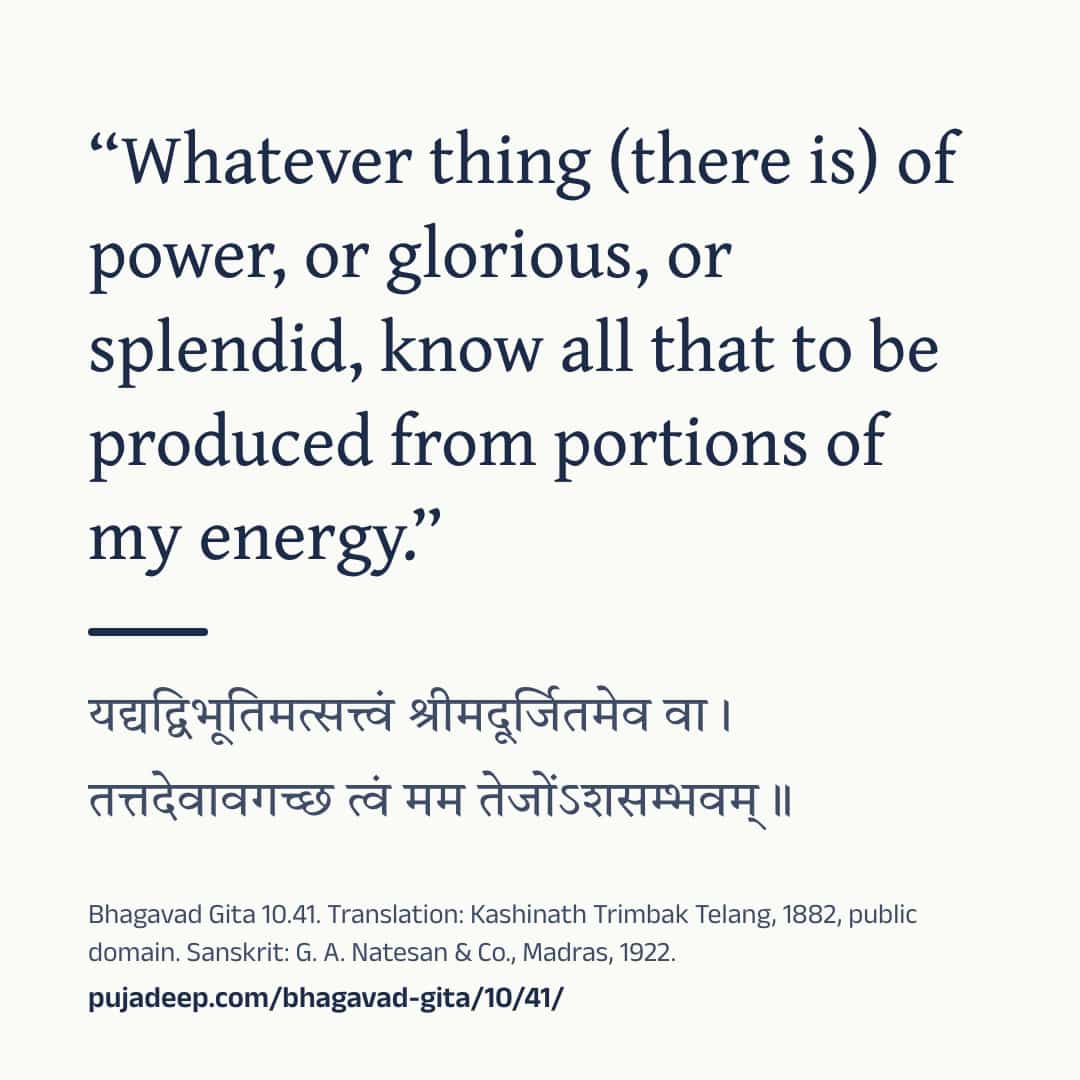
Drawing the picture
See the words
Bhagavad Gita 10.41

यद्यद्विभूतिमत्सत्त्वं श्रीमदूर्जितमेव वा ।
तत्तदेवावगच्छ त्वं मम तेजोंऽशसम्भवम् ॥

“Whatever thing (there is) of power, or glorious, or splendid, know all that to be produced from portions of my energy.”
(K. T. Telang, The Bhagavadgîtâ (The Sacred Books of the East, vol. VIII, Oxford: Clarendon Press, 1882), p. 91, public domain)

“Whatsoever is royal, good, prosperous, and mighty, understand thou that to go forth from My splendour.”
(Annie Besant, The Bhagavad Gîtâ, or The Lord's Song (London: Theosophical Publishing Society, 1895), p. 102, public domain)

“Whatever being there is great, prosperous or powerful, that know thou to be a product of a part of My splendour.”
(Swami Swarupananda, Srimad-Bhagavad-Gita (Mayavati: Prabuddha Bharata Press, 1909; first printed in Prabuddha Bharata, 1907–1909), p. 210, public domain)

Sanskrit: G. A. Natesan & Co., Madras, 1922.
https://pujadeep.com/bhagavad-gita/10/41/ Nothing is sent from this site. Your own app sends it, to the chat you choose. The picture quotes the translation you chose on this page, with its name and year.
Sanskrit text: The Bhagavad-Gita, or The Lord's Song, with the text in Devanagari and an English translation, 1922. Meanings: written for Pujadeep and checked against the cited edition. Source and changes
Questions families ask
Who speaks Bhagavad Gita 10.41?
Krishna speaks this verse, in chapter 10 (Vibhuti Yoga).
Where does the Sanskrit text come from?
Sanskrit text: The Bhagavad-Gita, or The Lord's Song, with the text in Devanagari and an English translation, 1922. Meanings: written for Pujadeep and checked against the cited edition. See the source
Is the meaning on this page a translation?
Explanation written for this site from the sources listed here, and checked against the cited edition. It is not a translation and not the only way to read the text. Free to quote with credit.
Source and licence
- Sanskrit text
- The Bhagavad-Gita, or The Lord's Song, with the text in Devanagari and an English translation (Annie Besant, G. A. Natesan & Co., Madras, 1922). Public domain. The Sanskrit on these pages was read from this printing’s page images.
- Translation
- The Bhagavadgîtâ with the Sanatsugâtîya and the Anugîtâ, translated by Kâshinâth Trimbak Telang (The Sacred Books of the East, vol. VIII, ed. F. Max Müller) (Kashinath Trimbak Telang, F. Max Müller, Clarendon Press, Oxford, 1882). Public domain. Shown verbatim, as printed.
- Translation
- The Bhagavad Gîtâ, or The Lord's Song, translated by Annie Besant (Annie Besant, Theosophical Publishing Society, London, 1895). Public domain. Shown verbatim, as printed.
- Translation
- Srimad-Bhagavad-Gita, with Sanskrit Text; Paraphrase with Word-by-word Literal Translation; English Rendering and Comments, Index, &c., by the Swami Swarupananda (Himalayan Series, No. XX) (Swami Swarupananda, The Editors and Publishers, Advaita Ashrama, Mayavati, Prabuddha Bharata Press, Mayavati, Almora, Himalayas, 1909). Public domain. Shown verbatim, as printed.
- Common wording
- In this text, 32 words follow today's common wording, checked against sanskritdocuments.org; Sanskrit Wikisource; Gita Press, Gorakhpur; GRETIL, Göttingen and Bhaktivedanta Book Trust.
- Our explanation
- Explanation written for this site from the sources listed here, and checked against the cited edition. It is not a translation and not the only way to read the text. Free to quote with credit.
- Checked
- Checked against the cited edition, October 15, 2026.
- Updated
- October 25, 2026