Bhagavad Gita 10.13: meaning and translation
Chapter 10: Vibhuti Yoga. Arjuna says
Arjuna says that all the sages declare this of Krishna, as do the divine sage Narada, and Asita, Devala and Vyasa, and now Krishna himself tells him so.
Click or tap a word for its meaning and its dictionary page.
Text and layers
Text and layers
These choices stay in this browser.
Bhagavad Gita 10.13
आहुस्त्वामृषयः सर्वे देवर्षिर्नारदस्तथा ।असितो देवलो व्यासः स्वयं चैव ब्रवीषि मे ॥
Ahustvamrishayah sarve devarshirnaradastathaAsito devalo vyasah svayam chaiva bravishi me
āhustvāmṛṣayaḥ sarve devarṣirnāradastathā |asito devalo vyāsaḥ svayaṃ caiva bravīṣi me ||
Our explanation Arjuna says that all the sages declare this of Krishna, as do the divine sage Narada, and Asita, Devala and Vyasa, and now Krishna himself tells him so.
हिंदी अर्थ अर्जुन कहते हैं कि सब ऋषि कृष्ण के बारे में यही कहते हैं, और देवर्षि नारद, असित, देवल और व्यास भी; और अब कृष्ण स्वयं भी उनसे यही कहते हैं।
Word by word
Every word, with its dictionary page
Word by word
- आहुः āhuḥ · say, declare (perfect with present sense, 3rd person plural) Dictionary: 1. ah, Monier-Williams 1899, p. 124, col. 1 “to say, speak”
- त्वाम् tvām · you (Krishna) (pronoun, accusative singular) Dictionary: yuṣmad, Monier-Williams 1899, p. 855, col. 3 “the base of the 2nd pers. pron. as used in comp.”
- ऋषयः ṛṣayaḥ · the sages (noun (masculine), nominative plural) Dictionary: ṛṣi, Monier-Williams 1899, p. 226, col. 3 “a singer of sacred hymns, an inspired poet or sage”
- सर्वे sarve · all (pronoun (masculine), nominative plural) Dictionary: sarva, Monier-Williams 1899, p. 1184, col. 3 “whole, entire, all, every”
- देवर्षिः devarṣiḥ · the divine sage (compound (masculine), nominative singular) Dictionary: deva-rṣi, Monier-Williams 1899, p. 494, col. 2 “a saint of the celestial class, as Nārada”
- नारदः nāradaḥ · Nārada (noun (masculine), nominative singular) Dictionary: nārada, Monier-Williams 1899, p. 537, col. 2 “N. of a Ṛishi”
- तथा tathā · also (indeclinable) Dictionary: tathā, Monier-Williams 1899, p. 433, col. 3 “in that manner, so, thus”
- असितः asitaḥ · Asita (noun (masculine), nominative singular) Dictionary: 2. asita, Monier-Williams 1899, p. 120, col. 3 “of a descendant of Kaśyapa”
- देवलः devalaḥ · Devala (noun (masculine), nominative singular) Dictionary: 1. devala, Monier-Williams 1899, p. 496, col. 1 “N. of a descendant of Kaśyapa and one of the authors of RV. ix”
- व्यासः vyāsaḥ · Vyāsa (noun (masculine), nominative singular) Dictionary: vy-āsa, Monier-Williams 1899, p. 1035, col. 2 “N. of a celebrated mythical sage and author”
- स्वयम् svayam · yourself (indeclinable) Dictionary: svayam, Monier-Williams 1899, p. 1278, col. 2 “self, one's self”
- च ca · and (indeclinable) Dictionary: 2. ca, Monier-Williams 1899, p. 380, col. 1 “and, both, also, moreover, as well as”
- एव eva · indeed (indeclinable) Dictionary: 1. eva, Monier-Williams 1899, p. 232, col. 2 “just, exactly, very, same, only, even, alone, merely”
- ब्रवीषि bravīṣi · you tell (present, 2nd person singular) Dictionary: brū, Monier-Williams 1899, p. 742, col. 1 “to speak, say, tell”
- मे me · to "me" (Arjuna) (pronoun, dative singular) Dictionary: 1. mad, Monier-Williams 1899, p. 777, col. 2 “base of the first pers. pron. in the sg. number (esp. in comp.)”
Old translations
Kashinath Trimbak Telang, 1882. Public domain.
Telang translates verses 12–13 together; see 10.12. Read it at 10.12
Compare 3 translations
Kashinath Trimbak Telang, 1882. Public domain.
Telang translates verses 12–13 together; see 10.12. Read it at 10.12
You are reading this one
Annie Besant, 1895. Public domain. Page 97.
All the Rishis acclaim Thee, as also the divine Rishi, Nârada; so Asita, Devala, Vyâsa; and now Thou Thyself tellest it me.
You are reading this one
Swami Swarupananda, 1909 (first printed 1907). Public domain.
Swarupananda renders verses 12–13 together; see 10.12. Read it at 10.12
You are reading this one
Cite this verse
The translation: K. T. Telang, The Bhagavadgîtâ (The Sacred Books of the East, vol. VIII, Oxford: Clarendon Press, 1882), p. 87. Bhagavad Gita 10.12–13.
The translation: Annie Besant, The Bhagavad Gîtâ, or The Lord's Song (London: Theosophical Publishing Society, 1895), p. 97. Bhagavad Gita 10.13.
The translation: Swami Swarupananda, Srimad-Bhagavad-Gita (Mayavati: Prabuddha Bharata Press, 1909; first printed in Prabuddha Bharata, 1907–1909), p. 199. Bhagavad Gita 10.12–13.
Our explanation: “Bhagavad Gita 10.13: meaning and translation.” Pujadeep. Updated October 25, 2026. https://pujadeep.com/bhagavad-gita/10/13/
Pujadeep’s explanations are free to quote with credit: name Pujadeep and link to the page. How to credit
Classical readings, by school
No readings by school on this verse yet.
Share
Show the ways to share
Send one picture or the text to one chat. The picture names its source and the address of this page.
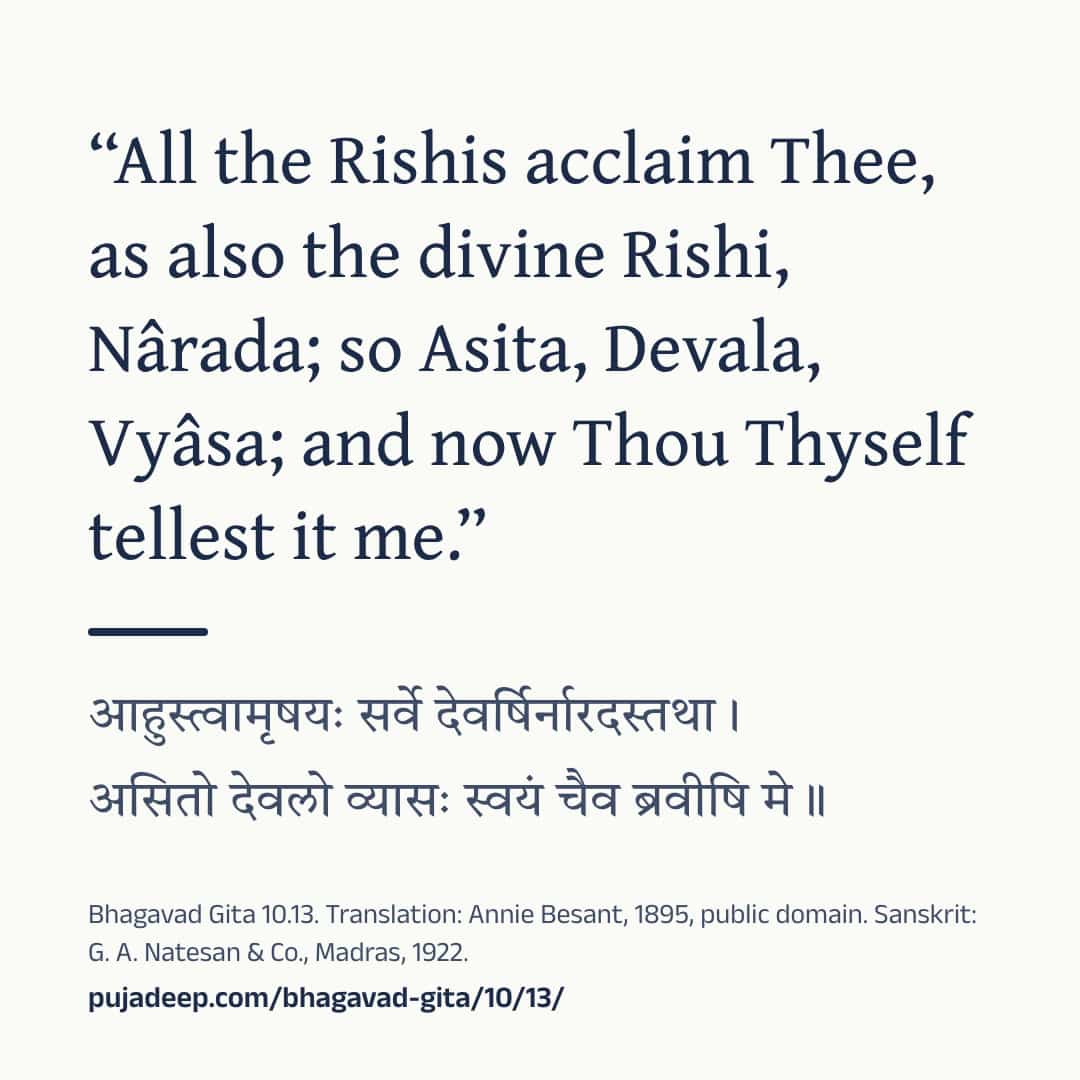
Drawing the picture
See the words
Bhagavad Gita 10.13

आहुस्त्वामृषयः सर्वे देवर्षिर्नारदस्तथा ।
असितो देवलो व्यासः स्वयं चैव ब्रवीषि मे ॥

“All the Rishis acclaim Thee, as also the divine Rishi, Nârada; so Asita, Devala, Vyâsa; and now Thou Thyself tellest it me.”
(Annie Besant, The Bhagavad Gîtâ, or The Lord's Song (London: Theosophical Publishing Society, 1895), p. 97, public domain)

Sanskrit: G. A. Natesan & Co., Madras, 1922.
https://pujadeep.com/bhagavad-gita/10/13/ Nothing is sent from this site. Your own app sends it, to the chat you choose. The picture quotes the translation you chose on this page, with its name and year.
Sanskrit text: The Bhagavad-Gita, or The Lord's Song, with the text in Devanagari and an English translation, 1922. Meanings: written for Pujadeep and checked against the cited edition. Source and changes
Questions families ask
Who speaks Bhagavad Gita 10.13?
Arjuna speaks this verse, in chapter 10 (Vibhuti Yoga).
Where does the Sanskrit text come from?
Sanskrit text: The Bhagavad-Gita, or The Lord's Song, with the text in Devanagari and an English translation, 1922. Meanings: written for Pujadeep and checked against the cited edition. See the source
Is the meaning on this page a translation?
Explanation written for this site from the sources listed here, and checked against the cited edition. It is not a translation and not the only way to read the text. Free to quote with credit.
Source and licence
- Sanskrit text
- The Bhagavad-Gita, or The Lord's Song, with the text in Devanagari and an English translation (Annie Besant, G. A. Natesan & Co., Madras, 1922). Public domain. The Sanskrit on these pages was read from this printing’s page images.
- Translation
- The Bhagavadgîtâ with the Sanatsugâtîya and the Anugîtâ, translated by Kâshinâth Trimbak Telang (The Sacred Books of the East, vol. VIII, ed. F. Max Müller) (Kashinath Trimbak Telang, F. Max Müller, Clarendon Press, Oxford, 1882). Public domain. Shown verbatim, as printed.
- Translation
- The Bhagavad Gîtâ, or The Lord's Song, translated by Annie Besant (Annie Besant, Theosophical Publishing Society, London, 1895). Public domain. Shown verbatim, as printed.
- Translation
- Srimad-Bhagavad-Gita, with Sanskrit Text; Paraphrase with Word-by-word Literal Translation; English Rendering and Comments, Index, &c., by the Swami Swarupananda (Himalayan Series, No. XX) (Swami Swarupananda, The Editors and Publishers, Advaita Ashrama, Mayavati, Prabuddha Bharata Press, Mayavati, Almora, Himalayas, 1909). Public domain. Shown verbatim, as printed.
- Common wording
- In this text, 32 words follow today's common wording, checked against sanskritdocuments.org; Sanskrit Wikisource; Gita Press, Gorakhpur; GRETIL, Göttingen and Bhaktivedanta Book Trust.
- Our explanation
- Explanation written for this site from the sources listed here, and checked against the cited edition. It is not a translation and not the only way to read the text. Free to quote with credit.
- Checked
- Checked against the cited edition, October 15, 2026.
- Updated
- October 25, 2026