Bhagavad Gita 10.7: meaning and translation
Chapter 10: Vibhuti Yoga. Krishna says
Krishna says that whoever truly knows this glory (vibhūti) and power (yoga) of his becomes joined to him by unwavering yoga; there is no doubt of it.
Click or tap a word for its meaning and its dictionary page.
Text and layers
Text and layers
These choices stay in this browser.
Bhagavad Gita 10.7
एतां विभूतिं योगं च मम यो वेत्ति तत्त्वतः ।सोऽविकम्पेन योगेन युज्यते नात्र संशयः ॥
Etam vibhutim yogam cha mama yo vetti tattvatahSovikampena yogena yujyate natra sanshayah
etāṃ vibhūtiṃ yogaṃ ca mama yo vetti tattvataḥ |so’vikampena yogena yujyate nātra saṃśayaḥ ||
Our explanation Krishna says that whoever truly knows this glory (vibhūti) and power (yoga) of his becomes joined to him by unwavering yoga; there is no doubt of it.
हिंदी अर्थ कृष्ण कहते हैं कि जो उनकी इस विभूति (महिमा) और योग (दिव्य शक्ति) को सच्चे रूप में जानता है, वह अविचल योग से युक्त होता है; इसमें संदेह नहीं।
Word by word
Every word, with its dictionary page
Word by word
- एताम् etām · this (pronoun (feminine), accusative singular) Dictionary: etad, Monier-Williams 1899, p. 231, col. 2 “this, this here, here”
- विभूतिम् vibhūtim · glory, manifest power (noun (feminine), accusative singular) Dictionary: vi-bhūti, Monier-Williams 1899, p. 978, col. 3 “manifestation of might, great power, superhuman power”
- योगम् yogam · power, yoga (noun (masculine), accusative singular) Dictionary: yoga, Monier-Williams 1899, p. 856, col. 2 “any junction, union, combination”
- च ca · and (indeclinable) Dictionary: 2. ca, Monier-Williams 1899, p. 380, col. 1 “and, both, also, moreover, as well as”
- मम mama · "my" (Krishna's) (pronoun, genitive singular) Dictionary: 1. mad, Monier-Williams 1899, p. 777, col. 2 “base of the first pers. pron. in the sg. number (esp. in comp.)”
- यः yaḥ · who (relative pronoun (masculine), nominative singular) Dictionary: yad, Monier-Williams 1899, p. 844, col. 2 “who, which, what, whichever, whatever, that”
- वेत्ति vetti · knows (present, 3rd person singular) Dictionary: 1. vid, Monier-Williams 1899, p. 963, col. 2 “to know, understand, perceive, learn”
- तत्त्वतः tattvataḥ · truly, in essence (indeclinable) Dictionary: tat-tva, Monier-Williams 1899, p. 432, col. 3 “true or real state, truth, reality”
- सः saḥ · he (pronoun (masculine), nominative singular) Dictionary: tad, Monier-Williams 1899, p. 434, col. 1 “m. he, f. she, n. it, that, this”
- अविकम्पेन avikampena · unwavering (adjective (masculine), instrumental singular) Dictionary: 3. a, Monier-Williams 1899, p. 1, col. 1 “having a negative or privative or contrary sense”; vi-kamp, Monier-Williams 1899, p. 953, col. 3 “to tremble greatly, quiver, move about”
- योगेन yogena · by yoga (noun (masculine), instrumental singular) Dictionary: yoga, Monier-Williams 1899, p. 856, col. 3 “application or concentration of the thoughts, abstract contemplation, meditation”
- युज्यते yujyate · is joined (present passive, 3rd person singular) Dictionary: 1. yuj, Monier-Williams 1899, p. 853, col. 2 “to yoke or join or fasten or harness”
- न na · not (indeclinable) Dictionary: 2. na, Monier-Williams 1899, p. 523, col. 1 “not, no, nor, neither”
- अत्र atra · about this (indeclinable) Dictionary: 1. a-tra, Monier-Williams 1899, p. 17, col. 2 “in this place, here”
- संशयः saṃśayaḥ · doubt (noun (masculine), nominative singular) Dictionary: saṃ-śaya, Monier-Williams 1899, p. 1117, col. 3 “uncertainty, irresolution, hesitation, doubt”
Old translations
Kashinath Trimbak Telang, 1882. Public domain. Page 87.
Whoever correctly knows these powers and emanations of mine, becomes possessed of devotion free from indecision; of this (there is) no doubt.
Compare 3 translations
Kashinath Trimbak Telang, 1882. Public domain. Page 87.
Whoever correctly knows these powers and emanations of mine, becomes possessed of devotion free from indecision; of this (there is) no doubt.
You are reading this one
Annie Besant, 1895. Public domain. Page 96.
He who knows in essence that sovereignty and Yoga of Mine, he is harmonised by unchanging Yoga; there is no doubt thereof.
You are reading this one
Swami Swarupananda, 1909 (first printed 1907). Public domain. Page 196.
He who in reality knows these manifold manifestation of My being and (this) Yoga power of Mine, becomes established in the unshakable Yoga; there is no doubt of it.
You are reading this one
Cite this verse
The translation: K. T. Telang, The Bhagavadgîtâ (The Sacred Books of the East, vol. VIII, Oxford: Clarendon Press, 1882), p. 87. Bhagavad Gita 10.7.
The translation: Annie Besant, The Bhagavad Gîtâ, or The Lord's Song (London: Theosophical Publishing Society, 1895), p. 96. Bhagavad Gita 10.7.
The translation: Swami Swarupananda, Srimad-Bhagavad-Gita (Mayavati: Prabuddha Bharata Press, 1909; first printed in Prabuddha Bharata, 1907–1909), p. 196. Bhagavad Gita 10.7.
Our explanation: “Bhagavad Gita 10.7: meaning and translation.” Pujadeep. Updated October 25, 2026. https://pujadeep.com/bhagavad-gita/10/7/
Pujadeep’s explanations are free to quote with credit: name Pujadeep and link to the page. How to credit
Classical readings, by school
No readings by school on this verse yet.
Share
Show the ways to share
Send one picture or the text to one chat. The picture names its source and the address of this page.
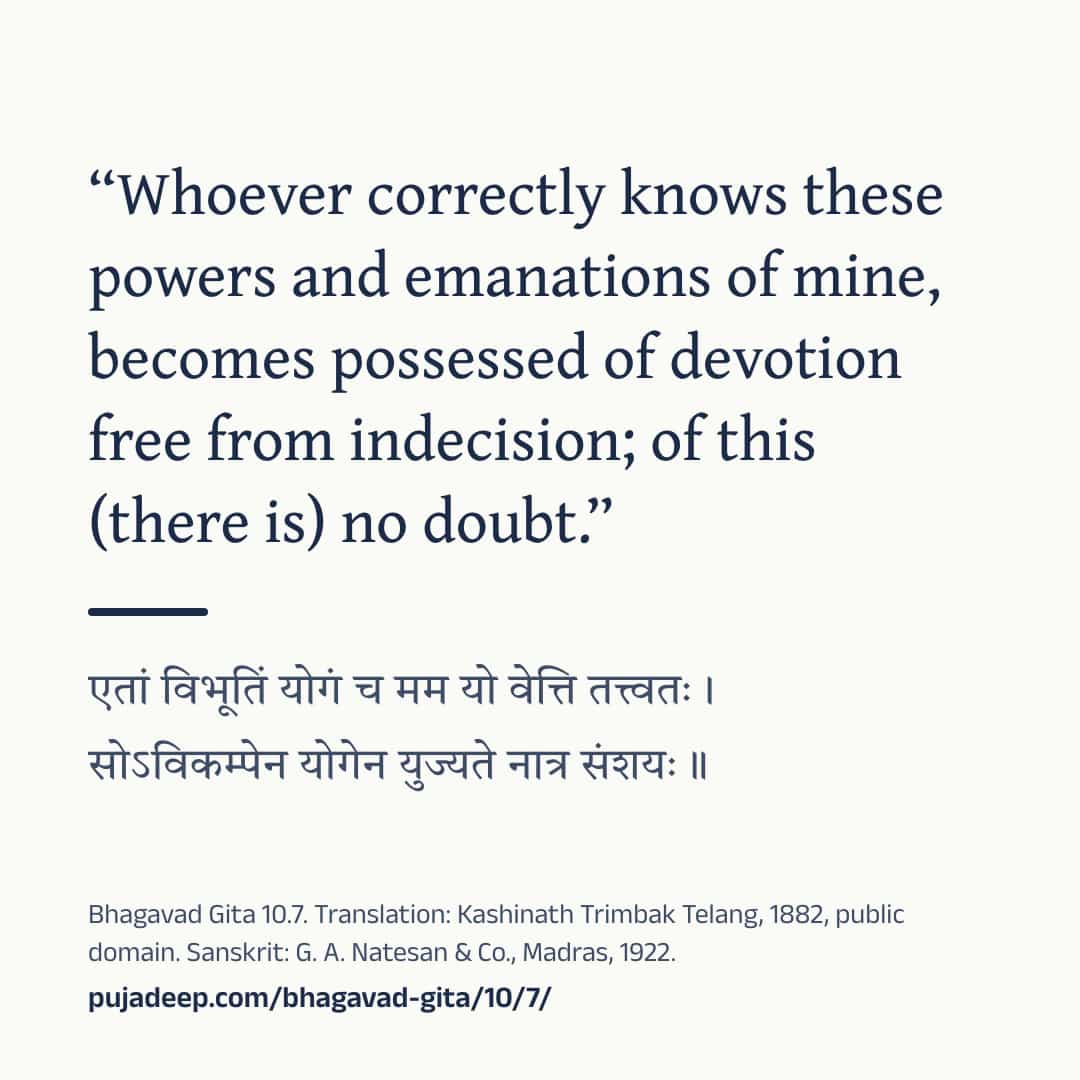
Drawing the picture
See the words
Bhagavad Gita 10.7

एतां विभूतिं योगं च मम यो वेत्ति तत्त्वतः ।
सोऽविकम्पेन योगेन युज्यते नात्र संशयः ॥

“Whoever correctly knows these powers and emanations of mine, becomes possessed of devotion free from indecision; of this (there is) no doubt.”
(K. T. Telang, The Bhagavadgîtâ (The Sacred Books of the East, vol. VIII, Oxford: Clarendon Press, 1882), p. 87, public domain)

“He who knows in essence that sovereignty and Yoga of Mine, he is harmonised by unchanging Yoga; there is no doubt thereof.”
(Annie Besant, The Bhagavad Gîtâ, or The Lord's Song (London: Theosophical Publishing Society, 1895), p. 96, public domain)

“He who in reality knows these manifold manifestation of My being and (this) Yoga power of Mine, becomes established in the unshakable Yoga; there is no doubt of it.”
(Swami Swarupananda, Srimad-Bhagavad-Gita (Mayavati: Prabuddha Bharata Press, 1909; first printed in Prabuddha Bharata, 1907–1909), p. 196, public domain)

Sanskrit: G. A. Natesan & Co., Madras, 1922.
https://pujadeep.com/bhagavad-gita/10/7/ Nothing is sent from this site. Your own app sends it, to the chat you choose. The picture quotes the translation you chose on this page, with its name and year.
Sanskrit text: The Bhagavad-Gita, or The Lord's Song, with the text in Devanagari and an English translation, 1922. Meanings: written for Pujadeep and checked against the cited edition. Source and changes
Questions families ask
Who speaks Bhagavad Gita 10.7?
Krishna speaks this verse, in chapter 10 (Vibhuti Yoga).
Where does the Sanskrit text come from?
Sanskrit text: The Bhagavad-Gita, or The Lord's Song, with the text in Devanagari and an English translation, 1922. Meanings: written for Pujadeep and checked against the cited edition. See the source
Is the meaning on this page a translation?
Explanation written for this site from the sources listed here, and checked against the cited edition. It is not a translation and not the only way to read the text. Free to quote with credit.
Source and licence
- Sanskrit text
- The Bhagavad-Gita, or The Lord's Song, with the text in Devanagari and an English translation (Annie Besant, G. A. Natesan & Co., Madras, 1922). Public domain. The Sanskrit on these pages was read from this printing’s page images.
- Translation
- The Bhagavadgîtâ with the Sanatsugâtîya and the Anugîtâ, translated by Kâshinâth Trimbak Telang (The Sacred Books of the East, vol. VIII, ed. F. Max Müller) (Kashinath Trimbak Telang, F. Max Müller, Clarendon Press, Oxford, 1882). Public domain. Shown verbatim, as printed.
- Translation
- The Bhagavad Gîtâ, or The Lord's Song, translated by Annie Besant (Annie Besant, Theosophical Publishing Society, London, 1895). Public domain. Shown verbatim, as printed.
- Translation
- Srimad-Bhagavad-Gita, with Sanskrit Text; Paraphrase with Word-by-word Literal Translation; English Rendering and Comments, Index, &c., by the Swami Swarupananda (Himalayan Series, No. XX) (Swami Swarupananda, The Editors and Publishers, Advaita Ashrama, Mayavati, Prabuddha Bharata Press, Mayavati, Almora, Himalayas, 1909). Public domain. Shown verbatim, as printed.
- Common wording
- In this text, 32 words follow today's common wording, checked against sanskritdocuments.org; Sanskrit Wikisource; Gita Press, Gorakhpur; GRETIL, Göttingen and Bhaktivedanta Book Trust.
- Our explanation
- Explanation written for this site from the sources listed here, and checked against the cited edition. It is not a translation and not the only way to read the text. Free to quote with credit.
- Checked
- Checked against the cited edition, October 15, 2026.
- Updated
- October 25, 2026