Bhagavad Gita 9.34: meaning and translation
Chapter 9: Raja Vidya Raja Guhya Yoga. Krishna says
Krishna closes the chapter: fix your mind on him, be his devotee, worship him and bow to him.
Click or tap a word for its meaning and its dictionary page.
Text and layers
Text and layers
These choices stay in this browser.
Bhagavad Gita 9.34
मन्मना भव मद्भक्तो मद्याजी मां नमस्कुरु ।मामेवैष्यसि युक्त्वैवमात्मानं मत्परायणः ॥
Manmana bhava madbhakto madyaji mam namaskuruMamevaishyasi yuktvaivamatmanam matparayanah
manmanā bhava madbhakto madyājī māṃ namaskuru |māmevaiṣyasi yuktvaivamātmānaṃ matparāyaṇaḥ ||
Our explanation Krishna closes the chapter: fix your mind on him, be his devotee, worship him and bow to him. Disciplining the self in this way and holding him as the highest goal, he says, Arjuna will come to him. The same words return in 18.65.
हिंदी अर्थ अध्याय के अंत में कृष्ण कहते हैं कि अर्जुन अपना मन उनमें लगाएँ, उनके भक्त बनें, उनकी पूजा करें और उन्हें नमस्कार करें। वे कहते हैं कि इस तरह अपने को साधकर और उन्हें परम लक्ष्य मानकर अर्जुन उन्हीं को प्राप्त होंगे। यही शब्द 18.65 में फिर आते हैं।
Word by word
Every word, with its dictionary page
Word by word
- मन्मनाः manmanāḥ · with mind on "me" (compound (masculine), nominative singular) Dictionary: 1. mad, Monier-Williams 1899, p. 777, col. 2 “base of the first pers. pron. in the sg. number (esp. in comp.)”; manas, Monier-Williams 1899, p. 783, col. 3 “mind (in its widest sense as applied to all the mental powers)”
- भव bhava · be (imperative, 2nd person singular) Dictionary: 1. bhū, Monier-Williams 1899, p. 760, col. 2 “to become, be”
- मद्भक्तः madbhaktaḥ · devotee of "me" (Krishna) (compound (masculine), nominative singular) Dictionary: mad-bhakta, Monier-Williams 1899, p. 777, col. 2 “devoted to me”
- मद्याजी madyājī · worshipper of "me" (compound (masculine), nominative singular) Dictionary: 1. mad, Monier-Williams 1899, p. 777, col. 2 “base of the first pers. pron. in the sg. number (esp. in comp.)”; yājin, Monier-Williams 1899, p. 850, col. 3 “worshipping, sacrificing, a sacrificer”
- माम् mām · "me" (Krishna) (pronoun, accusative singular) Dictionary: 1. mad, Monier-Williams 1899, p. 777, col. 2 “base of the first pers. pron. in the sg. number (esp. in comp.)”
- नमस्कुरु namaskuru · bow to (imperative, 2nd person singular) Dictionary: namas, Monier-Williams 1899, p. 528, col. 1 “bow, obeisance, reverential salutation, adoration”; 1. kṛ, Monier-Williams 1899, p. 301, col. 1 “to do, make, perform, accomplish, cause, effect”
- माम् mām · "me" (Krishna) (pronoun, accusative singular) Dictionary: 1. mad, Monier-Williams 1899, p. 777, col. 2 “base of the first pers. pron. in the sg. number (esp. in comp.)”
- एव eva · indeed (indeclinable) Dictionary: 1. eva, Monier-Williams 1899, p. 232, col. 2 “so, just so, exactly so; indeed, truly, really”
- एष्यसि eṣyasi · you will come (future, 2nd person singular) Dictionary: 5. i, Monier-Williams 1899, p. 163, col. 3 “to arrive at, reach, obtain”
- युक्त्वा yuktvā · having joined, disciplining (absolutive (having done)) Dictionary: 1. yuj, Monier-Williams 1899, p. 853, col. 2 “to yoke or join or fasten or harness”
- एवम् evam · thus (indeclinable) Dictionary: evam, Monier-Williams 1899, p. 232, col. 2 “thus, in this way, in such a manner”
- आत्मानम् ātmānam · self (noun (masculine), accusative singular) Dictionary: ātman, Monier-Williams 1899, p. 135, col. 1 “the individual soul, self”
- मत्परायणः matparāyaṇaḥ · holding "me" as the highest goal (compound (masculine), nominative singular) Dictionary: mat-para, Monier-Williams 1899, p. 777, col. 2 “devoted to me”
Old translations
Kashinath Trimbak Telang, 1882. Public domain. Page 86.
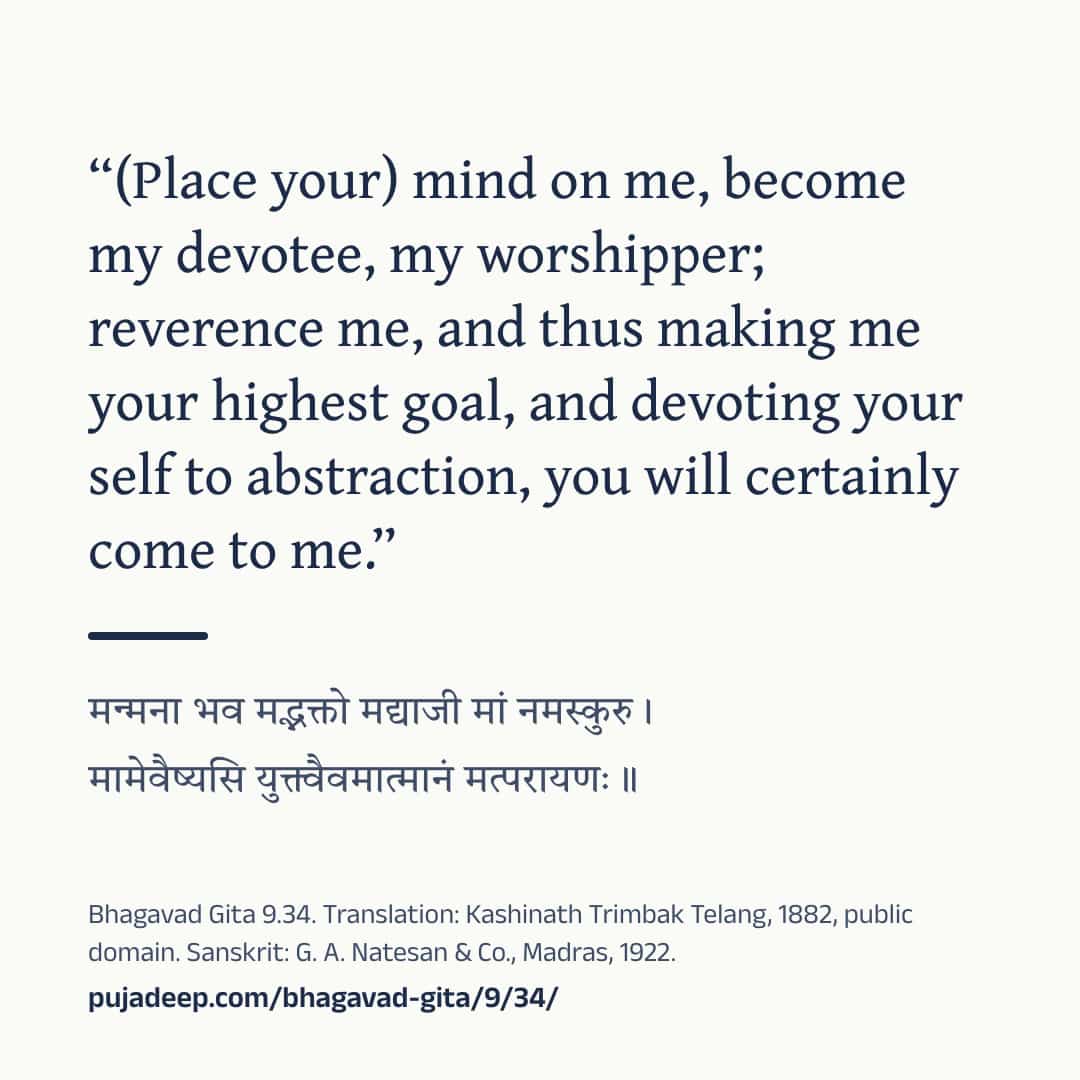
(Place your) mind on me, become my devotee, my worshipper; reverence me, and thus making me your highest goal, and devoting your self to abstraction, you will certainly come to me.
Compare 3 translations
Kashinath Trimbak Telang, 1882. Public domain. Page 86.
(Place your) mind on me, become my devotee, my worshipper; reverence me, and thus making me your highest goal, and devoting your self to abstraction, you will certainly come to me.
You are reading this one
Annie Besant, 1895. Public domain. Page 93–94.
On Me (fix) thy Manas; be devoted to Me; sacrifice to Me; prostrate thyself before Me; harmonised thus in the SELF, thou shalt come unto Me, being devoted to Me.
You are reading this one
Swami Swarupananda, 1909 (first printed 1907). Public domain. Page 192.
Fill thy mind with Me, be My devotee, sacrifice unto Me, bow down to Me; thus having made thy heart steadfast in Me, taking Me as the Supreme Goal, thou shalt come to Me.
You are reading this one
Cite this verse
The translation: K. T. Telang, The Bhagavadgîtâ (The Sacred Books of the East, vol. VIII, Oxford: Clarendon Press, 1882), p. 86. Bhagavad Gita 9.34.
The translation: Annie Besant, The Bhagavad Gîtâ, or The Lord's Song (London: Theosophical Publishing Society, 1895), pp. 93–94. Bhagavad Gita 9.34.
The translation: Swami Swarupananda, Srimad-Bhagavad-Gita (Mayavati: Prabuddha Bharata Press, 1909; first printed in Prabuddha Bharata, 1907–1909), p. 192. Bhagavad Gita 9.34.
Our explanation: “Bhagavad Gita 9.34: meaning and translation.” Pujadeep. Updated October 27, 2026. https://pujadeep.com/bhagavad-gita/9/34/
Pujadeep’s explanations are free to quote with credit: name Pujadeep and link to the page. How to credit
Classical readings, by school
Each reading is named by its school. None is presented as the only meaning.
What Advaita, Vishishtadvaita and Dvaita teach, in short
Shankara Advaita
Shankara says “Me” here is Vāsudeva, the Self of all beings and the supreme goal. Steadied in thought in this way, one reaches him, the Self.
Source: The Bhagavad-Gita, with the commentary of Sri Sankaracharya, translated by A. Mahadeva Sastri (2nd ed., Mysore: G. T. A. Printing Works, 1901), commentary on 9.34, p. 233. Summarised in our own words; none of its text is reproduced.
Ramanuja Vishishtadvaita
Ramanuja reads the verse as a summary of bhakti: the mind flows to the Lord without a break, like poured oil, dwelling on his qualities and form; worship becomes loving service, and bowing becomes humility. Doing all worldly and religious duties as service to him, one reaches him.
Source: Sri Bhagavad-Gita with Sri Ramanujacharya's Visishtadvaita commentary, translated by A. Govindacharya (Madras, 1898), commentary on 9.34, pp. 314–316. Summarised in our own words; none of its text is reproduced.
Share
Show the ways to share
Send one picture or the text to one chat. The picture names its source and the address of this page.
Drawing the picture
See the words
Bhagavad Gita 9.34

मन्मना भव मद्भक्तो मद्याजी मां नमस्कुरु ।
मामेवैष्यसि युक्त्वैवमात्मानं मत्परायणः ॥

“(Place your) mind on me, become my devotee, my worshipper; reverence me, and thus making me your highest goal, and devoting your self to abstraction, you will certainly come to me.”
(K. T. Telang, The Bhagavadgîtâ (The Sacred Books of the East, vol. VIII, Oxford: Clarendon Press, 1882), p. 86, public domain)

“On Me (fix) thy Manas; be devoted to Me; sacrifice to Me; prostrate thyself before Me; harmonised thus in the SELF, thou shalt come unto Me, being devoted to Me.”
(Annie Besant, The Bhagavad Gîtâ, or The Lord's Song (London: Theosophical Publishing Society, 1895), pp. 93–94, public domain)

“Fill thy mind with Me, be My devotee, sacrifice unto Me, bow down to Me; thus having made thy heart steadfast in Me, taking Me as the Supreme Goal, thou shalt come to Me.”
(Swami Swarupananda, Srimad-Bhagavad-Gita (Mayavati: Prabuddha Bharata Press, 1909; first printed in Prabuddha Bharata, 1907–1909), p. 192, public domain)

Sanskrit: G. A. Natesan & Co., Madras, 1922.
https://pujadeep.com/bhagavad-gita/9/34/ Nothing is sent from this site. Your own app sends it, to the chat you choose. The picture quotes the translation you chose on this page, with its name and year.
Sanskrit text: The Bhagavad-Gita, or The Lord's Song, with the text in Devanagari and an English translation, 1922. Meanings: written for Pujadeep and checked against the cited edition. Source and changes
Questions families ask
Who speaks Bhagavad Gita 9.34?
Krishna speaks this verse, in chapter 9 (Raja Vidya Raja Guhya Yoga).
Where does the Sanskrit text come from?
Sanskrit text: The Bhagavad-Gita, or The Lord's Song, with the text in Devanagari and an English translation, 1922. Meanings: written for Pujadeep and checked against the cited edition. See the source
Is the meaning on this page a translation?
Explanation written for this site from the sources listed here, and checked against the cited edition. It is not a translation and not the only way to read the text. Free to quote with credit.
Source and licence
- Sanskrit text
- The Bhagavad-Gita, or The Lord's Song, with the text in Devanagari and an English translation (Annie Besant, G. A. Natesan & Co., Madras, 1922). Public domain. The Sanskrit on these pages was read from this printing’s page images.
- Translation
- The Bhagavadgîtâ with the Sanatsugâtîya and the Anugîtâ, translated by Kâshinâth Trimbak Telang (The Sacred Books of the East, vol. VIII, ed. F. Max Müller) (Kashinath Trimbak Telang, F. Max Müller, Clarendon Press, Oxford, 1882). Public domain. Shown verbatim, as printed.
- Translation
- The Bhagavad Gîtâ, or The Lord's Song, translated by Annie Besant (Annie Besant, Theosophical Publishing Society, London, 1895). Public domain. Shown verbatim, as printed.
- Translation
- Srimad-Bhagavad-Gita, with Sanskrit Text; Paraphrase with Word-by-word Literal Translation; English Rendering and Comments, Index, &c., by the Swami Swarupananda (Himalayan Series, No. XX) (Swami Swarupananda, The Editors and Publishers, Advaita Ashrama, Mayavati, Prabuddha Bharata Press, Mayavati, Almora, Himalayas, 1909). Public domain. Shown verbatim, as printed.
- Commentary
- The Bhagavad-Gita, with the commentary of Sri Sankaracharya, translated by A. Mahadeva Sastri (2nd ed., Mysore: G. T. A. Printing Works, 1901) (Public-domain scan, University of California Libraries). Summarised in our own words; none of its text is reproduced.
- Commentary
- Sri Bhagavad-Gita with Sri Ramanujacharya's Visishtadvaita commentary, translated by A. Govindacharya (Madras, 1898) (Scan uploaded to archive.org (folkscanomy collection)). Summarised in our own words; none of its text is reproduced.
- Common wording
- In this text, 32 words follow today's common wording, checked against sanskritdocuments.org; Sanskrit Wikisource; Gita Press, Gorakhpur; GRETIL, Göttingen and Bhaktivedanta Book Trust.
- Our explanation
- Explanation written for this site from the sources listed here, and checked against the cited edition. It is not a translation and not the only way to read the text. Free to quote with credit.
- Checked
- Checked against the cited edition, October 15, 2026.
- Updated
- October 27, 2026