Bhagavad Gita 9.27: meaning and translation
Chapter 9: Raja Vidya Raja Guhya Yoga. Krishna says
Krishna tells Arjuna to make everything an offering to him: whatever he does, whatever he eats, whatever he offers in sacrifice, whatever he gives and whatever austerity he practises.
Click or tap a word for its meaning and its dictionary page.
Text and layers
Text and layers
These choices stay in this browser.
Bhagavad Gita 9.27
यत्करोषि यदश्नासि यज्जुहोषि ददासि यत् ।यत्तपस्यसि कौन्तेय तत्कुरुष्व मदर्पणम् ॥
Yatkaroshi yadashnasi yajjuhoshi dadasi yatYattapasyasi kaunteya tatkurushva madarpanam
yatkaroṣi yadaśnāsi yajjuhoṣi dadāsi yat |yattapasyasi kaunteya tatkuruṣva madarpaṇam ||
Our explanation Krishna tells Arjuna to make everything an offering to him: whatever he does, whatever he eats, whatever he offers in sacrifice, whatever he gives and whatever austerity he practises.
हिंदी अर्थ कृष्ण अर्जुन से कहते हैं कि वे जो कुछ करें, जो कुछ खाएँ, जो कुछ यज्ञ में अर्पित करें, जो कुछ दान दें और जो कुछ तप करें, वह सब उन्हें अर्पण के रूप में करें।
Word by word
Every word, with its dictionary page
Word by word
- यत् yat · whatever (relative pronoun (neuter), accusative singular) Dictionary: yad, Monier-Williams 1899, p. 844, col. 2 “who, which, what, whichever, whatever, that”
- करोषि karoṣi · you do (present, 2nd person singular) Dictionary: 1. kṛ, Monier-Williams 1899, p. 301, col. 1 “to do, make, perform, accomplish, cause, effect”
- यत् yat · whatever (relative pronoun (neuter), accusative singular) Dictionary: yad, Monier-Williams 1899, p. 844, col. 2 “who, which, what, whichever, whatever, that”
- अश्नासि aśnāsi · you eat (present, 2nd person singular) Dictionary: 2. aś, Monier-Williams 1899, p. 112, col. 2 “to eat, consume”
- यत् yat · whatever (relative pronoun (neuter), accusative singular) Dictionary: yad, Monier-Williams 1899, p. 844, col. 2 “who, which, what, whichever, whatever, that”
- जुहोषि juhoṣi · you offer (in the fire) (present, 2nd person singular) Dictionary: 1. hu, Monier-Williams 1899, p. 1301, col. 1 “to sacrifice (esp. pour butter into the fire), offer or present an oblation”
- ददासि dadāsi · you give (present, 2nd person singular) Dictionary: 1. dā, Monier-Williams 1899, p. 473, col. 3 “to give, bestow, grant”
- यत् yat · whatever (relative pronoun (neuter), accusative singular) Dictionary: yad, Monier-Williams 1899, p. 844, col. 2 “who, which, what, whichever, whatever, that”
- यत् yat · whatever (relative pronoun (neuter), accusative singular) Dictionary: yad, Monier-Williams 1899, p. 844, col. 2 “who, which, what, whichever, whatever, that”
- तपस्यसि tapasyasi · you practise austerity (present, 2nd person singular) Dictionary: 1. tapasya, Monier-Williams 1899, p. 437, col. 2 “to undergo religious austerities”
- कौन्तेय kaunteya · O son of Kunti (noun (masculine), vocative singular) Dictionary: kaunteya, Monier-Williams 1899, p. 316, col. 2 “metron. fr. Kuntī”
- तत् tat · that (pronoun (neuter), accusative singular) Dictionary: tad, Monier-Williams 1899, p. 434, col. 1 “m. he, f. she, n. it, that, this”
- कुरुष्व kuruṣva · make, do (imperative (middle), 2nd person singular) Dictionary: 1. kṛ, Monier-Williams 1899, p. 301, col. 1 “to do, make, perform, accomplish, cause, effect”
- मदर्पणम् madarpaṇam · an offering to "me" (compound (neuter), accusative singular) Dictionary: 1. mad, Monier-Williams 1899, p. 777, col. 2 “base of the first pers. pron. in the sg. number (esp. in comp.)”; arpaṇa, Monier-Williams 1899, p. 92, col. 3 “offering, delivering, consigning, entrusting”
Old translations
Kashinath Trimbak Telang, 1882. Public domain. Page 85.
Whatever you do, O son of Kuntî! whatever you eat, whatever sacrifice you make, whatever you give, whatever penance you perform, do that as offered to me1.
Footnotes (the translator’s own) - Cf. p. 55 supra, and other passages. ↩
Compare 3 translations
Kashinath Trimbak Telang, 1882. Public domain. Page 85.
Whatever you do, O son of Kuntî! whatever you eat, whatever sacrifice you make, whatever you give, whatever penance you perform, do that as offered to me1.
Footnotes (the translator’s own) - Cf. p. 55 supra, and other passages. ↩
You are reading this one
Annie Besant, 1895. Public domain. Page 92.
Whatsoever thou doest, whatsoever thou eatest, whatsoever thou offerest, whatsoever thou givest, whatsoever thou doest of austerity, O Kaunteya! do thou as an offering unto Me.
You are reading this one
Swami Swarupananda, 1909 (first printed 1907). Public domain. Page 189.
Whatever thou doest, whatever thou eatest, whatever thou offerest in sacrifice, whatever thou givest away, whatever austerity thou practisest, O son of Kunti, do that as an offering unto Me.
You are reading this one
Cite this verse
The translation: K. T. Telang, The Bhagavadgîtâ (The Sacred Books of the East, vol. VIII, Oxford: Clarendon Press, 1882), p. 85. Bhagavad Gita 9.27.
The translation: Annie Besant, The Bhagavad Gîtâ, or The Lord's Song (London: Theosophical Publishing Society, 1895), p. 92. Bhagavad Gita 9.27.
The translation: Swami Swarupananda, Srimad-Bhagavad-Gita (Mayavati: Prabuddha Bharata Press, 1909; first printed in Prabuddha Bharata, 1907–1909), p. 189. Bhagavad Gita 9.27.
Our explanation: “Bhagavad Gita 9.27: meaning and translation.” Pujadeep. Updated October 27, 2026. https://pujadeep.com/bhagavad-gita/9/27/
Pujadeep’s explanations are free to quote with credit: name Pujadeep and link to the page. How to credit
Classical readings, by school
No readings by school on this verse yet.
Share
Show the ways to share
Send one picture or the text to one chat. The picture names its source and the address of this page.
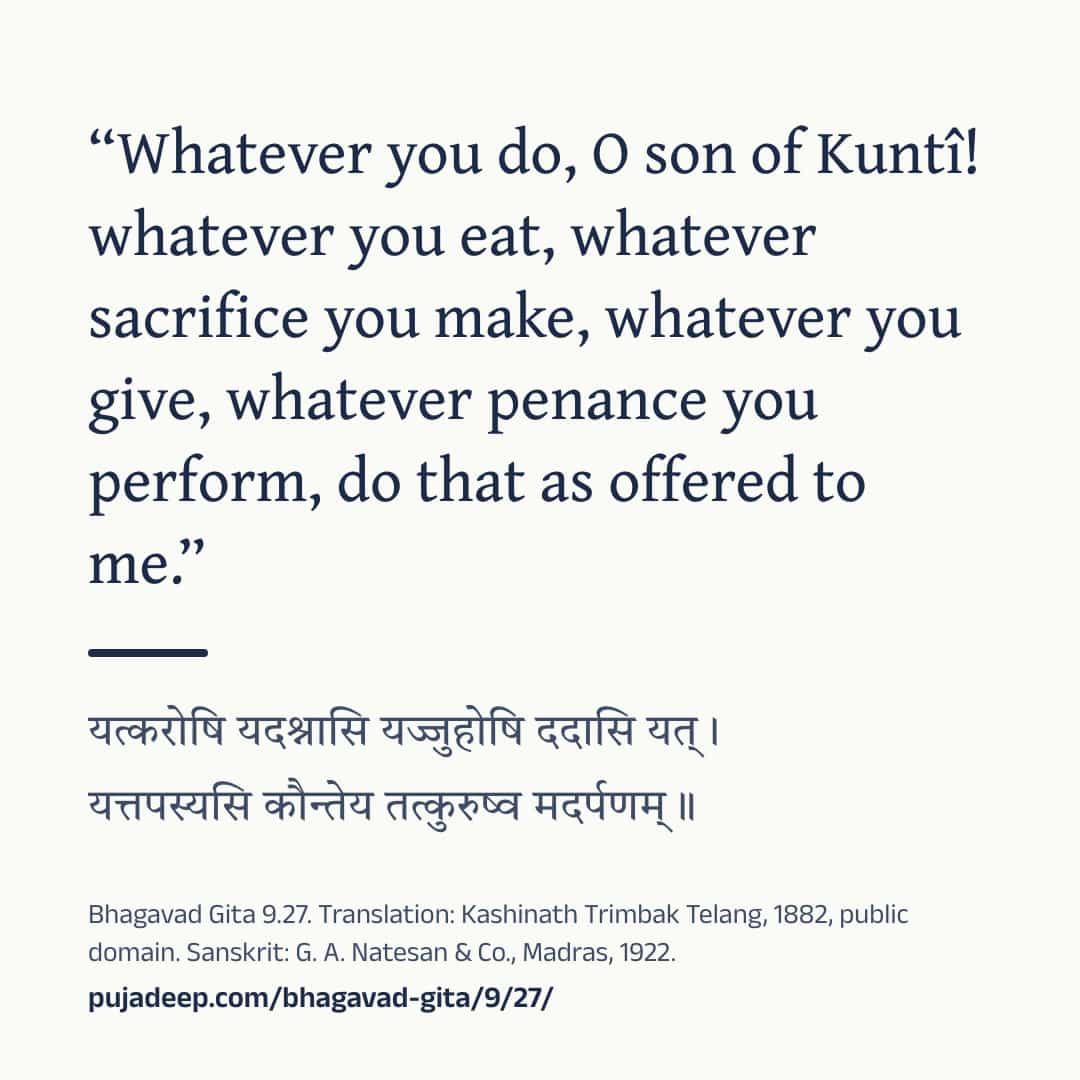
Drawing the picture
See the words
Bhagavad Gita 9.27

यत्करोषि यदश्नासि यज्जुहोषि ददासि यत् ।
यत्तपस्यसि कौन्तेय तत्कुरुष्व मदर्पणम् ॥

“Whatever you do, O son of Kuntî! whatever you eat, whatever sacrifice you make, whatever you give, whatever penance you perform, do that as offered to me.”
(K. T. Telang, The Bhagavadgîtâ (The Sacred Books of the East, vol. VIII, Oxford: Clarendon Press, 1882), p. 85, public domain)

“Whatsoever thou doest, whatsoever thou eatest, whatsoever thou offerest, whatsoever thou givest, whatsoever thou doest of austerity, O Kaunteya! do thou as an offering unto Me.”
(Annie Besant, The Bhagavad Gîtâ, or The Lord's Song (London: Theosophical Publishing Society, 1895), p. 92, public domain)

“Whatever thou doest, whatever thou eatest, whatever thou offerest in sacrifice, whatever thou givest away, whatever austerity thou practisest, O son of Kunti, do that as an offering unto Me.”
(Swami Swarupananda, Srimad-Bhagavad-Gita (Mayavati: Prabuddha Bharata Press, 1909; first printed in Prabuddha Bharata, 1907–1909), p. 189, public domain)

Sanskrit: G. A. Natesan & Co., Madras, 1922.
https://pujadeep.com/bhagavad-gita/9/27/ Nothing is sent from this site. Your own app sends it, to the chat you choose. The picture quotes the translation you chose on this page, with its name and year.
Sanskrit text: The Bhagavad-Gita, or The Lord's Song, with the text in Devanagari and an English translation, 1922. Meanings: written for Pujadeep and checked against the cited edition. Source and changes
Questions families ask
Who speaks Bhagavad Gita 9.27?
Krishna speaks this verse, in chapter 9 (Raja Vidya Raja Guhya Yoga).
Where does the Sanskrit text come from?
Sanskrit text: The Bhagavad-Gita, or The Lord's Song, with the text in Devanagari and an English translation, 1922. Meanings: written for Pujadeep and checked against the cited edition. See the source
Is the meaning on this page a translation?
Explanation written for this site from the sources listed here, and checked against the cited edition. It is not a translation and not the only way to read the text. Free to quote with credit.
Source and licence
- Sanskrit text
- The Bhagavad-Gita, or The Lord's Song, with the text in Devanagari and an English translation (Annie Besant, G. A. Natesan & Co., Madras, 1922). Public domain. The Sanskrit on these pages was read from this printing’s page images.
- Translation
- The Bhagavadgîtâ with the Sanatsugâtîya and the Anugîtâ, translated by Kâshinâth Trimbak Telang (The Sacred Books of the East, vol. VIII, ed. F. Max Müller) (Kashinath Trimbak Telang, F. Max Müller, Clarendon Press, Oxford, 1882). Public domain. Shown verbatim, as printed.
- Translation
- The Bhagavad Gîtâ, or The Lord's Song, translated by Annie Besant (Annie Besant, Theosophical Publishing Society, London, 1895). Public domain. Shown verbatim, as printed.
- Translation
- Srimad-Bhagavad-Gita, with Sanskrit Text; Paraphrase with Word-by-word Literal Translation; English Rendering and Comments, Index, &c., by the Swami Swarupananda (Himalayan Series, No. XX) (Swami Swarupananda, The Editors and Publishers, Advaita Ashrama, Mayavati, Prabuddha Bharata Press, Mayavati, Almora, Himalayas, 1909). Public domain. Shown verbatim, as printed.
- Common wording
- In this text, 32 words follow today's common wording, checked against sanskritdocuments.org; Sanskrit Wikisource; Gita Press, Gorakhpur; GRETIL, Göttingen and Bhaktivedanta Book Trust.
- Our explanation
- Explanation written for this site from the sources listed here, and checked against the cited edition. It is not a translation and not the only way to read the text. Free to quote with credit.
- Checked
- Checked against the cited edition, October 15, 2026.
- Updated
- October 27, 2026