Bhagavad Gita 9.17: meaning and translation
Chapter 9: Raja Vidya Raja Guhya Yoga. Krishna says
Krishna says that he is the father of this world, its mother, its supporter (dhātā) and its grandsire.
Click or tap a word for its meaning and its dictionary page.
Text and layers
Text and layers
These choices stay in this browser.
Bhagavad Gita 9.17
पिताऽहमस्य जगतो माता धाता पितामहः ।वेद्यं पवित्रमोङ्कार ऋक् साम यजुरेव च ॥
Pitahamasya jagato mata dhata pitamahahVedyam pavitramonkara rik sama yajureva cha
pitā’hamasya jagato mātā dhātā pitāmahaḥ |vedyaṃ pavitramoṅkāra ṛk sāma yajureva ca ||
Our explanation Krishna says that he is the father of this world, its mother, its supporter (dhātā) and its grandsire. He is what is to be known, the purifier, the sacred syllable Om, and the three Vedas, Ṛk, Sāman and Yajus.
हिंदी अर्थ कृष्ण कहते हैं कि वे इस जगत के पिता, माता, धाता (धारण करने वाले) और पितामह हैं। वे ही जानने योग्य हैं, पवित्र करने वाले हैं, ओंकार हैं, और तीनों वेद, ऋग्, साम और यजुः, भी वही हैं।
Word by word
Every word, with its dictionary page
Word by word
- पिता pitā · father (noun (masculine), nominative singular) Dictionary: pitṛ, Monier-Williams 1899, p. 626, col. 2 “the fathers, forefathers, ancestors”
- अहम् aham · "I" (Krishna) (pronoun, nominative singular) Dictionary: aham, Monier-Williams 1899, p. 124, col. 2 “nom. sg. ‘I,’”
- अस्य asya · of this (pronoun (neuter), genitive singular) Dictionary: 1. idam, Monier-Williams 1899, p. 165, col. 2
- जगतः jagataḥ · of the world (noun (neuter), genitive singular) Dictionary: jagat, Monier-Williams 1899, p. 408, col. 1 “the world, esp. this world, earth”
- माता mātā · mother (noun (feminine), nominative singular) Dictionary: 2. mātṛ, Monier-Williams 1899, p. 807, col. 1 “a mother”
- धाता dhātā · supporter, ordainer (noun (masculine), nominative singular) Dictionary: dhātṛ, Monier-Williams 1899, p. 514, col. 1 “establisher, founder, creator, bearer, supporter”
- पितामहः pitāmahaḥ · grandfather (noun (masculine), nominative singular) Dictionary: pitā-maha, Monier-Williams 1899, p. 627, col. 1 “a paternal grandfather”
- वेद्यम् vedyam · what is to be known (gerundive (to be known), nominative singular) Dictionary: 1. vedya, Monier-Williams 1899, p. 1017, col. 2 “to be learnt or known or understood”
- पवित्रम् pavitram · the purifier (noun (neuter), nominative singular) Dictionary: pavitra, Monier-Williams 1899, p. 611, col. 1 “a means of purification”
- ओङ्कारः oṅkāraḥ · the syllable Om (compound (masculine), nominative singular) Dictionary: om-kāra, Monier-Williams 1899, p. 236, col. 1 “the sacred and mystical syllable om”
- ऋक् ṛk · the Rig Veda (verses) (noun (feminine), nominative singular) Dictionary: 2. ṛc, Monier-Williams 1899, p. 225, col. 1
- साम sāma · the Sama Veda (chants) (noun (neuter), nominative singular) Dictionary: 3. sāman, Monier-Williams 1899, p. 1205, col. 1 “a metrical hymn or song of praise”
- यजुः yajuḥ · the Yajur Veda (noun (neuter), nominative singular) Dictionary: yajus, Monier-Williams 1899, p. 839, col. 2 “N. of the Yajur-veda”
- एव eva · indeed (indeclinable) Dictionary: 1. eva, Monier-Williams 1899, p. 232, col. 2 “so, just so, exactly so; indeed, truly, really”
- च ca · and (indeclinable) Dictionary: 2. ca, Monier-Williams 1899, p. 380, col. 1 “and, both, also, moreover, as well as”
1 printing differs
Edition differences. Another printing or text reads this place differently.
- Spelling A digital text reads Same words. The 1922 edition writes avagraha in पिताऽहम् and prints ऋक् साम as two words; the e-text writes पिताहम् and ऋक्साम. Another digital text writes pitāham and divides ṛk sāma like the edition.
Old translations
Kashinath Trimbak Telang, 1882. Public domain. Page 83.
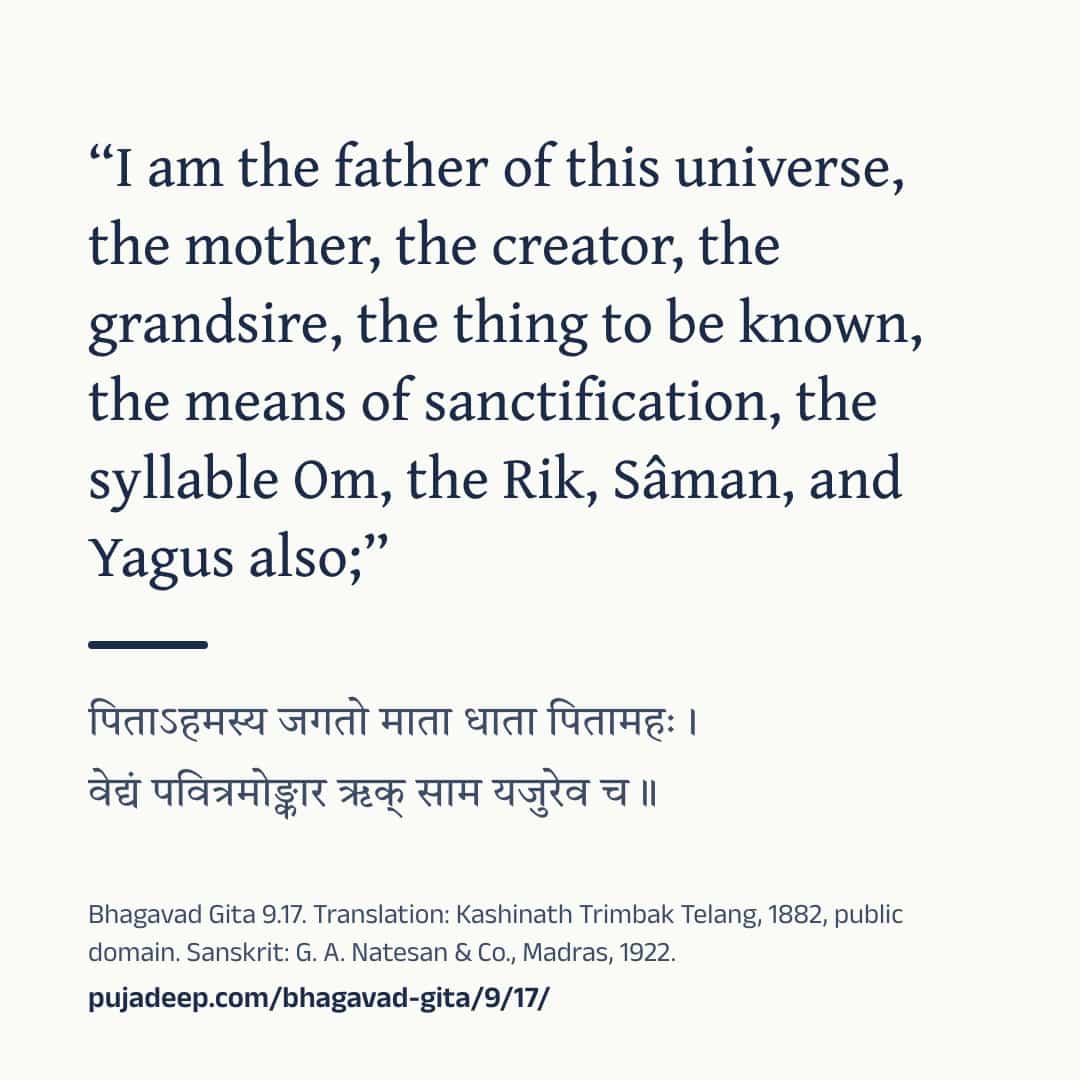
I am the father of this universe, the mother, the creator, the grandsire, the thing to be known, the means of sanctification, the syllable Om1, the Rik, Sâman, and Yagus also;
This sentence goes on in 9.18.
Footnotes (the translator’s own) - P. 79 supra. ↩
Compare 3 translations
Kashinath Trimbak Telang, 1882. Public domain. Page 83.
I am the father of this universe, the mother, the creator, the grandsire, the thing to be known, the means of sanctification, the syllable Om1, the Rik, Sâman, and Yagus also;
This sentence goes on in 9.18.
Footnotes (the translator’s own) - P. 79 supra. ↩
You are reading this one
Annie Besant, 1895. Public domain. Page 90.
I the Father of this universe, the Mother, the Supporter, the Grandsire; the One Purifier to be known, the Omkâra, and also the Rig, Sâma, and Yajur;
This sentence begins in 9.16. This sentence goes on in 9.18.
You are reading this one
Swami Swarupananda, 1909 (first printed 1907). Public domain. Page 183.
I am the Father of this world, the Mother, the Sustainer, the Grandfather; the Purifier, (the one thing) to be known, (the syllable) Om, and also the Rik, Sâman and Yajus.
You are reading this one
Cite this verse
The translation: K. T. Telang, The Bhagavadgîtâ (The Sacred Books of the East, vol. VIII, Oxford: Clarendon Press, 1882), p. 83. Bhagavad Gita 9.17.
The translation: Annie Besant, The Bhagavad Gîtâ, or The Lord's Song (London: Theosophical Publishing Society, 1895), p. 90. Bhagavad Gita 9.17.
The translation: Swami Swarupananda, Srimad-Bhagavad-Gita (Mayavati: Prabuddha Bharata Press, 1909; first printed in Prabuddha Bharata, 1907–1909), p. 183. Bhagavad Gita 9.17.
Our explanation: “Bhagavad Gita 9.17: meaning and translation.” Pujadeep. Updated October 27, 2026. https://pujadeep.com/bhagavad-gita/9/17/
Pujadeep’s explanations are free to quote with credit: name Pujadeep and link to the page. How to credit
Classical readings, by school
No readings by school on this verse yet.
Share
Show the ways to share
Send one picture or the text to one chat. The picture names its source and the address of this page.
Drawing the picture
See the words
Bhagavad Gita 9.17

पिताऽहमस्य जगतो माता धाता पितामहः ।
वेद्यं पवित्रमोङ्कार ऋक् साम यजुरेव च ॥

“I am the father of this universe, the mother, the creator, the grandsire, the thing to be known, the means of sanctification, the syllable Om, the Rik, Sâman, and Yagus also;”
(K. T. Telang, The Bhagavadgîtâ (The Sacred Books of the East, vol. VIII, Oxford: Clarendon Press, 1882), p. 83, public domain)
This sentence goes on in 9.18.

“I the Father of this universe, the Mother, the Supporter, the Grandsire; the One Purifier to be known, the Omkâra, and also the Rig, Sâma, and Yajur;”
(Annie Besant, The Bhagavad Gîtâ, or The Lord's Song (London: Theosophical Publishing Society, 1895), p. 90, public domain)
This sentence begins in 9.16. This sentence goes on in 9.18.

“I am the Father of this world, the Mother, the Sustainer, the Grandfather; the Purifier, (the one thing) to be known, (the syllable) Om, and also the Rik, Sâman and Yajus.”
(Swami Swarupananda, Srimad-Bhagavad-Gita (Mayavati: Prabuddha Bharata Press, 1909; first printed in Prabuddha Bharata, 1907–1909), p. 183, public domain)

Sanskrit: G. A. Natesan & Co., Madras, 1922.
https://pujadeep.com/bhagavad-gita/9/17/ Nothing is sent from this site. Your own app sends it, to the chat you choose. The picture quotes the translation you chose on this page, with its name and year.
Sanskrit text: The Bhagavad-Gita, or The Lord's Song, with the text in Devanagari and an English translation, 1922. Meanings: written for Pujadeep and checked against the cited edition. Source and changes
Questions families ask
Who speaks Bhagavad Gita 9.17?
Krishna speaks this verse, in chapter 9 (Raja Vidya Raja Guhya Yoga).
Where does the Sanskrit text come from?
Sanskrit text: The Bhagavad-Gita, or The Lord's Song, with the text in Devanagari and an English translation, 1922. Meanings: written for Pujadeep and checked against the cited edition. See the source
Is the meaning on this page a translation?
Explanation written for this site from the sources listed here, and checked against the cited edition. It is not a translation and not the only way to read the text. Free to quote with credit.
Source and licence
- Sanskrit text
- The Bhagavad-Gita, or The Lord's Song, with the text in Devanagari and an English translation (Annie Besant, G. A. Natesan & Co., Madras, 1922). Public domain. The Sanskrit on these pages was read from this printing’s page images.
- Translation
- The Bhagavadgîtâ with the Sanatsugâtîya and the Anugîtâ, translated by Kâshinâth Trimbak Telang (The Sacred Books of the East, vol. VIII, ed. F. Max Müller) (Kashinath Trimbak Telang, F. Max Müller, Clarendon Press, Oxford, 1882). Public domain. Shown verbatim, as printed.
- Translation
- The Bhagavad Gîtâ, or The Lord's Song, translated by Annie Besant (Annie Besant, Theosophical Publishing Society, London, 1895). Public domain. Shown verbatim, as printed.
- Translation
- Srimad-Bhagavad-Gita, with Sanskrit Text; Paraphrase with Word-by-word Literal Translation; English Rendering and Comments, Index, &c., by the Swami Swarupananda (Himalayan Series, No. XX) (Swami Swarupananda, The Editors and Publishers, Advaita Ashrama, Mayavati, Prabuddha Bharata Press, Mayavati, Almora, Himalayas, 1909). Public domain. Shown verbatim, as printed.
- Common wording
- In this text, 32 words follow today's common wording, checked against sanskritdocuments.org; Sanskrit Wikisource; Gita Press, Gorakhpur; GRETIL, Göttingen and Bhaktivedanta Book Trust.
- Our explanation
- Explanation written for this site from the sources listed here, and checked against the cited edition. It is not a translation and not the only way to read the text. Free to quote with credit.
- Checked
- Checked against the cited edition, October 15, 2026.
- Updated
- October 27, 2026