Bhagavad Gita 9.16: meaning and translation
Chapter 9: Raja Vidya Raja Guhya Yoga. Krishna says
Krishna names every part of the Vedic rite as himself: the ritual (kratu), the sacrifice (yajña), the offering to the ancestors (svadhā), the healing herb or grain (auṣadha), the sacred verse (mantra), the clarified butter, the fire and the act of offering.
Click or tap a word for its meaning and its dictionary page.
Text and layers
Text and layers
These choices stay in this browser.
Bhagavad Gita 9.16
अहं क्रतुरहं यज्ञः स्वधाऽहमहमौषधम् ।मन्त्रोऽहमहमेवाज्यमहमग्निरहं हुतम् ॥
Aham kraturaham yajnah svadhahamahamaushadhamMantrohamahamevajyamahamagniraham hutam
ahaṃ kraturahaṃ yajñaḥ svadhā’hamahamauṣadham |mantro’hamahamevājyamahamagnirahaṃ hutam ||
Our explanation Krishna names every part of the Vedic rite as himself: the ritual (kratu), the sacrifice (yajña), the offering to the ancestors (svadhā), the healing herb or grain (auṣadha), the sacred verse (mantra), the clarified butter, the fire and the act of offering.
हिंदी अर्थ कृष्ण वैदिक यज्ञ के हर अंग को अपना रूप बताते हैं: क्रतु (वैदिक अनुष्ठान), यज्ञ, स्वधा (पितरों को दी जाने वाली आहुति), औषध (जड़ी-बूटी या अन्न), मंत्र, घी, अग्नि और आहुति देने की क्रिया।
Word by word
Every word, with its dictionary page
Word by word
- अहम् aham · "I" (Krishna) (pronoun, nominative singular) Dictionary: aham, Monier-Williams 1899, p. 124, col. 2 “nom. sg. ‘I,’”
- क्रतुः kratuḥ · the Vedic rite (noun (masculine), nominative singular) Dictionary: kratu, Monier-Williams 1899, p. 319, col. 1 “a sacrificial rite or ceremony, sacrifice”
- अहम् aham · "I" (Krishna) (pronoun, nominative singular) Dictionary: aham, Monier-Williams 1899, p. 124, col. 2 “nom. sg. ‘I,’”
- यज्ञः yajñaḥ · the sacrifice (noun (masculine), nominative singular) Dictionary: yajña, Monier-Williams 1899, p. 839, col. 2 “act of worship or devotion, offering, oblation, sacrifice”
- स्वधा svadhā · the offering to the ancestors (noun (feminine), nominative singular) Dictionary: sva-dhā, Monier-Williams 1899, p. 1278, col. 1 “offered to the Pitṛis or spirits of deceased ancestors”
- अहम् aham · "I" (Krishna) (pronoun, nominative singular) Dictionary: aham, Monier-Williams 1899, p. 124, col. 2 “nom. sg. ‘I,’”
- अहम् aham · "I" (Krishna) (pronoun, nominative singular) Dictionary: aham, Monier-Williams 1899, p. 124, col. 2 “nom. sg. ‘I,’”
- औषधम् auṣadham · the herb (food or healing) (noun (neuter), nominative singular) Dictionary: auṣadha, Monier-Williams 1899, p. 240, col. 2 “herbs collectively, a herb”
- मन्त्रः mantraḥ · the sacred verse (noun (masculine), nominative singular) Dictionary: mantra, Monier-Williams 1899, p. 786, col. 1 “a sacred formula addressed to any individual deity (e.g. Om Śivāya namaḥ)”
- अहम् aham · "I" (Krishna) (pronoun, nominative singular) Dictionary: aham, Monier-Williams 1899, p. 124, col. 2 “nom. sg. ‘I,’”
- अहम् aham · "I" (Krishna) (pronoun, nominative singular) Dictionary: aham, Monier-Williams 1899, p. 124, col. 2 “nom. sg. ‘I,’”
- एव eva · indeed (indeclinable) Dictionary: 1. eva, Monier-Williams 1899, p. 232, col. 2 “so, just so, exactly so; indeed, truly, really”
- आज्यम् ājyam · the clarified butter (noun (neuter), nominative singular) Dictionary: 2. ājya, Monier-Williams 1899, p. 133, col. 2 “melted or clarified butter”
- अहम् aham · "I" (Krishna) (pronoun, nominative singular) Dictionary: aham, Monier-Williams 1899, p. 124, col. 2 “nom. sg. ‘I,’”
- अग्निः agniḥ · the fire (noun (masculine), nominative singular) Dictionary: agni, Monier-Williams 1899, p. 5, col. 1 “fire; sacrificial fire”
- अहम् aham · "I" (Krishna) (pronoun, nominative singular) Dictionary: aham, Monier-Williams 1899, p. 124, col. 2 “nom. sg. ‘I,’”
- हुतम् hutam · the offering made (past participle as noun, nominative singular) Dictionary: huta, Monier-Williams 1899, p. 1301, col. 1 “offered in fire, poured out (as clarified butter)”
1 printing differs
Edition differences. Another printing or text reads this place differently.
- Spelling A digital text reads Same words. The 1922 edition writes avagraha in स्वधाऽहम्; the e-text writes स्वधाहम्, as another digital text does (svadhāham).
Old translations
Kashinath Trimbak Telang, 1882. Public domain. Page 83.
I am the Kratu1, I am the Yagña, I am the Svadhâ, I the product of the herbs. I am the sacred verse. I too am the sacrificial butter, and I the fire, I the offering2.
Footnotes (the translator’s own) Compare 3 translations
Kashinath Trimbak Telang, 1882. Public domain. Page 83.
I am the Kratu1, I am the Yagña, I am the Svadhâ, I the product of the herbs. I am the sacred verse. I too am the sacrificial butter, and I the fire, I the offering2.
Footnotes (the translator’s own) You are reading this one
Annie Besant, 1895. Public domain. Page 90.
I the oblation; I the sacrifice; I the ancestral offering; I the fire-giving herb; the Mantram I; I also the butter; I the fire; I the burnt-offering;
This sentence goes on in 9.17.
You are reading this one
Swami Swarupananda, 1909 (first printed 1907). Public domain. Page 183.
I am the Kratu, I the Yajna, I the Svadhâ, I the Aushadham, I the Mantra, I the Ajyam, I the fire, and I the oblation.
You are reading this one
Cite this verse
The translation: K. T. Telang, The Bhagavadgîtâ (The Sacred Books of the East, vol. VIII, Oxford: Clarendon Press, 1882), p. 83. Bhagavad Gita 9.16.
The translation: Annie Besant, The Bhagavad Gîtâ, or The Lord's Song (London: Theosophical Publishing Society, 1895), p. 90. Bhagavad Gita 9.16.
The translation: Swami Swarupananda, Srimad-Bhagavad-Gita (Mayavati: Prabuddha Bharata Press, 1909; first printed in Prabuddha Bharata, 1907–1909), p. 183. Bhagavad Gita 9.16.
Our explanation: “Bhagavad Gita 9.16: meaning and translation.” Pujadeep. Updated October 27, 2026. https://pujadeep.com/bhagavad-gita/9/16/
Pujadeep’s explanations are free to quote with credit: name Pujadeep and link to the page. How to credit
Classical readings, by school
No readings by school on this verse yet.
Share
Show the ways to share
Send one picture or the text to one chat. The picture names its source and the address of this page.
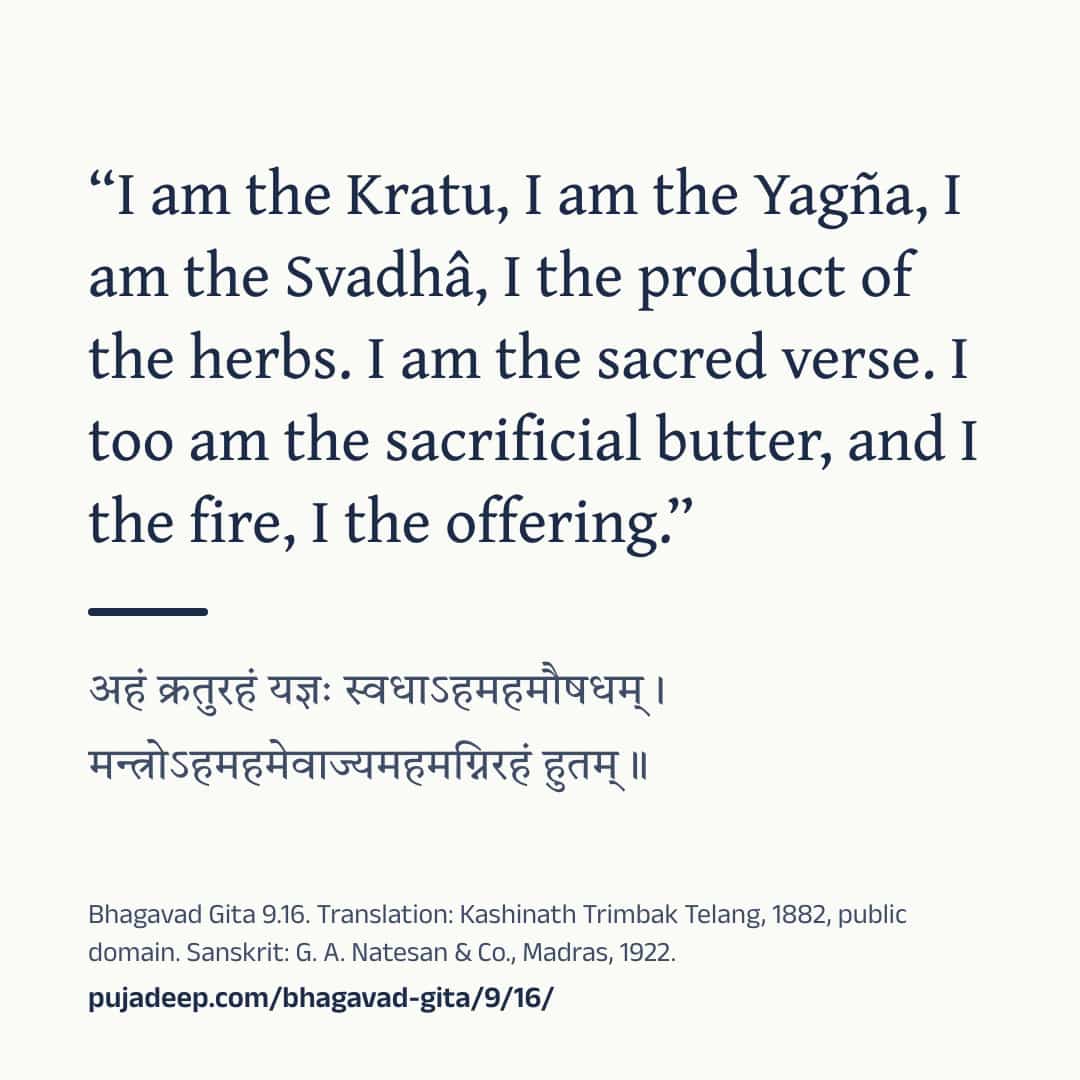
Drawing the picture
See the words
Bhagavad Gita 9.16

अहं क्रतुरहं यज्ञः स्वधाऽहमहमौषधम् ।
मन्त्रोऽहमहमेवाज्यमहमग्निरहं हुतम् ॥

“I am the Kratu, I am the Yagña, I am the Svadhâ, I the product of the herbs. I am the sacred verse. I too am the sacrificial butter, and I the fire, I the offering.”
(K. T. Telang, The Bhagavadgîtâ (The Sacred Books of the East, vol. VIII, Oxford: Clarendon Press, 1882), p. 83, public domain)

“I the oblation; I the sacrifice; I the ancestral offering; I the fire-giving herb; the Mantram I; I also the butter; I the fire; I the burnt-offering;”
(Annie Besant, The Bhagavad Gîtâ, or The Lord's Song (London: Theosophical Publishing Society, 1895), p. 90, public domain)
This sentence goes on in 9.17.

“I am the Kratu, I the Yajna, I the Svadhâ, I the Aushadham, I the Mantra, I the Ajyam, I the fire, and I the oblation.”
(Swami Swarupananda, Srimad-Bhagavad-Gita (Mayavati: Prabuddha Bharata Press, 1909; first printed in Prabuddha Bharata, 1907–1909), p. 183, public domain)

Sanskrit: G. A. Natesan & Co., Madras, 1922.
https://pujadeep.com/bhagavad-gita/9/16/ Nothing is sent from this site. Your own app sends it, to the chat you choose. The picture quotes the translation you chose on this page, with its name and year.
Sanskrit text: The Bhagavad-Gita, or The Lord's Song, with the text in Devanagari and an English translation, 1922. Meanings: written for Pujadeep and checked against the cited edition. Source and changes
Questions families ask
Who speaks Bhagavad Gita 9.16?
Krishna speaks this verse, in chapter 9 (Raja Vidya Raja Guhya Yoga).
Where does the Sanskrit text come from?
Sanskrit text: The Bhagavad-Gita, or The Lord's Song, with the text in Devanagari and an English translation, 1922. Meanings: written for Pujadeep and checked against the cited edition. See the source
Is the meaning on this page a translation?
Explanation written for this site from the sources listed here, and checked against the cited edition. It is not a translation and not the only way to read the text. Free to quote with credit.
Source and licence
- Sanskrit text
- The Bhagavad-Gita, or The Lord's Song, with the text in Devanagari and an English translation (Annie Besant, G. A. Natesan & Co., Madras, 1922). Public domain. The Sanskrit on these pages was read from this printing’s page images.
- Translation
- The Bhagavadgîtâ with the Sanatsugâtîya and the Anugîtâ, translated by Kâshinâth Trimbak Telang (The Sacred Books of the East, vol. VIII, ed. F. Max Müller) (Kashinath Trimbak Telang, F. Max Müller, Clarendon Press, Oxford, 1882). Public domain. Shown verbatim, as printed.
- Translation
- The Bhagavad Gîtâ, or The Lord's Song, translated by Annie Besant (Annie Besant, Theosophical Publishing Society, London, 1895). Public domain. Shown verbatim, as printed.
- Translation
- Srimad-Bhagavad-Gita, with Sanskrit Text; Paraphrase with Word-by-word Literal Translation; English Rendering and Comments, Index, &c., by the Swami Swarupananda (Himalayan Series, No. XX) (Swami Swarupananda, The Editors and Publishers, Advaita Ashrama, Mayavati, Prabuddha Bharata Press, Mayavati, Almora, Himalayas, 1909). Public domain. Shown verbatim, as printed.
- Common wording
- In this text, 32 words follow today's common wording, checked against sanskritdocuments.org; Sanskrit Wikisource; Gita Press, Gorakhpur; GRETIL, Göttingen and Bhaktivedanta Book Trust.
- Our explanation
- Explanation written for this site from the sources listed here, and checked against the cited edition. It is not a translation and not the only way to read the text. Free to quote with credit.
- Checked
- Checked against the cited edition, October 15, 2026.
- Updated
- October 27, 2026