Bhagavad Gita 9.11: meaning and translation
Chapter 9: Raja Vidya Raja Guhya Yoga. Krishna says
Krishna says that the deluded look down on him because he has taken a human body.
Click or tap a word for its meaning and its dictionary page.
Text and layers
Text and layers
These choices stay in this browser.
Bhagavad Gita 9.11
अवजानन्ति मां मूढा मानुषीं तनुमाश्रितम् ।परं भावमजानन्तो मम भूतमहेश्वरम् ॥
Avajananti mam mudha manushim tanumashritamParam bhavamajananto mama bhutamaheshvaram
avajānanti māṃ mūḍhā mānuṣīṃ tanumāśritam |paraṃ bhāvamajānanto mama bhūtamaheśvaram ||
Our explanation Krishna says that the deluded look down on him because he has taken a human body. They do not know his higher nature as the great Lord of all beings. The sentence continues in the next verse.
हिंदी अर्थ कृष्ण कहते हैं कि मूढ़ लोग उन्हें मनुष्य-शरीर धारण किए देखकर उनकी अवहेलना करते हैं। वे उनके परम भाव को, कि वे सब प्राणियों के महान ईश्वर हैं, नहीं जानते। यह वाक्य अगले श्लोक में पूरा होता है।
Word by word
Every word, with its dictionary page
Word by word
- अवजानन्ति avajānanti · look down on (present, 3rd person plural) Dictionary: 1. ava-jñā, Monier-Williams 1899, p. 98, col. 2 “to disesteem, have a low opinion of, despise, treat with contempt”
- माम् mām · "me" (Krishna) (pronoun, accusative singular) Dictionary: 1. mad, Monier-Williams 1899, p. 777, col. 2 “base of the first pers. pron. in the sg. number (esp. in comp.)”
- मूढाः mūḍhāḥ · the deluded (adjective (masculine), nominative plural) Dictionary: mūḍha, Monier-Williams 1899, p. 825, col. 2 “stupefied, bewildered, perplexed, confused”
- मानुषीम् mānuṣīm · human (adjective (feminine), accusative singular) Dictionary: mānuṣa, Monier-Williams 1899, p. 810, col. 2 “belonging to mankind, human”
- तनुम् tanum · body (noun (feminine), accusative singular) Dictionary: tanu, Monier-Williams 1899, p. 435, col. 2 “the body, person, self”
- आश्रितम् āśritam · who has taken (past participle (masculine), accusative singular) Dictionary: ā-śrita, Monier-Williams 1899, p. 158, col. 3 “inhabiting, dwelling in, resting on”
- परम् param · higher (adjective (masculine), accusative singular) Dictionary: 1. para, Monier-Williams 1899, p. 586, col. 1 “highest, supreme, chief”
- भावम् bhāvam · nature, being (noun (masculine), accusative singular) Dictionary: bhāva, Monier-Williams 1899, p. 754, col. 1 “becoming, being”
- अजानन्तः ajānantaḥ · not knowing (negative present participle (masculine), nominative plural) Dictionary: a-jānat, Monier-Williams 1899, p. 10, col. 1 “not knowing, unaware”
- मम mama · "my" (pronoun, genitive singular) Dictionary: 1. mad, Monier-Williams 1899, p. 777, col. 2 “base of the first pers. pron. in the sg. number (esp. in comp.)”
- भूतमहेश्वरम् bhūtamaheśvaram · great lord of beings (compound (masculine), accusative singular) Dictionary: bhūta, Monier-Williams 1899, p. 761, col. 3 “that which is or exists, any living being”; maheśvara, Monier-Williams 1899, p. 802, col. 2 “a great lord, sovereign, chief”
Old translations
Kashinath Trimbak Telang, 1882. Public domain. Page 82–83.
Deluded people of vain hopes, vain acts, vain knowledge1, whose minds are disordered, and who are inclined to the delusive nature of Asuras and Râkshasas, not knowing my highest nature as great lord of all entities, disregard me as I have assumed a human body2.
This sentence covers verses 9.11 to 9.12.
Footnotes (the translator’s own) Compare 3 translations
Kashinath Trimbak Telang, 1882. Public domain. Page 82–83.
Deluded people of vain hopes, vain acts, vain knowledge1, whose minds are disordered, and who are inclined to the delusive nature of Asuras and Râkshasas, not knowing my highest nature as great lord of all entities, disregard me as I have assumed a human body2.
This sentence covers verses 9.11 to 9.12.
Footnotes (the translator’s own) You are reading this one
Annie Besant, 1895. Public domain. Page 89.
The foolish disregard Me, when clad in human semblance, ignoring my higher nature, the Great Lord of beings;
This sentence goes on in 9.12.
You are reading this one
Swami Swarupananda, 1909 (first printed 1907). Public domain. Page 180.
Unaware of My higher state, as the great Lord of beings, fools disregard Me, dwelling in the human form.
You are reading this one
Cite this verse
The translation: K. T. Telang, The Bhagavadgîtâ (The Sacred Books of the East, vol. VIII, Oxford: Clarendon Press, 1882), pp. 82–83. Bhagavad Gita 9.11–12.
The translation: Annie Besant, The Bhagavad Gîtâ, or The Lord's Song (London: Theosophical Publishing Society, 1895), p. 89. Bhagavad Gita 9.11.
The translation: Swami Swarupananda, Srimad-Bhagavad-Gita (Mayavati: Prabuddha Bharata Press, 1909; first printed in Prabuddha Bharata, 1907–1909), p. 180. Bhagavad Gita 9.11.
Our explanation: “Bhagavad Gita 9.11: meaning and translation.” Pujadeep. Updated October 27, 2026. https://pujadeep.com/bhagavad-gita/9/11/
Pujadeep’s explanations are free to quote with credit: name Pujadeep and link to the page. How to credit
Classical readings, by school
Each reading is named by its school. None is presented as the only meaning.
What Advaita, Vishishtadvaita and Dvaita teach, in short
Shankara Advaita
Shankara says fools, unable to discriminate, despise the Lord living among them in a human body, not knowing that he is the supreme Self of all beings, nearer to things than space itself.
Source: The Bhagavad-Gita, with the commentary of Sri Sankaracharya, translated by A. Mahadeva Sastri (2nd ed., Mysore: G. T. A. Printing Works, 1901), commentary on 9.11, pp. 222–223. Summarised in our own words; none of its text is reproduced.
Ramanuja Vishishtadvaita
Ramanuja says the Lord takes a human form out of boundless compassion, so that all beings can reach him. The deluded mistake him for an ordinary man and miss the qualities of mercy and love that the human form was taken to show.
Source: Sri Bhagavad-Gita with Sri Ramanujacharya's Visishtadvaita commentary, translated by A. Govindacharya (Madras, 1898), commentary on 9.11, p. 296. Summarised in our own words; none of its text is reproduced.
Share
Show the ways to share
Send one picture or the text to one chat. The picture names its source and the address of this page.
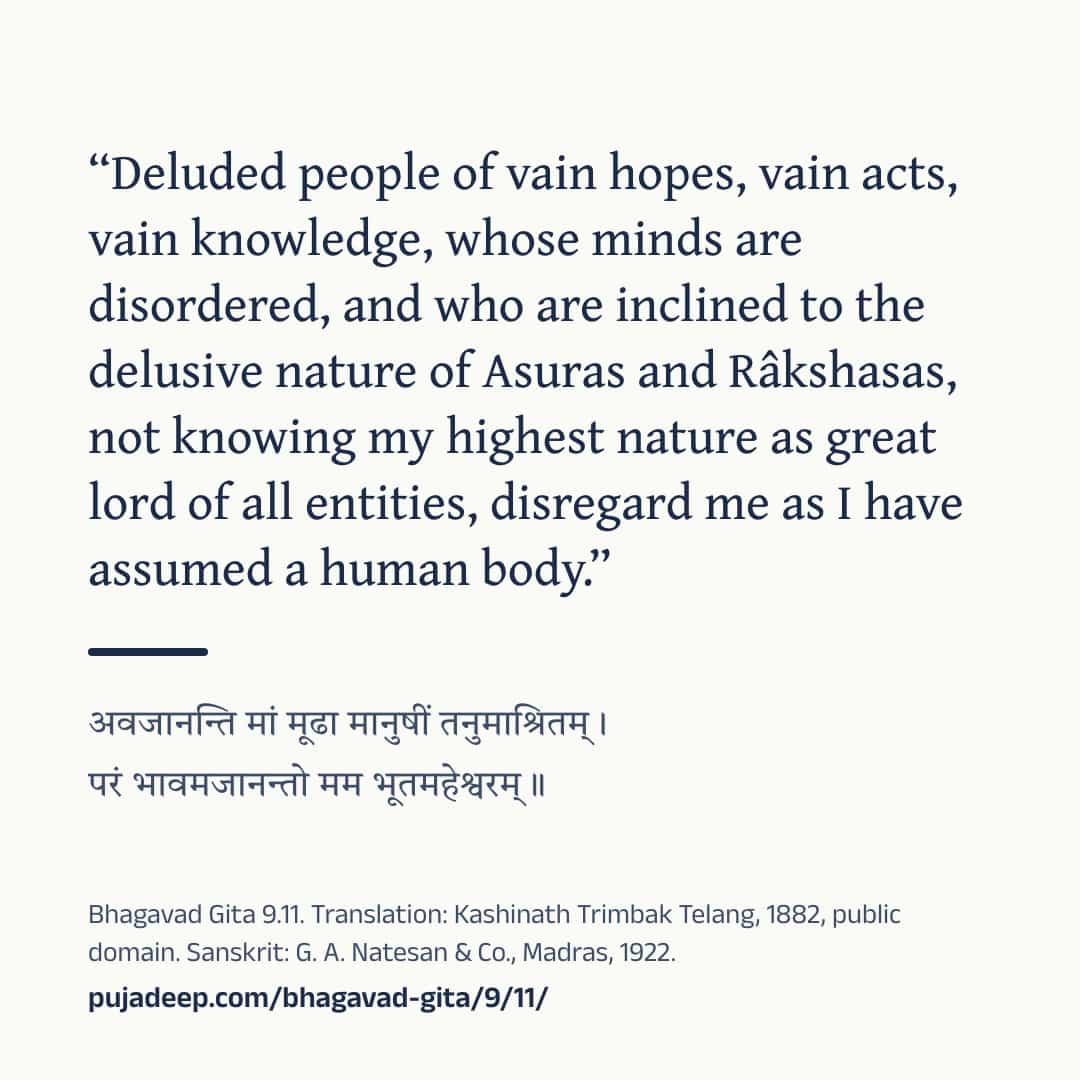
Drawing the picture
See the words
Bhagavad Gita 9.11

अवजानन्ति मां मूढा मानुषीं तनुमाश्रितम् ।
परं भावमजानन्तो मम भूतमहेश्वरम् ॥

“Deluded people of vain hopes, vain acts, vain knowledge, whose minds are disordered, and who are inclined to the delusive nature of Asuras and Râkshasas, not knowing my highest nature as great lord of all entities, disregard me as I have assumed a human body.”
(K. T. Telang, The Bhagavadgîtâ (The Sacred Books of the East, vol. VIII, Oxford: Clarendon Press, 1882), pp. 82–83, public domain)
This sentence covers verses 9.11 to 9.12.

“The foolish disregard Me, when clad in human semblance, ignoring my higher nature, the Great Lord of beings;”
(Annie Besant, The Bhagavad Gîtâ, or The Lord's Song (London: Theosophical Publishing Society, 1895), p. 89, public domain)
This sentence goes on in 9.12.

“Unaware of My higher state, as the great Lord of beings, fools disregard Me, dwelling in the human form.”
(Swami Swarupananda, Srimad-Bhagavad-Gita (Mayavati: Prabuddha Bharata Press, 1909; first printed in Prabuddha Bharata, 1907–1909), p. 180, public domain)

Sanskrit: G. A. Natesan & Co., Madras, 1922.
https://pujadeep.com/bhagavad-gita/9/11/ Nothing is sent from this site. Your own app sends it, to the chat you choose. The picture quotes the translation you chose on this page, with its name and year.
Sanskrit text: The Bhagavad-Gita, or The Lord's Song, with the text in Devanagari and an English translation, 1922. Meanings: written for Pujadeep and checked against the cited edition. Source and changes
Questions families ask
Who speaks Bhagavad Gita 9.11?
Krishna speaks this verse, in chapter 9 (Raja Vidya Raja Guhya Yoga).
Where does the Sanskrit text come from?
Sanskrit text: The Bhagavad-Gita, or The Lord's Song, with the text in Devanagari and an English translation, 1922. Meanings: written for Pujadeep and checked against the cited edition. See the source
Is the meaning on this page a translation?
Explanation written for this site from the sources listed here, and checked against the cited edition. It is not a translation and not the only way to read the text. Free to quote with credit.
Source and licence
- Sanskrit text
- The Bhagavad-Gita, or The Lord's Song, with the text in Devanagari and an English translation (Annie Besant, G. A. Natesan & Co., Madras, 1922). Public domain. The Sanskrit on these pages was read from this printing’s page images.
- Translation
- The Bhagavadgîtâ with the Sanatsugâtîya and the Anugîtâ, translated by Kâshinâth Trimbak Telang (The Sacred Books of the East, vol. VIII, ed. F. Max Müller) (Kashinath Trimbak Telang, F. Max Müller, Clarendon Press, Oxford, 1882). Public domain. Shown verbatim, as printed.
- Translation
- The Bhagavad Gîtâ, or The Lord's Song, translated by Annie Besant (Annie Besant, Theosophical Publishing Society, London, 1895). Public domain. Shown verbatim, as printed.
- Translation
- Srimad-Bhagavad-Gita, with Sanskrit Text; Paraphrase with Word-by-word Literal Translation; English Rendering and Comments, Index, &c., by the Swami Swarupananda (Himalayan Series, No. XX) (Swami Swarupananda, The Editors and Publishers, Advaita Ashrama, Mayavati, Prabuddha Bharata Press, Mayavati, Almora, Himalayas, 1909). Public domain. Shown verbatim, as printed.
- Commentary
- The Bhagavad-Gita, with the commentary of Sri Sankaracharya, translated by A. Mahadeva Sastri (2nd ed., Mysore: G. T. A. Printing Works, 1901) (Public-domain scan, University of California Libraries). Summarised in our own words; none of its text is reproduced.
- Commentary
- Sri Bhagavad-Gita with Sri Ramanujacharya's Visishtadvaita commentary, translated by A. Govindacharya (Madras, 1898) (Scan uploaded to archive.org (folkscanomy collection)). Summarised in our own words; none of its text is reproduced.
- Common wording
- In this text, 32 words follow today's common wording, checked against sanskritdocuments.org; Sanskrit Wikisource; Gita Press, Gorakhpur; GRETIL, Göttingen and Bhaktivedanta Book Trust.
- Our explanation
- Explanation written for this site from the sources listed here, and checked against the cited edition. It is not a translation and not the only way to read the text. Free to quote with credit.
- Checked
- Checked against the cited edition, October 15, 2026.
- Updated
- October 27, 2026