Bhagavad Gita 9.14: meaning and translation
Chapter 9: Raja Vidya Raja Guhya Yoga. Krishna says
Such people, Krishna says, always sing his praise (kīrtana), strive with firm vows, bow to him with devotion, and worship him, always joined to him.
Click or tap a word for its meaning and its dictionary page.
Text and layers
Text and layers
These choices stay in this browser.
Bhagavad Gita 9.14
सततं कीर्तयन्तो मां यतन्तश्च दृढव्रताः ।नमस्यन्तश्च मां भक्त्या नित्ययुक्ता उपासते ॥
Satatam kirtayanto mam yatantashcha dridhavratahNamasyantashcha mam bhaktya nityayukta upasate
satataṃ kīrtayanto māṃ yatantaśca dṛḍhavratāḥ |namasyantaśca māṃ bhaktyā nityayuktā upāsate ||
Our explanation Such people, Krishna says, always sing his praise (kīrtana), strive with firm vows, bow to him with devotion, and worship him, always joined to him.
हिंदी अर्थ कृष्ण कहते हैं कि ऐसे लोग सदा उनका कीर्तन करते हैं, दृढ़ व्रतों के साथ प्रयत्न करते हैं, भक्ति से उन्हें नमस्कार करते हैं, और सदा उनसे जुड़े रहकर उनकी उपासना करते हैं।
Word by word
Every word, with its dictionary page
Word by word
- सततम् satatam · always (adverb) Dictionary: sa-tata, Monier-Williams 1899, p. 1138, col. 1 “constant, perpetual, continual, uninterrupted”
- कीर्तयन्तः kīrtayantaḥ · praising, singing of (present participle (masculine), nominative plural) Dictionary: kīrt, Monier-Williams 1899, p. 285, col. 1 “to mention, make mention of, tell, name, call, recite, repeat”
- माम् mām · "me" (Krishna) (pronoun, accusative singular) Dictionary: 1. mad, Monier-Williams 1899, p. 777, col. 2 “base of the first pers. pron. in the sg. number (esp. in comp.)”
- यतन्तः yatantaḥ · striving (present participle (masculine), nominative plural) Dictionary: 2. yat, Monier-Williams 1899, p. 840, col. 3 “to exert one's self, take pains, endeavour, make effort, persevere”
- च ca · and (indeclinable) Dictionary: 2. ca, Monier-Williams 1899, p. 380, col. 1 “and, both, also, moreover, as well as”
- दृढव्रताः dṛḍhavratāḥ · firm in their vows (compound (masculine), nominative plural) Dictionary: dṛḍha, Monier-Williams 1899, p. 490, col. 2 “fixed, firm, hard, strong, solid, massive”; vrata, Monier-Williams 1899, p. 1042, col. 2 “a religious vow or practice, any pious observance”
- नमस्यन्तः namasyantaḥ · bowing to (present participle (masculine), nominative plural) Dictionary: 1. namasya, Monier-Williams 1899, p. 528, col. 2 “to pay homage, worship, be humble or deferential”
- च ca · and (indeclinable) Dictionary: 2. ca, Monier-Williams 1899, p. 380, col. 1 “and, both, also, moreover, as well as”
- माम् mām · "me" (Krishna) (pronoun, accusative singular) Dictionary: 1. mad, Monier-Williams 1899, p. 777, col. 2 “base of the first pers. pron. in the sg. number (esp. in comp.)”
- भक्त्या bhaktyā · with devotion (noun (feminine), instrumental singular) Dictionary: bhakti, Monier-Williams 1899, p. 743, col. 2 “attachment, devotion, fondness for, devotion to”
- नित्ययुक्ताः nityayuktāḥ · always joined (to him) (compound (masculine), nominative plural) Dictionary: nitya-yukta, Monier-Williams 1899, p. 547, col. 3 “always busy or intent upon”
- उपासते upāsate · worship (present (middle), 3rd person plural) Dictionary: 3. upās, Monier-Williams 1899, p. 215, col. 1 “serve, honour, revere, respect, acknowledge, do homage, worship”
Old translations
Kashinath Trimbak Telang, 1882. Public domain. Page 83.
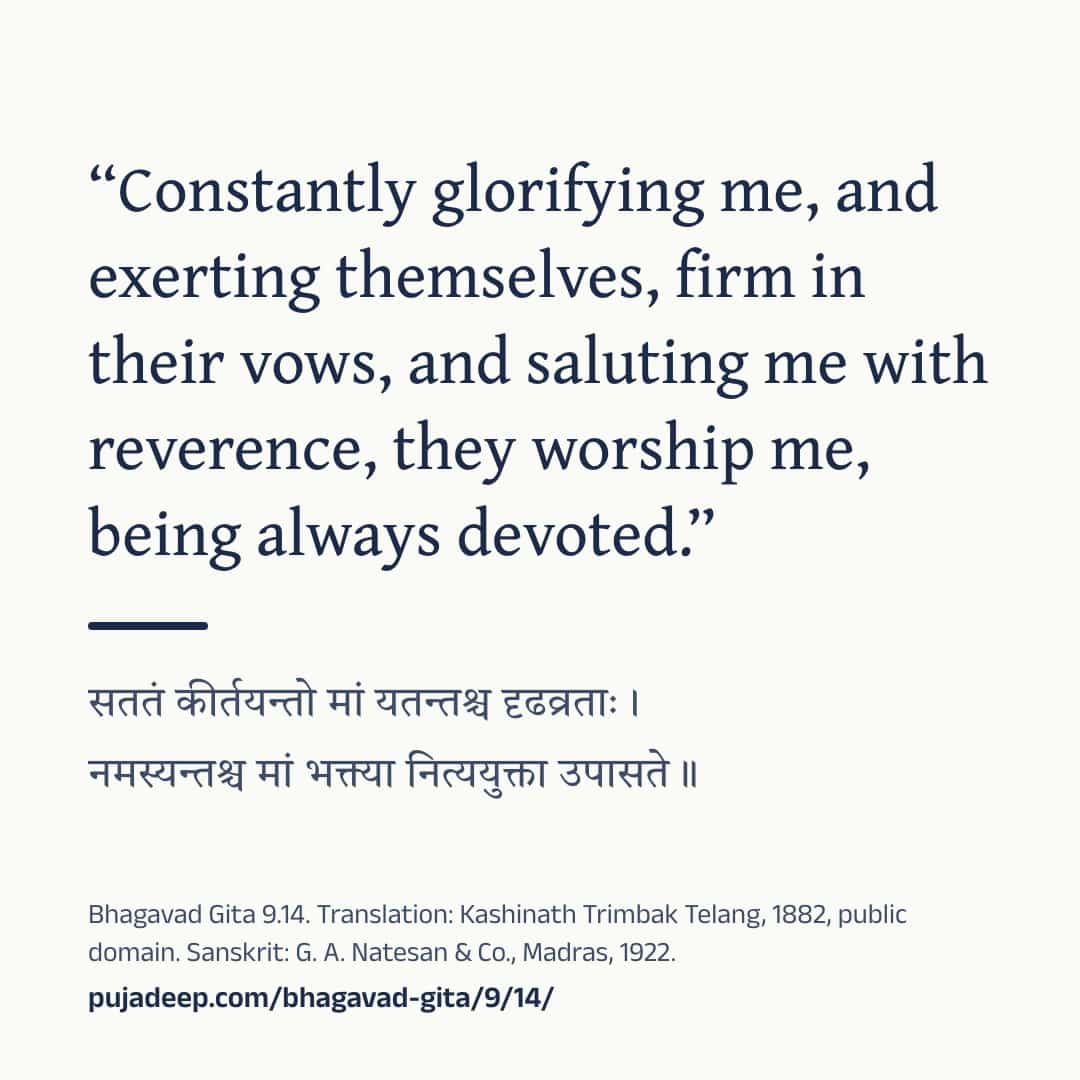
Constantly glorifying me, and exerting themselves1, firm in their vows2, and saluting me with reverence, they worship me, being always devoted.
Footnotes (the translator’s own) Compare 3 translations
Kashinath Trimbak Telang, 1882. Public domain. Page 83.
Constantly glorifying me, and exerting themselves1, firm in their vows2, and saluting me with reverence, they worship me, being always devoted.
Footnotes (the translator’s own) You are reading this one
Annie Besant, 1895. Public domain. Page 89.
Always praising Me, strenuous, firm in vows, prostrating themselves before Me, worshipping in binding love.
This sentence begins in 9.13.
You are reading this one
Swami Swarupananda, 1909 (first printed 1907). Public domain. Page 182.
Glorifying Me always and striving with firm resolve, bowing down to Me in devotion, always steadfast, they worship Me.
You are reading this one
Cite this verse
The translation: K. T. Telang, The Bhagavadgîtâ (The Sacred Books of the East, vol. VIII, Oxford: Clarendon Press, 1882), p. 83. Bhagavad Gita 9.14.
The translation: Annie Besant, The Bhagavad Gîtâ, or The Lord's Song (London: Theosophical Publishing Society, 1895), p. 89. Bhagavad Gita 9.14.
The translation: Swami Swarupananda, Srimad-Bhagavad-Gita (Mayavati: Prabuddha Bharata Press, 1909; first printed in Prabuddha Bharata, 1907–1909), p. 182. Bhagavad Gita 9.14.
Our explanation: “Bhagavad Gita 9.14: meaning and translation.” Pujadeep. Updated October 27, 2026. https://pujadeep.com/bhagavad-gita/9/14/
Pujadeep’s explanations are free to quote with credit: name Pujadeep and link to the page. How to credit
Classical readings, by school
No readings by school on this verse yet.
Share
Show the ways to share
Send one picture or the text to one chat. The picture names its source and the address of this page.
Drawing the picture
See the words
Bhagavad Gita 9.14

सततं कीर्तयन्तो मां यतन्तश्च दृढव्रताः ।
नमस्यन्तश्च मां भक्त्या नित्ययुक्ता उपासते ॥

“Constantly glorifying me, and exerting themselves, firm in their vows, and saluting me with reverence, they worship me, being always devoted.”
(K. T. Telang, The Bhagavadgîtâ (The Sacred Books of the East, vol. VIII, Oxford: Clarendon Press, 1882), p. 83, public domain)

“Always praising Me, strenuous, firm in vows, prostrating themselves before Me, worshipping in binding love.”
(Annie Besant, The Bhagavad Gîtâ, or The Lord's Song (London: Theosophical Publishing Society, 1895), p. 89, public domain)
This sentence begins in 9.13.

“Glorifying Me always and striving with firm resolve, bowing down to Me in devotion, always steadfast, they worship Me.”
(Swami Swarupananda, Srimad-Bhagavad-Gita (Mayavati: Prabuddha Bharata Press, 1909; first printed in Prabuddha Bharata, 1907–1909), p. 182, public domain)

Sanskrit: G. A. Natesan & Co., Madras, 1922.
https://pujadeep.com/bhagavad-gita/9/14/ Nothing is sent from this site. Your own app sends it, to the chat you choose. The picture quotes the translation you chose on this page, with its name and year.
Sanskrit text: The Bhagavad-Gita, or The Lord's Song, with the text in Devanagari and an English translation, 1922. Meanings: written for Pujadeep and checked against the cited edition. Source and changes
Questions families ask
Who speaks Bhagavad Gita 9.14?
Krishna speaks this verse, in chapter 9 (Raja Vidya Raja Guhya Yoga).
Where does the Sanskrit text come from?
Sanskrit text: The Bhagavad-Gita, or The Lord's Song, with the text in Devanagari and an English translation, 1922. Meanings: written for Pujadeep and checked against the cited edition. See the source
Is the meaning on this page a translation?
Explanation written for this site from the sources listed here, and checked against the cited edition. It is not a translation and not the only way to read the text. Free to quote with credit.
Source and licence
- Sanskrit text
- The Bhagavad-Gita, or The Lord's Song, with the text in Devanagari and an English translation (Annie Besant, G. A. Natesan & Co., Madras, 1922). Public domain. The Sanskrit on these pages was read from this printing’s page images.
- Translation
- The Bhagavadgîtâ with the Sanatsugâtîya and the Anugîtâ, translated by Kâshinâth Trimbak Telang (The Sacred Books of the East, vol. VIII, ed. F. Max Müller) (Kashinath Trimbak Telang, F. Max Müller, Clarendon Press, Oxford, 1882). Public domain. Shown verbatim, as printed.
- Translation
- The Bhagavad Gîtâ, or The Lord's Song, translated by Annie Besant (Annie Besant, Theosophical Publishing Society, London, 1895). Public domain. Shown verbatim, as printed.
- Translation
- Srimad-Bhagavad-Gita, with Sanskrit Text; Paraphrase with Word-by-word Literal Translation; English Rendering and Comments, Index, &c., by the Swami Swarupananda (Himalayan Series, No. XX) (Swami Swarupananda, The Editors and Publishers, Advaita Ashrama, Mayavati, Prabuddha Bharata Press, Mayavati, Almora, Himalayas, 1909). Public domain. Shown verbatim, as printed.
- Common wording
- In this text, 32 words follow today's common wording, checked against sanskritdocuments.org; Sanskrit Wikisource; Gita Press, Gorakhpur; GRETIL, Göttingen and Bhaktivedanta Book Trust.
- Our explanation
- Explanation written for this site from the sources listed here, and checked against the cited edition. It is not a translation and not the only way to read the text. Free to quote with credit.
- Checked
- Checked against the cited edition, October 15, 2026.
- Updated
- October 27, 2026