Bhagavad Gita 9.5: meaning and translation
Chapter 9: Raja Vidya Raja Guhya Yoga. Krishna says
Krishna then says that beings do not rest in him either, and asks Arjuna to see his divine power (yoga aiśvara).
Click or tap a word for its meaning and its dictionary page.
Text and layers
Text and layers
These choices stay in this browser.
Bhagavad Gita 9.5
न च मत्स्थानि भूतानि पश्य मे योगमैश्वरम् ।भूतभृन्न च भूतस्थो ममात्मा भूतभावनः ॥
Na cha matsthani bhutani pashya me yogamaishvaramBhutabhrinna cha bhutastho mamatma bhutabhavanah
na ca matsthāni bhūtāni paśya me yogamaiśvaram |bhūtabhṛnna ca bhūtastho mamātmā bhūtabhāvanaḥ ||
Our explanation Krishna then says that beings do not rest in him either, and asks Arjuna to see his divine power (yoga aiśvara). His self supports all beings and brings them into being, yet it does not dwell in them. The two statements of 9.4 and 9.5 are read differently by the schools (see the views).
हिंदी अर्थ फिर कृष्ण कहते हैं कि प्राणी उनमें स्थित भी नहीं, और अर्जुन से उनका ऐश्वर्य-योग (दिव्य शक्ति) देखने को कहते हैं। उनकी आत्मा सब प्राणियों को धारण करती है और उन्हें उत्पन्न करती है, फिर भी उनमें नहीं रहती। 9.4 और 9.5 की इन दोनों बातों को परंपराएँ अलग-अलग ढंग से समझती हैं।
Word by word
Every word, with its dictionary page
Word by word
- न na · not (indeclinable) Dictionary: 2. na, Monier-Williams 1899, p. 523, col. 1 “ind. not, no, nor, neither”
- च ca · and (indeclinable) Dictionary: 2. ca, Monier-Williams 1899, p. 380, col. 1 “and, both, also, moreover, as well as”
- मत्स्थानि matsthāni · resting in "me" (compound (neuter), nominative plural) Dictionary: 1. mad, Monier-Williams 1899, p. 777, col. 2 “base of the first pers. pron. in the sg. number (esp. in comp.)”; stha, Monier-Williams 1899, p. 1262, col. 3 “standing, staying, abiding, being situated in”
- भूतानि bhūtāni · beings (noun (neuter), nominative plural) Dictionary: bhūta, Monier-Williams 1899, p. 761, col. 3 “that which is or exists, any living being”
- पश्य paśya · see (imperative, 2nd person singular) Dictionary: 1. paś, Monier-Williams 1899, p. 611, col. 2 “to see, behold, look at, observe, perceive, notice”
- मे me · "my" (pronoun, genitive singular) Dictionary: 1. mad, Monier-Williams 1899, p. 777, col. 2 “base of the first pers. pron. in the sg. number (esp. in comp.)”
- योगम् yogam · power, yoga (noun (masculine), accusative singular) Dictionary: yoga, Monier-Williams 1899, p. 856, col. 2 “the act of yoking, joining, attaching”
- ऐश्वरम् aiśvaram · divine, of the Lord (adjective (masculine), accusative singular) Dictionary: aiśvara, Monier-Williams 1899, p. 234, col. 3 “relating to or coming from a mighty lord or king”
- भूतभृत् bhūtabhṛt · sustaining beings (compound (masculine), nominative singular) Dictionary: bhūta-bhṛt, Monier-Williams 1899, p. 762, col. 1 “sustaining the elements or creatures”
- न na · not (indeclinable) Dictionary: 2. na, Monier-Williams 1899, p. 523, col. 1 “ind. not, no, nor, neither”
- च ca · and (indeclinable) Dictionary: 2. ca, Monier-Williams 1899, p. 380, col. 1 “and, both, also, moreover, as well as”
- भूतस्थः bhūtasthaḥ · dwelling in beings (compound (masculine), nominative singular) Dictionary: bhūta, Monier-Williams 1899, p. 761, col. 3 “that which is or exists, any living being”; stha, Monier-Williams 1899, p. 1262, col. 3 “standing, staying, abiding, being situated in”
- मम mama · "my" (pronoun, genitive singular) Dictionary: 1. mad, Monier-Williams 1899, p. 777, col. 2 “base of the first pers. pron. in the sg. number (esp. in comp.)”
- आत्मा ātmā · self (noun (masculine), nominative singular) Dictionary: ātman, Monier-Williams 1899, p. 135, col. 1 “the individual soul, self”
- भूतभावनः bhūtabhāvanaḥ · bringing beings into being (compound (masculine), nominative singular) Dictionary: bhūta-bhāvana, Monier-Williams 1899, p. 762, col. 1 “creating or causing the welfare of living beings”
Old translations
Kashinath Trimbak Telang, 1882. Public domain. Page 82.
Nor yet do all entities live in me. See my divine power. Supporting all entities and producing all entities, my self lives not in (those) entities.
Compare 3 translations
Kashinath Trimbak Telang, 1882. Public domain. Page 82.
Nor yet do all entities live in me. See my divine power. Supporting all entities and producing all entities, my self lives not in (those) entities.
You are reading this one
Annie Besant, 1895. Public domain. Page 88.
Nor have beings root in Me; behold my sovereign Yoga! The support of beings and not rooted in beings, My SELF their efficient cause.
This sentence begins in 9.4.
You are reading this one
Swami Swarupananda, 1909 (first printed 1907). Public domain. Page Prabuddha Bharata, May 1908: Gita p. 65 (journal p. 97).
Nor do beings exist in Me (in reality), behold My Divine Yoga! Bringing forth and supporting the beings, My Self does not dwell in them.
You are reading this one
Cite this verse
The translation: K. T. Telang, The Bhagavadgîtâ (The Sacred Books of the East, vol. VIII, Oxford: Clarendon Press, 1882), p. 82. Bhagavad Gita 9.5.
The translation: Annie Besant, The Bhagavad Gîtâ, or The Lord's Song (London: Theosophical Publishing Society, 1895), p. 88. Bhagavad Gita 9.5.
The translation: Swami Swarupananda, Srimad-Bhagavad-Gita (Mayavati: Prabuddha Bharata Press, 1909; first printed in Prabuddha Bharata, 1907–1909), p. Prabuddha Bharata, May 1908: Gita p. 65 (journal p. 97). Bhagavad Gita 9.5.
Our explanation: “Bhagavad Gita 9.5: meaning and translation.” Pujadeep. Updated October 27, 2026. https://pujadeep.com/bhagavad-gita/9/5/
Pujadeep’s explanations are free to quote with credit: name Pujadeep and link to the page. How to credit
Classical readings, by school
Each reading is named by its school. None is presented as the only meaning.
What Advaita, Vishishtadvaita and Dvaita teach, in short
Shankara Advaita
Shankara says that, because the Self is attached to nothing, in truth the beings do not dwell in it either; this is the Lord's divine mystery. “My self” is said only in the everyday way of speaking, as if the Lord and the Self were two.
Source: The Bhagavad-Gita, with the commentary of Sri Sankaracharya, translated by A. Mahadeva Sastri (2nd ed., Mysore: G. T. A. Printing Works, 1901), commentary on 9.5, pp. 218–219. Summarised in our own words; none of its text is reproduced.
Ramanuja Vishishtadvaita
Ramanuja says beings do not hold the Lord up as a pot holds water; he supports all of them by his will alone. This unique way of bearing the world is his “divine yoga”.
Source: Sri Bhagavad-Gita with Sri Ramanujacharya's Visishtadvaita commentary, translated by A. Govindacharya (Madras, 1898), commentary on 9.5, pp. 291–292. Summarised in our own words; none of its text is reproduced.
Share
Show the ways to share
Send one picture or the text to one chat. The picture names its source and the address of this page.
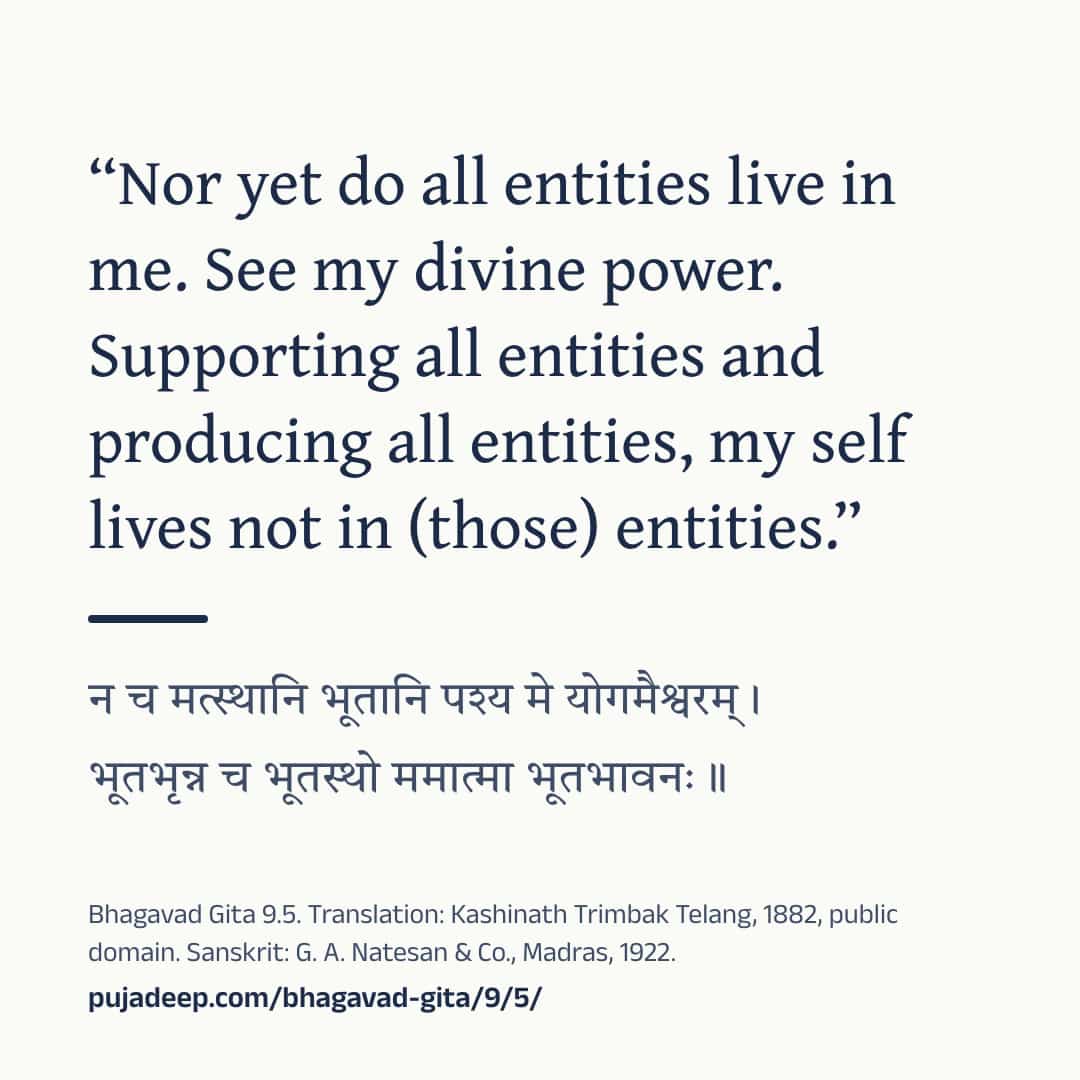
Drawing the picture
See the words
Bhagavad Gita 9.5

न च मत्स्थानि भूतानि पश्य मे योगमैश्वरम् ।
भूतभृन्न च भूतस्थो ममात्मा भूतभावनः ॥

“Nor yet do all entities live in me. See my divine power. Supporting all entities and producing all entities, my self lives not in (those) entities.”
(K. T. Telang, The Bhagavadgîtâ (The Sacred Books of the East, vol. VIII, Oxford: Clarendon Press, 1882), p. 82, public domain)

“Nor have beings root in Me; behold my sovereign Yoga! The support of beings and not rooted in beings, My SELF their efficient cause.”
(Annie Besant, The Bhagavad Gîtâ, or The Lord's Song (London: Theosophical Publishing Society, 1895), p. 88, public domain)
This sentence begins in 9.4.

“Nor do beings exist in Me (in reality), behold My Divine Yoga! Bringing forth and supporting the beings, My Self does not dwell in them.”
(Swami Swarupananda, Srimad-Bhagavad-Gita (Mayavati: Prabuddha Bharata Press, 1909; first printed in Prabuddha Bharata, 1907–1909), p. Prabuddha Bharata, May 1908: Gita p. 65 (journal p. 97), public domain)

Sanskrit: G. A. Natesan & Co., Madras, 1922.
https://pujadeep.com/bhagavad-gita/9/5/ Nothing is sent from this site. Your own app sends it, to the chat you choose. The picture quotes the translation you chose on this page, with its name and year.
Sanskrit text: The Bhagavad-Gita, or The Lord's Song, with the text in Devanagari and an English translation, 1922. Meanings: written for Pujadeep and checked against the cited edition. Source and changes
Questions families ask
Who speaks Bhagavad Gita 9.5?
Krishna speaks this verse, in chapter 9 (Raja Vidya Raja Guhya Yoga).
Where does the Sanskrit text come from?
Sanskrit text: The Bhagavad-Gita, or The Lord's Song, with the text in Devanagari and an English translation, 1922. Meanings: written for Pujadeep and checked against the cited edition. See the source
Is the meaning on this page a translation?
Explanation written for this site from the sources listed here, and checked against the cited edition. It is not a translation and not the only way to read the text. Free to quote with credit.
Source and licence
- Sanskrit text
- The Bhagavad-Gita, or The Lord's Song, with the text in Devanagari and an English translation (Annie Besant, G. A. Natesan & Co., Madras, 1922). Public domain. The Sanskrit on these pages was read from this printing’s page images.
- Translation
- The Bhagavadgîtâ with the Sanatsugâtîya and the Anugîtâ, translated by Kâshinâth Trimbak Telang (The Sacred Books of the East, vol. VIII, ed. F. Max Müller) (Kashinath Trimbak Telang, F. Max Müller, Clarendon Press, Oxford, 1882). Public domain. Shown verbatim, as printed.
- Translation
- The Bhagavad Gîtâ, or The Lord's Song, translated by Annie Besant (Annie Besant, Theosophical Publishing Society, London, 1895). Public domain. Shown verbatim, as printed.
- Translation
- Srimad-Bhagavad-Gita, with Sanskrit Text; Paraphrase with Word-by-word Literal Translation; English Rendering and Comments, Index, &c., by the Swami Swarupananda (Himalayan Series, No. XX) (Swami Swarupananda, The Editors and Publishers, Advaita Ashrama, Mayavati, Prabuddha Bharata Press, Mayavati, Almora, Himalayas, 1909). Public domain. Shown verbatim, as printed.
- Commentary
- The Bhagavad-Gita, with the commentary of Sri Sankaracharya, translated by A. Mahadeva Sastri (2nd ed., Mysore: G. T. A. Printing Works, 1901) (Public-domain scan, University of California Libraries). Summarised in our own words; none of its text is reproduced.
- Commentary
- Sri Bhagavad-Gita with Sri Ramanujacharya's Visishtadvaita commentary, translated by A. Govindacharya (Madras, 1898) (Scan uploaded to archive.org (folkscanomy collection)). Summarised in our own words; none of its text is reproduced.
- Common wording
- In this text, 32 words follow today's common wording, checked against sanskritdocuments.org; Sanskrit Wikisource; Gita Press, Gorakhpur; GRETIL, Göttingen and Bhaktivedanta Book Trust.
- Our explanation
- Explanation written for this site from the sources listed here, and checked against the cited edition. It is not a translation and not the only way to read the text. Free to quote with credit.
- Checked
- Checked against the cited edition, October 15, 2026.
- Updated
- October 27, 2026