Bhagavad Gita 9.13: meaning and translation
Chapter 9: Raja Vidya Raja Guhya Yoga. Krishna says
Krishna says that the great-souled (mahātmās), who take refuge in the divine nature, know him as the imperishable source of all beings and worship him with minds turned to nothing else.
Click or tap a word for its meaning and its dictionary page.
Text and layers
Text and layers
These choices stay in this browser.
Bhagavad Gita 9.13
महात्मानस्तु मां पार्थ दैवीं प्रकृतिमाश्रिताः ।भजन्त्यनन्यमनसो ज्ञात्वा भूतादिमव्ययम् ॥
Mahatmanastu mam partha daivim prakritimashritahBhajantyananyamanaso jnatva bhutadimavyayam
mahātmānastu māṃ pārtha daivīṃ prakṛtimāśritāḥ |bhajantyananyamanaso jñātvā bhūtādimavyayam ||
Our explanation Krishna says that the great-souled (mahātmās), who take refuge in the divine nature, know him as the imperishable source of all beings and worship him with minds turned to nothing else. He calls Arjuna Partha, son of Pritha.
हिंदी अर्थ कृष्ण कहते हैं कि महात्मा लोग, जिन्होंने दैवी प्रकृति का आश्रय लिया है, उन्हें सब प्राणियों का अविनाशी मूल जानकर अनन्य मन से, यानी और किसी ओर मन न लगाकर, उनकी भक्ति करते हैं। वे अर्जुन को पार्थ (पृथा के पुत्र) कहकर पुकारते हैं।
Word by word
Every word, with its dictionary page
Word by word
- महात्मानः mahātmānaḥ · the great-souled (noun (masculine), nominative plural) Dictionary: mahātman, Monier-Williams 1899, p. 796, col. 1 “‘high-souled,’ magnanimous”
- तु tu · but (indeclinable) Dictionary: 2. tu, Monier-Williams 1899, p. 449, col. 3 “but”
- माम् mām · "me" (Krishna) (pronoun, accusative singular) Dictionary: 1. mad, Monier-Williams 1899, p. 777, col. 2 “base of the first pers. pron. in the sg. number (esp. in comp.)”
- पार्थ pārtha · O Partha (son of Pritha) (noun (masculine), vocative singular) Dictionary: 2. pārtha, Monier-Williams 1899, p. 621, col. 3
- दैवीम् daivīm · divine (adjective (feminine), accusative singular) Dictionary: 1. daiva, Monier-Williams 1899, p. 497, col. 2 “belonging to or coming from the gods, divine, celestial”
- प्रकृतिम् prakṛtim · nature (noun (feminine), accusative singular) Dictionary: pra-kṛti, Monier-Williams 1899, p. 654, col. 1 “nature, character, constitution, temper, disposition”
- आश्रिताः āśritāḥ · taking refuge in (past participle (masculine), nominative plural) Dictionary: ā-śrita, Monier-Williams 1899, p. 158, col. 3 “having recourse to, resorting to as a retreat or asylum”
- भजन्ति bhajanti · worship (present, 3rd person plural) Dictionary: bhaj, Monier-Williams 1899, p. 743, col. 1 “to serve, honour, revere, love, adore”
- अनन्यमनसः ananyamanasaḥ · with minds on nothing else (compound (masculine), nominative plural) Dictionary: an-anya, Monier-Williams 1899, p. 25, col. 2 “having no other (object), undistracted”; manas, Monier-Williams 1899, p. 783, col. 3 “mind (in its widest sense as applied to all the mental powers)”
- ज्ञात्वा jñātvā · having known (absolutive (having done)) Dictionary: 1. jñā, Monier-Williams 1899, p. 425, col. 3 “to know, have knowledge, become acquainted with”
- भूतादिम् bhūtādim · the source of beings (compound (masculine), accusative singular) Dictionary: bhūta, Monier-Williams 1899, p. 761, col. 3 “that which is or exists, any living being”; 1. ādi, Monier-Williams 1899, p. 136, col. 3 “beginning, commencement”
- अव्ययम् avyayam · imperishable (adjective (masculine), accusative singular) Dictionary: 2. a-vyaya, Monier-Williams 1899, p. 111, col. 3 “not liable to change, imperishable, undecaying”
Old translations
Kashinath Trimbak Telang, 1882. Public domain. Page 83.
But the high-souled ones, O son of Prithâ! who are inclined to the godlike nature, knowing me as the inexhaustible source of (all) entities, worship me with minds not (turned) elsewhere.
Compare 3 translations
Kashinath Trimbak Telang, 1882. Public domain. Page 83.
But the high-souled ones, O son of Prithâ! who are inclined to the godlike nature, knowing me as the inexhaustible source of (all) entities, worship me with minds not (turned) elsewhere.
You are reading this one
Annie Besant, 1895. Public domain. Page 89.
Verily the Mahâtmâs, O Pârtha! partaking of My divine Prakriti, worship with Manas (fixed) on no other, having known the imperishable source of beings,
This sentence goes on in 9.14.
You are reading this one
Swami Swarupananda, 1909 (first printed 1907). Public domain. Page 181.
But the great-souled ones, O son of Prithâ, possessed of the Divine Prakriti, knowing Me to be the origin of beings, and immutable, worship Me with a single mind.
You are reading this one
Cite this verse
The translation: K. T. Telang, The Bhagavadgîtâ (The Sacred Books of the East, vol. VIII, Oxford: Clarendon Press, 1882), p. 83. Bhagavad Gita 9.13.
The translation: Annie Besant, The Bhagavad Gîtâ, or The Lord's Song (London: Theosophical Publishing Society, 1895), p. 89. Bhagavad Gita 9.13.
The translation: Swami Swarupananda, Srimad-Bhagavad-Gita (Mayavati: Prabuddha Bharata Press, 1909; first printed in Prabuddha Bharata, 1907–1909), p. 181. Bhagavad Gita 9.13.
Our explanation: “Bhagavad Gita 9.13: meaning and translation.” Pujadeep. Updated October 27, 2026. https://pujadeep.com/bhagavad-gita/9/13/
Pujadeep’s explanations are free to quote with credit: name Pujadeep and link to the page. How to credit
Classical readings, by school
No readings by school on this verse yet.
Share
Show the ways to share
Send one picture or the text to one chat. The picture names its source and the address of this page.
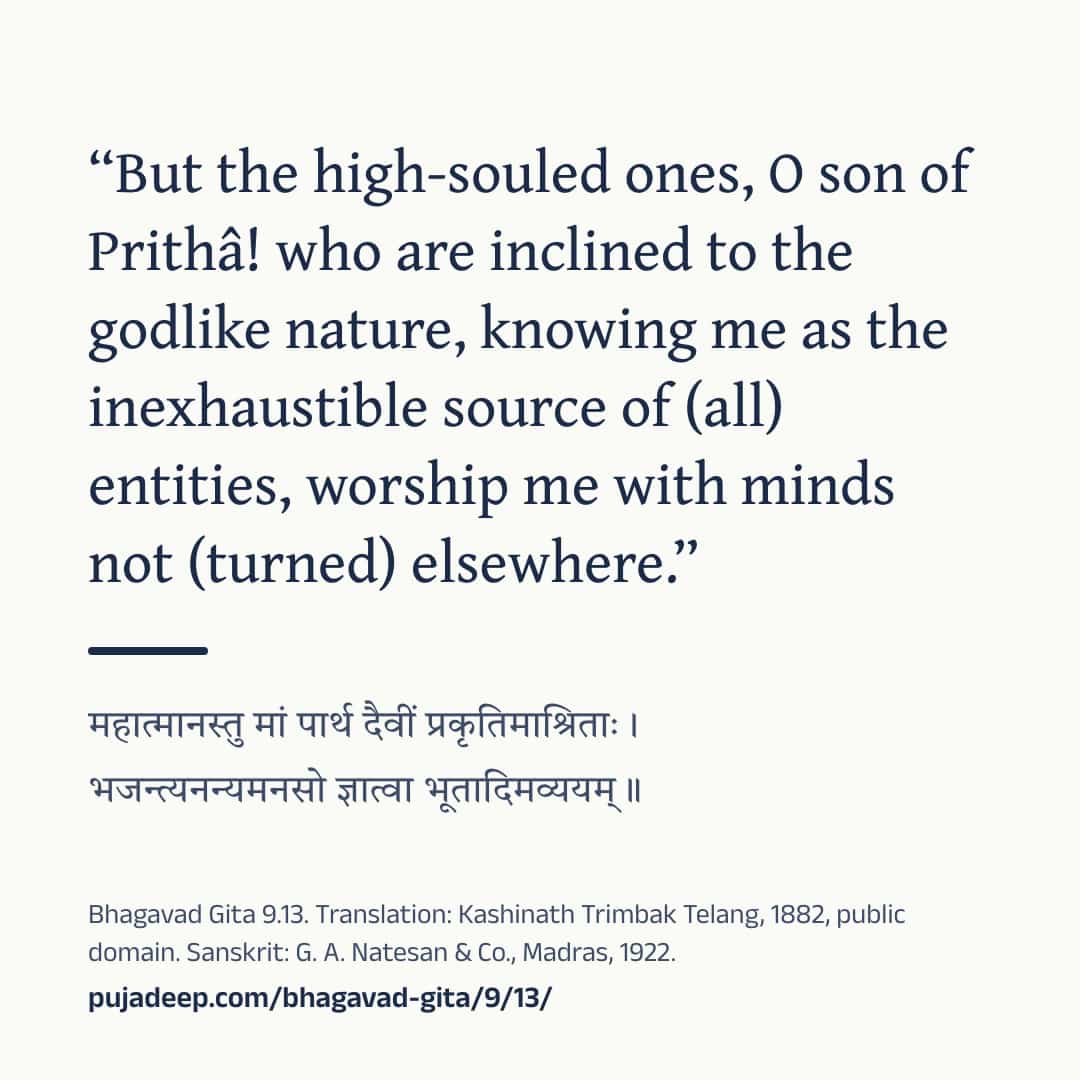
Drawing the picture
See the words
Bhagavad Gita 9.13

महात्मानस्तु मां पार्थ दैवीं प्रकृतिमाश्रिताः ।
भजन्त्यनन्यमनसो ज्ञात्वा भूतादिमव्ययम् ॥

“But the high-souled ones, O son of Prithâ! who are inclined to the godlike nature, knowing me as the inexhaustible source of (all) entities, worship me with minds not (turned) elsewhere.”
(K. T. Telang, The Bhagavadgîtâ (The Sacred Books of the East, vol. VIII, Oxford: Clarendon Press, 1882), p. 83, public domain)

“Verily the Mahâtmâs, O Pârtha! partaking of My divine Prakriti, worship with Manas (fixed) on no other, having known the imperishable source of beings,”
(Annie Besant, The Bhagavad Gîtâ, or The Lord's Song (London: Theosophical Publishing Society, 1895), p. 89, public domain)
This sentence goes on in 9.14.

“But the great-souled ones, O son of Prithâ, possessed of the Divine Prakriti, knowing Me to be the origin of beings, and immutable, worship Me with a single mind.”
(Swami Swarupananda, Srimad-Bhagavad-Gita (Mayavati: Prabuddha Bharata Press, 1909; first printed in Prabuddha Bharata, 1907–1909), p. 181, public domain)

Sanskrit: G. A. Natesan & Co., Madras, 1922.
https://pujadeep.com/bhagavad-gita/9/13/ Nothing is sent from this site. Your own app sends it, to the chat you choose. The picture quotes the translation you chose on this page, with its name and year.
Sanskrit text: The Bhagavad-Gita, or The Lord's Song, with the text in Devanagari and an English translation, 1922. Meanings: written for Pujadeep and checked against the cited edition. Source and changes
Questions families ask
Who speaks Bhagavad Gita 9.13?
Krishna speaks this verse, in chapter 9 (Raja Vidya Raja Guhya Yoga).
Where does the Sanskrit text come from?
Sanskrit text: The Bhagavad-Gita, or The Lord's Song, with the text in Devanagari and an English translation, 1922. Meanings: written for Pujadeep and checked against the cited edition. See the source
Is the meaning on this page a translation?
Explanation written for this site from the sources listed here, and checked against the cited edition. It is not a translation and not the only way to read the text. Free to quote with credit.
Source and licence
- Sanskrit text
- The Bhagavad-Gita, or The Lord's Song, with the text in Devanagari and an English translation (Annie Besant, G. A. Natesan & Co., Madras, 1922). Public domain. The Sanskrit on these pages was read from this printing’s page images.
- Translation
- The Bhagavadgîtâ with the Sanatsugâtîya and the Anugîtâ, translated by Kâshinâth Trimbak Telang (The Sacred Books of the East, vol. VIII, ed. F. Max Müller) (Kashinath Trimbak Telang, F. Max Müller, Clarendon Press, Oxford, 1882). Public domain. Shown verbatim, as printed.
- Translation
- The Bhagavad Gîtâ, or The Lord's Song, translated by Annie Besant (Annie Besant, Theosophical Publishing Society, London, 1895). Public domain. Shown verbatim, as printed.
- Translation
- Srimad-Bhagavad-Gita, with Sanskrit Text; Paraphrase with Word-by-word Literal Translation; English Rendering and Comments, Index, &c., by the Swami Swarupananda (Himalayan Series, No. XX) (Swami Swarupananda, The Editors and Publishers, Advaita Ashrama, Mayavati, Prabuddha Bharata Press, Mayavati, Almora, Himalayas, 1909). Public domain. Shown verbatim, as printed.
- Common wording
- In this text, 32 words follow today's common wording, checked against sanskritdocuments.org; Sanskrit Wikisource; Gita Press, Gorakhpur; GRETIL, Göttingen and Bhaktivedanta Book Trust.
- Our explanation
- Explanation written for this site from the sources listed here, and checked against the cited edition. It is not a translation and not the only way to read the text. Free to quote with credit.
- Checked
- Checked against the cited edition, October 15, 2026.
- Updated
- October 27, 2026