Bhagavad Gita 9.22: meaning and translation
Chapter 9: Raja Vidya Raja Guhya Yoga. Krishna says
Krishna says that for those who think of him alone and worship him, always joined to him, he himself carries their yoga-kṣema: gaining what they lack and keeping what they have.
Click or tap a word for its meaning and its dictionary page.
Text and layers
Text and layers
These choices stay in this browser.
Bhagavad Gita 9.22
अनन्याश्चिन्तयन्तो मां ये जनाः पर्युपासते ।तेषां नित्याभियुक्तानां योगक्षेमं वहाम्यहम् ॥
Ananyashchintayanto mam ye janah paryupasateTesham nityabhiyuktanam yogakshemam vahamyaham
ananyāścintayanto māṃ ye janāḥ paryupāsate |teṣāṃ nityābhiyuktānāṃ yogakṣemaṃ vahāmyaham ||
Our explanation Krishna says that for those who think of him alone and worship him, always joined to him, he himself carries their yoga-kṣema: gaining what they lack and keeping what they have. The schools explain what is gained and kept in different ways (see the views).
हिंदी अर्थ कृष्ण कहते हैं कि जो लोग अनन्य भाव से, केवल उन्हीं का चिंतन करते हुए, उनकी उपासना करते हैं और सदा उनसे जुड़े रहते हैं, उनका योगक्षेम वे स्वयं वहन करते हैं: जो उनके पास नहीं, उसे दिलाना, और जो है, उसकी रक्षा करना। परंपराएँ अलग-अलग बताती हैं कि यहाँ क्या दिलाया और क्या बचाया जाता है।
Word by word
Every word, with its dictionary page
Word by word
- अनन्याः ananyāḥ · with no other (thought) (adjective (masculine), nominative plural) Dictionary: an-anya, Monier-Williams 1899, p. 25, col. 2 “having no other (object), undistracted”
- चिन्तयन्तः cintayantaḥ · thinking of (present participle (masculine), nominative plural) Dictionary: cint, Monier-Williams 1899, p. 398, col. 1 “to think, have a thought or idea, reflect, consider”
- माम् mām · "me" (Krishna) (pronoun, accusative singular) Dictionary: 1. mad, Monier-Williams 1899, p. 777, col. 2 “base of the first pers. pron. in the sg. number (esp. in comp.)”
- ये ye · who (relative pronoun (masculine), nominative plural) Dictionary: yad, Monier-Williams 1899, p. 844, col. 2 “who, which, what, whichever, whatever, that”
- जनाः janāḥ · people (noun (masculine), nominative plural) Dictionary: jana, Monier-Williams 1899, p. 410, col. 1 “creature, living being, man, person, race”
- पर्युपासते paryupāsate · worship (present (middle), 3rd person plural) Dictionary: pary-upās, Monier-Williams 1899, p. 608, col. 3 “to approach respectfully, attend upon, worship”
- तेषाम् teṣām · of them, for them (pronoun (masculine), genitive plural) Dictionary: tad, Monier-Williams 1899, p. 434, col. 1 “m. he, f. she, n. it, that, this”
- नित्याभियुक्तानाम् nityābhiyuktānām · ever devoted (compound (masculine), genitive plural) Dictionary: nitya, Monier-Williams 1899, p. 547, col. 2 “continual, perpetual, eternal”; abhi-yukta, Monier-Williams 1899, p. 68, col. 1 “applied, intent on (loc.)”
- योगक्षेमम् yogakṣemam · gaining and keeping (compound (masculine), accusative singular) Dictionary: yoga-kṣema, Monier-Williams 1899, p. 856, col. 3 “the security or secure possession of what has been acquired”
- वहामि vahāmi · "I carry" (present, 1st person singular) Dictionary: 1. vah, Monier-Williams 1899, p. 933, col. 2 “to carry, transport, convey”
- अहम् aham · "I" (Krishna) (pronoun, nominative singular) Dictionary: aham, Monier-Williams 1899, p. 124, col. 2 “nom. sg. ‘I,’”
Old translations
Kashinath Trimbak Telang, 1882. Public domain. Page 84.
To those men who worship me, meditating on me and on no one else, and who are constantly devoted, I give new gifts and preserve what is acquired by them1.
Footnotes (the translator’s own) - Cf. Dhammapada, stanza 23. I. e. attainment to the Brahman and not returning from it.—Râmânuga. ↩
Compare 3 translations
Kashinath Trimbak Telang, 1882. Public domain. Page 84.
To those men who worship me, meditating on me and on no one else, and who are constantly devoted, I give new gifts and preserve what is acquired by them1.
Footnotes (the translator’s own) - Cf. Dhammapada, stanza 23. I. e. attainment to the Brahman and not returning from it.—Râmânuga. ↩
You are reading this one
Annie Besant, 1895. Public domain. Page 91.
To those men who worship Me, not meditating on another, to those ever harmonious, I bring full security of Yoga.
You are reading this one
Swami Swarupananda, 1909 (first printed 1907). Public domain. Page 186.
Persons who, meditating on Me as non-separate, worship Me in all beings, to them thus steadfast wholly and constantly, I carry what they lack and preserve what they already have.
You are reading this one
Cite this verse
The translation: K. T. Telang, The Bhagavadgîtâ (The Sacred Books of the East, vol. VIII, Oxford: Clarendon Press, 1882), p. 84. Bhagavad Gita 9.22.
The translation: Annie Besant, The Bhagavad Gîtâ, or The Lord's Song (London: Theosophical Publishing Society, 1895), p. 91. Bhagavad Gita 9.22.
The translation: Swami Swarupananda, Srimad-Bhagavad-Gita (Mayavati: Prabuddha Bharata Press, 1909; first printed in Prabuddha Bharata, 1907–1909), p. 186. Bhagavad Gita 9.22.
Our explanation: “Bhagavad Gita 9.22: meaning and translation.” Pujadeep. Updated October 27, 2026. https://pujadeep.com/bhagavad-gita/9/22/
Pujadeep’s explanations are free to quote with credit: name Pujadeep and link to the page. How to credit
Classical readings, by school
Each reading is named by its school. None is presented as the only meaning.
What Advaita, Vishishtadvaita and Dvaita teach, in short
Shankara Advaita
Shankara says these are renunciates who see the Lord, Nārāyaṇa, as their own Self and seek nothing for themselves. The Lord gives such people what they lack (yoga) and keeps what they have (kṣema). Other devotees strive for these things themselves; these do not, so the Lord does it for them.
Source: The Bhagavad-Gita, with the commentary of Sri Sankaracharya, translated by A. Mahadeva Sastri (2nd ed., Mysore: G. T. A. Printing Works, 1901), commentary on 9.22, pp. 227–228. Summarised in our own words; none of its text is reproduced.
Ramanuja Vishishtadvaita
Ramanuja says these are devotees for whom thinking of the Lord is life itself, and who long for eternal union with him. The Lord himself brings about that union (yoga), from which there is no return, and keeps it for ever (kṣema).
Source: Sri Bhagavad-Gita with Sri Ramanujacharya's Visishtadvaita commentary, translated by A. Govindacharya (Madras, 1898), commentary on 9.22, pp. 304–305. Summarised in our own words; none of its text is reproduced.
This verse is on our page of well-known Gita verses, by theme
Share
Show the ways to share
Send one picture or the text to one chat. The picture names its source and the address of this page.
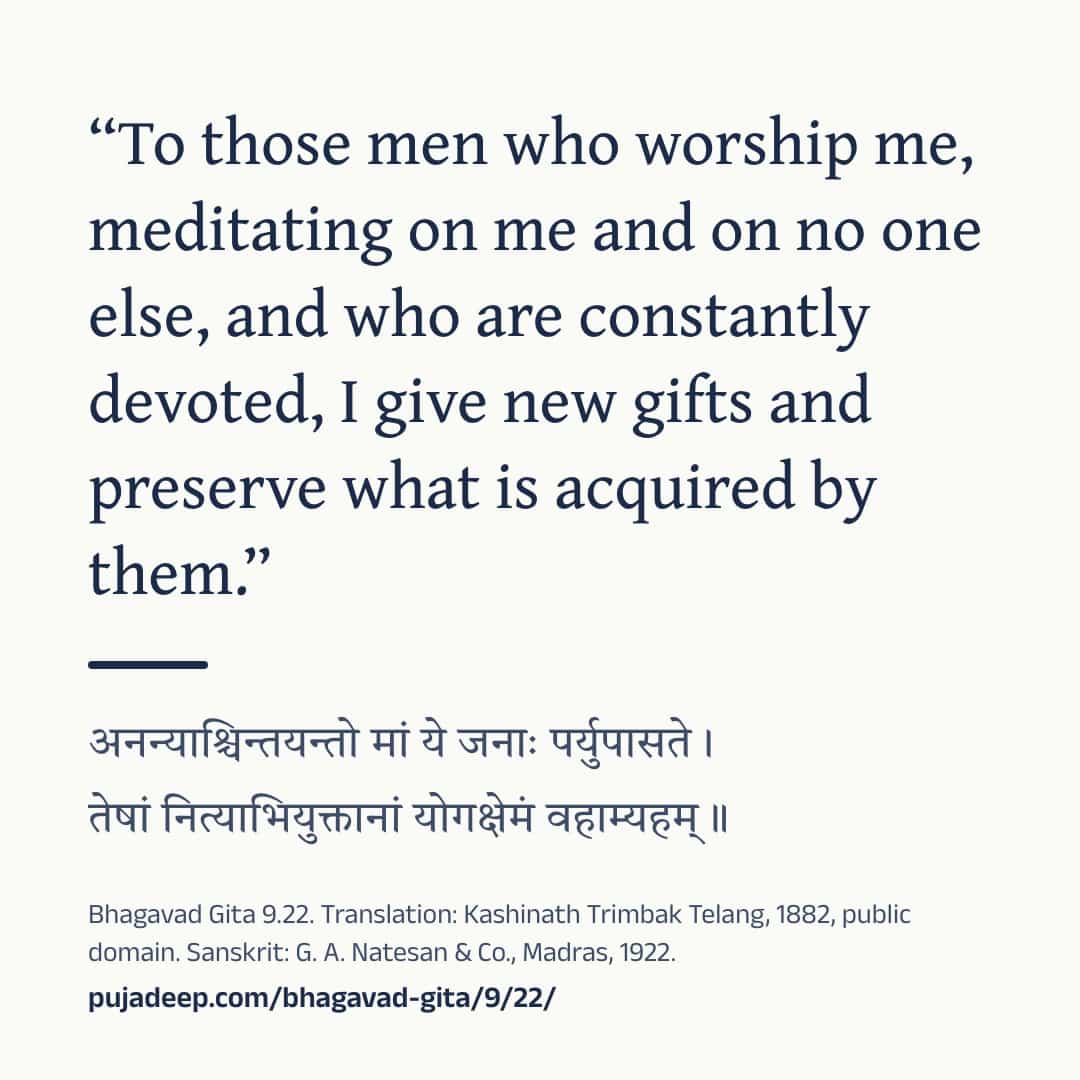
Drawing the picture
See the words
Bhagavad Gita 9.22

अनन्याश्चिन्तयन्तो मां ये जनाः पर्युपासते ।
तेषां नित्याभियुक्तानां योगक्षेमं वहाम्यहम् ॥

“To those men who worship me, meditating on me and on no one else, and who are constantly devoted, I give new gifts and preserve what is acquired by them.”
(K. T. Telang, The Bhagavadgîtâ (The Sacred Books of the East, vol. VIII, Oxford: Clarendon Press, 1882), p. 84, public domain)

“To those men who worship Me, not meditating on another, to those ever harmonious, I bring full security of Yoga.”
(Annie Besant, The Bhagavad Gîtâ, or The Lord's Song (London: Theosophical Publishing Society, 1895), p. 91, public domain)

“Persons who, meditating on Me as non-separate, worship Me in all beings, to them thus steadfast wholly and constantly, I carry what they lack and preserve what they already have.”
(Swami Swarupananda, Srimad-Bhagavad-Gita (Mayavati: Prabuddha Bharata Press, 1909; first printed in Prabuddha Bharata, 1907–1909), p. 186, public domain)

Sanskrit: G. A. Natesan & Co., Madras, 1922.
https://pujadeep.com/bhagavad-gita/9/22/ Nothing is sent from this site. Your own app sends it, to the chat you choose. The picture quotes the translation you chose on this page, with its name and year.
Sanskrit text: The Bhagavad-Gita, or The Lord's Song, with the text in Devanagari and an English translation, 1922. Meanings: written for Pujadeep and checked against the cited edition. Source and changes
Questions families ask
Who speaks Bhagavad Gita 9.22?
Krishna speaks this verse, in chapter 9 (Raja Vidya Raja Guhya Yoga).
Where does the Sanskrit text come from?
Sanskrit text: The Bhagavad-Gita, or The Lord's Song, with the text in Devanagari and an English translation, 1922. Meanings: written for Pujadeep and checked against the cited edition. See the source
Is the meaning on this page a translation?
Explanation written for this site from the sources listed here, and checked against the cited edition. It is not a translation and not the only way to read the text. Free to quote with credit.
Source and licence
- Sanskrit text
- The Bhagavad-Gita, or The Lord's Song, with the text in Devanagari and an English translation (Annie Besant, G. A. Natesan & Co., Madras, 1922). Public domain. The Sanskrit on these pages was read from this printing’s page images.
- Translation
- The Bhagavadgîtâ with the Sanatsugâtîya and the Anugîtâ, translated by Kâshinâth Trimbak Telang (The Sacred Books of the East, vol. VIII, ed. F. Max Müller) (Kashinath Trimbak Telang, F. Max Müller, Clarendon Press, Oxford, 1882). Public domain. Shown verbatim, as printed.
- Translation
- The Bhagavad Gîtâ, or The Lord's Song, translated by Annie Besant (Annie Besant, Theosophical Publishing Society, London, 1895). Public domain. Shown verbatim, as printed.
- Translation
- Srimad-Bhagavad-Gita, with Sanskrit Text; Paraphrase with Word-by-word Literal Translation; English Rendering and Comments, Index, &c., by the Swami Swarupananda (Himalayan Series, No. XX) (Swami Swarupananda, The Editors and Publishers, Advaita Ashrama, Mayavati, Prabuddha Bharata Press, Mayavati, Almora, Himalayas, 1909). Public domain. Shown verbatim, as printed.
- Commentary
- The Bhagavad-Gita, with the commentary of Sri Sankaracharya, translated by A. Mahadeva Sastri (2nd ed., Mysore: G. T. A. Printing Works, 1901) (Public-domain scan, University of California Libraries). Summarised in our own words; none of its text is reproduced.
- Commentary
- Sri Bhagavad-Gita with Sri Ramanujacharya's Visishtadvaita commentary, translated by A. Govindacharya (Madras, 1898) (Scan uploaded to archive.org (folkscanomy collection)). Summarised in our own words; none of its text is reproduced.
- Common wording
- In this text, 32 words follow today's common wording, checked against sanskritdocuments.org; Sanskrit Wikisource; Gita Press, Gorakhpur; GRETIL, Göttingen and Bhaktivedanta Book Trust.
- Our explanation
- Explanation written for this site from the sources listed here, and checked against the cited edition. It is not a translation and not the only way to read the text. Free to quote with credit.
- Checked
- Checked against the cited edition, October 15, 2026.
- Updated
- October 27, 2026