Bhagavad Gita 9.29: meaning and translation
Chapter 9: Raja Vidya Raja Guhya Yoga. Krishna says
Krishna says that he is the same towards all beings; no one is hateful to him and no one is his favourite.
Click or tap a word for its meaning and its dictionary page.
Text and layers
Text and layers
These choices stay in this browser.
Bhagavad Gita 9.29
समोऽहं सर्वभूतेषु न मे द्वेष्योऽस्ति न प्रियः ।ये भजन्ति तु मां भक्त्या मयि ते तेषु चाप्यहम् ॥
Samoham sarvabhuteshu na me dveshyosti na priyahYe bhajanti tu mam bhaktya mayi te teshu chapyaham
samo’haṃ sarvabhūteṣu na me dveṣyo’sti na priyaḥ |ye bhajanti tu māṃ bhaktyā mayi te teṣu cāpyaham ||
Our explanation Krishna says that he is the same towards all beings; no one is hateful to him and no one is his favourite. But those who worship him with devotion are in him, and he is in them. The schools explain how this fits with his being the same to all (see the views).
हिंदी अर्थ कृष्ण कहते हैं कि वे सब प्राणियों के प्रति समान हैं; न कोई उन्हें अप्रिय है, न कोई विशेष प्रिय। पर जो भक्ति से उनकी उपासना करते हैं, वे उनमें हैं और वे भी उनमें हैं। परंपराएँ समझाती हैं कि यह उनके सबके प्रति समान होने से कैसे मेल खाता है।
Word by word
Every word, with its dictionary page
Word by word
- समः samaḥ · the same, even (adjective (masculine), nominative singular) Dictionary: 2. sama, Monier-Williams 1899, p. 1152, col. 1 “same, equal, similar, like, equivalent”
- अहम् aham · "I" (Krishna) (pronoun, nominative singular) Dictionary: aham, Monier-Williams 1899, p. 124, col. 2 “nom. sg. ‘I,’”
- सर्वभूतेषु sarvabhūteṣu · to all beings (compound (neuter), locative plural) Dictionary: sarva, Monier-Williams 1899, p. 1184, col. 3 “whole, entire, all, every”; bhūta, Monier-Williams 1899, p. 761, col. 3 “that which is or exists, any living being”
- न na · not (indeclinable) Dictionary: 2. na, Monier-Williams 1899, p. 523, col. 1 “ind. not, no, nor, neither”
- मे me · to "me" (pronoun, genitive or dative singular) Dictionary: 1. mad, Monier-Williams 1899, p. 777, col. 2 “base of the first pers. pron. in the sg. number (esp. in comp.)”
- द्वेष्यः dveṣyaḥ · hateful (gerundive (masculine), nominative singular) Dictionary: dveṣya, Monier-Williams 1899, p. 507, col. 1 “to be hated or disliked, odious, detestable”
- अस्ति asti · is (present, 3rd person singular) Dictionary: 1. as, Monier-Williams 1899, p. 117, col. 2 “to be, live, exist, be present”
- न na · not (indeclinable) Dictionary: 2. na, Monier-Williams 1899, p. 523, col. 1 “ind. not, no, nor, neither”
- प्रियः priyaḥ · dear (adjective (masculine), nominative singular) Dictionary: priya, Monier-Williams 1899, p. 710, col. 1 “beloved, dear to (gen., loc., dat. or comp.), liked, favourite”
- ये ye · who (relative pronoun (masculine), nominative plural) Dictionary: yad, Monier-Williams 1899, p. 844, col. 2 “who, which, what, whichever, whatever, that”
- भजन्ति bhajanti · worship (present, 3rd person plural) Dictionary: bhaj, Monier-Williams 1899, p. 743, col. 1 “to serve, honour, revere, love, adore”
- तु tu · but (indeclinable) Dictionary: 2. tu, Monier-Williams 1899, p. 449, col. 3 “but”
- माम् mām · "me" (Krishna) (pronoun, accusative singular) Dictionary: 1. mad, Monier-Williams 1899, p. 777, col. 2 “base of the first pers. pron. in the sg. number (esp. in comp.)”
- भक्त्या bhaktyā · with devotion (noun (feminine), instrumental singular) Dictionary: bhakti, Monier-Williams 1899, p. 743, col. 2 “attachment, devotion, fondness for, devotion to”
- मयि mayi · in "me" (Krishna) (pronoun, locative singular) Dictionary: 1. mad, Monier-Williams 1899, p. 777, col. 2 “base of the first pers. pron. in the sg. number (esp. in comp.)”
- ते te · they (pronoun (masculine), nominative plural) Dictionary: tad, Monier-Williams 1899, p. 434, col. 1 “m. he, f. she, n. it, that, this”
- तेषु teṣu · in them (pronoun (masculine), locative plural) Dictionary: tad, Monier-Williams 1899, p. 434, col. 1 “m. he, f. she, n. it, that, this”
- च ca · and (indeclinable) Dictionary: 2. ca, Monier-Williams 1899, p. 380, col. 1 “and, both, also, moreover, as well as”
- अपि api · also (indeclinable) Dictionary: api, Monier-Williams 1899, p. 55, col. 1 “in the sense of even, also, very”
- अहम् aham · "I" (Krishna) (pronoun, nominative singular) Dictionary: aham, Monier-Williams 1899, p. 124, col. 2 “nom. sg. ‘I,’”
Old translations
Kashinath Trimbak Telang, 1882. Public domain. Page 85.
I am alike to all beings; to me none is hateful, none dear. But those who worship me with devotion (dwell) in me1, and I too in them.
Footnotes (the translator’s own) - 'They dwell in me' by their devotion to me; I dwell in them as giver of happiness to them. ↩
Compare 3 translations
Kashinath Trimbak Telang, 1882. Public domain. Page 85.
I am alike to all beings; to me none is hateful, none dear. But those who worship me with devotion (dwell) in me1, and I too in them.
Footnotes (the translator’s own) - 'They dwell in me' by their devotion to me; I dwell in them as giver of happiness to them. ↩
You are reading this one
Annie Besant, 1895. Public domain. Page 93.
The same am I amid all beings; there is none hateful to me nor dear. They verily who worship Me with devotion, they are in Me, and I also in them.
You are reading this one
Swami Swarupananda, 1909 (first printed 1907). Public domain. Page 190.
I am the same to all beings: to Me there is none hateful nor dear. But those who worship Me with devotion, they are in Me, and I too am in them.
You are reading this one
Cite this verse
The translation: K. T. Telang, The Bhagavadgîtâ (The Sacred Books of the East, vol. VIII, Oxford: Clarendon Press, 1882), p. 85. Bhagavad Gita 9.29.
The translation: Annie Besant, The Bhagavad Gîtâ, or The Lord's Song (London: Theosophical Publishing Society, 1895), p. 93. Bhagavad Gita 9.29.
The translation: Swami Swarupananda, Srimad-Bhagavad-Gita (Mayavati: Prabuddha Bharata Press, 1909; first printed in Prabuddha Bharata, 1907–1909), p. 190. Bhagavad Gita 9.29.
Our explanation: “Bhagavad Gita 9.29: meaning and translation.” Pujadeep. Updated October 27, 2026. https://pujadeep.com/bhagavad-gita/9/29/
Pujadeep’s explanations are free to quote with credit: name Pujadeep and link to the page. How to credit
Classical readings, by school
Each reading is named by its school. None is presented as the only meaning.
What Advaita, Vishishtadvaita and Dvaita teach, in short
Shankara Advaita
Shankara compares the Lord to fire. Fire keeps the cold away from those who come near it and not from those who stay far off, yet it loves no one more. In the same way the Lord's grace reaches those who come to him in devotion, without any partiality on his side.
Source: The Bhagavad-Gita, with the commentary of Sri Sankaracharya, translated by A. Mahadeva Sastri (2nd ed., Mysore: G. T. A. Printing Works, 1901), commentary on 9.29, p. 231. Summarised in our own words; none of its text is reproduced.
Ramanuja Vishishtadvaita
Ramanuja says no being is rejected or preferred for its birth, caste, looks, nature or learning; taking refuge in the Lord is the only claim. Those who worship him in love dwell in him, whatever their standing, and he dwells in them as if they were his own betters.
Source: Sri Bhagavad-Gita with Sri Ramanujacharya's Visishtadvaita commentary, translated by A. Govindacharya (Madras, 1898), commentary on 9.29, p. 311. Summarised in our own words; none of its text is reproduced.
Share
Show the ways to share
Send one picture or the text to one chat. The picture names its source and the address of this page.
Drawing the picture
See the words
Bhagavad Gita 9.29

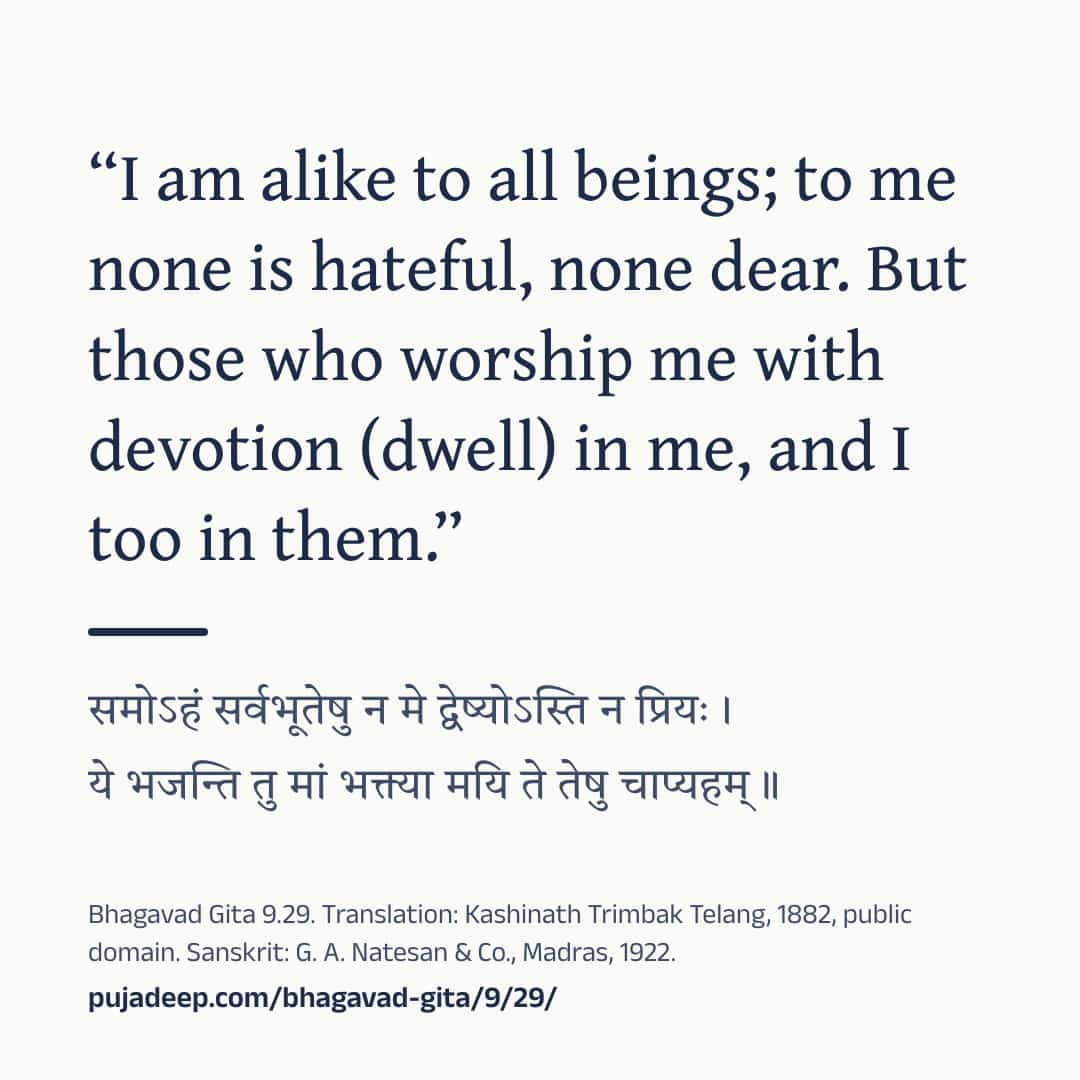
समोऽहं सर्वभूतेषु न मे द्वेष्योऽस्ति न प्रियः ।
ये भजन्ति तु मां भक्त्या मयि ते तेषु चाप्यहम् ॥

“I am alike to all beings; to me none is hateful, none dear. But those who worship me with devotion (dwell) in me, and I too in them.”
(K. T. Telang, The Bhagavadgîtâ (The Sacred Books of the East, vol. VIII, Oxford: Clarendon Press, 1882), p. 85, public domain)

“The same am I amid all beings; there is none hateful to me nor dear. They verily who worship Me with devotion, they are in Me, and I also in them.”
(Annie Besant, The Bhagavad Gîtâ, or The Lord's Song (London: Theosophical Publishing Society, 1895), p. 93, public domain)

“I am the same to all beings: to Me there is none hateful nor dear. But those who worship Me with devotion, they are in Me, and I too am in them.”
(Swami Swarupananda, Srimad-Bhagavad-Gita (Mayavati: Prabuddha Bharata Press, 1909; first printed in Prabuddha Bharata, 1907–1909), p. 190, public domain)

Sanskrit: G. A. Natesan & Co., Madras, 1922.
https://pujadeep.com/bhagavad-gita/9/29/ Nothing is sent from this site. Your own app sends it, to the chat you choose. The picture quotes the translation you chose on this page, with its name and year.
Sanskrit text: The Bhagavad-Gita, or The Lord's Song, with the text in Devanagari and an English translation, 1922. Meanings: written for Pujadeep and checked against the cited edition. Source and changes
Questions families ask
Who speaks Bhagavad Gita 9.29?
Krishna speaks this verse, in chapter 9 (Raja Vidya Raja Guhya Yoga).
Where does the Sanskrit text come from?
Sanskrit text: The Bhagavad-Gita, or The Lord's Song, with the text in Devanagari and an English translation, 1922. Meanings: written for Pujadeep and checked against the cited edition. See the source
Is the meaning on this page a translation?
Explanation written for this site from the sources listed here, and checked against the cited edition. It is not a translation and not the only way to read the text. Free to quote with credit.
Source and licence
- Sanskrit text
- The Bhagavad-Gita, or The Lord's Song, with the text in Devanagari and an English translation (Annie Besant, G. A. Natesan & Co., Madras, 1922). Public domain. The Sanskrit on these pages was read from this printing’s page images.
- Translation
- The Bhagavadgîtâ with the Sanatsugâtîya and the Anugîtâ, translated by Kâshinâth Trimbak Telang (The Sacred Books of the East, vol. VIII, ed. F. Max Müller) (Kashinath Trimbak Telang, F. Max Müller, Clarendon Press, Oxford, 1882). Public domain. Shown verbatim, as printed.
- Translation
- The Bhagavad Gîtâ, or The Lord's Song, translated by Annie Besant (Annie Besant, Theosophical Publishing Society, London, 1895). Public domain. Shown verbatim, as printed.
- Translation
- Srimad-Bhagavad-Gita, with Sanskrit Text; Paraphrase with Word-by-word Literal Translation; English Rendering and Comments, Index, &c., by the Swami Swarupananda (Himalayan Series, No. XX) (Swami Swarupananda, The Editors and Publishers, Advaita Ashrama, Mayavati, Prabuddha Bharata Press, Mayavati, Almora, Himalayas, 1909). Public domain. Shown verbatim, as printed.
- Commentary
- The Bhagavad-Gita, with the commentary of Sri Sankaracharya, translated by A. Mahadeva Sastri (2nd ed., Mysore: G. T. A. Printing Works, 1901) (Public-domain scan, University of California Libraries). Summarised in our own words; none of its text is reproduced.
- Commentary
- Sri Bhagavad-Gita with Sri Ramanujacharya's Visishtadvaita commentary, translated by A. Govindacharya (Madras, 1898) (Scan uploaded to archive.org (folkscanomy collection)). Summarised in our own words; none of its text is reproduced.
- Common wording
- In this text, 32 words follow today's common wording, checked against sanskritdocuments.org; Sanskrit Wikisource; Gita Press, Gorakhpur; GRETIL, Göttingen and Bhaktivedanta Book Trust.
- Our explanation
- Explanation written for this site from the sources listed here, and checked against the cited edition. It is not a translation and not the only way to read the text. Free to quote with credit.
- Checked
- Checked against the cited edition, October 15, 2026.
- Updated
- October 27, 2026