Bhagavad Gita 9.30: meaning and translation
Chapter 9: Raja Vidya Raja Guhya Yoga. Krishna says
Krishna says that even if a person of very wrong conduct worships him with undivided devotion, that person should be regarded as good (sādhu), because he has resolved rightly.
Click or tap a word for its meaning and its dictionary page.
Text and layers
Text and layers
These choices stay in this browser.
Bhagavad Gita 9.30
अपि चेत्सुदुराचारो भजते मामनन्यभाक् ।साधुरेव स मन्तव्यः सम्यग्व्यवसितो हि सः ॥
Api chetsuduracharo bhajate mamananyabhakSadhureva sa mantavyah samyagvyavasito hi sah
api cetsudurācāro bhajate māmananyabhāk |sādhureva sa mantavyaḥ samyagvyavasito hi saḥ ||
Our explanation Krishna says that even if a person of very wrong conduct worships him with undivided devotion, that person should be regarded as good (sādhu), because he has resolved rightly. The verse speaks of a change of heart, not of approval for wrong acts; 9.31 goes on to say that such a person soon becomes righteous.
हिंदी अर्थ कृष्ण कहते हैं कि यदि बहुत बुरे आचरण वाला व्यक्ति भी अनन्य भाव से उनकी भक्ति करता है, तो उसे साधु (अच्छा) ही मानना चाहिए, क्योंकि उसने सही निश्चय कर लिया है। यह श्लोक हृदय के बदलने की बात करता है, बुरे कर्मों की स्वीकृति की नहीं; 9.31 आगे कहता है कि ऐसा व्यक्ति शीघ्र धर्मात्मा बन जाता है।
Word by word
Every word, with its dictionary page
Word by word
- अपि api · also (indeclinable) Dictionary: api, Monier-Williams 1899, p. 55, col. 1 “in the sense of even, also, very”
- चेत् cet · if (indeclinable) Dictionary: ced, Monier-Williams 1899, p. 401, col. 3 “if”
- सुदुराचारः sudurācāraḥ · of very bad conduct (compound (masculine), nominative singular) Dictionary: 5. su, Monier-Williams 1899, p. 1219, col. 3 “good, excellent, right, virtuous, beautiful, easy, well, rightly, much, greatly, very”; dur-ācāra, Monier-Williams 1899, p. 484, col. 3 “ill-conducted, wicked”
- भजते bhajate · worships (present (middle), 3rd person singular) Dictionary: bhaj, Monier-Williams 1899, p. 743, col. 1 “to serve, honour, revere, love, adore”
- माम् mām · "me" (Krishna) (pronoun, accusative singular) Dictionary: 1. mad, Monier-Williams 1899, p. 777, col. 2 “base of the first pers. pron. in the sg. number (esp. in comp.)”
- अनन्यभाक् ananyabhāk · devoted to no other (compound (masculine), nominative singular) Dictionary: an-anya, Monier-Williams 1899, p. 25, col. 2 “having no other (object), undistracted”; bhaj, Monier-Williams 1899, p. 743, col. 1 “to serve, honour, revere, love, adore”
- साधुः sādhuḥ · good (adjective (masculine), nominative singular) Dictionary: sādhu, Monier-Williams 1899, p. 1201, col. 2 “good! well done! bravo!”
- एव eva · indeed (indeclinable) Dictionary: 1. eva, Monier-Williams 1899, p. 232, col. 2 “so, just so, exactly so; indeed, truly, really”
- सः saḥ · he (pronoun (masculine), nominative singular) Dictionary: tad, Monier-Williams 1899, p. 434, col. 1 “m. he, f. she, n. it, that, this”
- मन्तव्यः mantavyaḥ · is to be thought (gerundive (to be done) (masculine), nominative singular) Dictionary: mantavya, Monier-Williams 1899, p. 785, col. 3 “to be regarded or considered as (nom.)”
- सम्यक् samyak · rightly (adverb) Dictionary: samy-añc, Monier-Williams 1899, p. 1181, col. 2 “correctly, truly, properly, fitly, in the right way or manner, well, duly”
- व्यवसितः vyavasitaḥ · resolved (past participle (masculine), nominative singular) Dictionary: vy-avasita, Monier-Williams 1899, p. 1033, col. 3 “decided, determined, resolved”
- हि hi · for, indeed (indeclinable) Dictionary: 2. hi, Monier-Williams 1899, p. 1297, col. 3 “for, because, on account of”
- सः saḥ · he (pronoun (masculine), nominative singular) Dictionary: tad, Monier-Williams 1899, p. 434, col. 1 “m. he, f. she, n. it, that, this”
Old translations
Kashinath Trimbak Telang, 1882. Public domain. Page 85.
Even if a very ill-conducted man worships me, not worshipping any one else, he must certainly be deemed to be good, for he has well resolved1.
Footnotes (the translator’s own) - Viz. that the supreme Being alone should be reverenced. ↩
Compare 3 translations
Kashinath Trimbak Telang, 1882. Public domain. Page 85.
Even if a very ill-conducted man worships me, not worshipping any one else, he must certainly be deemed to be good, for he has well resolved1.
Footnotes (the translator’s own) - Viz. that the supreme Being alone should be reverenced. ↩
You are reading this one
Annie Besant, 1895. Public domain. Page 93.
But if an unrighteous person worship Me, worshipping not another, he must ever be accounted righteous, for he hath rightly resolved;
This sentence goes on in 9.31.
You are reading this one
Swami Swarupananda, 1909 (first printed 1907). Public domain. Page 190.
Even if the very wicked worship Me, with devotion to none else, he should be regarded as good, for he has rightly resolved.
You are reading this one
Cite this verse
The translation: K. T. Telang, The Bhagavadgîtâ (The Sacred Books of the East, vol. VIII, Oxford: Clarendon Press, 1882), p. 85. Bhagavad Gita 9.30.
The translation: Annie Besant, The Bhagavad Gîtâ, or The Lord's Song (London: Theosophical Publishing Society, 1895), p. 93. Bhagavad Gita 9.30.
The translation: Swami Swarupananda, Srimad-Bhagavad-Gita (Mayavati: Prabuddha Bharata Press, 1909; first printed in Prabuddha Bharata, 1907–1909), p. 190. Bhagavad Gita 9.30.
Our explanation: “Bhagavad Gita 9.30: meaning and translation.” Pujadeep. Updated October 27, 2026. https://pujadeep.com/bhagavad-gita/9/30/
Pujadeep’s explanations are free to quote with credit: name Pujadeep and link to the page. How to credit
Classical readings, by school
Each reading is named by its school. None is presented as the only meaning.
What Advaita, Vishishtadvaita and Dvaita teach, in short
Shankara Advaita
Shankara says such a person is “rightly resolved”: his resolve is good. By giving up wrong ways in his outer life and by the strength of this inner resolve, he soon becomes righteous.
Source: The Bhagavad-Gita, with the commentary of Sri Sankaracharya, translated by A. Mahadeva Sastri (2nd ed., Mysore: G. T. A. Printing Works, 1901), commentary on 9.30–9.31, p. 232. Summarised in our own words; none of its text is reproduced.
Ramanuja Vishishtadvaita
Ramanuja says that even someone who breaks the rules of conduct of his station is to be honoured as a good person if he worships the Lord alone, because his settled conviction is right. Loving devotion soon washes away the faults, and he becomes a righteous soul.
Source: Sri Bhagavad-Gita with Sri Ramanujacharya's Visishtadvaita commentary, translated by A. Govindacharya (Madras, 1898), commentary on 9.30–9.31, pp. 312–313. Summarised in our own words; none of its text is reproduced.
Share
Show the ways to share
Send one picture or the text to one chat. The picture names its source and the address of this page.
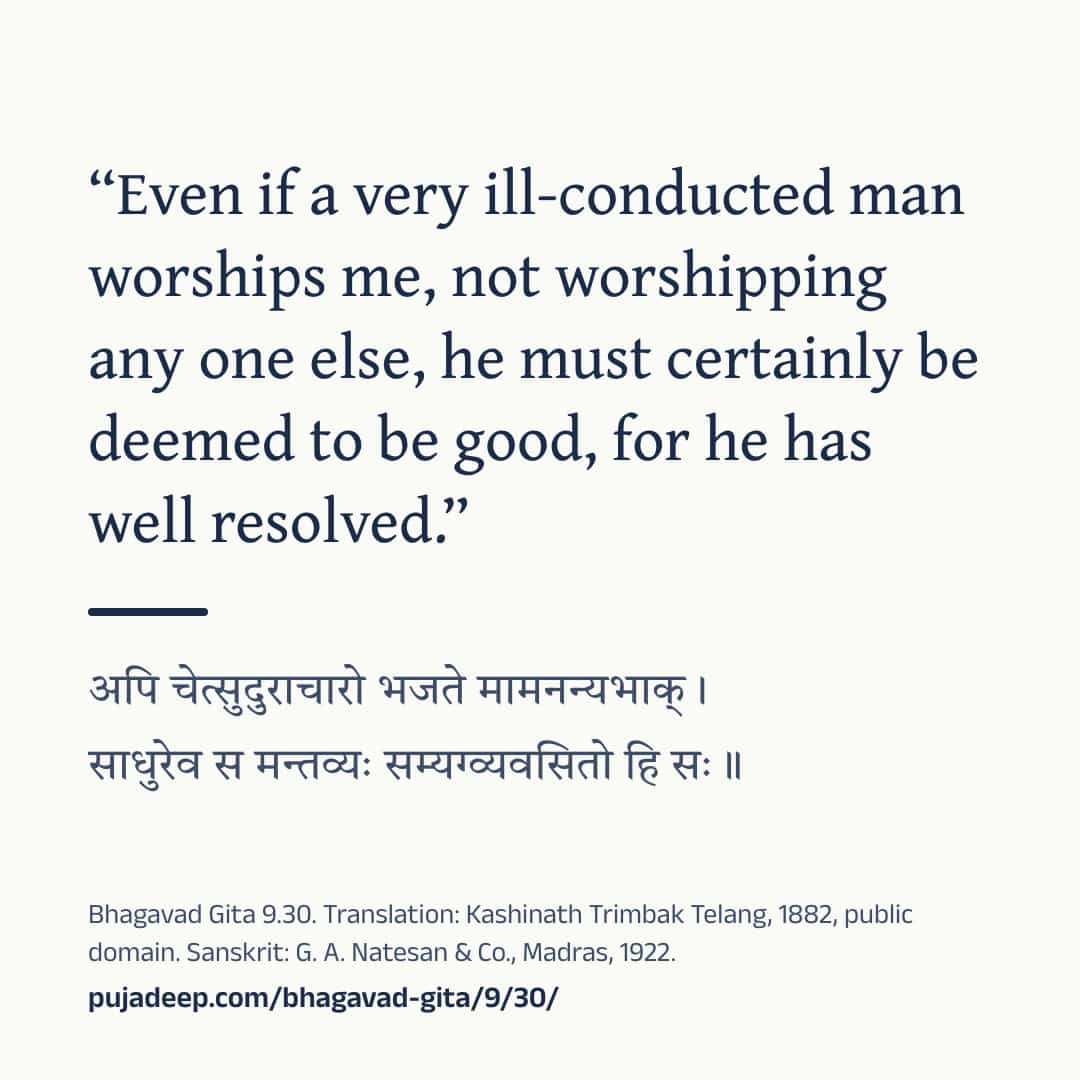
Drawing the picture
See the words
Bhagavad Gita 9.30

अपि चेत्सुदुराचारो भजते मामनन्यभाक् ।
साधुरेव स मन्तव्यः सम्यग्व्यवसितो हि सः ॥

“Even if a very ill-conducted man worships me, not worshipping any one else, he must certainly be deemed to be good, for he has well resolved.”
(K. T. Telang, The Bhagavadgîtâ (The Sacred Books of the East, vol. VIII, Oxford: Clarendon Press, 1882), p. 85, public domain)

“But if an unrighteous person worship Me, worshipping not another, he must ever be accounted righteous, for he hath rightly resolved;”
(Annie Besant, The Bhagavad Gîtâ, or The Lord's Song (London: Theosophical Publishing Society, 1895), p. 93, public domain)
This sentence goes on in 9.31.

“Even if the very wicked worship Me, with devotion to none else, he should be regarded as good, for he has rightly resolved.”
(Swami Swarupananda, Srimad-Bhagavad-Gita (Mayavati: Prabuddha Bharata Press, 1909; first printed in Prabuddha Bharata, 1907–1909), p. 190, public domain)

Sanskrit: G. A. Natesan & Co., Madras, 1922.
https://pujadeep.com/bhagavad-gita/9/30/ Nothing is sent from this site. Your own app sends it, to the chat you choose. The picture quotes the translation you chose on this page, with its name and year.
Sanskrit text: The Bhagavad-Gita, or The Lord's Song, with the text in Devanagari and an English translation, 1922. Meanings: written for Pujadeep and checked against the cited edition. Source and changes
Questions families ask
Who speaks Bhagavad Gita 9.30?
Krishna speaks this verse, in chapter 9 (Raja Vidya Raja Guhya Yoga).
Where does the Sanskrit text come from?
Sanskrit text: The Bhagavad-Gita, or The Lord's Song, with the text in Devanagari and an English translation, 1922. Meanings: written for Pujadeep and checked against the cited edition. See the source
Is the meaning on this page a translation?
Explanation written for this site from the sources listed here, and checked against the cited edition. It is not a translation and not the only way to read the text. Free to quote with credit.
Source and licence
- Sanskrit text
- The Bhagavad-Gita, or The Lord's Song, with the text in Devanagari and an English translation (Annie Besant, G. A. Natesan & Co., Madras, 1922). Public domain. The Sanskrit on these pages was read from this printing’s page images.
- Translation
- The Bhagavadgîtâ with the Sanatsugâtîya and the Anugîtâ, translated by Kâshinâth Trimbak Telang (The Sacred Books of the East, vol. VIII, ed. F. Max Müller) (Kashinath Trimbak Telang, F. Max Müller, Clarendon Press, Oxford, 1882). Public domain. Shown verbatim, as printed.
- Translation
- The Bhagavad Gîtâ, or The Lord's Song, translated by Annie Besant (Annie Besant, Theosophical Publishing Society, London, 1895). Public domain. Shown verbatim, as printed.
- Translation
- Srimad-Bhagavad-Gita, with Sanskrit Text; Paraphrase with Word-by-word Literal Translation; English Rendering and Comments, Index, &c., by the Swami Swarupananda (Himalayan Series, No. XX) (Swami Swarupananda, The Editors and Publishers, Advaita Ashrama, Mayavati, Prabuddha Bharata Press, Mayavati, Almora, Himalayas, 1909). Public domain. Shown verbatim, as printed.
- Commentary
- The Bhagavad-Gita, with the commentary of Sri Sankaracharya, translated by A. Mahadeva Sastri (2nd ed., Mysore: G. T. A. Printing Works, 1901) (Public-domain scan, University of California Libraries). Summarised in our own words; none of its text is reproduced.
- Commentary
- Sri Bhagavad-Gita with Sri Ramanujacharya's Visishtadvaita commentary, translated by A. Govindacharya (Madras, 1898) (Scan uploaded to archive.org (folkscanomy collection)). Summarised in our own words; none of its text is reproduced.
- Common wording
- In this text, 32 words follow today's common wording, checked against sanskritdocuments.org; Sanskrit Wikisource; Gita Press, Gorakhpur; GRETIL, Göttingen and Bhaktivedanta Book Trust.
- Our explanation
- Explanation written for this site from the sources listed here, and checked against the cited edition. It is not a translation and not the only way to read the text. Free to quote with credit.
- Checked
- Checked against the cited edition, October 15, 2026.
- Updated
- October 27, 2026