Bhagavad Gita 9.23: meaning and translation
Chapter 9: Raja Vidya Raja Guhya Yoga. Krishna says
Krishna says that even those who are devoted to other deities and worship them with faith are in fact worshipping him, though not in the prescribed way (avidhi-pūrvakam).
Click or tap a word for its meaning and its dictionary page.
Text and layers
Text and layers
These choices stay in this browser.
Bhagavad Gita 9.23
येऽप्यन्यदेवताभक्ता यजन्ते श्रद्धयाऽन्विताः ।तेऽपि मामेव कौन्तेय यजन्त्यविधिपूर्वकम् ॥
Yepyanyadevatabhakta yajante shraddhayanvitahTepi mameva kaunteya yajantyavidhipurvakam
ye’pyanyadevatābhaktā yajante śraddhayā’nvitāḥ |te’pi māmeva kaunteya yajantyavidhipūrvakam ||
Our explanation Krishna says that even those who are devoted to other deities and worship them with faith are in fact worshipping him, though not in the prescribed way (avidhi-pūrvakam). The schools explain why (see the views).
हिंदी अर्थ कृष्ण कहते हैं कि जो लोग दूसरे देवताओं के भक्त हैं और श्रद्धा से उनकी पूजा करते हैं, वे भी वास्तव में उन्हीं की पूजा करते हैं, यद्यपि विधि के अनुसार नहीं (अविधिपूर्वक)। परंपराएँ इसका कारण अलग-अलग बताती हैं।
Word by word
Every word, with its dictionary page
Word by word
- ये ye · who (relative pronoun (masculine), nominative plural) Dictionary: yad, Monier-Williams 1899, p. 844, col. 2 “who, which, what, whichever, whatever, that”
- अपि api · also (indeclinable) Dictionary: api, Monier-Williams 1899, p. 55, col. 1 “in the sense of even, also, very”
- अन्यदेवताभक्ताः anyadevatābhaktāḥ · devoted to other deities (compound (masculine), nominative plural) Dictionary: 2. anya, Monier-Williams 1899, p. 45, col. 2 “other, different”; devatā, Monier-Williams 1899, p. 495, col. 3 “godhead, divinity”; bhakta, Monier-Williams 1899, p. 743, col. 1 “attached or devoted to, loyal, faithful, honouring, worshipping, serving”
- यजन्ते yajante · worship (present (middle), 3rd person plural) Dictionary: 1. yaj, Monier-Williams 1899, p. 838, col. 3 “to worship, adore, honour (esp. with sacrifice or oblations)”
- श्रद्धया śraddhayā · with faith (noun (feminine), instrumental singular) Dictionary: śraddhā, Monier-Williams 1899, p. 1095, col. 3 “faith, trust, confidence, trustfulness, faithfulness, belief in”
- अन्विताः anvitāḥ · endowed (past participle (masculine), nominative plural) Dictionary: anv-ita, Monier-Williams 1899, p. 47, col. 2 “gone along with; joined, attended, accompanied by, connected with”
- ते te · they (pronoun (masculine), nominative plural) Dictionary: tad, Monier-Williams 1899, p. 434, col. 1 “m. he, f. she, n. it, that, this”
- अपि api · also (indeclinable) Dictionary: api, Monier-Williams 1899, p. 55, col. 1 “in the sense of even, also, very”
- माम् mām · "me" (Krishna) (pronoun, accusative singular) Dictionary: 1. mad, Monier-Williams 1899, p. 777, col. 2 “base of the first pers. pron. in the sg. number (esp. in comp.)”
- एव eva · indeed (indeclinable) Dictionary: 1. eva, Monier-Williams 1899, p. 232, col. 2 “so, just so, exactly so; indeed, truly, really”
- कौन्तेय kaunteya · O son of Kunti (noun (masculine), vocative singular) Dictionary: kaunteya, Monier-Williams 1899, p. 316, col. 2 “metron. fr. Kuntī”
- यजन्ति yajanti · worship (present, 3rd person plural) Dictionary: 1. yaj, Monier-Williams 1899, p. 838, col. 3 “to worship, adore, honour (esp. with sacrifice or oblations)”
- अविधिपूर्वकम् avidhipūrvakam · not by the set rule (compound, used as adverb) Dictionary: a-vidhi-pūrvakam, Monier-Williams 1899, p. 108, col. 3 “not according to rule”
1 printing differs
Edition differences. Another printing or text reads this place differently.
- Spelling A digital text reads Same words. The e-text prints अन्यदेवता भक्ता as two words and writes श्रद्धयान्विताः; the 1922 edition joins येऽप्यन्यदेवताभक्ता and writes avagraha in श्रद्धयाऽन्विताः. Another digital text writes śraddhayānvitāḥ.
Old translations
Kashinath Trimbak Telang, 1882. Public domain. Page 84.
Even those, O son of Kuntî! who being devotees of other divinities worship with faith, worship me only, (but) irregularly1.
Footnotes (the translator’s own) - Because in form they worship other divinities. ↩
Compare 3 translations
Kashinath Trimbak Telang, 1882. Public domain. Page 84.
Even those, O son of Kuntî! who being devotees of other divinities worship with faith, worship me only, (but) irregularly1.
Footnotes (the translator’s own) - Because in form they worship other divinities. ↩
You are reading this one
Annie Besant, 1895. Public domain. Page 91.
They also who worship other Gods with devotion, full of faith, they also worship Me, O son of Kuntî; though contrary to the ancient rule.
You are reading this one
Swami Swarupananda, 1909 (first printed 1907). Public domain. Page 187.
Even those devotees, who endued with Shraddhá, worship other gods, they too, worship Me alone, O son of Kunti; (but) by the wrong method.
You are reading this one
Cite this verse
The translation: K. T. Telang, The Bhagavadgîtâ (The Sacred Books of the East, vol. VIII, Oxford: Clarendon Press, 1882), p. 84. Bhagavad Gita 9.23.
The translation: Annie Besant, The Bhagavad Gîtâ, or The Lord's Song (London: Theosophical Publishing Society, 1895), p. 91. Bhagavad Gita 9.23.
The translation: Swami Swarupananda, Srimad-Bhagavad-Gita (Mayavati: Prabuddha Bharata Press, 1909; first printed in Prabuddha Bharata, 1907–1909), p. 187. Bhagavad Gita 9.23.
Our explanation: “Bhagavad Gita 9.23: meaning and translation.” Pujadeep. Updated October 27, 2026. https://pujadeep.com/bhagavad-gita/9/23/
Pujadeep’s explanations are free to quote with credit: name Pujadeep and link to the page. How to credit
Classical readings, by school
Each reading is named by its school. None is presented as the only meaning.
What Advaita, Vishishtadvaita and Dvaita teach, in short
Shankara Advaita
Shankara says the other gods are not apart from the Lord, so their worshippers do worship him, but in ignorance: they do not know him as the one to whom every sacrifice goes. Their worship still bears fruit suited to it, but they return to this world after a time.
Source: The Bhagavad-Gita, with the commentary of Sri Sankaracharya, translated by A. Mahadeva Sastri (2nd ed., Mysore: G. T. A. Printing Works, 1901), commentary on 9.23–9.24, pp. 228–229. Summarised in our own words; none of its text is reproduced.
Ramanuja Vishishtadvaita
Ramanuja says Indra and the other gods form the Lord's body, and he is their inner soul, so sacrifices to them reach him in the end. But their worshippers do not know this law, and so they gain only a limited reward.
Source: Sri Bhagavad-Gita with Sri Ramanujacharya's Visishtadvaita commentary, translated by A. Govindacharya (Madras, 1898), commentary on 9.23, pp. 305–306. Summarised in our own words; none of its text is reproduced.
Share
Show the ways to share
Send one picture or the text to one chat. The picture names its source and the address of this page.
Drawing the picture
See the words
Bhagavad Gita 9.23

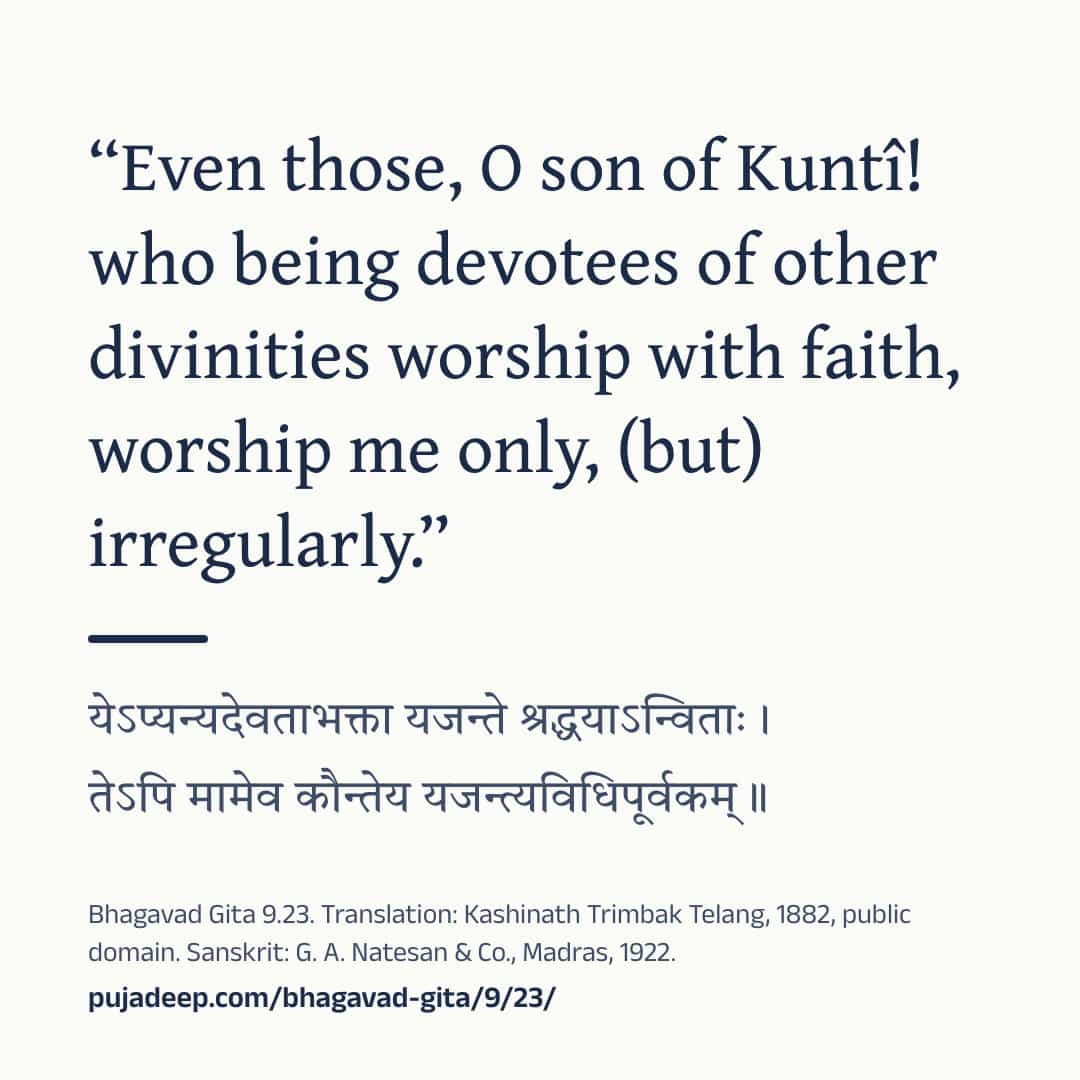
येऽप्यन्यदेवताभक्ता यजन्ते श्रद्धयाऽन्विताः ।
तेऽपि मामेव कौन्तेय यजन्त्यविधिपूर्वकम् ॥

“Even those, O son of Kuntî! who being devotees of other divinities worship with faith, worship me only, (but) irregularly.”
(K. T. Telang, The Bhagavadgîtâ (The Sacred Books of the East, vol. VIII, Oxford: Clarendon Press, 1882), p. 84, public domain)

“They also who worship other Gods with devotion, full of faith, they also worship Me, O son of Kuntî; though contrary to the ancient rule.”
(Annie Besant, The Bhagavad Gîtâ, or The Lord's Song (London: Theosophical Publishing Society, 1895), p. 91, public domain)

“Even those devotees, who endued with Shraddhá, worship other gods, they too, worship Me alone, O son of Kunti; (but) by the wrong method.”
(Swami Swarupananda, Srimad-Bhagavad-Gita (Mayavati: Prabuddha Bharata Press, 1909; first printed in Prabuddha Bharata, 1907–1909), p. 187, public domain)

Sanskrit: G. A. Natesan & Co., Madras, 1922.
https://pujadeep.com/bhagavad-gita/9/23/ Nothing is sent from this site. Your own app sends it, to the chat you choose. The picture quotes the translation you chose on this page, with its name and year.
Sanskrit text: The Bhagavad-Gita, or The Lord's Song, with the text in Devanagari and an English translation, 1922. Meanings: written for Pujadeep and checked against the cited edition. Source and changes
Questions families ask
Who speaks Bhagavad Gita 9.23?
Krishna speaks this verse, in chapter 9 (Raja Vidya Raja Guhya Yoga).
Where does the Sanskrit text come from?
Sanskrit text: The Bhagavad-Gita, or The Lord's Song, with the text in Devanagari and an English translation, 1922. Meanings: written for Pujadeep and checked against the cited edition. See the source
Is the meaning on this page a translation?
Explanation written for this site from the sources listed here, and checked against the cited edition. It is not a translation and not the only way to read the text. Free to quote with credit.
Source and licence
- Sanskrit text
- The Bhagavad-Gita, or The Lord's Song, with the text in Devanagari and an English translation (Annie Besant, G. A. Natesan & Co., Madras, 1922). Public domain. The Sanskrit on these pages was read from this printing’s page images.
- Translation
- The Bhagavadgîtâ with the Sanatsugâtîya and the Anugîtâ, translated by Kâshinâth Trimbak Telang (The Sacred Books of the East, vol. VIII, ed. F. Max Müller) (Kashinath Trimbak Telang, F. Max Müller, Clarendon Press, Oxford, 1882). Public domain. Shown verbatim, as printed.
- Translation
- The Bhagavad Gîtâ, or The Lord's Song, translated by Annie Besant (Annie Besant, Theosophical Publishing Society, London, 1895). Public domain. Shown verbatim, as printed.
- Translation
- Srimad-Bhagavad-Gita, with Sanskrit Text; Paraphrase with Word-by-word Literal Translation; English Rendering and Comments, Index, &c., by the Swami Swarupananda (Himalayan Series, No. XX) (Swami Swarupananda, The Editors and Publishers, Advaita Ashrama, Mayavati, Prabuddha Bharata Press, Mayavati, Almora, Himalayas, 1909). Public domain. Shown verbatim, as printed.
- Commentary
- The Bhagavad-Gita, with the commentary of Sri Sankaracharya, translated by A. Mahadeva Sastri (2nd ed., Mysore: G. T. A. Printing Works, 1901) (Public-domain scan, University of California Libraries). Summarised in our own words; none of its text is reproduced.
- Commentary
- Sri Bhagavad-Gita with Sri Ramanujacharya's Visishtadvaita commentary, translated by A. Govindacharya (Madras, 1898) (Scan uploaded to archive.org (folkscanomy collection)). Summarised in our own words; none of its text is reproduced.
- Common wording
- In this text, 32 words follow today's common wording, checked against sanskritdocuments.org; Sanskrit Wikisource; Gita Press, Gorakhpur; GRETIL, Göttingen and Bhaktivedanta Book Trust.
- Our explanation
- Explanation written for this site from the sources listed here, and checked against the cited edition. It is not a translation and not the only way to read the text. Free to quote with credit.
- Checked
- Checked against the cited edition, October 15, 2026.
- Updated
- October 27, 2026