Bhagavad Gita 9.18: meaning and translation
Chapter 9: Raja Vidya Raja Guhya Yoga. Krishna says
Krishna: The list goes on: he is the goal, the one who sustains, the master, the witness, the dwelling place, the refuge and the friend (suhṛt); the origin and the dissolution, the ground on which all rests, the treasure-house, and the seed that never perishes.
Click or tap a word for its meaning and its dictionary page.
Text and layers
Text and layers
These choices stay in this browser.
Bhagavad Gita 9.18
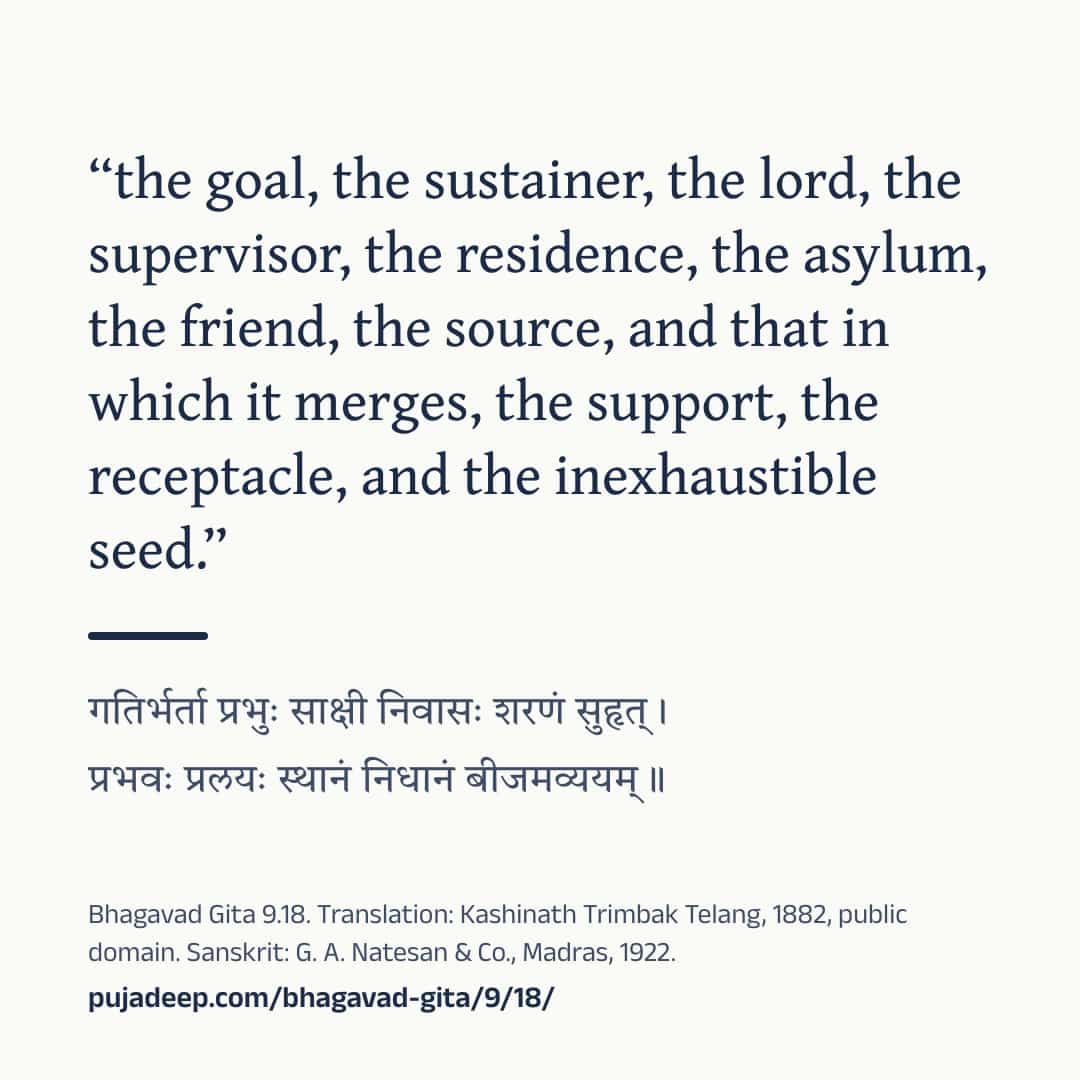
गतिर्भर्ता प्रभुः साक्षी निवासः शरणं सुहृत् ।प्रभवः प्रलयः स्थानं निधानं बीजमव्ययम् ॥
Gatirbharta prabhuh sakshi nivasah sharanam suhritPrabhavah pralayah sthanam nidhanam bijamavyayam
gatirbhartā prabhuḥ sākṣī nivāsaḥ śaraṇaṃ suhṛt |prabhavaḥ pralayaḥ sthānaṃ nidhānaṃ bījamavyayam ||
Our explanation The list goes on: he is the goal, the one who sustains, the master, the witness, the dwelling place, the refuge and the friend (suhṛt); the origin and the dissolution, the ground on which all rests, the treasure-house, and the seed that never perishes.
हिंदी अर्थ सूची आगे चलती है: वे गति (लक्ष्य), भरण-पोषण करने वाले, स्वामी, साक्षी, निवास, शरण और सुहृद (मित्र) हैं; वे उत्पत्ति और प्रलय हैं, सबका आधार हैं, निधान (भंडार) हैं, और कभी नष्ट न होने वाला बीज हैं।
Word by word
Every word, with its dictionary page
Word by word
- गतिः gatiḥ · goal (noun (feminine), nominative singular) Dictionary: gati, Monier-Williams 1899, p. 347, col. 3 “a happy issue”
- भर्ता bhartā · sustainer (noun (masculine), nominative singular) Dictionary: bhartṛ, Monier-Williams 1899, p. 748, col. 1 “a preserver, protector, maintainer, chief, lord, master”
- प्रभुः prabhuḥ · lord, master (noun (masculine), nominative singular) Dictionary: pra-bhu, Monier-Williams 1899, p. 684, col. 3 “excelling, mighty, powerful, rich, abundant”
- साक्षी sākṣī · witness (noun (masculine), nominative singular) Dictionary: sākṣin, Monier-Williams 1899, p. 1198, col. 1 “an eye-witness, witness”
- निवासः nivāsaḥ · abode (noun (masculine), nominative singular) Dictionary: ni-vāsa, Monier-Williams 1899, p. 559, col. 1 “dwelling-place, abode, house, habitation”
- शरणम् śaraṇam · refuge (noun (neuter), nominative singular) Dictionary: 2. śaraṇa, Monier-Williams 1899, p. 1057, col. 1 “refuge, protection”
- सुहृत् suhṛt · friend (noun (masculine), nominative singular) Dictionary: su-hṛd, Monier-Williams 1899, p. 1239, col. 3 “‘good-hearted,’ ‘kind-hearted,’ ‘well-disposed,’ a friend, ally”
- प्रभवः prabhavaḥ · origin (noun (masculine), nominative singular) Dictionary: pra-bhava, Monier-Williams 1899, p. 684, col. 2 “production, source, origin, cause of existence”
- प्रलयः pralayaḥ · dissolution (noun (masculine), nominative singular) Dictionary: pra-laya, Monier-Williams 1899, p. 689, col. 3 “dissolution, reabsorption, destruction, annihilation”
- स्थानम् sthānam · ground, resting place (noun (neuter), nominative singular) Dictionary: sthāna, Monier-Williams 1899, p. 1263, col. 1 “place of standing or staying, any place, spot, locality, abode”
- निधानम् nidhānam · treasure-house (noun (neuter), nominative singular) Dictionary: ni-dhāna, Monier-Williams 1899, p. 548, col. 3 “place for depositing anything, receptacle … a store, hoard, treasure”
- बीजम् bījam · seed (noun (neuter), nominative singular) Dictionary: bīja, Monier-Williams 1899, p. 732, col. 2 “seed (of plants), semen (of men and animals)”
- अव्ययम् avyayam · imperishable (adjective (neuter), nominative singular) Dictionary: 2. a-vyaya, Monier-Williams 1899, p. 111, col. 3 “not liable to change, imperishable, undecaying”
Old translations
Kashinath Trimbak Telang, 1882. Public domain. Page 83–84.
the goal, the sustainer, the lord, the supervisor, the residence1, the asylum, the friend, the source, and that in which it merges, the support, the receptacle, and the inexhaustible seed.
This sentence begins in 9.17.
Footnotes (the translator’s own) - I. e. the seat of enjoyment; receptacle=where things are preserved for future use, say the commentators. ↩
Compare 3 translations
Kashinath Trimbak Telang, 1882. Public domain. Page 83–84.
the goal, the sustainer, the lord, the supervisor, the residence1, the asylum, the friend, the source, and that in which it merges, the support, the receptacle, and the inexhaustible seed.
This sentence begins in 9.17.
Footnotes (the translator’s own) - I. e. the seat of enjoyment; receptacle=where things are preserved for future use, say the commentators. ↩
You are reading this one
Annie Besant, 1895. Public domain. Page 90.
The Path, Nourisher, Lord, Witness, Abode, Shelter, Lover, Origin, Dissolution, Foundation, Treasure-house, Seed imperishable.
This sentence begins in 9.16.
You are reading this one
Swami Swarupananda, 1909 (first printed 1907). Public domain. Page 184.
The Goal, the Supporter, the Lord, the Witness, the Abode, the Refuge, the Friend, the Origin, the Dissolution, the Substratum, the Storehouse, the Seed immutable.
You are reading this one
Cite this verse
The translation: K. T. Telang, The Bhagavadgîtâ (The Sacred Books of the East, vol. VIII, Oxford: Clarendon Press, 1882), pp. 83–84. Bhagavad Gita 9.18.
The translation: Annie Besant, The Bhagavad Gîtâ, or The Lord's Song (London: Theosophical Publishing Society, 1895), p. 90. Bhagavad Gita 9.18.
The translation: Swami Swarupananda, Srimad-Bhagavad-Gita (Mayavati: Prabuddha Bharata Press, 1909; first printed in Prabuddha Bharata, 1907–1909), p. 184. Bhagavad Gita 9.18.
Our explanation: “Bhagavad Gita 9.18: meaning and translation.” Pujadeep. Updated October 27, 2026. https://pujadeep.com/bhagavad-gita/9/18/
Pujadeep’s explanations are free to quote with credit: name Pujadeep and link to the page. How to credit
Classical readings, by school
No readings by school on this verse yet.
Share
Show the ways to share
Send one picture or the text to one chat. The picture names its source and the address of this page.
Drawing the picture
See the words
Bhagavad Gita 9.18

गतिर्भर्ता प्रभुः साक्षी निवासः शरणं सुहृत् ।
प्रभवः प्रलयः स्थानं निधानं बीजमव्ययम् ॥

“the goal, the sustainer, the lord, the supervisor, the residence, the asylum, the friend, the source, and that in which it merges, the support, the receptacle, and the inexhaustible seed.”
(K. T. Telang, The Bhagavadgîtâ (The Sacred Books of the East, vol. VIII, Oxford: Clarendon Press, 1882), pp. 83–84, public domain)
This sentence begins in 9.17.

“The Path, Nourisher, Lord, Witness, Abode, Shelter, Lover, Origin, Dissolution, Foundation, Treasure-house, Seed imperishable.”
(Annie Besant, The Bhagavad Gîtâ, or The Lord's Song (London: Theosophical Publishing Society, 1895), p. 90, public domain)
This sentence begins in 9.16.

“The Goal, the Supporter, the Lord, the Witness, the Abode, the Refuge, the Friend, the Origin, the Dissolution, the Substratum, the Storehouse, the Seed immutable.”
(Swami Swarupananda, Srimad-Bhagavad-Gita (Mayavati: Prabuddha Bharata Press, 1909; first printed in Prabuddha Bharata, 1907–1909), p. 184, public domain)

Sanskrit: G. A. Natesan & Co., Madras, 1922.
https://pujadeep.com/bhagavad-gita/9/18/ Nothing is sent from this site. Your own app sends it, to the chat you choose. The picture quotes the translation you chose on this page, with its name and year.
Sanskrit text: The Bhagavad-Gita, or The Lord's Song, with the text in Devanagari and an English translation, 1922. Meanings: written for Pujadeep and checked against the cited edition. Source and changes
Questions families ask
Who speaks Bhagavad Gita 9.18?
Krishna speaks this verse, in chapter 9 (Raja Vidya Raja Guhya Yoga).
Where does the Sanskrit text come from?
Sanskrit text: The Bhagavad-Gita, or The Lord's Song, with the text in Devanagari and an English translation, 1922. Meanings: written for Pujadeep and checked against the cited edition. See the source
Is the meaning on this page a translation?
Explanation written for this site from the sources listed here, and checked against the cited edition. It is not a translation and not the only way to read the text. Free to quote with credit.
Source and licence
- Sanskrit text
- The Bhagavad-Gita, or The Lord's Song, with the text in Devanagari and an English translation (Annie Besant, G. A. Natesan & Co., Madras, 1922). Public domain. The Sanskrit on these pages was read from this printing’s page images.
- Translation
- The Bhagavadgîtâ with the Sanatsugâtîya and the Anugîtâ, translated by Kâshinâth Trimbak Telang (The Sacred Books of the East, vol. VIII, ed. F. Max Müller) (Kashinath Trimbak Telang, F. Max Müller, Clarendon Press, Oxford, 1882). Public domain. Shown verbatim, as printed.
- Translation
- The Bhagavad Gîtâ, or The Lord's Song, translated by Annie Besant (Annie Besant, Theosophical Publishing Society, London, 1895). Public domain. Shown verbatim, as printed.
- Translation
- Srimad-Bhagavad-Gita, with Sanskrit Text; Paraphrase with Word-by-word Literal Translation; English Rendering and Comments, Index, &c., by the Swami Swarupananda (Himalayan Series, No. XX) (Swami Swarupananda, The Editors and Publishers, Advaita Ashrama, Mayavati, Prabuddha Bharata Press, Mayavati, Almora, Himalayas, 1909). Public domain. Shown verbatim, as printed.
- Common wording
- In this text, 32 words follow today's common wording, checked against sanskritdocuments.org; Sanskrit Wikisource; Gita Press, Gorakhpur; GRETIL, Göttingen and Bhaktivedanta Book Trust.
- Our explanation
- Explanation written for this site from the sources listed here, and checked against the cited edition. It is not a translation and not the only way to read the text. Free to quote with credit.
- Checked
- Checked against the cited edition, October 15, 2026.
- Updated
- October 27, 2026