Bhagavad Gita 9.19: meaning and translation
Chapter 9: Raja Vidya Raja Guhya Yoga. Krishna says
Krishna says that he gives heat, holds back the rain and sends it forth.
Click or tap a word for its meaning and its dictionary page.
Text and layers
Text and layers
These choices stay in this browser.
Bhagavad Gita 9.19
तपाम्यहमहं वर्षं निगृह्णाम्युत्सृजामि च ।अमृतं चैव मृत्युश्च सदसच्चाहमर्जुन ॥
Tapamyahamaham varsham nigrihnamyutsrijami chaAmritam chaiva mrityushcha sadasachchahamarjuna
tapāmyahamahaṃ varṣaṃ nigṛhṇāmyutsṛjāmi ca |amṛtaṃ caiva mṛtyuśca sadasaccāhamarjuna ||
Our explanation Krishna says that he gives heat, holds back the rain and sends it forth. He is deathlessness and death, and he is both what is (sat) and what is not (asat). The commentators explain sat and asat in different ways, for example as effect and cause.
हिंदी अर्थ कृष्ण कहते हैं कि वे ही ताप देते हैं, वर्षा को रोकते हैं और बरसाते हैं। वे अमृत भी हैं और मृत्यु भी, सत् भी हैं और असत् भी। टीकाकार सत् और असत् को अलग-अलग ढंग से समझाते हैं, जैसे कार्य और कारण।
Word by word
Every word, with its dictionary page
Word by word
- तपामि tapāmi · "I give heat" (present, 1st person singular) Dictionary: 2. tap, Monier-Williams 1899, p. 436, col. 3 “to give out heat, be hot, shine (as the sun)”
- अहम् aham · "I" (Krishna) (pronoun, nominative singular) Dictionary: aham, Monier-Williams 1899, p. 124, col. 2 “nom. sg. ‘I,’”
- अहम् aham · "I" (Krishna) (pronoun, nominative singular) Dictionary: aham, Monier-Williams 1899, p. 124, col. 2 “nom. sg. ‘I,’”
- वर्षम् varṣam · rain (noun (neuter), accusative singular) Dictionary: varṣa, Monier-Williams 1899, p. 926, col. 3 “rain, raining, a shower”
- निगृह्णामि nigṛhṇāmi · "I hold back" (present, 1st person singular) Dictionary: ni-grah, Monier-Williams 1899, p. 546, col. 1 “to keep or hold back”
- उत्सृजामि utsṛjāmi · "I send forth" (present, 1st person singular) Dictionary: ut-sṛj, Monier-Williams 1899, p. 182, col. 3 “to pour out, emit, send forth”
- च ca · and (indeclinable) Dictionary: 2. ca, Monier-Williams 1899, p. 380, col. 1 “and, both, also, moreover, as well as”
- अमृतम् amṛtam · deathlessness (noun (neuter), nominative singular) Dictionary: a-mṛta, Monier-Williams 1899, p. 82, col. 2 “immortality”
- च ca · and (indeclinable) Dictionary: 2. ca, Monier-Williams 1899, p. 380, col. 1 “and, both, also, moreover, as well as”
- एव eva · indeed (indeclinable) Dictionary: 1. eva, Monier-Williams 1899, p. 232, col. 2 “so, just so, exactly so; indeed, truly, really”
- मृत्युः mṛtyuḥ · death (noun (masculine), nominative singular) Dictionary: mṛtyu, Monier-Williams 1899, p. 827, col. 3 “death, dying”
- च ca · and (indeclinable) Dictionary: 2. ca, Monier-Williams 1899, p. 380, col. 1 “and, both, also, moreover, as well as”
- सत् sat · what is (sat) (noun (neuter), nominative singular) Dictionary: sat, Monier-Williams 1899, p. 1134, col. 2 “that which really is, entity or existence, essence”
- असत् asat · what is not (asat) (noun (neuter), nominative singular) Dictionary: a-sat, Monier-Williams 1899, p. 118, col. 2 “not being, not existing, unreal”
- च ca · and (indeclinable) Dictionary: 2. ca, Monier-Williams 1899, p. 380, col. 1 “and, both, also, moreover, as well as”
- अहम् aham · "I" (Krishna) (pronoun, nominative singular) Dictionary: aham, Monier-Williams 1899, p. 124, col. 2 “nom. sg. ‘I,’”
- अर्जुन arjuna · O Arjuna (noun (masculine), vocative singular) Dictionary: arjuna, Monier-Williams 1899, p. 90, col. 1
Old translations
Kashinath Trimbak Telang, 1882. Public domain. Page 84.
I cause heat and I send forth and stop showers. I am immortality and also death; and I, O Arguna! am that which is and that which is not1.
Footnotes (the translator’s own) - The gross and the subtle elements, or causes and effects. ↩
Compare 3 translations
Kashinath Trimbak Telang, 1882. Public domain. Page 84.
I cause heat and I send forth and stop showers. I am immortality and also death; and I, O Arguna! am that which is and that which is not1.
Footnotes (the translator’s own) - The gross and the subtle elements, or causes and effects. ↩
You are reading this one
Annie Besant, 1895. Public domain. Page 90.
I give heat; I hold back and send forth the rain; immortality and also death, Sat and Asat1 am I, Arjuna.
Footnotes (the translator’s own) - Existence and non-existence, the final pair of opposites, beyond which is only the One. ↩
You are reading this one
Swami Swarupananda, 1909 (first printed 1907). Public domain. Page 184.
(As sun) I give heat: I withhold and send forth the rain; I am immortality and also death, the being and non-being am I, O Arjuna!
You are reading this one
Cite this verse
The translation: K. T. Telang, The Bhagavadgîtâ (The Sacred Books of the East, vol. VIII, Oxford: Clarendon Press, 1882), p. 84. Bhagavad Gita 9.19.
The translation: Annie Besant, The Bhagavad Gîtâ, or The Lord's Song (London: Theosophical Publishing Society, 1895), p. 90. Bhagavad Gita 9.19.
The translation: Swami Swarupananda, Srimad-Bhagavad-Gita (Mayavati: Prabuddha Bharata Press, 1909; first printed in Prabuddha Bharata, 1907–1909), p. 184. Bhagavad Gita 9.19.
Our explanation: “Bhagavad Gita 9.19: meaning and translation.” Pujadeep. Updated October 27, 2026. https://pujadeep.com/bhagavad-gita/9/19/
Pujadeep’s explanations are free to quote with credit: name Pujadeep and link to the page. How to credit
Classical readings, by school
No readings by school on this verse yet.
Share
Show the ways to share
Send one picture or the text to one chat. The picture names its source and the address of this page.
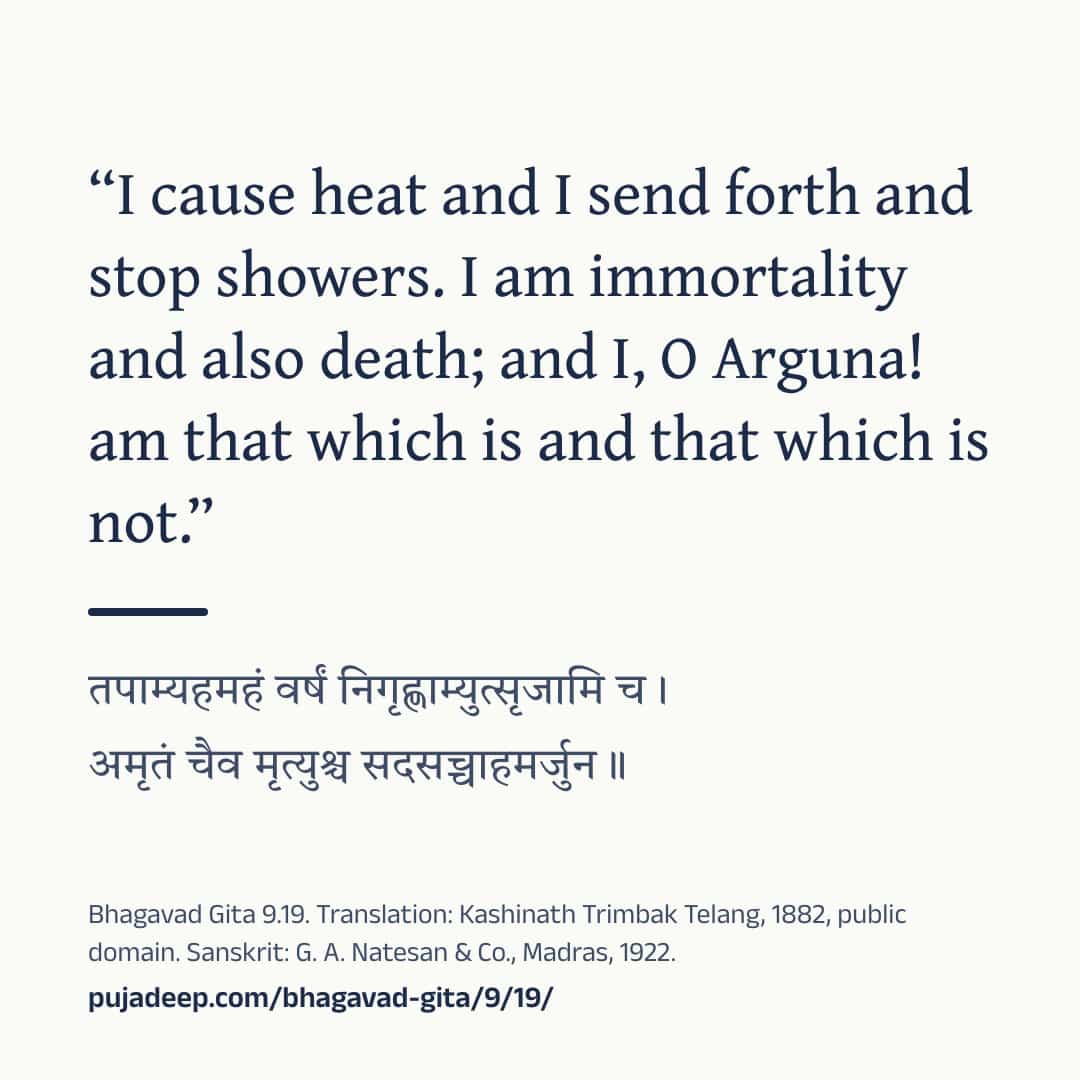
Drawing the picture
See the words
Bhagavad Gita 9.19

तपाम्यहमहं वर्षं निगृह्णाम्युत्सृजामि च ।
अमृतं चैव मृत्युश्च सदसच्चाहमर्जुन ॥

“I cause heat and I send forth and stop showers. I am immortality and also death; and I, O Arguna! am that which is and that which is not.”
(K. T. Telang, The Bhagavadgîtâ (The Sacred Books of the East, vol. VIII, Oxford: Clarendon Press, 1882), p. 84, public domain)

“I give heat; I hold back and send forth the rain; immortality and also death, Sat and Asat am I, Arjuna.”
(Annie Besant, The Bhagavad Gîtâ, or The Lord's Song (London: Theosophical Publishing Society, 1895), p. 90, public domain)

“(As sun) I give heat: I withhold and send forth the rain; I am immortality and also death, the being and non-being am I, O Arjuna!”
(Swami Swarupananda, Srimad-Bhagavad-Gita (Mayavati: Prabuddha Bharata Press, 1909; first printed in Prabuddha Bharata, 1907–1909), p. 184, public domain)

Sanskrit: G. A. Natesan & Co., Madras, 1922.
https://pujadeep.com/bhagavad-gita/9/19/ Nothing is sent from this site. Your own app sends it, to the chat you choose. The picture quotes the translation you chose on this page, with its name and year.
Sanskrit text: The Bhagavad-Gita, or The Lord's Song, with the text in Devanagari and an English translation, 1922. Meanings: written for Pujadeep and checked against the cited edition. Source and changes
Questions families ask
Who speaks Bhagavad Gita 9.19?
Krishna speaks this verse, in chapter 9 (Raja Vidya Raja Guhya Yoga).
Where does the Sanskrit text come from?
Sanskrit text: The Bhagavad-Gita, or The Lord's Song, with the text in Devanagari and an English translation, 1922. Meanings: written for Pujadeep and checked against the cited edition. See the source
Is the meaning on this page a translation?
Explanation written for this site from the sources listed here, and checked against the cited edition. It is not a translation and not the only way to read the text. Free to quote with credit.
Source and licence
- Sanskrit text
- The Bhagavad-Gita, or The Lord's Song, with the text in Devanagari and an English translation (Annie Besant, G. A. Natesan & Co., Madras, 1922). Public domain. The Sanskrit on these pages was read from this printing’s page images.
- Translation
- The Bhagavadgîtâ with the Sanatsugâtîya and the Anugîtâ, translated by Kâshinâth Trimbak Telang (The Sacred Books of the East, vol. VIII, ed. F. Max Müller) (Kashinath Trimbak Telang, F. Max Müller, Clarendon Press, Oxford, 1882). Public domain. Shown verbatim, as printed.
- Translation
- The Bhagavad Gîtâ, or The Lord's Song, translated by Annie Besant (Annie Besant, Theosophical Publishing Society, London, 1895). Public domain. Shown verbatim, as printed.
- Translation
- Srimad-Bhagavad-Gita, with Sanskrit Text; Paraphrase with Word-by-word Literal Translation; English Rendering and Comments, Index, &c., by the Swami Swarupananda (Himalayan Series, No. XX) (Swami Swarupananda, The Editors and Publishers, Advaita Ashrama, Mayavati, Prabuddha Bharata Press, Mayavati, Almora, Himalayas, 1909). Public domain. Shown verbatim, as printed.
- Common wording
- In this text, 32 words follow today's common wording, checked against sanskritdocuments.org; Sanskrit Wikisource; Gita Press, Gorakhpur; GRETIL, Göttingen and Bhaktivedanta Book Trust.
- Our explanation
- Explanation written for this site from the sources listed here, and checked against the cited edition. It is not a translation and not the only way to read the text. Free to quote with credit.
- Checked
- Checked against the cited edition, October 15, 2026.
- Updated
- October 27, 2026