Bhagavad Gita 9.26: meaning and translation
Chapter 9: Raja Vidya Raja Guhya Yoga. Krishna says
Krishna says that whoever offers him a leaf, a flower, a fruit or water with devotion, he accepts that offering of love from one whose heart is pure.
Click or tap a word for its meaning and its dictionary page.
Text and layers
Text and layers
These choices stay in this browser.
Bhagavad Gita 9.26
पत्रं पुष्पं फलं तोयं यो मे भक्त्या प्रयच्छति ।तदहं भक्त्युपहृतमश्नामि प्रयतात्मनः ॥
Patram pushpam phalam toyam yo me bhaktya prayachchhatiTadaham bhaktyupahritamashnami prayatatmanah
patraṃ puṣpaṃ phalaṃ toyaṃ yo me bhaktyā prayacchati |tadahaṃ bhaktyupahṛtamaśnāmi prayatātmanaḥ ||
Our explanation Krishna says that whoever offers him a leaf, a flower, a fruit or water with devotion, he accepts that offering of love from one whose heart is pure.
हिंदी अर्थ कृष्ण कहते हैं कि जो कोई भक्ति से उन्हें पत्ता, फूल, फल या जल अर्पित करता है, शुद्ध मन वाले उस व्यक्ति का प्रेम से दिया वह उपहार वे स्वीकार करते हैं।
Word by word
Every word, with its dictionary page
Word by word
- पत्रम् patram · a leaf (noun (neuter), accusative singular) Dictionary: pattra, Monier-Williams 1899, p. 581, col. 2 “a leaf, petal”
- पुष्पम् puṣpam · a flower (noun (neuter), accusative singular) Dictionary: puṣpa, Monier-Williams 1899, p. 639, col. 2 “a flower”
- फलम् phalam · a fruit (noun (neuter), accusative singular) Dictionary: phala, Monier-Williams 1899, p. 716, col. 2 “fruit (esp. of trees)”
- तोयम् toyam · water (noun (neuter), accusative singular) Dictionary: toya, Monier-Williams 1899, p. 456, col. 1 “water”
- यः yaḥ · whoever (relative pronoun (masculine), nominative singular) Dictionary: yad, Monier-Williams 1899, p. 844, col. 2 “who, which, what, whichever, whatever, that”
- मे me · to "me" (pronoun, dative singular) Dictionary: 1. mad, Monier-Williams 1899, p. 777, col. 2 “base of the first pers. pron. in the sg. number (esp. in comp.)”
- भक्त्या bhaktyā · with devotion (noun (feminine), instrumental singular) Dictionary: bhakti, Monier-Williams 1899, p. 743, col. 2 “attachment, devotion, fondness for, devotion to”
- प्रयच्छति prayacchati · offers (present, 3rd person singular) Dictionary: pra-yam, Monier-Williams 1899, p. 687, col. 3 “to offer, present, give, grant, bestow”
- तत् tat · that (pronoun (neuter), accusative singular) Dictionary: tad, Monier-Williams 1899, p. 434, col. 1 “m. he, f. she, n. it, that, this”
- अहम् aham · "I" (Krishna) (pronoun, nominative singular) Dictionary: aham, Monier-Williams 1899, p. 124, col. 2 “nom. sg. ‘I,’”
- भक्त्युपहृतम् bhaktyupahṛtam · offered with devotion (compound (neuter), accusative singular) Dictionary: bhakti, Monier-Williams 1899, p. 743, col. 2 “attachment, devotion, fondness for, devotion to”; upa-hṛta, Monier-Williams 1899, p. 212, col. 2 “brought near, offered, presented”
- अश्नामि aśnāmi · "I accept" (lit. eat) (present, 1st person singular) Dictionary: 2. aś, Monier-Williams 1899, p. 112, col. 2 “to eat, consume”
- प्रयतात्मनः prayatātmanaḥ · from one pure in heart (compound (masculine), genitive singular) Dictionary: pra-yatātman, Monier-Williams 1899, p. 687, col. 3; pra-yata-mānasa, Monier-Williams 1899, p. 687, col. 3 “pious-minded, devout, ascetic”
Old translations
Kashinath Trimbak Telang, 1882. Public domain. Page 85.
Whoever with devotion offers me leaf, flower, fruit, water, that, presented with devotion, I accept from him whose self is pure.
Compare 3 translations
Kashinath Trimbak Telang, 1882. Public domain. Page 85.
Whoever with devotion offers me leaf, flower, fruit, water, that, presented with devotion, I accept from him whose self is pure.
You are reading this one
Annie Besant, 1895. Public domain. Page 92.
He who offereth to Me with devotion a leaf, a flower, a fruit, water, that I accept from the purified self, offered as it is with devotion.
You are reading this one
Swami Swarupananda, 1909 (first printed 1907). Public domain. Page 188.
Whoever, with devotion offers Me, a leaf, a flower, a fruit, water, that I accept;—the devout gift of the pure-minded.
You are reading this one
Cite this verse
The translation: K. T. Telang, The Bhagavadgîtâ (The Sacred Books of the East, vol. VIII, Oxford: Clarendon Press, 1882), p. 85. Bhagavad Gita 9.26.
The translation: Annie Besant, The Bhagavad Gîtâ, or The Lord's Song (London: Theosophical Publishing Society, 1895), p. 92. Bhagavad Gita 9.26.
The translation: Swami Swarupananda, Srimad-Bhagavad-Gita (Mayavati: Prabuddha Bharata Press, 1909; first printed in Prabuddha Bharata, 1907–1909), p. 188. Bhagavad Gita 9.26.
Our explanation: “Bhagavad Gita 9.26: meaning and translation.” Pujadeep. Updated October 27, 2026. https://pujadeep.com/bhagavad-gita/9/26/
Pujadeep’s explanations are free to quote with credit: name Pujadeep and link to the page. How to credit
Classical readings, by school
No readings by school on this verse yet.
This verse is on our page of well-known Gita verses, by theme
Share
Show the ways to share
Send one picture or the text to one chat. The picture names its source and the address of this page.
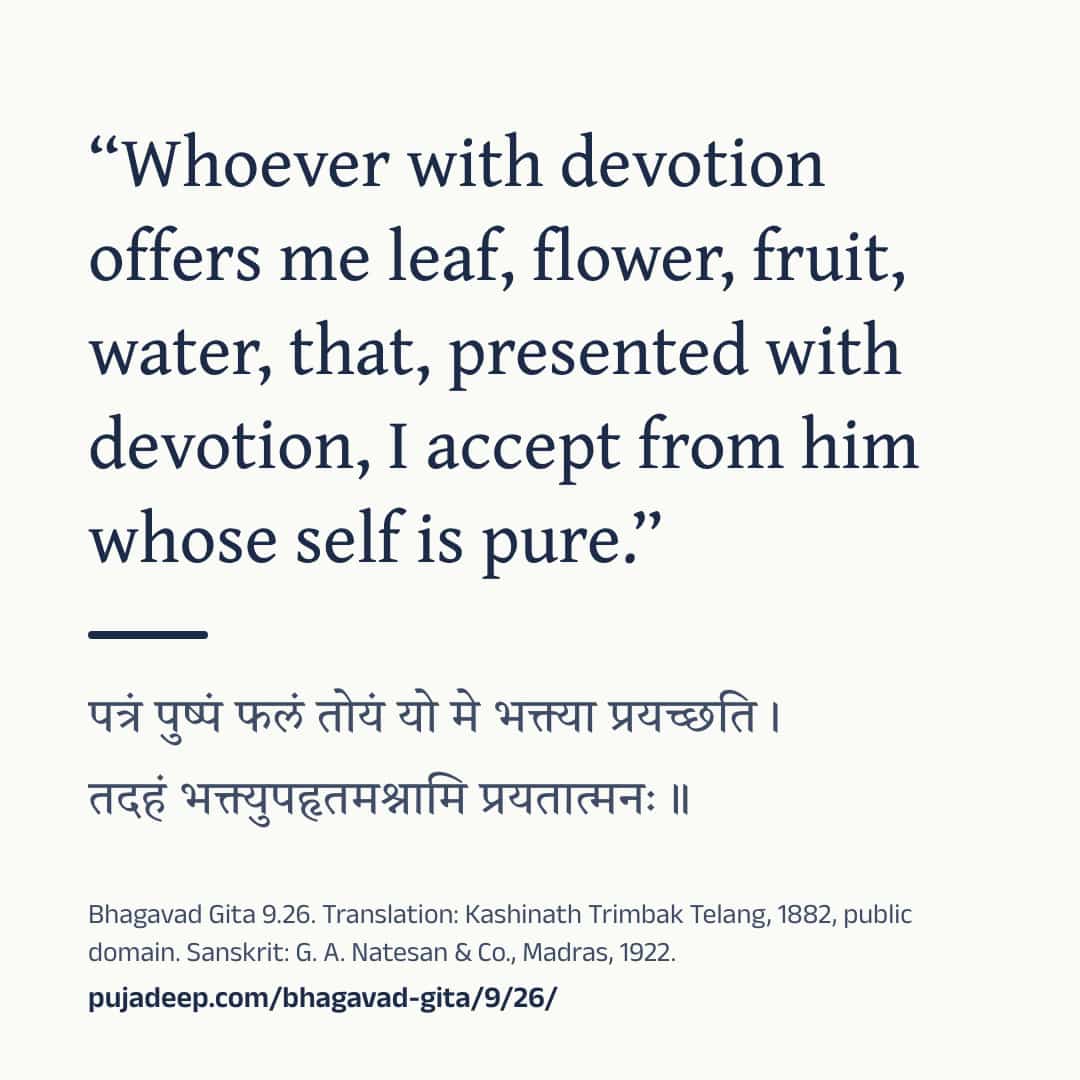
Drawing the picture
See the words
Bhagavad Gita 9.26

पत्रं पुष्पं फलं तोयं यो मे भक्त्या प्रयच्छति ।
तदहं भक्त्युपहृतमश्नामि प्रयतात्मनः ॥

“Whoever with devotion offers me leaf, flower, fruit, water, that, presented with devotion, I accept from him whose self is pure.”
(K. T. Telang, The Bhagavadgîtâ (The Sacred Books of the East, vol. VIII, Oxford: Clarendon Press, 1882), p. 85, public domain)

“He who offereth to Me with devotion a leaf, a flower, a fruit, water, that I accept from the purified self, offered as it is with devotion.”
(Annie Besant, The Bhagavad Gîtâ, or The Lord's Song (London: Theosophical Publishing Society, 1895), p. 92, public domain)

“Whoever, with devotion offers Me, a leaf, a flower, a fruit, water, that I accept;—the devout gift of the pure-minded.”
(Swami Swarupananda, Srimad-Bhagavad-Gita (Mayavati: Prabuddha Bharata Press, 1909; first printed in Prabuddha Bharata, 1907–1909), p. 188, public domain)

Sanskrit: G. A. Natesan & Co., Madras, 1922.
https://pujadeep.com/bhagavad-gita/9/26/ Nothing is sent from this site. Your own app sends it, to the chat you choose. The picture quotes the translation you chose on this page, with its name and year.
Sanskrit text: The Bhagavad-Gita, or The Lord's Song, with the text in Devanagari and an English translation, 1922. Meanings: written for Pujadeep and checked against the cited edition. Source and changes
Questions families ask
Who speaks Bhagavad Gita 9.26?
Krishna speaks this verse, in chapter 9 (Raja Vidya Raja Guhya Yoga).
Where does the Sanskrit text come from?
Sanskrit text: The Bhagavad-Gita, or The Lord's Song, with the text in Devanagari and an English translation, 1922. Meanings: written for Pujadeep and checked against the cited edition. See the source
Is the meaning on this page a translation?
Explanation written for this site from the sources listed here, and checked against the cited edition. It is not a translation and not the only way to read the text. Free to quote with credit.
Source and licence
- Sanskrit text
- The Bhagavad-Gita, or The Lord's Song, with the text in Devanagari and an English translation (Annie Besant, G. A. Natesan & Co., Madras, 1922). Public domain. The Sanskrit on these pages was read from this printing’s page images.
- Translation
- The Bhagavadgîtâ with the Sanatsugâtîya and the Anugîtâ, translated by Kâshinâth Trimbak Telang (The Sacred Books of the East, vol. VIII, ed. F. Max Müller) (Kashinath Trimbak Telang, F. Max Müller, Clarendon Press, Oxford, 1882). Public domain. Shown verbatim, as printed.
- Translation
- The Bhagavad Gîtâ, or The Lord's Song, translated by Annie Besant (Annie Besant, Theosophical Publishing Society, London, 1895). Public domain. Shown verbatim, as printed.
- Translation
- Srimad-Bhagavad-Gita, with Sanskrit Text; Paraphrase with Word-by-word Literal Translation; English Rendering and Comments, Index, &c., by the Swami Swarupananda (Himalayan Series, No. XX) (Swami Swarupananda, The Editors and Publishers, Advaita Ashrama, Mayavati, Prabuddha Bharata Press, Mayavati, Almora, Himalayas, 1909). Public domain. Shown verbatim, as printed.
- Common wording
- In this text, 32 words follow today's common wording, checked against sanskritdocuments.org; Sanskrit Wikisource; Gita Press, Gorakhpur; GRETIL, Göttingen and Bhaktivedanta Book Trust.
- Our explanation
- Explanation written for this site from the sources listed here, and checked against the cited edition. It is not a translation and not the only way to read the text. Free to quote with credit.
- Checked
- Checked against the cited edition, October 15, 2026.
- Updated
- October 27, 2026