Bhagavad Gita 9.28: meaning and translation
Chapter 9: Raja Vidya Raja Guhya Yoga. Krishna says
Krishna says that in this way Arjuna will be freed from the bonds of action, whose fruits are pleasant and unpleasant.
Click or tap a word for its meaning and its dictionary page.
Text and layers
Text and layers
These choices stay in this browser.
Bhagavad Gita 9.28
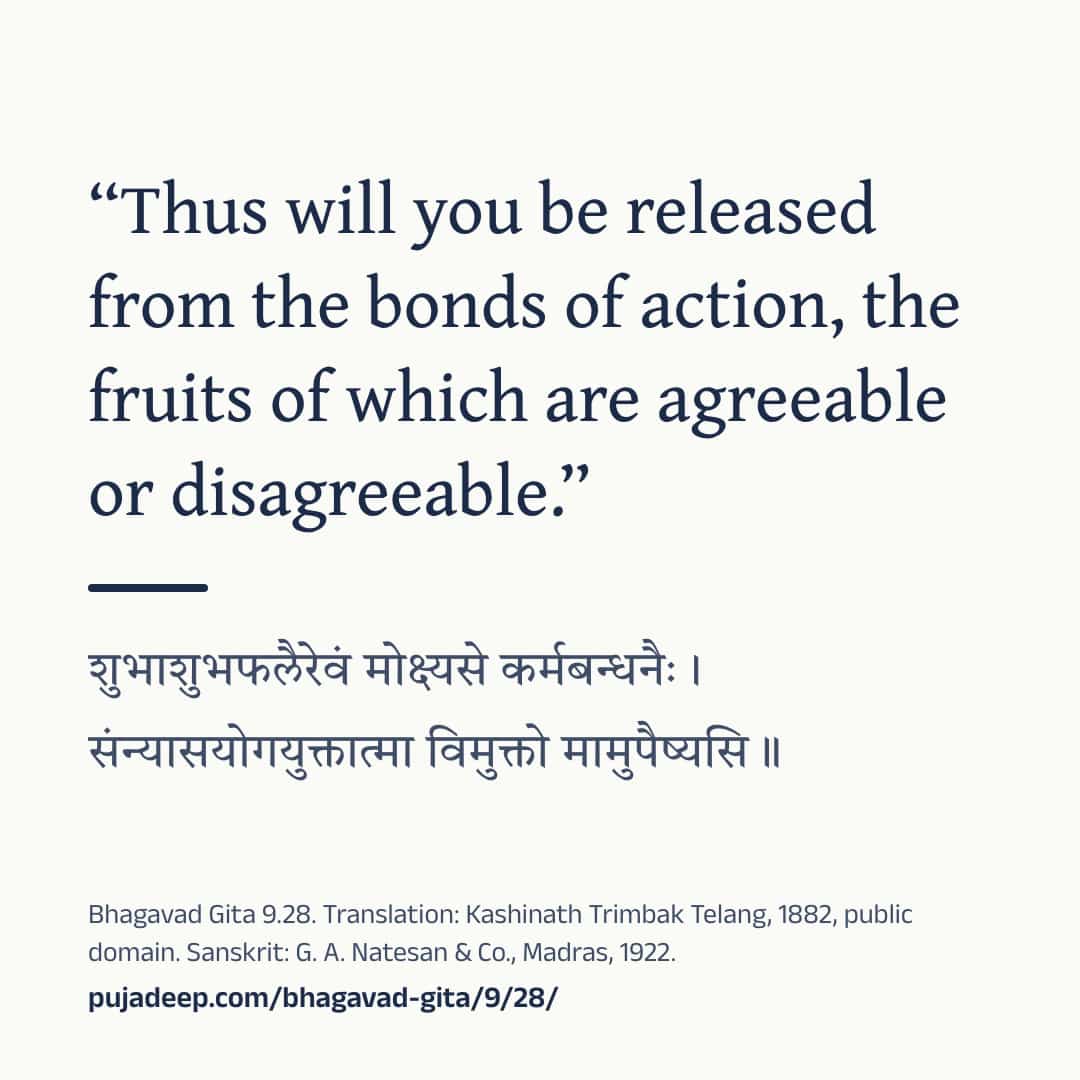
शुभाशुभफलैरेवं मोक्ष्यसे कर्मबन्धनैः ।संन्यासयोगयुक्तात्मा विमुक्तो मामुपैष्यसि ॥
Shubhashubhaphalairevam mokshyase karmabandhanaihSannyasayogayuktatma vimukto mamupaishyasi
śubhāśubhaphalairevaṃ mokṣyase karmabandhanaiḥ |saṃnyāsayogayuktātmā vimukto māmupaiṣyasi ||
Our explanation Krishna says that in this way Arjuna will be freed from the bonds of action, whose fruits are pleasant and unpleasant. With his mind joined in the yoga of renunciation (saṃnyāsa-yoga), Krishna says, he will be free and will come to him.
हिंदी अर्थ कृष्ण कहते हैं कि इस तरह अर्जुन शुभ और अशुभ फल देने वाले कर्म-बंधनों से छूट जाएँगे। कृष्ण कहते हैं कि संन्यास-योग से युक्त मन के साथ वे मुक्त होकर उन्हीं को प्राप्त होंगे।
Word by word
Every word, with its dictionary page
Word by word
- शुभाशुभफलैः śubhāśubhaphalaiḥ · whose fruits are good and bad (compound (neuter), instrumental plural) Dictionary: śubhāśubha, Monier-Williams 1899, p. 1083, col. 3 “pleasant and unpleasant, agreeable and disagreeable”; phala, Monier-Williams 1899, p. 716, col. 2 “fruit (esp. of trees)”
- एवम् evam · thus (indeclinable) Dictionary: evam, Monier-Williams 1899, p. 232, col. 2 “thus, in this way, in such a manner”
- मोक्ष्यसे mokṣyase · you will be freed (future (middle), 2nd person singular) Dictionary: 2. muc, Monier-Williams 1899, p. 820, col. 3 “to be loosed, to be set free or released”
- कर्मबन्धनैः karmabandhanaiḥ · from the bonds of action (compound (neuter), instrumental plural) Dictionary: karman, Monier-Williams 1899, p. 258, col. 2 “act, action, performance, business”; bandhana, Monier-Williams 1899, p. 721, col. 1 “a bond, tie (also fig.), rope, cord, tether”
- संन्यासयोगयुक्तात्मा saṃnyāsayogayuktātmā · with mind joined in the yoga of renunciation (compound (masculine), nominative singular) Dictionary: saṃ-nyāsa, Monier-Williams 1899, p. 1148, col. 1 “renunciation of the world, profession of asceticism”; yoga, Monier-Williams 1899, p. 856, col. 2 “the act of yoking, joining, attaching”; yukta, Monier-Williams 1899, p. 853, col. 2 “yoked or joined or fastened or attached or harnessed”; ātman, Monier-Williams 1899, p. 135, col. 1 “the individual soul, self”
- विमुक्तः vimuktaḥ · freed (past participle (masculine), nominative singular) Dictionary: vi-mukta, Monier-Williams 1899, p. 980, col. 2 “set free, liberated, freed or delivered or escaped from”
- माम् mām · to "me" (Krishna) (pronoun, accusative singular) Dictionary: 1. mad, Monier-Williams 1899, p. 777, col. 2 “base of the first pers. pron. in the sg. number (esp. in comp.)”
- उपैष्यसि upaiṣyasi · you will come (future, 2nd person singular) Dictionary: 1. upe, Monier-Williams 1899, p. 215, col. 2 “to go or come or step near, approach, betake one's self to, arrive at”
Old translations
Kashinath Trimbak Telang, 1882. Public domain. Page 85.
Thus will you be released from the bonds of action, the fruits of which are agreeable or disagreeable. And with your self possessed of (this) devotion, (this) renunciation1, you will be released (from the bonds of action) and will come to me.
Footnotes (the translator’s own) - This mode of action is at once devotion and renunciation: the first, because one cares not for fruit; the second, because it is offered to the supreme. ↩
Compare 3 translations
Kashinath Trimbak Telang, 1882. Public domain. Page 85.
Thus will you be released from the bonds of action, the fruits of which are agreeable or disagreeable. And with your self possessed of (this) devotion, (this) renunciation1, you will be released (from the bonds of action) and will come to me.
Footnotes (the translator’s own) - This mode of action is at once devotion and renunciation: the first, because one cares not for fruit; the second, because it is offered to the supreme. ↩
You are reading this one
Annie Besant, 1895. Public domain. Page 92.
Thus shalt thou be liberated from the bands of actions of good and evil fruits; thyself knit to the Yoga of renunciation, thou shalt come unto Me when set free.
You are reading this one
Swami Swarupananda, 1909 (first printed 1907). Public domain. Page 189.
Thus shalt thou be freed from the bondages of actions, bearing good and evil results: with the heart steadfast in the Yoga of renunciation, and liberated, thou shalt come unto Me.
You are reading this one
Cite this verse
The translation: K. T. Telang, The Bhagavadgîtâ (The Sacred Books of the East, vol. VIII, Oxford: Clarendon Press, 1882), p. 85. Bhagavad Gita 9.28.
The translation: Annie Besant, The Bhagavad Gîtâ, or The Lord's Song (London: Theosophical Publishing Society, 1895), p. 92. Bhagavad Gita 9.28.
The translation: Swami Swarupananda, Srimad-Bhagavad-Gita (Mayavati: Prabuddha Bharata Press, 1909; first printed in Prabuddha Bharata, 1907–1909), p. 189. Bhagavad Gita 9.28.
Our explanation: “Bhagavad Gita 9.28: meaning and translation.” Pujadeep. Updated October 27, 2026. https://pujadeep.com/bhagavad-gita/9/28/
Pujadeep’s explanations are free to quote with credit: name Pujadeep and link to the page. How to credit
Classical readings, by school
No readings by school on this verse yet.
Share
Show the ways to share
Send one picture or the text to one chat. The picture names its source and the address of this page.
Drawing the picture
See the words
Bhagavad Gita 9.28

शुभाशुभफलैरेवं मोक्ष्यसे कर्मबन्धनैः ।
संन्यासयोगयुक्तात्मा विमुक्तो मामुपैष्यसि ॥

“Thus will you be released from the bonds of action, the fruits of which are agreeable or disagreeable. And with your self possessed of (this) devotion, (this) renunciation, you will be released (from the bonds of action) and will come to me.”
(K. T. Telang, The Bhagavadgîtâ (The Sacred Books of the East, vol. VIII, Oxford: Clarendon Press, 1882), p. 85, public domain)

“Thus shalt thou be liberated from the bands of actions of good and evil fruits; thyself knit to the Yoga of renunciation, thou shalt come unto Me when set free.”
(Annie Besant, The Bhagavad Gîtâ, or The Lord's Song (London: Theosophical Publishing Society, 1895), p. 92, public domain)

“Thus shalt thou be freed from the bondages of actions, bearing good and evil results: with the heart steadfast in the Yoga of renunciation, and liberated, thou shalt come unto Me.”
(Swami Swarupananda, Srimad-Bhagavad-Gita (Mayavati: Prabuddha Bharata Press, 1909; first printed in Prabuddha Bharata, 1907–1909), p. 189, public domain)

Sanskrit: G. A. Natesan & Co., Madras, 1922.
https://pujadeep.com/bhagavad-gita/9/28/ Nothing is sent from this site. Your own app sends it, to the chat you choose. The picture quotes the translation you chose on this page, with its name and year.
Sanskrit text: The Bhagavad-Gita, or The Lord's Song, with the text in Devanagari and an English translation, 1922. Meanings: written for Pujadeep and checked against the cited edition. Source and changes
Questions families ask
Who speaks Bhagavad Gita 9.28?
Krishna speaks this verse, in chapter 9 (Raja Vidya Raja Guhya Yoga).
Where does the Sanskrit text come from?
Sanskrit text: The Bhagavad-Gita, or The Lord's Song, with the text in Devanagari and an English translation, 1922. Meanings: written for Pujadeep and checked against the cited edition. See the source
Is the meaning on this page a translation?
Explanation written for this site from the sources listed here, and checked against the cited edition. It is not a translation and not the only way to read the text. Free to quote with credit.
Source and licence
- Sanskrit text
- The Bhagavad-Gita, or The Lord's Song, with the text in Devanagari and an English translation (Annie Besant, G. A. Natesan & Co., Madras, 1922). Public domain. The Sanskrit on these pages was read from this printing’s page images.
- Translation
- The Bhagavadgîtâ with the Sanatsugâtîya and the Anugîtâ, translated by Kâshinâth Trimbak Telang (The Sacred Books of the East, vol. VIII, ed. F. Max Müller) (Kashinath Trimbak Telang, F. Max Müller, Clarendon Press, Oxford, 1882). Public domain. Shown verbatim, as printed.
- Translation
- The Bhagavad Gîtâ, or The Lord's Song, translated by Annie Besant (Annie Besant, Theosophical Publishing Society, London, 1895). Public domain. Shown verbatim, as printed.
- Translation
- Srimad-Bhagavad-Gita, with Sanskrit Text; Paraphrase with Word-by-word Literal Translation; English Rendering and Comments, Index, &c., by the Swami Swarupananda (Himalayan Series, No. XX) (Swami Swarupananda, The Editors and Publishers, Advaita Ashrama, Mayavati, Prabuddha Bharata Press, Mayavati, Almora, Himalayas, 1909). Public domain. Shown verbatim, as printed.
- Common wording
- In this text, 32 words follow today's common wording, checked against sanskritdocuments.org; Sanskrit Wikisource; Gita Press, Gorakhpur; GRETIL, Göttingen and Bhaktivedanta Book Trust.
- Our explanation
- Explanation written for this site from the sources listed here, and checked against the cited edition. It is not a translation and not the only way to read the text. Free to quote with credit.
- Checked
- Checked against the cited edition, October 15, 2026.
- Updated
- October 27, 2026