भगवद्गीता 9.28: अर्थ और अनुवाद
अध्याय 9: राजविद्याराजगुह्ययोग। कृष्ण कहते हैं
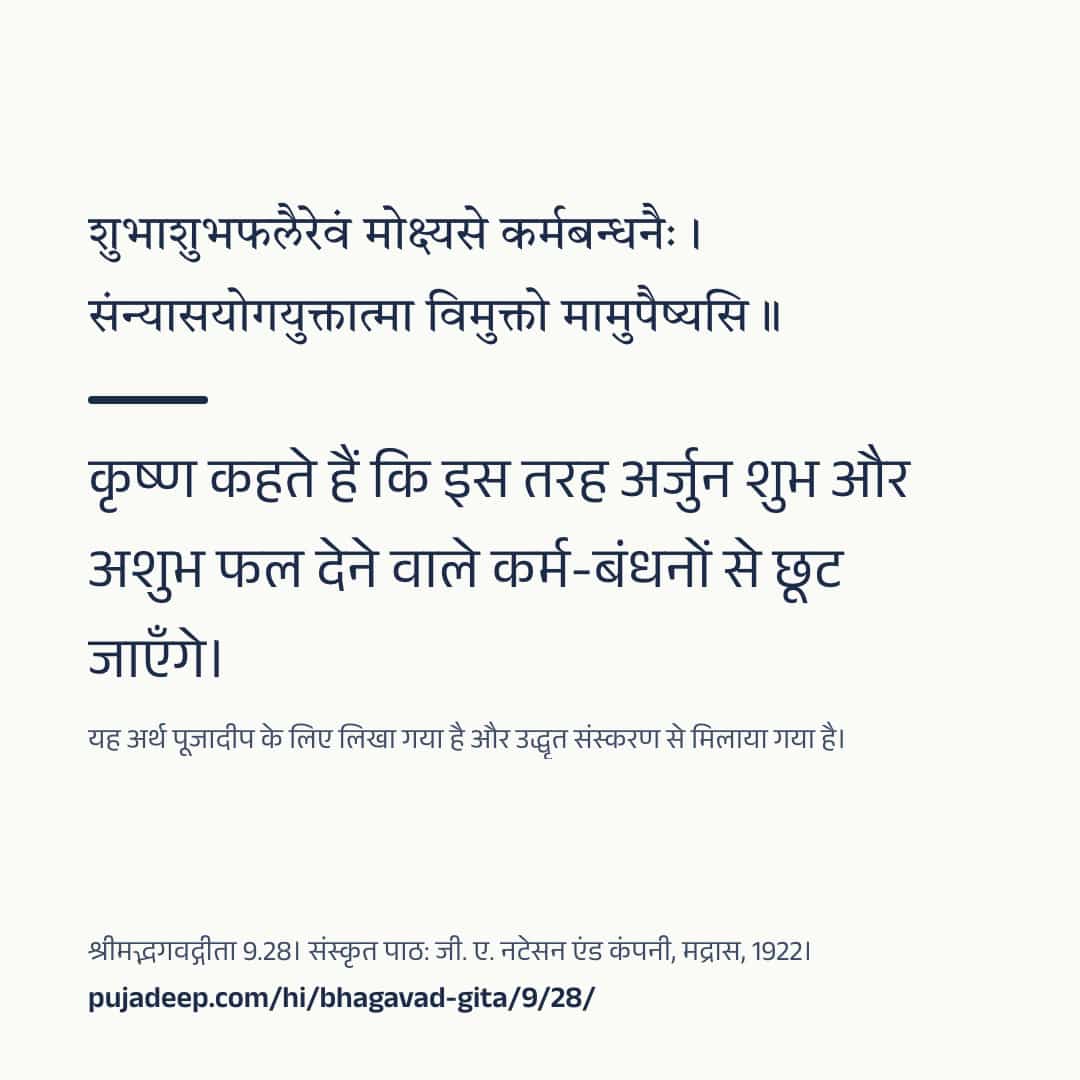
श्रीमद्भगवद्गीता (Bhagavad Gita) 9.28: कृष्ण कहते हैं कि इस तरह अर्जुन शुभ और अशुभ फल देने वाले कर्म-बंधनों से छूट जाएँगे।
किसी शब्द पर क्लिक करें या उसे छुएँ, उसका अर्थ और कोश का पृष्ठ देखें।
दिखावट
दिखावट
ये चुनाव इसी ब्राउज़र में रहते हैं।
श्रीमद्भगवद्गीता 9.28
शुभाशुभफलैरेवं मोक्ष्यसे कर्मबन्धनैः ।संन्यासयोगयुक्तात्मा विमुक्तो मामुपैष्यसि ॥
Shubhashubhaphalairevam mokshyase karmabandhanaihSannyasayogayuktatma vimukto mamupaishyasi
śubhāśubhaphalairevaṃ mokṣyase karmabandhanaiḥ |saṃnyāsayogayuktātmā vimukto māmupaiṣyasi ||
भावार्थ कृष्ण कहते हैं कि इस तरह अर्जुन शुभ और अशुभ फल देने वाले कर्म-बंधनों से छूट जाएँगे। कृष्ण कहते हैं कि संन्यास-योग से युक्त मन के साथ वे मुक्त होकर उन्हीं को प्राप्त होंगे।
English meaning Krishna says that in this way Arjuna will be freed from the bonds of action, whose fruits are pleasant and unpleasant. With his mind joined in the yoga of renunciation (saṃnyāsa-yoga), Krishna says, he will be free and will come to him.
शब्दार्थ
हर शब्द, शब्दकोश के पृष्ठ के साथ
शब्दार्थ
- शुभाशुभफलैः śubhāśubhaphalaiḥ · शुभ और अशुभ फल वाले (समास (नपुंसकलिंग), तृतीया बहुवचन) शब्दकोश: śubhāśubha, मोनियर-विलियम्स 1899, पृ. 1083, स्तंभ 3
pleasant and unpleasant, agreeable and disagreeable
; phala, मोनियर-विलियम्स 1899, पृ. 716, स्तंभ 2fruit (esp. of trees)
- एवम् evam · इस प्रकार (अव्यय) शब्दकोश: evam, मोनियर-विलियम्स 1899, पृ. 232, स्तंभ 2
thus, in this way, in such a manner
- मोक्ष्यसे mokṣyase · तुम मुक्त हो जाओगे (भविष्यत् काल (लृट्, आत्मनेपद), मध्यम पुरुष एकवचन) शब्दकोश: 2. muc, मोनियर-विलियम्स 1899, पृ. 820, स्तंभ 3
to be loosed, to be set free or released
- कर्मबन्धनैः karmabandhanaiḥ · कर्म के बंधनों से (समास (नपुंसकलिंग), तृतीया बहुवचन) शब्दकोश: karman, मोनियर-विलियम्स 1899, पृ. 258, स्तंभ 2
act, action, performance, business
; bandhana, मोनियर-विलियम्स 1899, पृ. 721, स्तंभ 1a bond, tie (also fig.), rope, cord, tether
- संन्यासयोगयुक्तात्मा saṃnyāsayogayuktātmā · संन्यास-योग से युक्त मन वाला (समास (पुंलिंग), प्रथमा एकवचन) शब्दकोश: saṃ-nyāsa, मोनियर-विलियम्स 1899, पृ. 1148, स्तंभ 1
renunciation of the world, profession of asceticism
; yoga, मोनियर-विलियम्स 1899, पृ. 856, स्तंभ 2the act of yoking, joining, attaching
; yukta, मोनियर-विलियम्स 1899, पृ. 853, स्तंभ 2yoked or joined or fastened or attached or harnessed
; ātman, मोनियर-विलियम्स 1899, पृ. 135, स्तंभ 1the individual soul, self
- विमुक्तः vimuktaḥ · मुक्त (भूतकालिक कृदन्त (पुंलिंग), प्रथमा एकवचन) शब्दकोश: vi-mukta, मोनियर-विलियम्स 1899, पृ. 980, स्तंभ 2
set free, liberated, freed or delivered or escaped from
- माम् mām · "मुझको" (कृष्ण को) (सर्वनाम, द्वितीया एकवचन) शब्दकोश: 1. mad, मोनियर-विलियम्स 1899, पृ. 777, स्तंभ 2
base of the first pers. pron. in the sg. number (esp. in comp.)
- उपैष्यसि upaiṣyasi · तुम प्राप्त होगे (भविष्यत् काल (लृट्), मध्यम पुरुष एकवचन) शब्दकोश: 1. upe, मोनियर-विलियम्स 1899, पृ. 215, स्तंभ 2
to go or come or step near, approach, betake one's self to, arrive at
पुराने अंग्रेज़ी अनुवाद
Kashinath Trimbak Telang, 1882। सार्वजनिक डोमेन (कॉपीराइट-मुक्त)। पृष्ठ 85।
Thus will you be released from the bonds of action, the fruits of which are agreeable or disagreeable. And with your self possessed of (this) devotion, (this) renunciation1, you will be released (from the bonds of action) and will come to me.
पाद-टिप्पणियाँ (अनुवादक की अपनी) - This mode of action is at once devotion and renunciation: the first, because one cares not for fruit; the second, because it is offered to the supreme. ↩
3 अनुवादों की तुलना करें
Kashinath Trimbak Telang, 1882। सार्वजनिक डोमेन (कॉपीराइट-मुक्त)। पृष्ठ 85।
Thus will you be released from the bonds of action, the fruits of which are agreeable or disagreeable. And with your self possessed of (this) devotion, (this) renunciation1, you will be released (from the bonds of action) and will come to me.
पाद-टिप्पणियाँ (अनुवादक की अपनी) - This mode of action is at once devotion and renunciation: the first, because one cares not for fruit; the second, because it is offered to the supreme. ↩
आप यही पढ़ रहे हैं
Annie Besant, 1895। सार्वजनिक डोमेन (कॉपीराइट-मुक्त)। पृष्ठ 92।
Thus shalt thou be liberated from the bands of actions of good and evil fruits; thyself knit to the Yoga of renunciation, thou shalt come unto Me when set free.
आप यही पढ़ रहे हैं
Swami Swarupananda, 1909 (पहली बार 1907 में छपा)। सार्वजनिक डोमेन (कॉपीराइट-मुक्त)। पृष्ठ 189।
Thus shalt thou be freed from the bondages of actions, bearing good and evil results: with the heart steadfast in the Yoga of renunciation, and liberated, thou shalt come unto Me.
आप यही पढ़ रहे हैं
इस श्लोक का हवाला दें
अनुवाद: K. T. Telang, The Bhagavadgîtâ (The Sacred Books of the East, vol. VIII, Oxford: Clarendon Press, 1882), पृष्ठ 85। भगवद्गीता 9.28।
अनुवाद: Annie Besant, The Bhagavad Gîtâ, or The Lord's Song (London: Theosophical Publishing Society, 1895), पृष्ठ 92। भगवद्गीता 9.28।
अनुवाद: Swami Swarupananda, Srimad-Bhagavad-Gita (Mayavati: Prabuddha Bharata Press, 1909; first printed in Prabuddha Bharata, 1907–1909), पृष्ठ 189। भगवद्गीता 9.28।
हमारी व्याख्या: “भगवद्गीता 9.28: अर्थ और अनुवाद”। पूजादीप। अद्यतन 27 अक्टूबर 2026। https://pujadeep.com/hi/bhagavad-gita/9/28/
पूजादीप की व्याख्याएँ श्रेय देकर उद्धृत की जा सकती हैं: पूजादीप का नाम और पृष्ठ का लिंक दें। श्रेय कैसे दें
शास्त्रीय व्याख्याएँ, संप्रदाय के अनुसार
इस श्लोक पर अभी संप्रदायों की व्याख्या नहीं है।
भेजें
साझा करने के तरीके दिखाएँ
एक तस्वीर या पाठ एक चैट में भेजें। तस्वीर पर उसका स्रोत और इस पृष्ठ का पता लिखा है।
तस्वीर बन रही है
शब्द देखें
श्रीमद्भगवद्गीता 9.28

शुभाशुभफलैरेवं मोक्ष्यसे कर्मबन्धनैः ।
संन्यासयोगयुक्तात्मा विमुक्तो मामुपैष्यसि ॥

“Thus will you be released from the bonds of action, the fruits of which are agreeable or disagreeable. And with your self possessed of (this) devotion, (this) renunciation, you will be released (from the bonds of action) and will come to me.”
(K. T. Telang, The Bhagavadgîtâ (The Sacred Books of the East, vol. VIII, Oxford: Clarendon Press, 1882), p. 85, public domain)

“Thus shalt thou be liberated from the bands of actions of good and evil fruits; thyself knit to the Yoga of renunciation, thou shalt come unto Me when set free.”
(Annie Besant, The Bhagavad Gîtâ, or The Lord's Song (London: Theosophical Publishing Society, 1895), p. 92, public domain)

“Thus shalt thou be freed from the bondages of actions, bearing good and evil results: with the heart steadfast in the Yoga of renunciation, and liberated, thou shalt come unto Me.”
(Swami Swarupananda, Srimad-Bhagavad-Gita (Mayavati: Prabuddha Bharata Press, 1909; first printed in Prabuddha Bharata, 1907–1909), p. 189, public domain)

संस्कृत पाठ: जी. ए. नटेसन एंड कंपनी, मद्रास, 1922।
https://pujadeep.com/hi/bhagavad-gita/9/28/
इस साइट से कुछ नहीं भेजा जाता। आपका अपना ऐप उसे आपकी चुनी हुई चैट में भेजता है। तस्वीर में वही अनुवाद है जो आपने इस पृष्ठ पर चुना है, उसके नाम और वर्ष के साथ।
संस्कृत पाठ: 1922 का मद्रास मुद्रण। अर्थ: पूजादीप के लिए लिखे और जाँचे गए। स्रोत और बदलाव
परिवारों के प्रश्न
गीता 9.28 कौन कहता है?
यह श्लोक कृष्ण कहते हैं, अध्याय 9 (राजविद्याराजगुह्ययोग) में।
संस्कृत पाठ कहाँ से लिया गया है?
संस्कृत पाठ: 1922 का मद्रास मुद्रण। अर्थ: पूजादीप के लिए लिखे और जाँचे गए। स्रोत देखें
क्या इस पृष्ठ का अर्थ अनुवाद है?
इस साइट के लिए यहाँ दिए स्रोतों के आधार पर लिखी और उद्धृत संस्करण से मिलाई गई व्याख्या। यह अनुवाद नहीं है, और पाठ को पढ़ने का एकमात्र तरीका भी नहीं है। श्रेय देकर आप इसे उद्धृत कर सकते हैं।
स्रोत और लाइसेंस
- संस्कृत पाठ
- The Bhagavad-Gita, or The Lord's Song, with the text in Devanagari and an English translation (Annie Besant, G. A. Natesan & Co., Madras, 1922). सार्वजनिक डोमेन (कॉपीराइट-मुक्त)। इन पृष्ठों का संस्कृत पाठ इसी मुद्रण के पृष्ठ-चित्रों से पढ़ा गया है।
- अनुवाद
- The Bhagavadgîtâ with the Sanatsugâtîya and the Anugîtâ, translated by Kâshinâth Trimbak Telang (The Sacred Books of the East, vol. VIII, ed. F. Max Müller) (Kashinath Trimbak Telang, F. Max Müller, Clarendon Press, Oxford, 1882). सार्वजनिक डोमेन (कॉपीराइट-मुक्त)। जैसा छपा है, वैसा ही दिखाया गया।
- अनुवाद
- The Bhagavad Gîtâ, or The Lord's Song, translated by Annie Besant (Annie Besant, Theosophical Publishing Society, London, 1895). सार्वजनिक डोमेन (कॉपीराइट-मुक्त)। जैसा छपा है, वैसा ही दिखाया गया।
- अनुवाद
- Srimad-Bhagavad-Gita, with Sanskrit Text; Paraphrase with Word-by-word Literal Translation; English Rendering and Comments, Index, &c., by the Swami Swarupananda (Himalayan Series, No. XX) (Swami Swarupananda, The Editors and Publishers, Advaita Ashrama, Mayavati, Prabuddha Bharata Press, Mayavati, Almora, Himalayas, 1909). सार्वजनिक डोमेन (कॉपीराइट-मुक्त)। जैसा छपा है, वैसा ही दिखाया गया।
- प्रचलित पाठ
- इस पाठ में 32 शब्द आज के प्रचलित रूप में हैं; इन्हें sanskritdocuments.org; संस्कृत विकिस्रोत; गीता प्रेस, गोरखपुर; ग्रेटिल, गॉटिंगेन और भक्तिवेदांत बुक ट्रस्ट के पाठ से मिलाकर जाँचा गया।
- हमारी व्याख्या
- इस साइट के लिए यहाँ दिए स्रोतों के आधार पर लिखी और उद्धृत संस्करण से मिलाई गई व्याख्या। यह अनुवाद नहीं है, और पाठ को पढ़ने का एकमात्र तरीका भी नहीं है। श्रेय देकर आप इसे उद्धृत कर सकते हैं।
- जाँच
- उद्धृत संस्करण से मिलाया गया, 15 अक्टूबर 2026।
- अद्यतन
- 27 अक्टूबर 2026