Bhagavad Gita 9.20: meaning and translation
Chapter 9: Raja Vidya Raja Guhya Yoga. Krishna says
Krishna describes those who follow the rites of the three Vedas.
Click or tap a word for its meaning and its dictionary page.
Text and layers
Text and layers
These choices stay in this browser.
Bhagavad Gita 9.20
त्रैविद्या मां सोमपाः पूतपापाः यज्ञैरिष्ट्वा स्वर्गतिं प्रार्थयन्ते ।ते पुण्यमासाद्य सुरेन्द्रलोकमश्नन्ति दिव्यान्दिवि देवभोगान् ॥
Traividya mam somapah putapapah yajnairishtva svargatim prarthayanteTe punyamasadya surendralokamashnanti divyandivi devabhogan
traividyā māṃ somapāḥ pūtapāpāḥ yajñairiṣṭvā svargatiṃ prārthayante |te puṇyamāsādya surendralokamaśnanti divyāndivi devabhogān ||
Our explanation Krishna describes those who follow the rites of the three Vedas. They drink the soma, are cleansed of sin, worship him through sacrifices and ask for the way to heaven (svarga). He says that they reach the bright world of Indra, lord of the gods, and there enjoy the pleasures of the gods.
हिंदी अर्थ कृष्ण उन लोगों का वर्णन करते हैं जो तीनों वेदों के कर्मकांड का पालन करते हैं। वे सोमरस पीते हैं, पापों से शुद्ध होते हैं, यज्ञों से उनकी पूजा करते हैं और स्वर्ग का मार्ग माँगते हैं। वे कहते हैं कि ऐसे लोग देवताओं के राजा इंद्र के पुण्य लोक में पहुँचकर वहाँ देवताओं के भोग भोगते हैं।
Word by word
Every word, with its dictionary page
Word by word
- त्रैविद्याः traividyāḥ · knowers of the three Vedas (adjective (masculine), nominative plural) Dictionary: traividya, Monier-Williams 1899, p. 462, col. 3 “familiar with tri-vidyā”
- माम् mām · "me" (Krishna) (pronoun, accusative singular) Dictionary: 1. mad, Monier-Williams 1899, p. 777, col. 2 “base of the first pers. pron. in the sg. number (esp. in comp.)”
- सोमपाः somapāḥ · drinkers of soma (compound (masculine), nominative plural) Dictionary: soma-pa, Monier-Williams 1899, p. 1250, col. 2 “drinking or entitled to drink Soma-juice”
- पूतपापाः pūtapāpāḥ · cleansed of sin (compound (masculine), nominative plural) Dictionary: 1. pūta, Monier-Williams 1899, p. 640, col. 3 “cleaned, purified, pure, clear, bright”; pāpa, Monier-Williams 1899, p. 618, col. 2 “sin, vice, crime, guilt”
- यज्ञैः yajñaiḥ · with sacrifices (noun (masculine), instrumental plural) Dictionary: yajña, Monier-Williams 1899, p. 839, col. 2 “act of worship or devotion, offering, oblation, sacrifice”
- इष्ट्वा iṣṭvā · having worshipped (absolutive (having done)) Dictionary: 1. yaj, Monier-Williams 1899, p. 838, col. 3 “to worship, adore, honour (esp. with sacrifice or oblations)”
- स्वर्गतिम् svargatim · the way to heaven (compound (feminine), accusative singular) Dictionary: svar-gati, Monier-Williams 1899, p. 1281, col. 2 “‘going to h°,’ death, future felicity”
- प्रार्थयन्ते prārthayante · pray for (present (middle), 3rd person plural) Dictionary: prārth, Monier-Williams 1899, p. 708, col. 3 “to wish or long for, desire”
- ते te · they (pronoun (masculine), nominative plural) Dictionary: tad, Monier-Williams 1899, p. 434, col. 1 “m. he, f. she, n. it, that, this”
- पुण्यम् puṇyam · holy (adjective (masculine), accusative singular) Dictionary: puṇya, Monier-Williams 1899, p. 632, col. 1 “auspicious, propitious, fair, pleasant, good, right, virtuous, meritorious, pure, holy, sacred”
- आसाद्य āsādya · having reached (absolutive (having done)) Dictionary: ā-sad, Monier-Williams 1899, p. 160, col. 1 “to meet with, reach, find”
- सुरेन्द्रलोकम् surendralokam · the world of Indra (compound (masculine), accusative singular) Dictionary: surendra-loka, Monier-Williams 1899, p. 1235, col. 2 “Indra's world”
- अश्नन्ति aśnanti · enjoy (present, 3rd person plural) Dictionary: 2. aś, Monier-Williams 1899, p. 112, col. 2 “to enjoy”
- दिव्यान् divyān · divine (adjective (masculine), accusative plural) Dictionary: 2. divya, Monier-Williams 1899, p. 479, col. 2 “divine, heavenly, celestial”
- दिवि divi · in heaven (noun (feminine), locative singular) Dictionary: 3. div, Monier-Williams 1899, p. 478, col. 3 “heaven, the sky”
- देवभोगान् devabhogān · pleasures of the gods (compound (masculine), accusative plural) Dictionary: deva, Monier-Williams 1899, p. 492, col. 2 “a deity, god”; 2. bhoga, Monier-Williams 1899, p. 767, col. 2 “enjoyment, eating, feeding on”
2 printings differ
Edition differences. Another printing or text reads this place differently.
- Spelling A digital text reads Same words. The 1922 edition prints the first half of this long-metre verse on two lines and keeps the visarga at the line end (पूतपापाः यज्ञैः…); the e-text applies sandhi (पूतपापा यज्ञैः…), as another digital text does (pūtapāpā yajñair).
- Spelling A digital text reads Same words. Another digital text ends the line with surendralokaṃ and starts the next with aśnanti; the edition joins surendralokamaśnanti (सुरेन्द्रलोक-मश्नन्ति, broken across the printed lines with a hyphen), as another digital text does.
Old translations
Kashinath Trimbak Telang, 1882. Public domain. Page 84.
Those who know the three (branches of) knowledge, who drink the Soma juice, whose sins are washed away, offer sacrifices and pray to me for a passage into heaven; and reaching the holy world of the lord of gods, they enjoy in the celestial regions the celestial pleasures of the gods.
Compare 3 translations
Kashinath Trimbak Telang, 1882. Public domain. Page 84.
Those who know the three (branches of) knowledge, who drink the Soma juice, whose sins are washed away, offer sacrifices and pray to me for a passage into heaven; and reaching the holy world of the lord of gods, they enjoy in the celestial regions the celestial pleasures of the gods.
You are reading this one
Annie Besant, 1895. Public domain. Page 90–91.
The knowers of the Three,1 the Soma-drinkers, the purified from sin, the sacrificers, pray of Me the way to Svarga; they reach the holy world of the God Indra, and eat in heaven the divine feasts of the Gods.
Footnotes (the translator’s own) - Vedas. ↩
You are reading this one
Swami Swarupananda, 1909 (first printed 1907). Public domain. Page 185.
The knowers of the three Vedas, having worshipped Me by Yajna, drunk the Soma, and (thus) been purified from sin, pray for passage to heaven; reaching the holy world of the Lord of the Devas, they enjoy in heaven the divine pleasures of the Devas.
You are reading this one
Cite this verse
The translation: K. T. Telang, The Bhagavadgîtâ (The Sacred Books of the East, vol. VIII, Oxford: Clarendon Press, 1882), p. 84. Bhagavad Gita 9.20.
The translation: Annie Besant, The Bhagavad Gîtâ, or The Lord's Song (London: Theosophical Publishing Society, 1895), pp. 90–91. Bhagavad Gita 9.20.
The translation: Swami Swarupananda, Srimad-Bhagavad-Gita (Mayavati: Prabuddha Bharata Press, 1909; first printed in Prabuddha Bharata, 1907–1909), p. 185. Bhagavad Gita 9.20.
Our explanation: “Bhagavad Gita 9.20: meaning and translation.” Pujadeep. Updated October 27, 2026. https://pujadeep.com/bhagavad-gita/9/20/
Pujadeep’s explanations are free to quote with credit: name Pujadeep and link to the page. How to credit
Classical readings, by school
No readings by school on this verse yet.
Share
Show the ways to share
Send one picture or the text to one chat. The picture names its source and the address of this page.
Drawing the picture
See the words
Bhagavad Gita 9.20

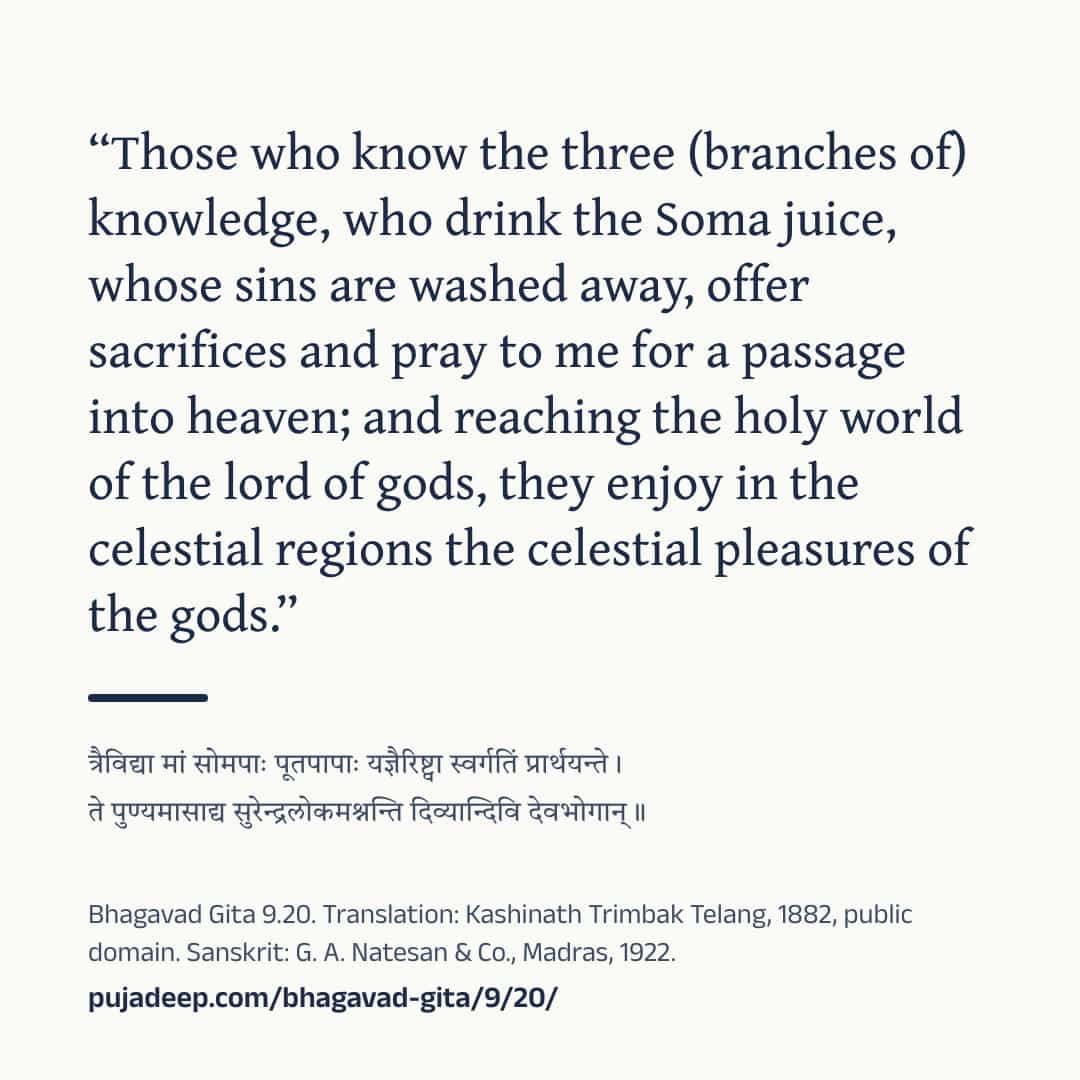
त्रैविद्या मां सोमपाः पूतपापाः यज्ञैरिष्ट्वा स्वर्गतिं प्रार्थयन्ते ।
ते पुण्यमासाद्य सुरेन्द्रलोकमश्नन्ति दिव्यान्दिवि देवभोगान् ॥

“Those who know the three (branches of) knowledge, who drink the Soma juice, whose sins are washed away, offer sacrifices and pray to me for a passage into heaven; and reaching the holy world of the lord of gods, they enjoy in the celestial regions the celestial pleasures of the gods.”
(K. T. Telang, The Bhagavadgîtâ (The Sacred Books of the East, vol. VIII, Oxford: Clarendon Press, 1882), p. 84, public domain)

“The knowers of the Three, the Soma-drinkers, the purified from sin, the sacrificers, pray of Me the way to Svarga; they reach the holy world of the God Indra, and eat in heaven the divine feasts of the Gods.”
(Annie Besant, The Bhagavad Gîtâ, or The Lord's Song (London: Theosophical Publishing Society, 1895), pp. 90–91, public domain)

“The knowers of the three Vedas, having worshipped Me by Yajna, drunk the Soma, and (thus) been purified from sin, pray for passage to heaven; reaching the holy world of the Lord of the Devas, they enjoy in heaven the divine pleasures of the Devas.”
(Swami Swarupananda, Srimad-Bhagavad-Gita (Mayavati: Prabuddha Bharata Press, 1909; first printed in Prabuddha Bharata, 1907–1909), p. 185, public domain)

Sanskrit: G. A. Natesan & Co., Madras, 1922.
https://pujadeep.com/bhagavad-gita/9/20/ Nothing is sent from this site. Your own app sends it, to the chat you choose. The picture quotes the translation you chose on this page, with its name and year.
Sanskrit text: The Bhagavad-Gita, or The Lord's Song, with the text in Devanagari and an English translation, 1922. Meanings: written for Pujadeep and checked against the cited edition. Source and changes
Questions families ask
Who speaks Bhagavad Gita 9.20?
Krishna speaks this verse, in chapter 9 (Raja Vidya Raja Guhya Yoga).
Where does the Sanskrit text come from?
Sanskrit text: The Bhagavad-Gita, or The Lord's Song, with the text in Devanagari and an English translation, 1922. Meanings: written for Pujadeep and checked against the cited edition. See the source
Is the meaning on this page a translation?
Explanation written for this site from the sources listed here, and checked against the cited edition. It is not a translation and not the only way to read the text. Free to quote with credit.
Source and licence
- Sanskrit text
- The Bhagavad-Gita, or The Lord's Song, with the text in Devanagari and an English translation (Annie Besant, G. A. Natesan & Co., Madras, 1922). Public domain. The Sanskrit on these pages was read from this printing’s page images.
- Translation
- The Bhagavadgîtâ with the Sanatsugâtîya and the Anugîtâ, translated by Kâshinâth Trimbak Telang (The Sacred Books of the East, vol. VIII, ed. F. Max Müller) (Kashinath Trimbak Telang, F. Max Müller, Clarendon Press, Oxford, 1882). Public domain. Shown verbatim, as printed.
- Translation
- The Bhagavad Gîtâ, or The Lord's Song, translated by Annie Besant (Annie Besant, Theosophical Publishing Society, London, 1895). Public domain. Shown verbatim, as printed.
- Translation
- Srimad-Bhagavad-Gita, with Sanskrit Text; Paraphrase with Word-by-word Literal Translation; English Rendering and Comments, Index, &c., by the Swami Swarupananda (Himalayan Series, No. XX) (Swami Swarupananda, The Editors and Publishers, Advaita Ashrama, Mayavati, Prabuddha Bharata Press, Mayavati, Almora, Himalayas, 1909). Public domain. Shown verbatim, as printed.
- Common wording
- In this text, 32 words follow today's common wording, checked against sanskritdocuments.org; Sanskrit Wikisource; Gita Press, Gorakhpur; GRETIL, Göttingen and Bhaktivedanta Book Trust.
- Our explanation
- Explanation written for this site from the sources listed here, and checked against the cited edition. It is not a translation and not the only way to read the text. Free to quote with credit.
- Checked
- Checked against the cited edition, October 15, 2026.
- Updated
- October 27, 2026