Bhagavad Gita 9.15: meaning and translation
Chapter 9: Raja Vidya Raja Guhya Yoga. Krishna says
Krishna says that others worship him through the sacrifice of knowledge (jñāna-yajña): as the One, as distinct in many forms, and as the one whose faces are everywhere (viśvatomukha).
Click or tap a word for its meaning and its dictionary page.
Text and layers
Text and layers
These choices stay in this browser.
Bhagavad Gita 9.15
ज्ञानयज्ञेन चाप्यन्ये यजन्तो मामुपासते ।एकत्वेन पृथक्त्वेन बहुधा विश्वतोमुखम् ॥
Jnanayajnena chapyanye yajanto mamupasateEkatvena prithaktvena bahudha vishvatomukham
jñānayajñena cāpyanye yajanto māmupāsate |ekatvena pṛthaktvena bahudhā viśvatomukham ||
Our explanation Krishna says that others worship him through the sacrifice of knowledge (jñāna-yajña): as the One, as distinct in many forms, and as the one whose faces are everywhere (viśvatomukha). The schools explain these ways in different ways (see the views).
हिंदी अर्थ कृष्ण कहते हैं कि कुछ दूसरे लोग ज्ञान-यज्ञ से उनकी उपासना करते हैं: एक के रूप में, अनेक अलग-अलग रूपों में, और उस रूप में जिसके मुख सब ओर हैं (विश्वतोमुख)। परंपराएँ इन उपासनाओं को अलग-अलग ढंग से समझाती हैं।
Word by word
Every word, with its dictionary page
Word by word
- ज्ञानयज्ञेन jñānayajñena · by the sacrifice of knowledge (compound (masculine), instrumental singular) Dictionary: jñāna, Monier-Williams 1899, p. 426, col. 1 “knowing, becoming acquainted with, knowledge”; yajña, Monier-Williams 1899, p. 839, col. 2 “act of worship or devotion, offering, oblation, sacrifice”
- च ca · and (indeclinable) Dictionary: 2. ca, Monier-Williams 1899, p. 380, col. 1 “and, both, also, moreover, as well as”
- अपि api · also (indeclinable) Dictionary: api, Monier-Williams 1899, p. 55, col. 1 “in the sense of even, also, very”
- अन्ये anye · others (pronominal adjective (masculine), nominative plural) Dictionary: 2. anya, Monier-Williams 1899, p. 45, col. 2 “other, different”
- यजन्तः yajantaḥ · worshipping, offering (present participle (masculine), nominative plural) Dictionary: 1. yaj, Monier-Williams 1899, p. 838, col. 3 “to worship, adore, honour (esp. with sacrifice or oblations)”
- माम् mām · "me" (Krishna) (pronoun, accusative singular) Dictionary: 1. mad, Monier-Williams 1899, p. 777, col. 2 “base of the first pers. pron. in the sg. number (esp. in comp.)”
- उपासते upāsate · worship (present (middle), 3rd person plural) Dictionary: 3. upās, Monier-Williams 1899, p. 215, col. 1 “serve, honour, revere, respect, acknowledge, do homage, worship”
- एकत्वेन ekatvena · as one (noun (neuter), instrumental singular) Dictionary: eka-tva, Monier-Williams 1899, p. 228, col. 1 “oneness, unity, union, coincidence, identity”
- पृथक्त्वेन pṛthaktvena · as distinct (noun (neuter), instrumental singular) Dictionary: pṛthak-tva, Monier-Williams 1899, p. 645, col. 3; pṛthak-tā, Monier-Williams 1899, p. 645, col. 3 “separateness, severalty, singleness, individuality”
- बहुधा bahudhā · in many ways (indeclinable) Dictionary: bahudhā, Monier-Williams 1899, p. 726, col. 2 “in many ways or parts or forms or directions, variously, manifoldly”
- विश्वतोमुखम् viśvatomukham · facing every way (compound (masculine), accusative singular) Dictionary: viśvato-mukha, Monier-Williams 1899, p. 994, col. 3 “facing all sides, one whose face is turned everywhere”
Old translations
Kashinath Trimbak Telang, 1882. Public domain. Page 83.
And others again, offering up the sacrifice of knowledge, worship me as one, as distinct, and as all-pervading in numerous forms1.
Footnotes (the translator’s own) - Sacrifice of knowledge, viz. the knowledge that Vâsudeva is all; as one=believing that all is one; as distinct=believing that sun, moon, &c. are different manifestations of 'me.' ↩
Compare 3 translations
Kashinath Trimbak Telang, 1882. Public domain. Page 83.
And others again, offering up the sacrifice of knowledge, worship me as one, as distinct, and as all-pervading in numerous forms1.
Footnotes (the translator’s own) - Sacrifice of knowledge, viz. the knowledge that Vâsudeva is all; as one=believing that all is one; as distinct=believing that sun, moon, &c. are different manifestations of 'me.' ↩
You are reading this one
Annie Besant, 1895. Public domain. Page 89–90.
Others also sacrifice with the sacrifice of wisdom, worshipping Me, as the One and the Manifold everywhere, pervading all forms.
You are reading this one
Swami Swarupananda, 1909 (first printed 1907). Public domain. Page 182.
Others, too, sacrificing by the Yajna of knowledge, (i. e., seeing the Self in all) worship Me the All-Formed, as one, as distinct, as manifold.
You are reading this one
Cite this verse
The translation: K. T. Telang, The Bhagavadgîtâ (The Sacred Books of the East, vol. VIII, Oxford: Clarendon Press, 1882), p. 83. Bhagavad Gita 9.15.
The translation: Annie Besant, The Bhagavad Gîtâ, or The Lord's Song (London: Theosophical Publishing Society, 1895), pp. 89–90. Bhagavad Gita 9.15.
The translation: Swami Swarupananda, Srimad-Bhagavad-Gita (Mayavati: Prabuddha Bharata Press, 1909; first printed in Prabuddha Bharata, 1907–1909), p. 182. Bhagavad Gita 9.15.
Our explanation: “Bhagavad Gita 9.15: meaning and translation.” Pujadeep. Updated October 27, 2026. https://pujadeep.com/bhagavad-gita/9/15/
Pujadeep’s explanations are free to quote with credit: name Pujadeep and link to the page. How to credit
Classical readings, by school
Each reading is named by its school. None is presented as the only meaning.
What Advaita, Vishishtadvaita and Dvaita teach, in short
Shankara Advaita
Shankara says the sacrifice of knowledge takes several forms. Some worship with the knowledge that the supreme Brahman is one. Some see Lord Vishnu himself existing as different beings, as the sun, the moon and so on. Others worship the one Lord present in every form, with faces on all sides.
Source: The Bhagavad-Gita, with the commentary of Sri Sankaracharya, translated by A. Mahadeva Sastri (2nd ed., Mysore: G. T. A. Printing Works, 1901), commentary on 9.15, p. 224. Summarised in our own words; none of its text is reproduced.
Ramanuja Vishishtadvaita
Ramanuja says this is one meditation: on the Lord as the single being whose body is the whole universe, in its subtle form before creation and in all its many forms after it. The one appears as the many because he wills it.
Source: Sri Bhagavad-Gita with Sri Ramanujacharya's Visishtadvaita commentary, translated by A. Govindacharya (Madras, 1898), commentary on 9.15, p. 299. Summarised in our own words; none of its text is reproduced.
Share
Show the ways to share
Send one picture or the text to one chat. The picture names its source and the address of this page.
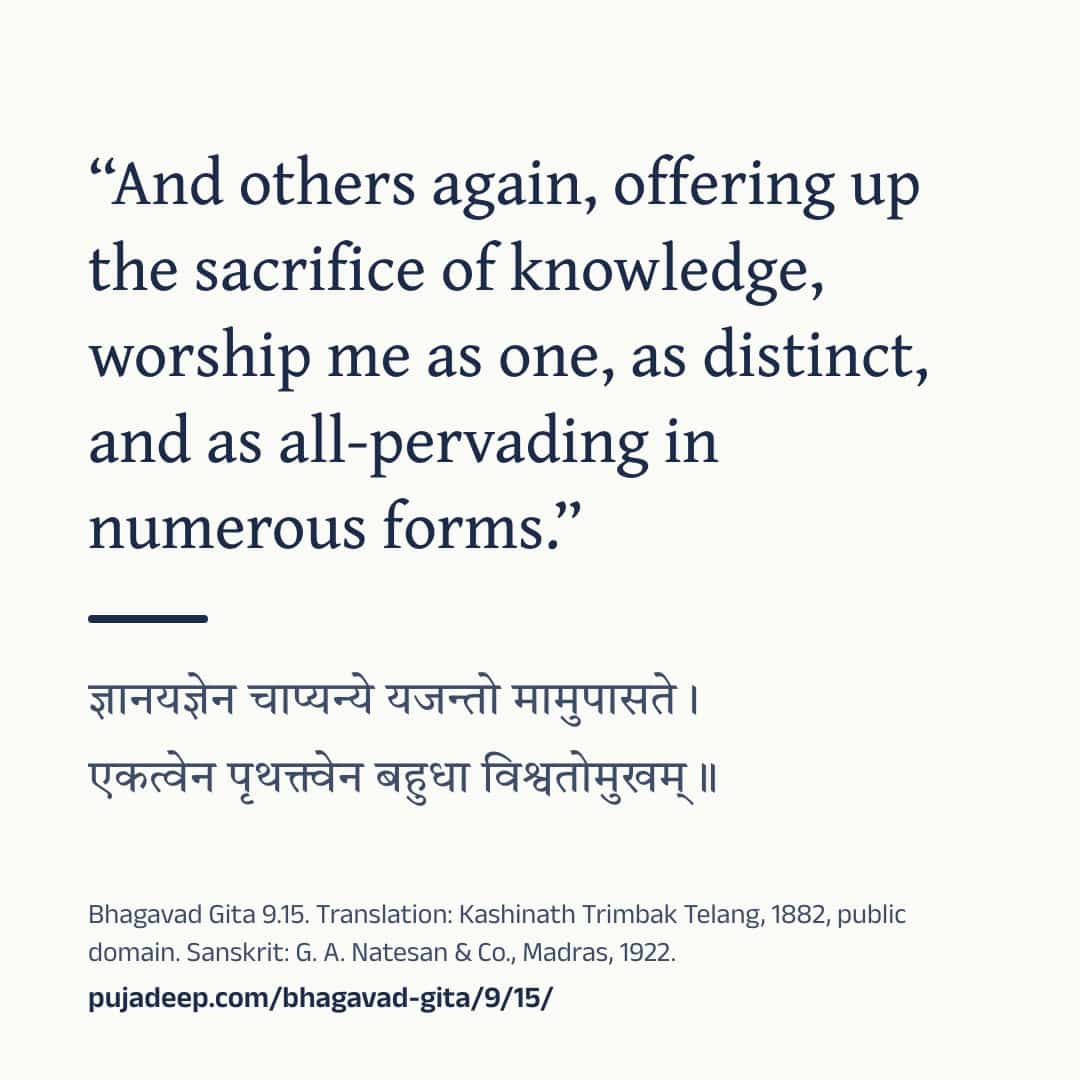
Drawing the picture
See the words
Bhagavad Gita 9.15

ज्ञानयज्ञेन चाप्यन्ये यजन्तो मामुपासते ।
एकत्वेन पृथक्त्वेन बहुधा विश्वतोमुखम् ॥

“And others again, offering up the sacrifice of knowledge, worship me as one, as distinct, and as all-pervading in numerous forms.”
(K. T. Telang, The Bhagavadgîtâ (The Sacred Books of the East, vol. VIII, Oxford: Clarendon Press, 1882), p. 83, public domain)

“Others also sacrifice with the sacrifice of wisdom, worshipping Me, as the One and the Manifold everywhere, pervading all forms.”
(Annie Besant, The Bhagavad Gîtâ, or The Lord's Song (London: Theosophical Publishing Society, 1895), pp. 89–90, public domain)

“Others, too, sacrificing by the Yajna of knowledge, (i. e., seeing the Self in all) worship Me the All-Formed, as one, as distinct, as manifold.”
(Swami Swarupananda, Srimad-Bhagavad-Gita (Mayavati: Prabuddha Bharata Press, 1909; first printed in Prabuddha Bharata, 1907–1909), p. 182, public domain)

Sanskrit: G. A. Natesan & Co., Madras, 1922.
https://pujadeep.com/bhagavad-gita/9/15/ Nothing is sent from this site. Your own app sends it, to the chat you choose. The picture quotes the translation you chose on this page, with its name and year.
Sanskrit text: The Bhagavad-Gita, or The Lord's Song, with the text in Devanagari and an English translation, 1922. Meanings: written for Pujadeep and checked against the cited edition. Source and changes
Questions families ask
Who speaks Bhagavad Gita 9.15?
Krishna speaks this verse, in chapter 9 (Raja Vidya Raja Guhya Yoga).
Where does the Sanskrit text come from?
Sanskrit text: The Bhagavad-Gita, or The Lord's Song, with the text in Devanagari and an English translation, 1922. Meanings: written for Pujadeep and checked against the cited edition. See the source
Is the meaning on this page a translation?
Explanation written for this site from the sources listed here, and checked against the cited edition. It is not a translation and not the only way to read the text. Free to quote with credit.
Source and licence
- Sanskrit text
- The Bhagavad-Gita, or The Lord's Song, with the text in Devanagari and an English translation (Annie Besant, G. A. Natesan & Co., Madras, 1922). Public domain. The Sanskrit on these pages was read from this printing’s page images.
- Translation
- The Bhagavadgîtâ with the Sanatsugâtîya and the Anugîtâ, translated by Kâshinâth Trimbak Telang (The Sacred Books of the East, vol. VIII, ed. F. Max Müller) (Kashinath Trimbak Telang, F. Max Müller, Clarendon Press, Oxford, 1882). Public domain. Shown verbatim, as printed.
- Translation
- The Bhagavad Gîtâ, or The Lord's Song, translated by Annie Besant (Annie Besant, Theosophical Publishing Society, London, 1895). Public domain. Shown verbatim, as printed.
- Translation
- Srimad-Bhagavad-Gita, with Sanskrit Text; Paraphrase with Word-by-word Literal Translation; English Rendering and Comments, Index, &c., by the Swami Swarupananda (Himalayan Series, No. XX) (Swami Swarupananda, The Editors and Publishers, Advaita Ashrama, Mayavati, Prabuddha Bharata Press, Mayavati, Almora, Himalayas, 1909). Public domain. Shown verbatim, as printed.
- Commentary
- The Bhagavad-Gita, with the commentary of Sri Sankaracharya, translated by A. Mahadeva Sastri (2nd ed., Mysore: G. T. A. Printing Works, 1901) (Public-domain scan, University of California Libraries). Summarised in our own words; none of its text is reproduced.
- Commentary
- Sri Bhagavad-Gita with Sri Ramanujacharya's Visishtadvaita commentary, translated by A. Govindacharya (Madras, 1898) (Scan uploaded to archive.org (folkscanomy collection)). Summarised in our own words; none of its text is reproduced.
- Common wording
- In this text, 32 words follow today's common wording, checked against sanskritdocuments.org; Sanskrit Wikisource; Gita Press, Gorakhpur; GRETIL, Göttingen and Bhaktivedanta Book Trust.
- Our explanation
- Explanation written for this site from the sources listed here, and checked against the cited edition. It is not a translation and not the only way to read the text. Free to quote with credit.
- Checked
- Checked against the cited edition, October 15, 2026.
- Updated
- October 27, 2026