Bhagavad Gita 9.7: meaning and translation
Chapter 9: Raja Vidya Raja Guhya Yoga. Krishna says
Krishna says that at the end of a kalpa, a great cycle of the world, all beings go back into his own nature (prakṛti).
Click or tap a word for its meaning and its dictionary page.
Text and layers
Text and layers
These choices stay in this browser.
Bhagavad Gita 9.7
सर्वभूतानि कौन्तेय प्रकृतिं यान्ति मामिकाम् ।कल्पक्षये पुनस्तानि कल्पादौ विसृजाम्यहम् ॥
Sarvabhutani kaunteya prakritim yanti mamikamKalpakshaye punastani kalpadau visrijamyaham
sarvabhūtāni kaunteya prakṛtiṃ yānti māmikām |kalpakṣaye punastāni kalpādau visṛjāmyaham ||
Our explanation Krishna says that at the end of a kalpa, a great cycle of the world, all beings go back into his own nature (prakṛti). At the start of the next kalpa he sends them forth again.
हिंदी अर्थ कृष्ण कहते हैं कि कल्प (संसार के एक बड़े युग-चक्र) के अंत में सब प्राणी उनकी अपनी प्रकृति में लौट जाते हैं। अगले कल्प के आरंभ में वे उन्हें फिर से रचते हैं।
Word by word
Every word, with its dictionary page
Word by word
- सर्वभूतानि sarvabhūtāni · all beings (compound (neuter), nominative plural) Dictionary: sarva, Monier-Williams 1899, p. 1184, col. 3 “whole, entire, all, every”; bhūta, Monier-Williams 1899, p. 761, col. 3 “that which is or exists, any living being”
- कौन्तेय kaunteya · O son of Kunti (noun (masculine), vocative singular) Dictionary: kaunteya, Monier-Williams 1899, p. 316, col. 2 “metron. fr. Kuntī”
- प्रकृतिम् prakṛtim · nature (noun (feminine), accusative singular) Dictionary: pra-kṛti, Monier-Williams 1899, p. 654, col. 1 “nature, character, constitution, temper, disposition”
- यान्ति yānti · go (present, 3rd person plural) Dictionary: yā, Monier-Williams 1899, p. 849, col. 1 “to go, proceed, move, walk, set out”
- मामिकाम् māmikām · "my" own (adjective (feminine), accusative singular) Dictionary: māmaka, Monier-Williams 1899, p. 810, col. 3 “my, mine”
- कल्पक्षये kalpakṣaye · at the end of a kalpa (compound (masculine), locative singular) Dictionary: 1. kalpa, Monier-Williams 1899, p. 262, col. 3 “a fabulous period of time”; 3. kṣaya, Monier-Williams 1899, p. 328, col. 1 “end, termination”
- पुनः punaḥ · again (indeclinable) Dictionary: punar, Monier-Williams 1899, p. 633, col. 2 “again, once more”
- तानि tāni · them (pronoun (neuter), accusative plural) Dictionary: tad, Monier-Williams 1899, p. 434, col. 1 “m. he, f. she, n. it, that, this”
- कल्पादौ kalpādau · at the start of a kalpa (compound (masculine), locative singular) Dictionary: 1. kalpa, Monier-Williams 1899, p. 262, col. 3 “a fabulous period of time”; 1. ādi, Monier-Williams 1899, p. 136, col. 3 “beginning, commencement”
- विसृजामि visṛjāmi · "I send forth" (present, 1st person singular) Dictionary: vi-sṛj, Monier-Williams 1899, p. 1001, col. 1 “to send or pour forth, let go or run or flow, discharge, emit”
- अहम् aham · "I" (Krishna) (pronoun, nominative singular) Dictionary: aham, Monier-Williams 1899, p. 124, col. 2 “nom. sg. ‘I,’”
Old translations
Kashinath Trimbak Telang, 1882. Public domain. Page 82.
At the expiration of a Kalpa, O son of Kuntî! all entities enter my nature; and at the beginning of a Kalpa, I again bring them forth.
Compare 3 translations
Kashinath Trimbak Telang, 1882. Public domain. Page 82.
At the expiration of a Kalpa, O son of Kuntî! all entities enter my nature; and at the beginning of a Kalpa, I again bring them forth.
You are reading this one
Annie Besant, 1895. Public domain. Page 88.
All things, O Kaunteya! go into my Prakriti at the destruction of a Kalpa;1 at the beginning of a Kalpa I again send them out.
Footnotes (the translator’s own) - A period of activity, of manifestation. ↩
You are reading this one
Swami Swarupananda, 1909 (first printed 1907). Public domain. Page 178.
At the end of a Kalpa, O son of Kunti, all beings go back to My Prakriti: at the beginning of (another) Kalpa, I send them forth again.
You are reading this one
Cite this verse
The translation: K. T. Telang, The Bhagavadgîtâ (The Sacred Books of the East, vol. VIII, Oxford: Clarendon Press, 1882), p. 82. Bhagavad Gita 9.7.
The translation: Annie Besant, The Bhagavad Gîtâ, or The Lord's Song (London: Theosophical Publishing Society, 1895), p. 88. Bhagavad Gita 9.7.
The translation: Swami Swarupananda, Srimad-Bhagavad-Gita (Mayavati: Prabuddha Bharata Press, 1909; first printed in Prabuddha Bharata, 1907–1909), p. 178. Bhagavad Gita 9.7.
Our explanation: “Bhagavad Gita 9.7: meaning and translation.” Pujadeep. Updated October 27, 2026. https://pujadeep.com/bhagavad-gita/9/7/
Pujadeep’s explanations are free to quote with credit: name Pujadeep and link to the page. How to credit
Classical readings, by school
No readings by school on this verse yet.
Share
Show the ways to share
Send one picture or the text to one chat. The picture names its source and the address of this page.
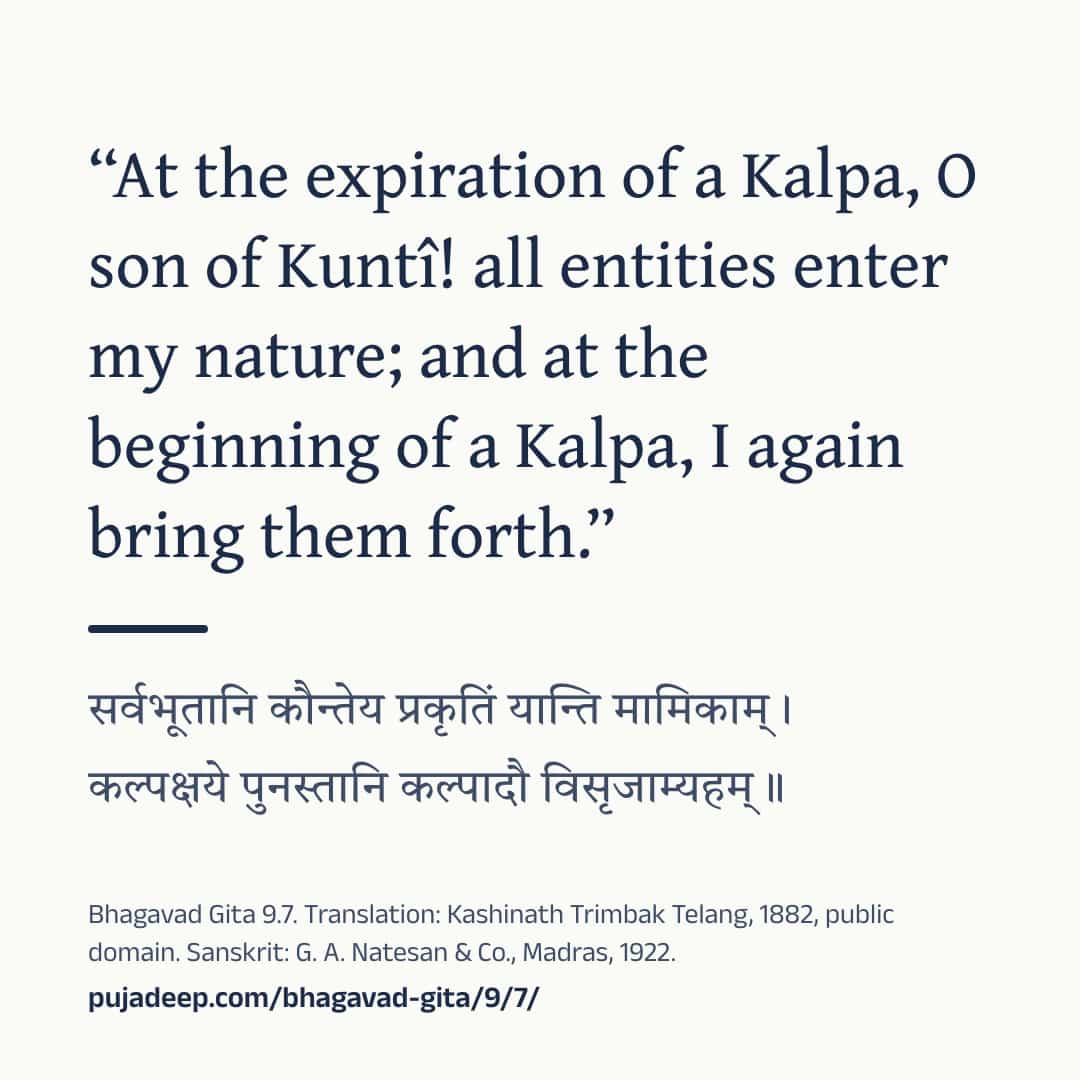
Drawing the picture
See the words
Bhagavad Gita 9.7

सर्वभूतानि कौन्तेय प्रकृतिं यान्ति मामिकाम् ।
कल्पक्षये पुनस्तानि कल्पादौ विसृजाम्यहम् ॥

“At the expiration of a Kalpa, O son of Kuntî! all entities enter my nature; and at the beginning of a Kalpa, I again bring them forth.”
(K. T. Telang, The Bhagavadgîtâ (The Sacred Books of the East, vol. VIII, Oxford: Clarendon Press, 1882), p. 82, public domain)

“All things, O Kaunteya! go into my Prakriti at the destruction of a Kalpa; at the beginning of a Kalpa I again send them out.”
(Annie Besant, The Bhagavad Gîtâ, or The Lord's Song (London: Theosophical Publishing Society, 1895), p. 88, public domain)

“At the end of a Kalpa, O son of Kunti, all beings go back to My Prakriti: at the beginning of (another) Kalpa, I send them forth again.”
(Swami Swarupananda, Srimad-Bhagavad-Gita (Mayavati: Prabuddha Bharata Press, 1909; first printed in Prabuddha Bharata, 1907–1909), p. 178, public domain)

Sanskrit: G. A. Natesan & Co., Madras, 1922.
https://pujadeep.com/bhagavad-gita/9/7/ Nothing is sent from this site. Your own app sends it, to the chat you choose. The picture quotes the translation you chose on this page, with its name and year.
Sanskrit text: The Bhagavad-Gita, or The Lord's Song, with the text in Devanagari and an English translation, 1922. Meanings: written for Pujadeep and checked against the cited edition. Source and changes
Questions families ask
Who speaks Bhagavad Gita 9.7?
Krishna speaks this verse, in chapter 9 (Raja Vidya Raja Guhya Yoga).
Where does the Sanskrit text come from?
Sanskrit text: The Bhagavad-Gita, or The Lord's Song, with the text in Devanagari and an English translation, 1922. Meanings: written for Pujadeep and checked against the cited edition. See the source
Is the meaning on this page a translation?
Explanation written for this site from the sources listed here, and checked against the cited edition. It is not a translation and not the only way to read the text. Free to quote with credit.
Source and licence
- Sanskrit text
- The Bhagavad-Gita, or The Lord's Song, with the text in Devanagari and an English translation (Annie Besant, G. A. Natesan & Co., Madras, 1922). Public domain. The Sanskrit on these pages was read from this printing’s page images.
- Translation
- The Bhagavadgîtâ with the Sanatsugâtîya and the Anugîtâ, translated by Kâshinâth Trimbak Telang (The Sacred Books of the East, vol. VIII, ed. F. Max Müller) (Kashinath Trimbak Telang, F. Max Müller, Clarendon Press, Oxford, 1882). Public domain. Shown verbatim, as printed.
- Translation
- The Bhagavad Gîtâ, or The Lord's Song, translated by Annie Besant (Annie Besant, Theosophical Publishing Society, London, 1895). Public domain. Shown verbatim, as printed.
- Translation
- Srimad-Bhagavad-Gita, with Sanskrit Text; Paraphrase with Word-by-word Literal Translation; English Rendering and Comments, Index, &c., by the Swami Swarupananda (Himalayan Series, No. XX) (Swami Swarupananda, The Editors and Publishers, Advaita Ashrama, Mayavati, Prabuddha Bharata Press, Mayavati, Almora, Himalayas, 1909). Public domain. Shown verbatim, as printed.
- Common wording
- In this text, 32 words follow today's common wording, checked against sanskritdocuments.org; Sanskrit Wikisource; Gita Press, Gorakhpur; GRETIL, Göttingen and Bhaktivedanta Book Trust.
- Our explanation
- Explanation written for this site from the sources listed here, and checked against the cited edition. It is not a translation and not the only way to read the text. Free to quote with credit.
- Checked
- Checked against the cited edition, October 15, 2026.
- Updated
- October 27, 2026