Bhagavad Gita 9.3: meaning and translation
Chapter 9: Raja Vidya Raja Guhya Yoga. Krishna says
Krishna says that people who have no faith (śraddhā) in this dharma do not reach him, and turn back onto the path of saṃsāra, the round of death and birth.
Click or tap a word for its meaning and its dictionary page.
Text and layers
Text and layers
These choices stay in this browser.
Bhagavad Gita 9.3
अश्रद्दधानाः पुरुषा धर्मस्यास्य परन्तप ।अप्राप्य मां निवर्तन्ते मृत्युसंसारवर्त्मनि ॥
Ashraddadhanah purusha dharmasyasya parantapaAprapya mam nivartante mrityusansaravartmani
aśraddadhānāḥ puruṣā dharmasyāsya parantapa |aprāpya māṃ nivartante mṛtyusaṃsāravartmani ||
Our explanation Krishna says that people who have no faith (śraddhā) in this dharma do not reach him, and turn back onto the path of saṃsāra, the round of death and birth. He calls Arjuna Parantapa, scorcher of foes.
हिंदी अर्थ कृष्ण कहते हैं कि जिन लोगों को इस धर्म में श्रद्धा नहीं, वे उन तक नहीं पहुँचते और मृत्यु से भरे संसार (जन्म-मरण के चक्र) के मार्ग पर लौट आते हैं। वे अर्जुन को परंतप (शत्रुओं को तपाने वाले) कहकर पुकारते हैं।
Word by word
Every word, with its dictionary page
Word by word
- अश्रद्दधानाः aśraddadhānāḥ · who have no faith (negative present participle (masculine), nominative plural) Dictionary: a-śraddadhāna, Monier-Williams 1899, p. 114, col. 2 “not trusting in (gen., Bhag. ix, 3), unbelieving”
- पुरुषाः puruṣāḥ · people (noun (masculine), nominative plural) Dictionary: puruṣa, Monier-Williams 1899, p. 637, col. 1 “a man, male, human being (pl. people, mankind)”
- धर्मस्य dharmasya · in this dharma (noun (masculine), genitive singular) Dictionary: dharma, Monier-Williams 1899, p. 510, col. 3 “usage, practice, customary observance or prescribed conduct, duty”
- अस्य asya · this (pronoun (masculine), genitive singular) Dictionary: 1. idam, Monier-Williams 1899, p. 165, col. 2
- परन्तप parantapa · O scorcher of foes (noun (masculine), vocative singular) Dictionary: param-tapa, Monier-Williams 1899, p. 586, col. 3 “destroying foes (said of heroes)”
- अप्राप्य aprāpya · without reaching (negative absolutive (not having reached)) Dictionary: 2. a-prāpya, Monier-Williams 1899, p. 59, col. 2 “not having obtained; not reaching”
- माम् mām · "me" (Krishna) (pronoun, accusative singular) Dictionary: 1. mad, Monier-Williams 1899, p. 777, col. 2 “base of the first pers. pron. in the sg. number (esp. in comp.)”
- निवर्तन्ते nivartante · return, turn back (present (middle), 3rd person plural) Dictionary: ni-vṛt, Monier-Williams 1899, p. 560, col. 1 “to turn back, stop; to return from”
- मृत्युसंसारवर्त्मनि mṛtyusaṃsāravartmani · on the path of death and rebirth (compound (neuter), locative singular) Dictionary: mṛtyu, Monier-Williams 1899, p. 827, col. 3 “death, dying”; saṃ-sāra, Monier-Williams 1899, p. 1119, col. 2 “going or wandering through, undergoing transmigration”; vartman, Monier-Williams 1899, p. 925, col. 3 “the track or rut of a wheel, path, road, way, course”
Old translations
Kashinath Trimbak Telang, 1882. Public domain. Page 82.
O terror of your foes! those men who have no faith in this holy doctrine, return to the path of this mortal world, without attaining to me.
Compare 3 translations
Kashinath Trimbak Telang, 1882. Public domain. Page 82.
O terror of your foes! those men who have no faith in this holy doctrine, return to the path of this mortal world, without attaining to me.
You are reading this one
Annie Besant, 1895. Public domain. Page 87.
Men without faith, not receiving this Dharma, O Parantapa, reach Me not; they return to the paths of this mortal world.
You are reading this one
Swami Swarupananda, 1909 (first printed 1907). Public domain. Page 176.
Persons without Shraddhá for this Dharma, return, O scorcher of foes, without attaining Me, to the path of re-birth fraught with death.
You are reading this one
Cite this verse
The translation: K. T. Telang, The Bhagavadgîtâ (The Sacred Books of the East, vol. VIII, Oxford: Clarendon Press, 1882), p. 82. Bhagavad Gita 9.3.
The translation: Annie Besant, The Bhagavad Gîtâ, or The Lord's Song (London: Theosophical Publishing Society, 1895), p. 87. Bhagavad Gita 9.3.
The translation: Swami Swarupananda, Srimad-Bhagavad-Gita (Mayavati: Prabuddha Bharata Press, 1909; first printed in Prabuddha Bharata, 1907–1909), p. 176. Bhagavad Gita 9.3.
Our explanation: “Bhagavad Gita 9.3: meaning and translation.” Pujadeep. Updated October 27, 2026. https://pujadeep.com/bhagavad-gita/9/3/
Pujadeep’s explanations are free to quote with credit: name Pujadeep and link to the page. How to credit
Classical readings, by school
No readings by school on this verse yet.
Share
Show the ways to share
Send one picture or the text to one chat. The picture names its source and the address of this page.
Drawing the picture
See the words
Bhagavad Gita 9.3

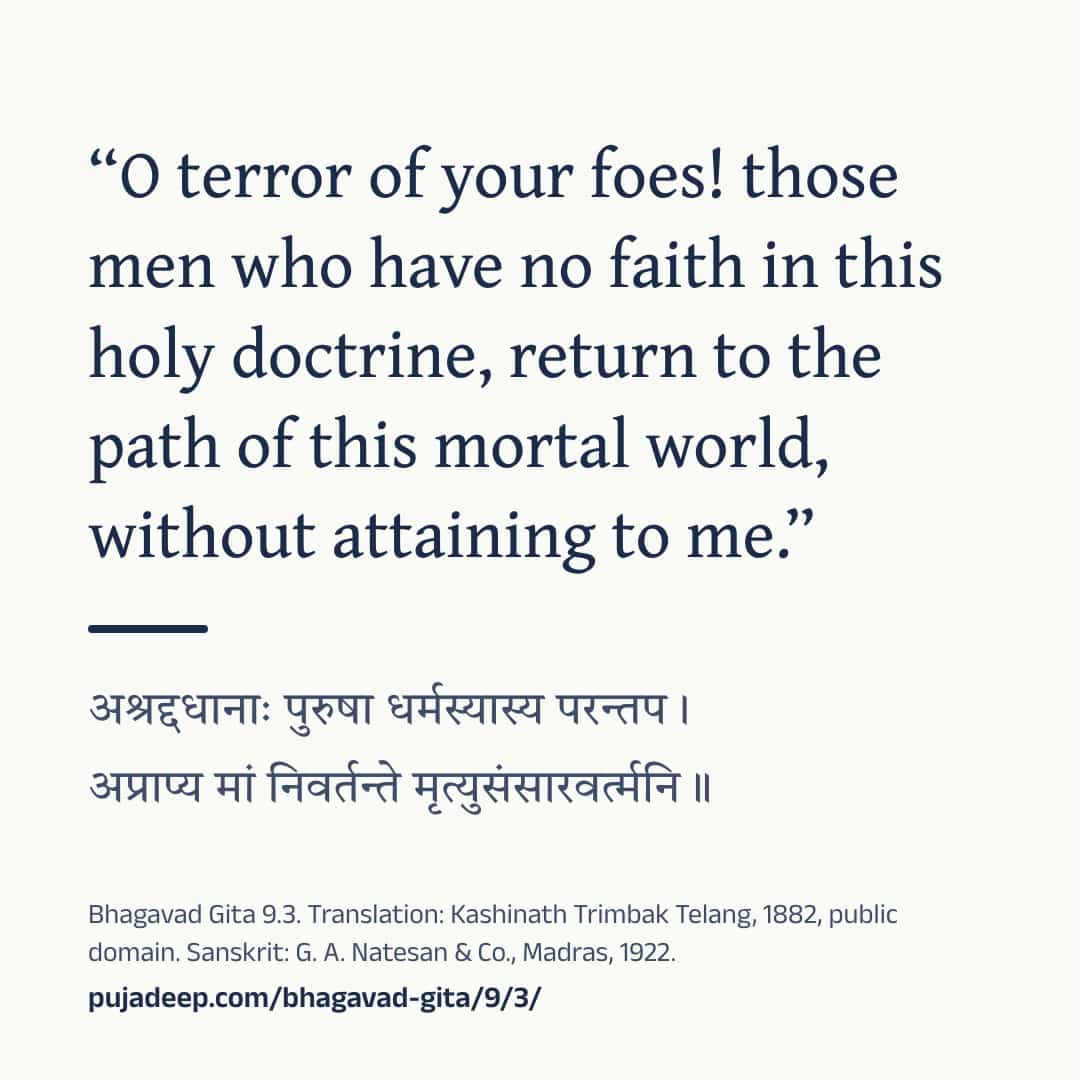
अश्रद्दधानाः पुरुषा धर्मस्यास्य परन्तप ।
अप्राप्य मां निवर्तन्ते मृत्युसंसारवर्त्मनि ॥

“O terror of your foes! those men who have no faith in this holy doctrine, return to the path of this mortal world, without attaining to me.”
(K. T. Telang, The Bhagavadgîtâ (The Sacred Books of the East, vol. VIII, Oxford: Clarendon Press, 1882), p. 82, public domain)

“Men without faith, not receiving this Dharma, O Parantapa, reach Me not; they return to the paths of this mortal world.”
(Annie Besant, The Bhagavad Gîtâ, or The Lord's Song (London: Theosophical Publishing Society, 1895), p. 87, public domain)

“Persons without Shraddhá for this Dharma, return, O scorcher of foes, without attaining Me, to the path of re-birth fraught with death.”
(Swami Swarupananda, Srimad-Bhagavad-Gita (Mayavati: Prabuddha Bharata Press, 1909; first printed in Prabuddha Bharata, 1907–1909), p. 176, public domain)

Sanskrit: G. A. Natesan & Co., Madras, 1922.
https://pujadeep.com/bhagavad-gita/9/3/ Nothing is sent from this site. Your own app sends it, to the chat you choose. The picture quotes the translation you chose on this page, with its name and year.
Sanskrit text: The Bhagavad-Gita, or The Lord's Song, with the text in Devanagari and an English translation, 1922. Meanings: written for Pujadeep and checked against the cited edition. Source and changes
Questions families ask
Who speaks Bhagavad Gita 9.3?
Krishna speaks this verse, in chapter 9 (Raja Vidya Raja Guhya Yoga).
Where does the Sanskrit text come from?
Sanskrit text: The Bhagavad-Gita, or The Lord's Song, with the text in Devanagari and an English translation, 1922. Meanings: written for Pujadeep and checked against the cited edition. See the source
Is the meaning on this page a translation?
Explanation written for this site from the sources listed here, and checked against the cited edition. It is not a translation and not the only way to read the text. Free to quote with credit.
Source and licence
- Sanskrit text
- The Bhagavad-Gita, or The Lord's Song, with the text in Devanagari and an English translation (Annie Besant, G. A. Natesan & Co., Madras, 1922). Public domain. The Sanskrit on these pages was read from this printing’s page images.
- Translation
- The Bhagavadgîtâ with the Sanatsugâtîya and the Anugîtâ, translated by Kâshinâth Trimbak Telang (The Sacred Books of the East, vol. VIII, ed. F. Max Müller) (Kashinath Trimbak Telang, F. Max Müller, Clarendon Press, Oxford, 1882). Public domain. Shown verbatim, as printed.
- Translation
- The Bhagavad Gîtâ, or The Lord's Song, translated by Annie Besant (Annie Besant, Theosophical Publishing Society, London, 1895). Public domain. Shown verbatim, as printed.
- Translation
- Srimad-Bhagavad-Gita, with Sanskrit Text; Paraphrase with Word-by-word Literal Translation; English Rendering and Comments, Index, &c., by the Swami Swarupananda (Himalayan Series, No. XX) (Swami Swarupananda, The Editors and Publishers, Advaita Ashrama, Mayavati, Prabuddha Bharata Press, Mayavati, Almora, Himalayas, 1909). Public domain. Shown verbatim, as printed.
- Common wording
- In this text, 32 words follow today's common wording, checked against sanskritdocuments.org; Sanskrit Wikisource; Gita Press, Gorakhpur; GRETIL, Göttingen and Bhaktivedanta Book Trust.
- Our explanation
- Explanation written for this site from the sources listed here, and checked against the cited edition. It is not a translation and not the only way to read the text. Free to quote with credit.
- Checked
- Checked against the cited edition, October 15, 2026.
- Updated
- October 27, 2026