Bhagavad Gita 9.12: meaning and translation
Chapter 9: Raja Vidya Raja Guhya Yoga. Krishna says
Krishna: Their hopes, their acts and their knowledge come to nothing (mogha), and their minds are confused.
Click or tap a word for its meaning and its dictionary page.
Text and layers
Text and layers
These choices stay in this browser.
Bhagavad Gita 9.12
मोघाशा मोघकर्माणो मोघज्ञाना विचेतसः ।राक्षसीमासुरीं चैव प्रकृतिं मोहिनीं श्रिताः ॥
Moghasha moghakarmano moghajnana vichetasahRakshasimasurim chaiva prakritim mohinim shritah
moghāśā moghakarmāṇo moghajñānā vicetasaḥ |rākṣasīmāsurīṃ caiva prakṛtiṃ mohinīṃ śritāḥ ||
Our explanation Their hopes, their acts and their knowledge come to nothing (mogha), and their minds are confused. Krishna says that they have taken on the deluding nature of the rākṣasas and asuras, the demon-like beings of the old stories. Shankara explains the first as a nature given to cruelty and the second as one given to taking what belongs to others.
हिंदी अर्थ उनकी आशाएँ, उनके कर्म और उनका ज्ञान व्यर्थ (मोघ) होते हैं, और उनका चित्त भ्रमित रहता है। कृष्ण कहते हैं कि उन्होंने राक्षसों और असुरों की, यानी पुरानी कथाओं के दानव-जैसे प्राणियों की, मोह में डालने वाली प्रकृति अपना ली है। शंकराचार्य पहली को क्रूरता वाली प्रकृति और दूसरी को दूसरों का धन छीनने वाली प्रकृति बताते हैं।
Word by word
Every word, with its dictionary page
Word by word
- मोघाशाः moghāśāḥ · whose hopes are vain (compound (masculine), nominative plural) Dictionary: mogha, Monier-Williams 1899, p. 835, col. 2 “vain, fruitless, useless, unsuccessful, unprofitable”; 1. āśā, Monier-Williams 1899, p. 157, col. 1 “wish, desire, hope, expectation”
- मोघकर्माणः moghakarmāṇaḥ · whose acts are vain (compound (masculine), nominative plural) Dictionary: mogha, Monier-Williams 1899, p. 835, col. 2 “vain, fruitless, useless, unsuccessful, unprofitable”; karman, Monier-Williams 1899, p. 258, col. 2 “act, action, performance, business”
- मोघज्ञानाः moghajñānāḥ · whose knowledge is vain (compound (masculine), nominative plural) Dictionary: mogha, Monier-Williams 1899, p. 835, col. 2 “vain, fruitless, useless, unsuccessful, unprofitable”; jñāna, Monier-Williams 1899, p. 426, col. 1 “knowing, becoming acquainted with, knowledge”
- विचेतसः vicetasaḥ · senseless, confused (adjective (masculine), nominative plural) Dictionary: 1. vi-cetas, Monier-Williams 1899, p. 950, col. 2 “absent-minded, confounded, perplexed”
- राक्षसीम् rākṣasīm · of the rākṣasas (adjective (feminine), accusative singular) Dictionary: rākṣasa, Monier-Williams 1899, p. 871, col. 3 “belonging to or like a Rakshas, demoniacal”
- आसुरीम् āsurīm · of the asuras (adjective (feminine), accusative singular) Dictionary: 1. āsura, Monier-Williams 1899, p. 160, col. 3 “belonging or relating to the Asuras”
- च ca · and (indeclinable) Dictionary: 2. ca, Monier-Williams 1899, p. 380, col. 1 “and, both, also, moreover, as well as”
- एव eva · indeed (indeclinable) Dictionary: 1. eva, Monier-Williams 1899, p. 232, col. 2 “so, just so, exactly so; indeed, truly, really”
- प्रकृतिम् prakṛtim · nature (noun (feminine), accusative singular) Dictionary: pra-kṛti, Monier-Williams 1899, p. 654, col. 1 “nature, character, constitution, temper, disposition”
- मोहिनीम् mohinīm · deluding (adjective (feminine), accusative singular) Dictionary: mohin, Monier-Williams 1899, p. 836, col. 2 “deluding, confusing, perplexing, illusive”
- श्रिताः śritāḥ · having taken to (past participle (masculine), nominative plural) Dictionary: śrita, Monier-Williams 1899, p. 1098, col. 2 “clinging or attached to, standing or lying or being or fixed or situated in or on”
Old translations
Kashinath Trimbak Telang, 1882. Public domain.
Telang translates verses 11–12 as one sentence; see 9.11. Read it at 9.11
Compare 3 translations
Kashinath Trimbak Telang, 1882. Public domain.
Telang translates verses 11–12 as one sentence; see 9.11. Read it at 9.11
You are reading this one
Annie Besant, 1895. Public domain. Page 89.
Empty of hope, empty of deeds, empty of wisdom, senseless, partaking of the deceiving Râkshasic and Âsûric Prakriti.1
This sentence begins in 9.11.
Footnotes (the translator’s own) - The Tâmasic Guna, or dark quality of Prakriti, characterises these demons. ↩
You are reading this one
Swami Swarupananda, 1909 (first printed 1907). Public domain. Page 181.
Of vain hopes, of vain works, of vain knowledge, and senseless, they verily are possessed of the delusive nature of Ràkshasas and Asuras.
You are reading this one
Cite this verse
The translation: K. T. Telang, The Bhagavadgîtâ (The Sacred Books of the East, vol. VIII, Oxford: Clarendon Press, 1882), pp. 82–83. Bhagavad Gita 9.11–12.
The translation: Annie Besant, The Bhagavad Gîtâ, or The Lord's Song (London: Theosophical Publishing Society, 1895), p. 89. Bhagavad Gita 9.12.
The translation: Swami Swarupananda, Srimad-Bhagavad-Gita (Mayavati: Prabuddha Bharata Press, 1909; first printed in Prabuddha Bharata, 1907–1909), p. 181. Bhagavad Gita 9.12.
Our explanation: “Bhagavad Gita 9.12: meaning and translation.” Pujadeep. Updated October 27, 2026. https://pujadeep.com/bhagavad-gita/9/12/
Pujadeep’s explanations are free to quote with credit: name Pujadeep and link to the page. How to credit
Classical readings, by school
No readings by school on this verse yet.
Share
Show the ways to share
Send one picture or the text to one chat. The picture names its source and the address of this page.
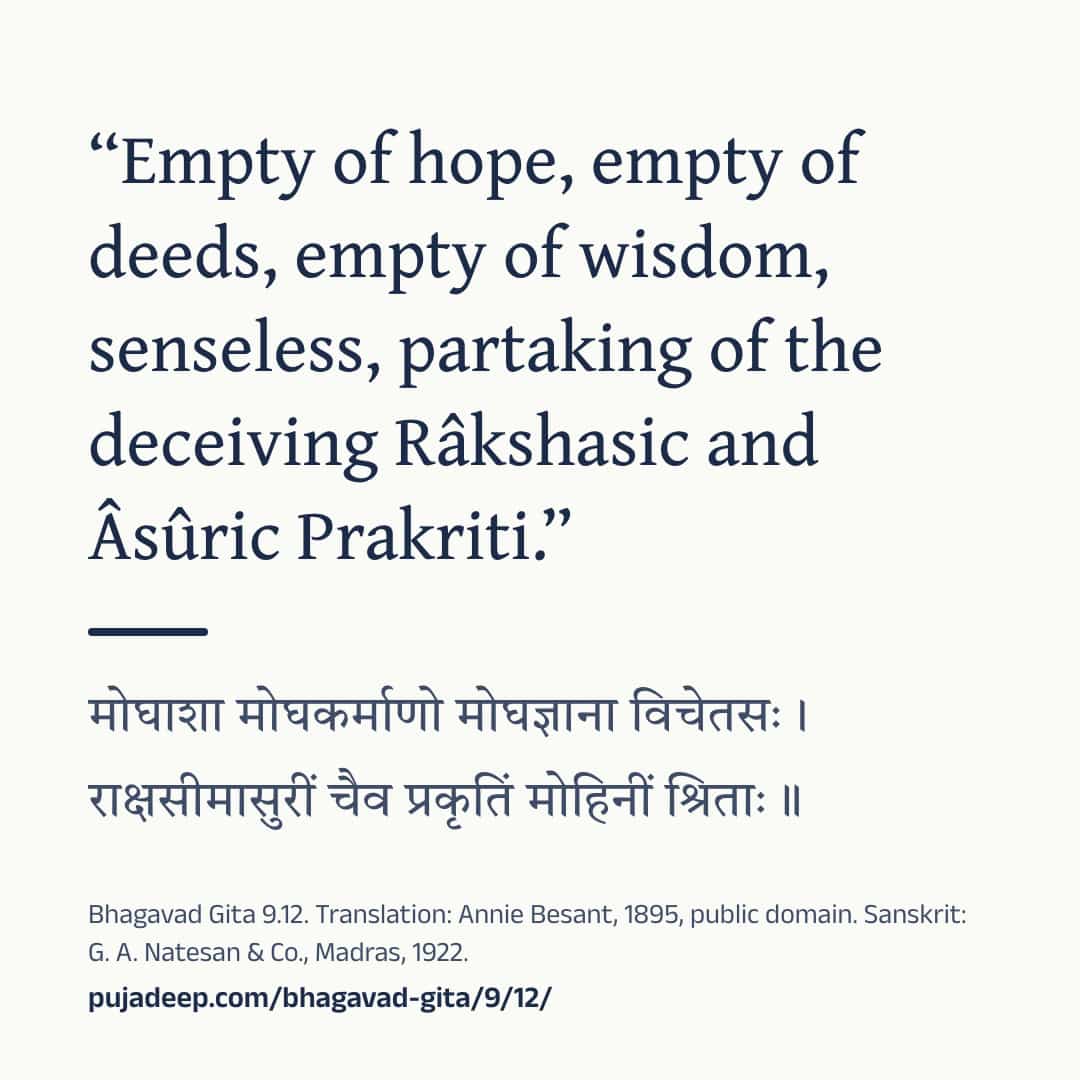
Drawing the picture
See the words
Bhagavad Gita 9.12

मोघाशा मोघकर्माणो मोघज्ञाना विचेतसः ।
राक्षसीमासुरीं चैव प्रकृतिं मोहिनीं श्रिताः ॥

“Empty of hope, empty of deeds, empty of wisdom, senseless, partaking of the deceiving Râkshasic and Âsûric Prakriti.”
(Annie Besant, The Bhagavad Gîtâ, or The Lord's Song (London: Theosophical Publishing Society, 1895), p. 89, public domain)
This sentence begins in 9.11.

“Of vain hopes, of vain works, of vain knowledge, and senseless, they verily are possessed of the delusive nature of Ràkshasas and Asuras.”
(Swami Swarupananda, Srimad-Bhagavad-Gita (Mayavati: Prabuddha Bharata Press, 1909; first printed in Prabuddha Bharata, 1907–1909), p. 181, public domain)

Sanskrit: G. A. Natesan & Co., Madras, 1922.
https://pujadeep.com/bhagavad-gita/9/12/ Nothing is sent from this site. Your own app sends it, to the chat you choose. The picture quotes the translation you chose on this page, with its name and year.
Sanskrit text: The Bhagavad-Gita, or The Lord's Song, with the text in Devanagari and an English translation, 1922. Meanings: written for Pujadeep and checked against the cited edition. Source and changes
Questions families ask
Who speaks Bhagavad Gita 9.12?
Krishna speaks this verse, in chapter 9 (Raja Vidya Raja Guhya Yoga).
Where does the Sanskrit text come from?
Sanskrit text: The Bhagavad-Gita, or The Lord's Song, with the text in Devanagari and an English translation, 1922. Meanings: written for Pujadeep and checked against the cited edition. See the source
Is the meaning on this page a translation?
Explanation written for this site from the sources listed here, and checked against the cited edition. It is not a translation and not the only way to read the text. Free to quote with credit.
Source and licence
- Sanskrit text
- The Bhagavad-Gita, or The Lord's Song, with the text in Devanagari and an English translation (Annie Besant, G. A. Natesan & Co., Madras, 1922). Public domain. The Sanskrit on these pages was read from this printing’s page images.
- Translation
- The Bhagavadgîtâ with the Sanatsugâtîya and the Anugîtâ, translated by Kâshinâth Trimbak Telang (The Sacred Books of the East, vol. VIII, ed. F. Max Müller) (Kashinath Trimbak Telang, F. Max Müller, Clarendon Press, Oxford, 1882). Public domain. Shown verbatim, as printed.
- Translation
- The Bhagavad Gîtâ, or The Lord's Song, translated by Annie Besant (Annie Besant, Theosophical Publishing Society, London, 1895). Public domain. Shown verbatim, as printed.
- Translation
- Srimad-Bhagavad-Gita, with Sanskrit Text; Paraphrase with Word-by-word Literal Translation; English Rendering and Comments, Index, &c., by the Swami Swarupananda (Himalayan Series, No. XX) (Swami Swarupananda, The Editors and Publishers, Advaita Ashrama, Mayavati, Prabuddha Bharata Press, Mayavati, Almora, Himalayas, 1909). Public domain. Shown verbatim, as printed.
- Common wording
- In this text, 32 words follow today's common wording, checked against sanskritdocuments.org; Sanskrit Wikisource; Gita Press, Gorakhpur; GRETIL, Göttingen and Bhaktivedanta Book Trust.
- Our explanation
- Explanation written for this site from the sources listed here, and checked against the cited edition. It is not a translation and not the only way to read the text. Free to quote with credit.
- Checked
- Checked against the cited edition, October 15, 2026.
- Updated
- October 27, 2026