Bhagavad Gita 9.2: meaning and translation
Chapter 9: Raja Vidya Raja Guhya Yoga. Krishna says
Krishna calls this teaching the king of sciences and the king of secrets (rāja-vidyā, rāja-guhya), the highest purifier.
Click or tap a word for its meaning and its dictionary page.
Text and layers
Text and layers
These choices stay in this browser.
Bhagavad Gita 9.2
राजविद्या राजगुह्यं पवित्रमिदमुत्तमम् ।प्रत्यक्षावगमं धर्म्यं सुसुखं कर्तुमव्ययम् ॥
Rajavidya rajaguhyam pavitramidamuttamamPratyakshavagamam dharmyam susukham kartumavyayam
rājavidyā rājaguhyaṃ pavitramidamuttamam |pratyakṣāvagamaṃ dharmyaṃ susukhaṃ kartumavyayam ||
Our explanation Krishna calls this teaching the king of sciences and the king of secrets (rāja-vidyā, rāja-guhya), the highest purifier. It can be known by direct experience, it is in keeping with dharma, it is very easy to practise, and it does not fade away. The schools explain what “this” teaching is in different ways (see the views).
हिंदी अर्थ कृष्ण इस उपदेश को राजविद्या (विद्याओं का राजा) और राजगुह्य (रहस्यों का राजा) कहते हैं, जो सबसे उत्तम पवित्र करने वाला है। इसे प्रत्यक्ष अनुभव से जाना जा सकता है, यह धर्म के अनुकूल है, इसका पालन बहुत सरल है, और यह नष्ट नहीं होता। परंपराएँ अलग-अलग बताती हैं कि यह उपदेश कौन-सा है।
Word by word
Every word, with its dictionary page
Word by word
- राजविद्या rājavidyā · king of sciences (compound (feminine), nominative singular) Dictionary: rāja-vidyā, Monier-Williams 1899, p. 874, col. 1 “royal science, state policy, statesmanship”
- राजगुह्यम् rājaguhyam · king of secrets (compound (neuter), nominative singular) Dictionary: rāja-guhya, Monier-Williams 1899, p. 873, col. 1 “a royal mystery”
- पवित्रम् pavitram · purifier (noun (neuter), nominative singular) Dictionary: pavitra, Monier-Williams 1899, p. 611, col. 1 “a means of purification”
- इदम् idam · this (pronoun (neuter), nominative singular) Dictionary: 1. idam, Monier-Williams 1899, p. 165, col. 2
- उत्तमम् uttamam · highest, best (adjective (neuter), nominative singular) Dictionary: ut-tama, Monier-Williams 1899, p. 177, col. 3 “uppermost, highest, chief; most elevated, principal; best, excellent”
- प्रत्यक्षावगमम् pratyakṣāvagamam · known by direct experience (compound (neuter), nominative singular) Dictionary: praty-akṣa, Monier-Williams 1899, p. 674, col. 2 “clear, distinct, manifest, direct, immediate, actual, real”; ava-gama, Monier-Williams 1899, p. 97, col. 2 “understanding, comprehension, intelligence”
- धर्म्यम् dharmyam · in keeping with dharma (adjective (neuter), nominative singular) Dictionary: dharmya, Monier-Williams 1899, p. 513, col. 1 “just, virtuous, righteous”
- सुसुखम् susukham · very easy (adjective (neuter), nominative singular) Dictionary: su-sukha, Monier-Williams 1899, p. 1239, col. 1 “very pleasant or easy or comfortable”
- कर्तुम् kartum · to practise (infinitive (to do)) Dictionary: 1. kṛ, Monier-Williams 1899, p. 301, col. 1 “to do, make, perform, accomplish, cause, effect”
- अव्ययम् avyayam · unfading, imperishable (adjective (neuter), nominative singular) Dictionary: 2. a-vyaya, Monier-Williams 1899, p. 111, col. 3 “not liable to change, imperishable, undecaying”
Old translations
Kashinath Trimbak Telang, 1882. Public domain. Page 81–82.
It is the chief among the sciences, the chief among the mysteries. It is the best means of sanctification. It is imperishable, not opposed to the sacred law. It is to be apprehended directly1, and is easy to practise.
Footnotes (the translator’s own) - I. e. by immediate consciousness, not mediately; 'not opposed to the sacred law,' i.e. like the Syena sacrifice for destroying a foe. ↩
Compare 3 translations
Kashinath Trimbak Telang, 1882. Public domain. Page 81–82.
It is the chief among the sciences, the chief among the mysteries. It is the best means of sanctification. It is imperishable, not opposed to the sacred law. It is to be apprehended directly1, and is easy to practise.
Footnotes (the translator’s own) - I. e. by immediate consciousness, not mediately; 'not opposed to the sacred law,' i.e. like the Syena sacrifice for destroying a foe. ↩
You are reading this one
Annie Besant, 1895. Public domain. Page 87.
Kingly Science, kingly Secret, supreme Purifier, this; explicit, according to Dharma,1 very easy to perform, imperishable.
Footnotes (the translator’s own) - e inner law of nature. ↩
You are reading this one
Swami Swarupananda, 1909 (first printed 1907). Public domain. Page 176.
Of sciences, the highest; of profundities, the deepest; of purifiers, the supreme, is this; realisable by direct perception, endowed with (immense) merit, very easy to perform, and of an imperishable nature.
You are reading this one
Cite this verse
The translation: K. T. Telang, The Bhagavadgîtâ (The Sacred Books of the East, vol. VIII, Oxford: Clarendon Press, 1882), pp. 81–82. Bhagavad Gita 9.2.
The translation: Annie Besant, The Bhagavad Gîtâ, or The Lord's Song (London: Theosophical Publishing Society, 1895), p. 87. Bhagavad Gita 9.2.
The translation: Swami Swarupananda, Srimad-Bhagavad-Gita (Mayavati: Prabuddha Bharata Press, 1909; first printed in Prabuddha Bharata, 1907–1909), p. 176. Bhagavad Gita 9.2.
Our explanation: “Bhagavad Gita 9.2: meaning and translation.” Pujadeep. Updated October 27, 2026. https://pujadeep.com/bhagavad-gita/9/2/
Pujadeep’s explanations are free to quote with credit: name Pujadeep and link to the page. How to credit
Classical readings, by school
Each reading is named by its school. None is presented as the only meaning.
What Advaita, Vishishtadvaita and Dvaita teach, in short
Shankara Advaita
Shankara says the teaching is the knowledge of Brahman, the direct means to liberation. It is the best purifier because it burns away in an instant the karma of many births; it is known by direct experience, like pleasure; it is not opposed to dharma; it is easy to gain from a teacher; and, unlike the fruit of an act, it does not perish.
Source: The Bhagavad-Gita, with the commentary of Sri Sankaracharya, translated by A. Mahadeva Sastri (2nd ed., Mysore: G. T. A. Printing Works, 1901), commentary on 9.1–9.2, pp. 215–217. Summarised in our own words; none of its text is reproduced.
Ramanuja Vishishtadvaita
Ramanuja says the teaching is about bhakti, loving devotion. “Known by direct experience” means that the Lord, worshipped with love, reveals himself to the devotee at once. It is “imperishable” because this love does not end when the Lord is reached; it goes on after.
Source: Sri Bhagavad-Gita with Sri Ramanujacharya's Visishtadvaita commentary, translated by A. Govindacharya (Madras, 1898), commentary on 9.1–9.2, pp. 287–289. Summarised in our own words; none of its text is reproduced.
Share
Show the ways to share
Send one picture or the text to one chat. The picture names its source and the address of this page.
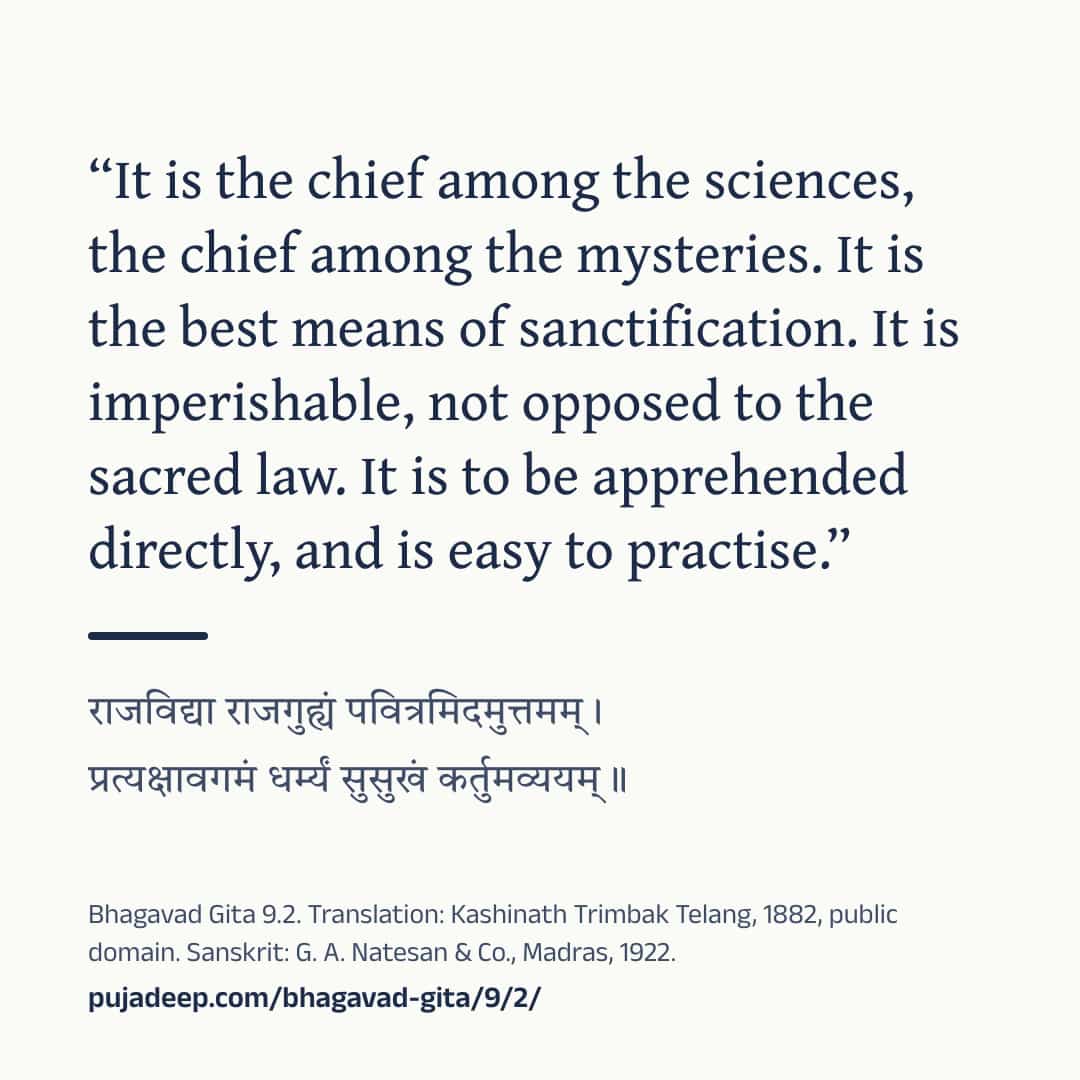
Drawing the picture
See the words
Bhagavad Gita 9.2

राजविद्या राजगुह्यं पवित्रमिदमुत्तमम् ।
प्रत्यक्षावगमं धर्म्यं सुसुखं कर्तुमव्ययम् ॥

“It is the chief among the sciences, the chief among the mysteries. It is the best means of sanctification. It is imperishable, not opposed to the sacred law. It is to be apprehended directly, and is easy to practise.”
(K. T. Telang, The Bhagavadgîtâ (The Sacred Books of the East, vol. VIII, Oxford: Clarendon Press, 1882), pp. 81–82, public domain)

“Kingly Science, kingly Secret, supreme Purifier, this; explicit, according to Dharma, very easy to perform, imperishable.”
(Annie Besant, The Bhagavad Gîtâ, or The Lord's Song (London: Theosophical Publishing Society, 1895), p. 87, public domain)

“Of sciences, the highest; of profundities, the deepest; of purifiers, the supreme, is this; realisable by direct perception, endowed with (immense) merit, very easy to perform, and of an imperishable nature.”
(Swami Swarupananda, Srimad-Bhagavad-Gita (Mayavati: Prabuddha Bharata Press, 1909; first printed in Prabuddha Bharata, 1907–1909), p. 176, public domain)

Sanskrit: G. A. Natesan & Co., Madras, 1922.
https://pujadeep.com/bhagavad-gita/9/2/ Nothing is sent from this site. Your own app sends it, to the chat you choose. The picture quotes the translation you chose on this page, with its name and year.
Sanskrit text: The Bhagavad-Gita, or The Lord's Song, with the text in Devanagari and an English translation, 1922. Meanings: written for Pujadeep and checked against the cited edition. Source and changes
Questions families ask
Who speaks Bhagavad Gita 9.2?
Krishna speaks this verse, in chapter 9 (Raja Vidya Raja Guhya Yoga).
Where does the Sanskrit text come from?
Sanskrit text: The Bhagavad-Gita, or The Lord's Song, with the text in Devanagari and an English translation, 1922. Meanings: written for Pujadeep and checked against the cited edition. See the source
Is the meaning on this page a translation?
Explanation written for this site from the sources listed here, and checked against the cited edition. It is not a translation and not the only way to read the text. Free to quote with credit.
Source and licence
- Sanskrit text
- The Bhagavad-Gita, or The Lord's Song, with the text in Devanagari and an English translation (Annie Besant, G. A. Natesan & Co., Madras, 1922). Public domain. The Sanskrit on these pages was read from this printing’s page images.
- Translation
- The Bhagavadgîtâ with the Sanatsugâtîya and the Anugîtâ, translated by Kâshinâth Trimbak Telang (The Sacred Books of the East, vol. VIII, ed. F. Max Müller) (Kashinath Trimbak Telang, F. Max Müller, Clarendon Press, Oxford, 1882). Public domain. Shown verbatim, as printed.
- Translation
- The Bhagavad Gîtâ, or The Lord's Song, translated by Annie Besant (Annie Besant, Theosophical Publishing Society, London, 1895). Public domain. Shown verbatim, as printed.
- Translation
- Srimad-Bhagavad-Gita, with Sanskrit Text; Paraphrase with Word-by-word Literal Translation; English Rendering and Comments, Index, &c., by the Swami Swarupananda (Himalayan Series, No. XX) (Swami Swarupananda, The Editors and Publishers, Advaita Ashrama, Mayavati, Prabuddha Bharata Press, Mayavati, Almora, Himalayas, 1909). Public domain. Shown verbatim, as printed.
- Commentary
- The Bhagavad-Gita, with the commentary of Sri Sankaracharya, translated by A. Mahadeva Sastri (2nd ed., Mysore: G. T. A. Printing Works, 1901) (Public-domain scan, University of California Libraries). Summarised in our own words; none of its text is reproduced.
- Commentary
- Sri Bhagavad-Gita with Sri Ramanujacharya's Visishtadvaita commentary, translated by A. Govindacharya (Madras, 1898) (Scan uploaded to archive.org (folkscanomy collection)). Summarised in our own words; none of its text is reproduced.
- Common wording
- In this text, 32 words follow today's common wording, checked against sanskritdocuments.org; Sanskrit Wikisource; Gita Press, Gorakhpur; GRETIL, Göttingen and Bhaktivedanta Book Trust.
- Our explanation
- Explanation written for this site from the sources listed here, and checked against the cited edition. It is not a translation and not the only way to read the text. Free to quote with credit.
- Checked
- Checked against the cited edition, October 15, 2026.
- Updated
- October 27, 2026