Bhagavad Gita 9.33: meaning and translation
Chapter 9: Raja Vidya Raja Guhya Yoga. Krishna says
How much more, then, Krishna says, holy brāhmaṇas and devoted royal sages (rājarṣis).
Click or tap a word for its meaning and its dictionary page.
Text and layers
Text and layers
These choices stay in this browser.
Bhagavad Gita 9.33
किं पुनर्ब्राह्मणाः पुण्या भक्ता राजर्षयस्तथा ।अनित्यमसुखं लोकमिमं प्राप्य भजस्व माम् ॥
Kim punarbrahmanah punya bhakta rajarshayastathaAnityamasukham lokamimam prapya bhajasva mam
kiṃ punarbrāhmaṇāḥ puṇyā bhaktā rājarṣayastathā |anityamasukhaṃ lokamimaṃ prāpya bhajasva mām ||
Our explanation How much more, then, Krishna says, holy brāhmaṇas and devoted royal sages (rājarṣis). Since Arjuna has come into this passing, joyless world, Krishna tells him to worship him.
हिंदी अर्थ कृष्ण कहते हैं कि तब पुण्यशील ब्राह्मणों और भक्त राजर्षियों का तो कहना ही क्या। अर्जुन इस अनित्य और सुखहीन संसार में आए हैं, इसलिए कृष्ण उनसे अपनी भक्ति करने को कहते हैं।
Word by word
Every word, with its dictionary page
Word by word
- किम् kim · what (need be said) (indeclinable) Dictionary: kim, Monier-Williams 1899, p. 282, col. 2 “what? how? whence? wherefore? why?”
- पुनः punaḥ · again (indeclinable) Dictionary: punar, Monier-Williams 1899, p. 633, col. 2 “again, once more”
- ब्राह्मणाः brāhmaṇāḥ · brāhmaṇas (noun (masculine), nominative plural) Dictionary: brāhmaṇa, Monier-Williams 1899, p. 741, col. 2 “one who has divine knowledge (sometimes applied to Agni), a Brāhman”
- पुण्याः puṇyāḥ · holy (adjective (masculine), nominative plural) Dictionary: puṇya, Monier-Williams 1899, p. 632, col. 1 “auspicious, propitious, fair, pleasant, good, right, virtuous, meritorious, pure, holy, sacred”
- भक्ताः bhaktāḥ · devoted (adjective (masculine), nominative plural) Dictionary: bhakta, Monier-Williams 1899, p. 743, col. 1 “attached or devoted to, loyal, faithful, honouring, worshipping, serving”
- राजर्षयः rājarṣayaḥ · royal sages (compound (masculine), nominative plural) Dictionary: rāja-ṛṣi, Monier-Williams 1899, p. 874, col. 1 “a royal Ṛishi or saint”
- तथा tathā · likewise (indeclinable) Dictionary: tathā, Monier-Williams 1899, p. 433, col. 3 “in that manner, so, thus”
- अनित्यम् anityam · passing (adjective (masculine), accusative singular) Dictionary: a-nitya, Monier-Williams 1899, p. 29, col. 2 “not everlasting, transient”
- असुखम् asukham · joyless (adjective (masculine), accusative singular) Dictionary: a-sukha, Monier-Williams 1899, p. 121, col. 2 “unhappy, sorrowful”
- लोकम् lokam · world (noun (masculine), accusative singular) Dictionary: loka, Monier-Williams 1899, p. 906, col. 1 “the wide space or world”
- इमम् imam · this (pronoun (masculine), accusative singular) Dictionary: 1. idam, Monier-Williams 1899, p. 165, col. 2
- प्राप्य prāpya · having come to (absolutive (having done)) Dictionary: prāp, Monier-Williams 1899, p. 707, col. 2 “to attain to, reach, arrive at, meet with, find”
- भजस्व bhajasva · worship (imperative (middle), 2nd person singular) Dictionary: bhaj, Monier-Williams 1899, p. 743, col. 1 “to serve, honour, revere, love, adore”
- माम् mām · "me" (Krishna) (pronoun, accusative singular) Dictionary: 1. mad, Monier-Williams 1899, p. 777, col. 2 “base of the first pers. pron. in the sg. number (esp. in comp.)”
Old translations
Kashinath Trimbak Telang, 1882. Public domain. Page 85–86.
What then (need be said of) holy Brâhmanas and royal saints who are (my) devotees? Coming to this transient unhappy1 world, worship me.
Footnotes (the translator’s own) - Cf. p. 79 supra. ↩
Compare 3 translations
Kashinath Trimbak Telang, 1882. Public domain. Page 85–86.
What then (need be said of) holy Brâhmanas and royal saints who are (my) devotees? Coming to this transient unhappy1 world, worship me.
Footnotes (the translator’s own) - Cf. p. 79 supra. ↩
You are reading this one
Annie Besant, 1895. Public domain. Page 93.
How much rather holy Brâhmans and devoted royal saints; having obtained this transient joyless world, worship thou Me.
You are reading this one
Swami Swarupananda, 1909 (first printed 1907). Public domain. Page 192.
What need to mention holy Brâhmanas, and devoted Râjarshis! Having obtained this transient, joyless world, worship thou Me.
You are reading this one
Cite this verse
The translation: K. T. Telang, The Bhagavadgîtâ (The Sacred Books of the East, vol. VIII, Oxford: Clarendon Press, 1882), pp. 85–86. Bhagavad Gita 9.33.
The translation: Annie Besant, The Bhagavad Gîtâ, or The Lord's Song (London: Theosophical Publishing Society, 1895), p. 93. Bhagavad Gita 9.33.
The translation: Swami Swarupananda, Srimad-Bhagavad-Gita (Mayavati: Prabuddha Bharata Press, 1909; first printed in Prabuddha Bharata, 1907–1909), p. 192. Bhagavad Gita 9.33.
Our explanation: “Bhagavad Gita 9.33: meaning and translation.” Pujadeep. Updated October 27, 2026. https://pujadeep.com/bhagavad-gita/9/33/
Pujadeep’s explanations are free to quote with credit: name Pujadeep and link to the page. How to credit
Classical readings, by school
No readings by school on this verse yet.
Share
Show the ways to share
Send one picture or the text to one chat. The picture names its source and the address of this page.
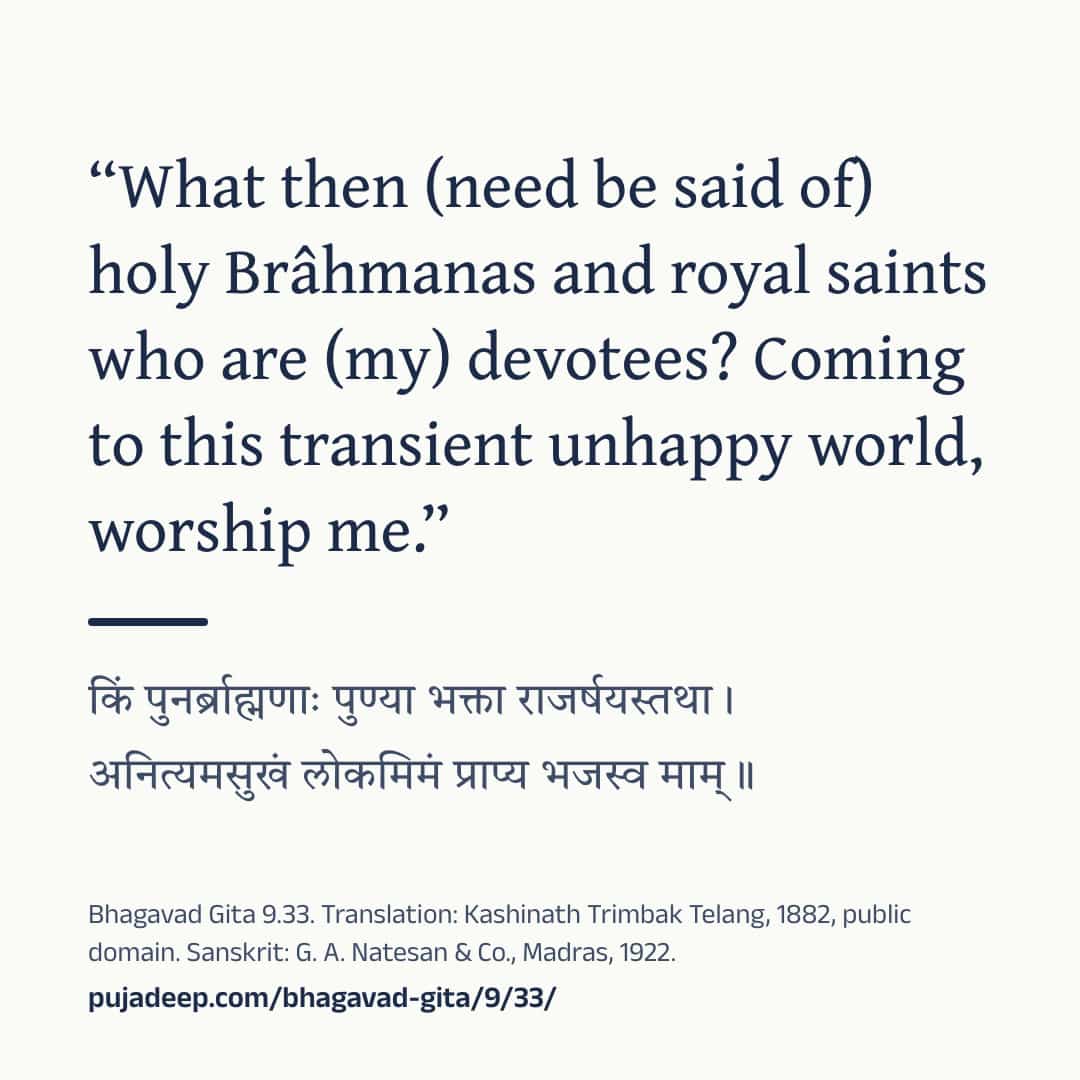
Drawing the picture
See the words
Bhagavad Gita 9.33

किं पुनर्ब्राह्मणाः पुण्या भक्ता राजर्षयस्तथा ।
अनित्यमसुखं लोकमिमं प्राप्य भजस्व माम् ॥

“What then (need be said of) holy Brâhmanas and royal saints who are (my) devotees? Coming to this transient unhappy world, worship me.”
(K. T. Telang, The Bhagavadgîtâ (The Sacred Books of the East, vol. VIII, Oxford: Clarendon Press, 1882), pp. 85–86, public domain)

“How much rather holy Brâhmans and devoted royal saints; having obtained this transient joyless world, worship thou Me.”
(Annie Besant, The Bhagavad Gîtâ, or The Lord's Song (London: Theosophical Publishing Society, 1895), p. 93, public domain)

“What need to mention holy Brâhmanas, and devoted Râjarshis! Having obtained this transient, joyless world, worship thou Me.”
(Swami Swarupananda, Srimad-Bhagavad-Gita (Mayavati: Prabuddha Bharata Press, 1909; first printed in Prabuddha Bharata, 1907–1909), p. 192, public domain)

Sanskrit: G. A. Natesan & Co., Madras, 1922.
https://pujadeep.com/bhagavad-gita/9/33/ Nothing is sent from this site. Your own app sends it, to the chat you choose. The picture quotes the translation you chose on this page, with its name and year.
Sanskrit text: The Bhagavad-Gita, or The Lord's Song, with the text in Devanagari and an English translation, 1922. Meanings: written for Pujadeep and checked against the cited edition. Source and changes
Questions families ask
Who speaks Bhagavad Gita 9.33?
Krishna speaks this verse, in chapter 9 (Raja Vidya Raja Guhya Yoga).
Where does the Sanskrit text come from?
Sanskrit text: The Bhagavad-Gita, or The Lord's Song, with the text in Devanagari and an English translation, 1922. Meanings: written for Pujadeep and checked against the cited edition. See the source
Is the meaning on this page a translation?
Explanation written for this site from the sources listed here, and checked against the cited edition. It is not a translation and not the only way to read the text. Free to quote with credit.
Source and licence
- Sanskrit text
- The Bhagavad-Gita, or The Lord's Song, with the text in Devanagari and an English translation (Annie Besant, G. A. Natesan & Co., Madras, 1922). Public domain. The Sanskrit on these pages was read from this printing’s page images.
- Translation
- The Bhagavadgîtâ with the Sanatsugâtîya and the Anugîtâ, translated by Kâshinâth Trimbak Telang (The Sacred Books of the East, vol. VIII, ed. F. Max Müller) (Kashinath Trimbak Telang, F. Max Müller, Clarendon Press, Oxford, 1882). Public domain. Shown verbatim, as printed.
- Translation
- The Bhagavad Gîtâ, or The Lord's Song, translated by Annie Besant (Annie Besant, Theosophical Publishing Society, London, 1895). Public domain. Shown verbatim, as printed.
- Translation
- Srimad-Bhagavad-Gita, with Sanskrit Text; Paraphrase with Word-by-word Literal Translation; English Rendering and Comments, Index, &c., by the Swami Swarupananda (Himalayan Series, No. XX) (Swami Swarupananda, The Editors and Publishers, Advaita Ashrama, Mayavati, Prabuddha Bharata Press, Mayavati, Almora, Himalayas, 1909). Public domain. Shown verbatim, as printed.
- Common wording
- In this text, 32 words follow today's common wording, checked against sanskritdocuments.org; Sanskrit Wikisource; Gita Press, Gorakhpur; GRETIL, Göttingen and Bhaktivedanta Book Trust.
- Our explanation
- Explanation written for this site from the sources listed here, and checked against the cited edition. It is not a translation and not the only way to read the text. Free to quote with credit.
- Checked
- Checked against the cited edition, October 15, 2026.
- Updated
- October 27, 2026