Bhagavad Gita 9.32: meaning and translation
Chapter 9: Raja Vidya Raja Guhya Yoga. Krishna says
Krishna says that all who take refuge in him reach the highest goal, and he names groups that the society of that age ranked below the brāhmaṇas and royal sages of the next verse: people “of sinful birth” (pāpa-yoni), women, vaiśyas and śūdras.
Click or tap a word for its meaning and its dictionary page.
Text and layers
Text and layers
These choices stay in this browser.
Bhagavad Gita 9.32
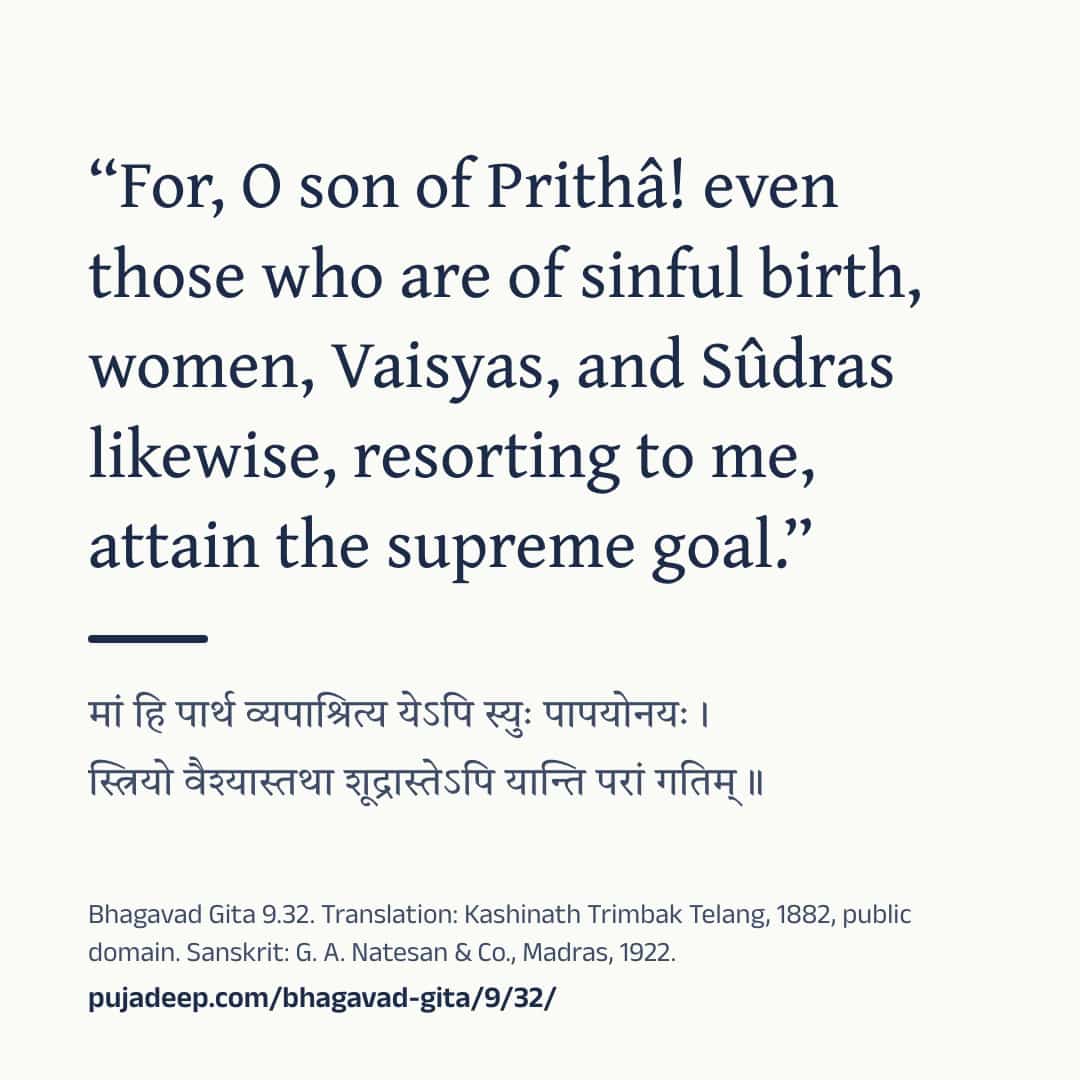
मां हि पार्थ व्यपाश्रित्य येऽपि स्युः पापयोनयः ।स्त्रियो वैश्यास्तथा शूद्रास्तेऽपि यान्ति परां गतिम् ॥
Mam hi partha vyapashritya yepi syuh papayonayahStriyo vaishyastatha shudrastepi yanti param gatim
māṃ hi pārtha vyapāśritya ye’pi syuḥ pāpayonayaḥ |striyo vaiśyāstathā śūdrāste’pi yānti parāṃ gatim ||
Our explanation Krishna says that all who take refuge in him reach the highest goal, and he names groups that the society of that age ranked below the brāhmaṇas and royal sages of the next verse: people “of sinful birth” (pāpa-yoni), women, vaiśyas and śūdras. The verse says that even they reach the highest goal, so no one who takes refuge in him is shut out; 9.29 has already said that Krishna is the same to all beings. The verse is read in two ways. Shankara and Ramanuja take women, vaiśyas and śūdras as the examples of “sinful birth”, which Shankara explains as a birth that results from past sins. The commentator Śrīdhara takes “of sinful birth” as a separate group, people of low birth, as Telang's footnote reports.
हिंदी अर्थ कृष्ण कहते हैं कि जो कोई उनकी शरण लेता है, वह परम गति पाता है, और वे उन वर्गों के नाम लेते हैं जिन्हें उस समय का समाज अगले श्लोक के ब्राह्मणों और राजर्षियों से नीचे रखता था: “पाप-योनि” कहे गए लोग, स्त्रियाँ, वैश्य और शूद्र। श्लोक कहता है कि वे भी परम गति पाते हैं, इसलिए उनकी शरण लेने वाला कोई भी बाहर नहीं; 9.29 पहले ही कह चुका है कि कृष्ण सब प्राणियों के प्रति समान हैं। इस श्लोक को दो तरह पढ़ा जाता है। शंकराचार्य और रामानुजाचार्य स्त्रियों, वैश्यों और शूद्रों को “पाप-योनि” के उदाहरण मानते हैं, और शंकराचार्य “पाप-योनि” का अर्थ पिछले पापों के फल से हुआ जन्म बताते हैं। टीकाकार श्रीधर “पाप-योनि” को एक अलग समूह, यानी नीचा माने गए कुल में जन्मे लोग, मानते हैं, जैसा तेलंग की टिप्पणी बताती है।
Word by word
Every word, with its dictionary page
Word by word
- माम् mām · "me" (Krishna) (pronoun, accusative singular) Dictionary: 1. mad, Monier-Williams 1899, p. 777, col. 2 “base of the first pers. pron. in the sg. number (esp. in comp.)”
- हि hi · for, indeed (indeclinable) Dictionary: 2. hi, Monier-Williams 1899, p. 1297, col. 3 “for, because, on account of”
- पार्थ pārtha · O Partha (son of Pritha) (noun (masculine), vocative singular) Dictionary: 2. pārtha, Monier-Williams 1899, p. 621, col. 3
- व्यपाश्रित्य vyapāśritya · taking refuge in (absolutive (having done)) Dictionary: vy-apā-śri, Monier-Williams 1899, p. 1032, col. 1 “to go to for refuge, have recourse to (acc.)”
- ये ye · who (relative pronoun (masculine), nominative plural) Dictionary: yad, Monier-Williams 1899, p. 844, col. 2 “who, which, what, whichever, whatever, that”
- अपि api · also (indeclinable) Dictionary: api, Monier-Williams 1899, p. 55, col. 1 “in the sense of even, also, very”
- स्युः syuḥ · may be (optative, 3rd person plural) Dictionary: 1. as, Monier-Williams 1899, p. 117, col. 2 “to be, live, exist, be present”
- पापयोनयः pāpayonayaḥ · of sinful birth (compound (masculine), nominative plural) Dictionary: pāpa, Monier-Williams 1899, p. 618, col. 2 “sin, vice, crime, guilt”; yoni, Monier-Williams 1899, p. 858, col. 2 “family, race, stock, caste, the form of existence or station fixed by birth”
- स्त्रियः striyaḥ · women (noun (feminine), nominative plural) Dictionary: strī, Monier-Williams 1899, p. 1260, col. 3 “a woman, female, wife”
- वैश्याः vaiśyāḥ · vaiśyas (noun (masculine), nominative plural) Dictionary: vaiśya, Monier-Williams 1899, p. 1026, col. 3 “man of the third class or caste”
- तथा tathā · and also (indeclinable) Dictionary: tathā, Monier-Williams 1899, p. 433, col. 3 “in that manner, so, thus”
- शूद्राः śūdrāḥ · śūdras (noun (masculine), nominative plural) Dictionary: śūdra, Monier-Williams 1899, p. 1085, col. 3 “a Śūdra, a man of the fourth or lowest of the four original classes or castes”
- ते te · they (pronoun (masculine), nominative plural) Dictionary: tad, Monier-Williams 1899, p. 434, col. 1 “m. he, f. she, n. it, that, this”
- अपि api · also (indeclinable) Dictionary: api, Monier-Williams 1899, p. 55, col. 1 “in the sense of even, also, very”
- यान्ति yānti · go (present, 3rd person plural) Dictionary: yā, Monier-Williams 1899, p. 849, col. 1 “to go, proceed, move, walk, set out”
- पराम् parām · the highest (adjective (feminine), accusative singular) Dictionary: 1. para, Monier-Williams 1899, p. 586, col. 1 “highest, supreme, chief”
- गतिम् gatim · goal (noun (feminine), accusative singular) Dictionary: gati, Monier-Williams 1899, p. 347, col. 3 “a happy issue”
Old translations
Kashinath Trimbak Telang, 1882. Public domain. Page 85.
For, O son of Prithâ! even those who are of sinful birth1, women, Vaisyas, and Sûdras likewise, resorting to me, attain the supreme goal.
Footnotes (the translator’s own) - Saṅkara takes Vaisyas &c. as examples of this; not so Srîdhara. Cf. as to women and Sûdras, Nrisimha-tâpinî, p. 14. 'Of sinful birth'=of low birth (Srîdhara)=birth resulting from sins (Saṅkara). ↩
Compare 3 translations
Kashinath Trimbak Telang, 1882. Public domain. Page 85.
For, O son of Prithâ! even those who are of sinful birth1, women, Vaisyas, and Sûdras likewise, resorting to me, attain the supreme goal.
Footnotes (the translator’s own) - Saṅkara takes Vaisyas &c. as examples of this; not so Srîdhara. Cf. as to women and Sûdras, Nrisimha-tâpinî, p. 14. 'Of sinful birth'=of low birth (Srîdhara)=birth resulting from sins (Saṅkara). ↩
You are reading this one
Annie Besant, 1895. Public domain. Page 93.
They who take refuge with Me, O Pârtha! though of the womb of sin, women, Vaishyas, even Shûdras, they also tread the highest Path.
You are reading this one
Swami Swarupananda, 1909 (first printed 1907). Public domain. Page 191.
For, taking refuge in Me, they also, O son of Prithá, who might be of inferior birth,—women, Vaishyas, as well as Sudras,—even they attain to the Supreme Goal.
You are reading this one
Cite this verse
The translation: K. T. Telang, The Bhagavadgîtâ (The Sacred Books of the East, vol. VIII, Oxford: Clarendon Press, 1882), p. 85. Bhagavad Gita 9.32.
The translation: Annie Besant, The Bhagavad Gîtâ, or The Lord's Song (London: Theosophical Publishing Society, 1895), p. 93. Bhagavad Gita 9.32.
The translation: Swami Swarupananda, Srimad-Bhagavad-Gita (Mayavati: Prabuddha Bharata Press, 1909; first printed in Prabuddha Bharata, 1907–1909), p. 191. Bhagavad Gita 9.32.
Our explanation: “Bhagavad Gita 9.32: meaning and translation.” Pujadeep. Updated October 27, 2026. https://pujadeep.com/bhagavad-gita/9/32/
Pujadeep’s explanations are free to quote with credit: name Pujadeep and link to the page. How to credit
Classical readings, by school
No readings by school on this verse yet.
Share
Show the ways to share
Send one picture or the text to one chat. The picture names its source and the address of this page.
Drawing the picture
See the words
Bhagavad Gita 9.32

मां हि पार्थ व्यपाश्रित्य येऽपि स्युः पापयोनयः ।
स्त्रियो वैश्यास्तथा शूद्रास्तेऽपि यान्ति परां गतिम् ॥

“For, O son of Prithâ! even those who are of sinful birth, women, Vaisyas, and Sûdras likewise, resorting to me, attain the supreme goal.”
(K. T. Telang, The Bhagavadgîtâ (The Sacred Books of the East, vol. VIII, Oxford: Clarendon Press, 1882), p. 85, public domain)

“They who take refuge with Me, O Pârtha! though of the womb of sin, women, Vaishyas, even Shûdras, they also tread the highest Path.”
(Annie Besant, The Bhagavad Gîtâ, or The Lord's Song (London: Theosophical Publishing Society, 1895), p. 93, public domain)

“For, taking refuge in Me, they also, O son of Prithá, who might be of inferior birth,—women, Vaishyas, as well as Sudras,—even they attain to the Supreme Goal.”
(Swami Swarupananda, Srimad-Bhagavad-Gita (Mayavati: Prabuddha Bharata Press, 1909; first printed in Prabuddha Bharata, 1907–1909), p. 191, public domain)

Sanskrit: G. A. Natesan & Co., Madras, 1922.
https://pujadeep.com/bhagavad-gita/9/32/ Nothing is sent from this site. Your own app sends it, to the chat you choose. The picture quotes the translation you chose on this page, with its name and year.
Sanskrit text: The Bhagavad-Gita, or The Lord's Song, with the text in Devanagari and an English translation, 1922. Meanings: written for Pujadeep and checked against the cited edition. Source and changes
Questions families ask
Who speaks Bhagavad Gita 9.32?
Krishna speaks this verse, in chapter 9 (Raja Vidya Raja Guhya Yoga).
Where does the Sanskrit text come from?
Sanskrit text: The Bhagavad-Gita, or The Lord's Song, with the text in Devanagari and an English translation, 1922. Meanings: written for Pujadeep and checked against the cited edition. See the source
Is the meaning on this page a translation?
Explanation written for this site from the sources listed here, and checked against the cited edition. It is not a translation and not the only way to read the text. Free to quote with credit.
Source and licence
- Sanskrit text
- The Bhagavad-Gita, or The Lord's Song, with the text in Devanagari and an English translation (Annie Besant, G. A. Natesan & Co., Madras, 1922). Public domain. The Sanskrit on these pages was read from this printing’s page images.
- Translation
- The Bhagavadgîtâ with the Sanatsugâtîya and the Anugîtâ, translated by Kâshinâth Trimbak Telang (The Sacred Books of the East, vol. VIII, ed. F. Max Müller) (Kashinath Trimbak Telang, F. Max Müller, Clarendon Press, Oxford, 1882). Public domain. Shown verbatim, as printed.
- Translation
- The Bhagavad Gîtâ, or The Lord's Song, translated by Annie Besant (Annie Besant, Theosophical Publishing Society, London, 1895). Public domain. Shown verbatim, as printed.
- Translation
- Srimad-Bhagavad-Gita, with Sanskrit Text; Paraphrase with Word-by-word Literal Translation; English Rendering and Comments, Index, &c., by the Swami Swarupananda (Himalayan Series, No. XX) (Swami Swarupananda, The Editors and Publishers, Advaita Ashrama, Mayavati, Prabuddha Bharata Press, Mayavati, Almora, Himalayas, 1909). Public domain. Shown verbatim, as printed.
- Common wording
- In this text, 32 words follow today's common wording, checked against sanskritdocuments.org; Sanskrit Wikisource; Gita Press, Gorakhpur; GRETIL, Göttingen and Bhaktivedanta Book Trust.
- Our explanation
- Explanation written for this site from the sources listed here, and checked against the cited edition. It is not a translation and not the only way to read the text. Free to quote with credit.
- Checked
- Checked against the cited edition, October 15, 2026.
- Updated
- October 27, 2026