Bhagavad Gita 9.31: meaning and translation
Chapter 9: Raja Vidya Raja Guhya Yoga. Krishna says
Krishna says that such a person soon becomes righteous at heart (dharmātmā) and reaches lasting peace.
Click or tap a word for its meaning and its dictionary page.
Text and layers
Text and layers
These choices stay in this browser.
Bhagavad Gita 9.31
क्षिप्रं भवति धर्मात्मा शश्वच्छान्तिं निगच्छति ।कौन्तेय प्रतिजानीहि न मे भक्तः प्रणश्यति ॥
Kshipram bhavati dharmatma shashvachchhantim nigachchhatiKaunteya pratijanihi na me bhaktah pranashyati
kṣipraṃ bhavati dharmātmā śaśvacchāntiṃ nigacchati |kaunteya pratijānīhi na me bhaktaḥ praṇaśyati ||
Our explanation Krishna says that such a person soon becomes righteous at heart (dharmātmā) and reaches lasting peace. He tells Arjuna to declare it boldly: “my devotee never perishes.”
हिंदी अर्थ कृष्ण कहते हैं कि ऐसा व्यक्ति शीघ्र ही धर्मात्मा बन जाता है और शाश्वत शांति पाता है। वे अर्जुन से कहते हैं कि यह दृढ़ता से घोषित कर दें: “मेरा भक्त कभी नष्ट नहीं होता।”
Word by word
Every word, with its dictionary page
Word by word
- क्षिप्रम् kṣipram · soon (adverb) Dictionary: kṣipra, Monier-Williams 1899, p. 329, col. 1 “quick, speedy, swift”
- भवति bhavati · becomes (present, 3rd person singular) Dictionary: 1. bhū, Monier-Williams 1899, p. 760, col. 2 “to become, be”
- धर्मात्मा dharmātmā · righteous at heart (compound (masculine), nominative singular) Dictionary: dharmātman, Monier-Williams 1899, p. 512, col. 2 “religious-minded, just, virtuous, dutiful”
- शश्वत् śaśvat · lasting (adverb) Dictionary: śaśvat, Monier-Williams 1899, p. 1060, col. 3 “perpetual, continual, endless”
- शान्तिम् śāntim · peace (noun (feminine), accusative singular) Dictionary: śānti, Monier-Williams 1899, p. 1064, col. 3 “tranquillity, peace, quiet, peace or calmness of mind”
- निगच्छति nigacchati · attains (present, 3rd person singular) Dictionary: ni-gam, Monier-Williams 1899, p. 545, col. 3 “to enter, resort to, undergo, incur, become”
- कौन्तेय kaunteya · O son of Kunti (noun (masculine), vocative singular) Dictionary: kaunteya, Monier-Williams 1899, p. 316, col. 2 “metron. fr. Kuntī”
- प्रतिजानीहि pratijānīhi · declare, know for sure (imperative, 2nd person singular) Dictionary: prati-jñā, Monier-Williams 1899, p. 665, col. 3 “to maintain, assert, allege, state”
- न na · not (indeclinable) Dictionary: 2. na, Monier-Williams 1899, p. 523, col. 1 “ind. not, no, nor, neither”
- मे me · "my" (pronoun, genitive singular) Dictionary: 1. mad, Monier-Williams 1899, p. 777, col. 2 “base of the first pers. pron. in the sg. number (esp. in comp.)”
- भक्तः bhaktaḥ · devotee (noun (masculine), nominative singular) Dictionary: bhakta, Monier-Williams 1899, p. 743, col. 1 “attached or devoted to, loyal, faithful, honouring, worshipping, serving”
- प्रणश्यति praṇaśyati · perishes, is lost (present, 3rd person singular) Dictionary: pra-ṇaś, Monier-Williams 1899, p. 659, col. 3
Old translations
Kashinath Trimbak Telang, 1882. Public domain. Page 85.
He soon becomes devout of heart, and obtains lasting tranquillity. (You may) affirm, O son of Kuntî! that my devotee is never ruined.
Compare 3 translations
Kashinath Trimbak Telang, 1882. Public domain. Page 85.
He soon becomes devout of heart, and obtains lasting tranquillity. (You may) affirm, O son of Kuntî! that my devotee is never ruined.
You are reading this one
Annie Besant, 1895. Public domain. Page 93.
Speedily he becometh dutiful and goeth to eternal Peace. O Kaunteya, know thou certainly that My devotee is never destroyed.
This sentence begins in 9.30.
You are reading this one
Swami Swarupananda, 1909 (first printed 1907). Public domain. Page 191.
Soon does he become righteous, and attains to eternal Peace, O son of Kunti; boldly canst thou proclaim, that My devotee is never destroyed.
You are reading this one
Cite this verse
The translation: K. T. Telang, The Bhagavadgîtâ (The Sacred Books of the East, vol. VIII, Oxford: Clarendon Press, 1882), p. 85. Bhagavad Gita 9.31.
The translation: Annie Besant, The Bhagavad Gîtâ, or The Lord's Song (London: Theosophical Publishing Society, 1895), p. 93. Bhagavad Gita 9.31.
The translation: Swami Swarupananda, Srimad-Bhagavad-Gita (Mayavati: Prabuddha Bharata Press, 1909; first printed in Prabuddha Bharata, 1907–1909), p. 191. Bhagavad Gita 9.31.
Our explanation: “Bhagavad Gita 9.31: meaning and translation.” Pujadeep. Updated October 27, 2026. https://pujadeep.com/bhagavad-gita/9/31/
Pujadeep’s explanations are free to quote with credit: name Pujadeep and link to the page. How to credit
Classical readings, by school
No readings by school on this verse yet.
Share
Show the ways to share
Send one picture or the text to one chat. The picture names its source and the address of this page.
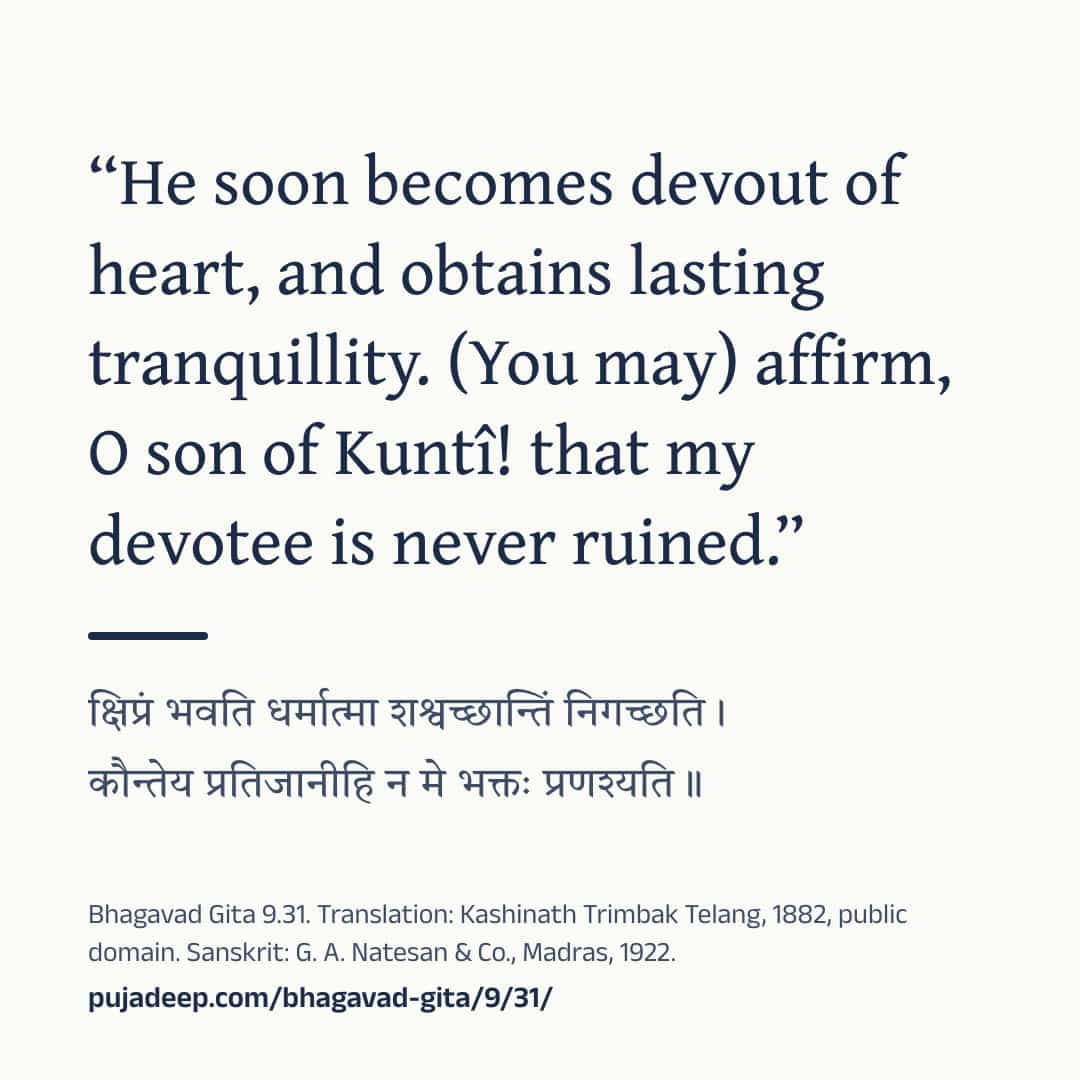
Drawing the picture
See the words
Bhagavad Gita 9.31

क्षिप्रं भवति धर्मात्मा शश्वच्छान्तिं निगच्छति ।
कौन्तेय प्रतिजानीहि न मे भक्तः प्रणश्यति ॥

“He soon becomes devout of heart, and obtains lasting tranquillity. (You may) affirm, O son of Kuntî! that my devotee is never ruined.”
(K. T. Telang, The Bhagavadgîtâ (The Sacred Books of the East, vol. VIII, Oxford: Clarendon Press, 1882), p. 85, public domain)

“Speedily he becometh dutiful and goeth to eternal Peace. O Kaunteya, know thou certainly that My devotee is never destroyed.”
(Annie Besant, The Bhagavad Gîtâ, or The Lord's Song (London: Theosophical Publishing Society, 1895), p. 93, public domain)
This sentence begins in 9.30.

“Soon does he become righteous, and attains to eternal Peace, O son of Kunti; boldly canst thou proclaim, that My devotee is never destroyed.”
(Swami Swarupananda, Srimad-Bhagavad-Gita (Mayavati: Prabuddha Bharata Press, 1909; first printed in Prabuddha Bharata, 1907–1909), p. 191, public domain)

Sanskrit: G. A. Natesan & Co., Madras, 1922.
https://pujadeep.com/bhagavad-gita/9/31/ Nothing is sent from this site. Your own app sends it, to the chat you choose. The picture quotes the translation you chose on this page, with its name and year.
Sanskrit text: The Bhagavad-Gita, or The Lord's Song, with the text in Devanagari and an English translation, 1922. Meanings: written for Pujadeep and checked against the cited edition. Source and changes
Questions families ask
Who speaks Bhagavad Gita 9.31?
Krishna speaks this verse, in chapter 9 (Raja Vidya Raja Guhya Yoga).
Where does the Sanskrit text come from?
Sanskrit text: The Bhagavad-Gita, or The Lord's Song, with the text in Devanagari and an English translation, 1922. Meanings: written for Pujadeep and checked against the cited edition. See the source
Is the meaning on this page a translation?
Explanation written for this site from the sources listed here, and checked against the cited edition. It is not a translation and not the only way to read the text. Free to quote with credit.
Source and licence
- Sanskrit text
- The Bhagavad-Gita, or The Lord's Song, with the text in Devanagari and an English translation (Annie Besant, G. A. Natesan & Co., Madras, 1922). Public domain. The Sanskrit on these pages was read from this printing’s page images.
- Translation
- The Bhagavadgîtâ with the Sanatsugâtîya and the Anugîtâ, translated by Kâshinâth Trimbak Telang (The Sacred Books of the East, vol. VIII, ed. F. Max Müller) (Kashinath Trimbak Telang, F. Max Müller, Clarendon Press, Oxford, 1882). Public domain. Shown verbatim, as printed.
- Translation
- The Bhagavad Gîtâ, or The Lord's Song, translated by Annie Besant (Annie Besant, Theosophical Publishing Society, London, 1895). Public domain. Shown verbatim, as printed.
- Translation
- Srimad-Bhagavad-Gita, with Sanskrit Text; Paraphrase with Word-by-word Literal Translation; English Rendering and Comments, Index, &c., by the Swami Swarupananda (Himalayan Series, No. XX) (Swami Swarupananda, The Editors and Publishers, Advaita Ashrama, Mayavati, Prabuddha Bharata Press, Mayavati, Almora, Himalayas, 1909). Public domain. Shown verbatim, as printed.
- Common wording
- In this text, 32 words follow today's common wording, checked against sanskritdocuments.org; Sanskrit Wikisource; Gita Press, Gorakhpur; GRETIL, Göttingen and Bhaktivedanta Book Trust.
- Our explanation
- Explanation written for this site from the sources listed here, and checked against the cited edition. It is not a translation and not the only way to read the text. Free to quote with credit.
- Checked
- Checked against the cited edition, October 15, 2026.
- Updated
- October 27, 2026