Bhagavad Gita 12.2: meaning and translation
Chapter 12: Bhakti Yoga. Krishna says
Krishna answers.
Click or tap a word for its meaning and its dictionary page.
Text and layers
Text and layers
These choices stay in this browser.
Bhagavad Gita 12.2
श्रीभगवानुवाच ।
मय्यावेश्य मनो ये मां नित्ययुक्ता उपासते ।श्रद्धया परयोपेतास्ते मे युक्ततमा मताः ॥
Mayyaveshya mano ye mam nityayukta upasateShraddhaya parayopetaste me yuktatama matah
mayyāveśya mano ye māṃ nityayuktā upāsate |śraddhayā parayopetāste me yuktatamā matāḥ ||
Our explanation Krishna answers. Those who fix their mind on him, worship him while always joined to him, and are full of the highest faith (śraddhā) are, in his view, the most devoted in yoga (yuktatama).
हिंदी अर्थ कृष्ण उत्तर देते हैं। जो अपना मन उनमें लगाकर, सदा उनसे जुड़े रहकर, परम श्रद्धा के साथ उनकी उपासना करते हैं, वे उनके मत में योग में सबसे श्रेष्ठ (युक्ततम) हैं।
Word by word
Every word, with its dictionary page
Word by word
- मयि mayi · on "me" (Krishna) (pronoun, locative singular) Dictionary: 1. mad, Monier-Williams 1899, p. 777, col. 2 “base of the first pers. pron. in the sg. number (esp. in comp.)”
- आवेश्य āveśya · having fixed, having set (absolutive of the causative ('having made')) Dictionary: ā-viś, Monier-Williams 1899, p. 155, col. 3 “Caus. -veśayati, to cause to enter or approach”
- मनः manaḥ · the mind (accusative singular) Dictionary: manas, Monier-Williams 1899, p. 783, col. 3 “mind (in its widest sense as applied to all the mental powers)”
- ये ye · those who (relative pronoun, nominative plural) Dictionary: yad, Monier-Williams 1899, p. 844, col. 2 “who, which, what, whichever, whatever, that”
- माम् mām · "me" (Krishna) (pronoun, accusative singular) Dictionary: 1. mad, Monier-Williams 1899, p. 777, col. 2 “base of the first pers. pron. in the sg. number (esp. in comp.)”
- नित्ययुक्ताः nityayuktāḥ · ever joined, always steadfast (compound, nominative plural) Dictionary: nitya-yukta, Monier-Williams 1899, p. 547, col. 3 “always busy or intent upon”
- उपासते upāsate · worship (present, 3rd person plural) Dictionary: 3. upās, Monier-Williams 1899, p. 215, col. 1 “serve, honour, revere, respect, acknowledge, do homage, worship”
- श्रद्धया śraddhayā · with faith (instrumental singular) Dictionary: śraddhā, Monier-Williams 1899, p. 1095, col. 3 “faith, trust, confidence, trustfulness, faithfulness, belief in”
- परया parayā · supreme, highest (instrumental singular (feminine)) Dictionary: 1. para, Monier-Williams 1899, p. 586, col. 1 “highest, supreme, chief”
- उपेताः upetāḥ · endowed with (past participle, nominative plural) Dictionary: upeta, Monier-Williams 1899, p. 215, col. 3 “accompanied by, endowed with, furnished with, having, possessing”
- ते te · they (pronoun, nominative plural) Dictionary: tad, Monier-Williams 1899, p. 434, col. 1 “m. he, f. she, n. it, that, this”
- मे me · "by me", in Krishna's view (pronoun, genitive singular) Dictionary: 1. mad, Monier-Williams 1899, p. 777, col. 2 “base of the first pers. pron. in the sg. number (esp. in comp.)”
- युक्ततमाः yuktatamāḥ · the most steadfast in yoga (superlative, nominative plural) Dictionary: yukta, Monier-Williams 1899, p. 853, col. 2 “absorbed in abstract meditation, concentrated, attentive”; 2. tama, Monier-Williams 1899, p. 438, col. 2 “an affix forming the superl. degree of adjectives”
- मताः matāḥ · are considered (past participle, nominative plural) Dictionary: mata, Monier-Williams 1899, p. 783, col. 1 “thought, believed, imagined, supposed, understood; regarded or considered as”
2 printings differ
Edition differences. Another printing or text reads this place differently.
- Spelling A digital text reads Same words, without sandhi: the e-text keeps the visarga (परयोपेताः ते); the 1922 edition joins the words (परयोपेतास्ते).
- Spelling A digital text reads Same words, without sandhi (parayopetāḥ te), like another digital text.
Old translations
Kashinath Trimbak Telang, 1882. Public domain. Page 99.
The Deity said:
Those who being constantly devoted, and possessed of the highest faith, worship me with a mind fixed on me, are deemed by me to be the most devoted.
Compare 3 translations
Kashinath Trimbak Telang, 1882. Public domain. Page 99.
The Deity said:
Those who being constantly devoted, and possessed of the highest faith, worship me with a mind fixed on me, are deemed by me to be the most devoted.
You are reading this one
Annie Besant, 1895. Public domain. Page 118.
The Blessed Lord said:
They who have fixed Manas on Me, and ever harmonised worship Me, with faith supreme endowed, these, in My opinion, are best in Yoga.
You are reading this one
Swami Swarupananda, 1909 (first printed 1907). Public domain. Page 243.
The Blessed Lord said:
Those who, fixing their mind on Me, worship Me, ever-steadfast, and endowed with Supreme Shraddhâ, they in My opinion are the best versed in Yoga.
You are reading this one
Cite this verse
The translation: K. T. Telang, The Bhagavadgîtâ (The Sacred Books of the East, vol. VIII, Oxford: Clarendon Press, 1882), p. 99. Bhagavad Gita 12.2.
The translation: Annie Besant, The Bhagavad Gîtâ, or The Lord's Song (London: Theosophical Publishing Society, 1895), p. 118. Bhagavad Gita 12.2.
The translation: Swami Swarupananda, Srimad-Bhagavad-Gita (Mayavati: Prabuddha Bharata Press, 1909; first printed in Prabuddha Bharata, 1907–1909), p. 243. Bhagavad Gita 12.2.
Our explanation: “Bhagavad Gita 12.2: meaning and translation.” Pujadeep. Updated October 27, 2026. https://pujadeep.com/bhagavad-gita/12/2/
Pujadeep’s explanations are free to quote with credit: name Pujadeep and link to the page. How to credit
Classical readings, by school
Each reading is named by its school. None is presented as the only meaning.
What Advaita, Vishishtadvaita and Dvaita teach, in short
Shankara Advaita
Shankara says Krishna sets the worshippers of the Imperishable aside for the moment, to speak of them later. Those who fix their minds on him as the Supreme Lord in the universal form, and think of him day and night with faith, are rightly called the best yogins.
Source: The Bhagavad-Gita, with the commentary of Sri Sankaracharya, translated by A. Mahadeva Sastri (2nd ed., Mysore: G. T. A. Printing Works, 1901), commentary on 12.2, pp. 266–267. Summarised in our own words; none of its text is reproduced.
Ramanuja Vishishtadvaita
Ramanuja says these devotees let their minds enter into the Lord because he is the one they love most, and they long for union with him. “Most devoted” means that they reach him, their goal, quickly and with ease.
Source: Sri Bhagavad-Gita with Sri Ramanujacharya's Visishtadvaita commentary, translated by A. Govindacharya (Madras, 1898), commentary on 12.2, pp. 381–382. Summarised in our own words; none of its text is reproduced.
Madhva Dvaita
Madhva takes 'always joined in yoga' to mean a twofold yoga: doing one's duties without attachment to their results, and deep meditation on the Lord. Those who follow both for the sake of liberation are, in his reading, the best in yoga.
Source: The Bhagavad-Gita: translation and commentaries in English according to Sri Madhwacharya's Bhashyas, by S. Subba Rau (Madras, 1906), commentary on 12.2, p. 236 (leaf n234). Summarised in our own words; none of its text is reproduced.
Share
Show the ways to share
Send one picture or the text to one chat. The picture names its source and the address of this page.
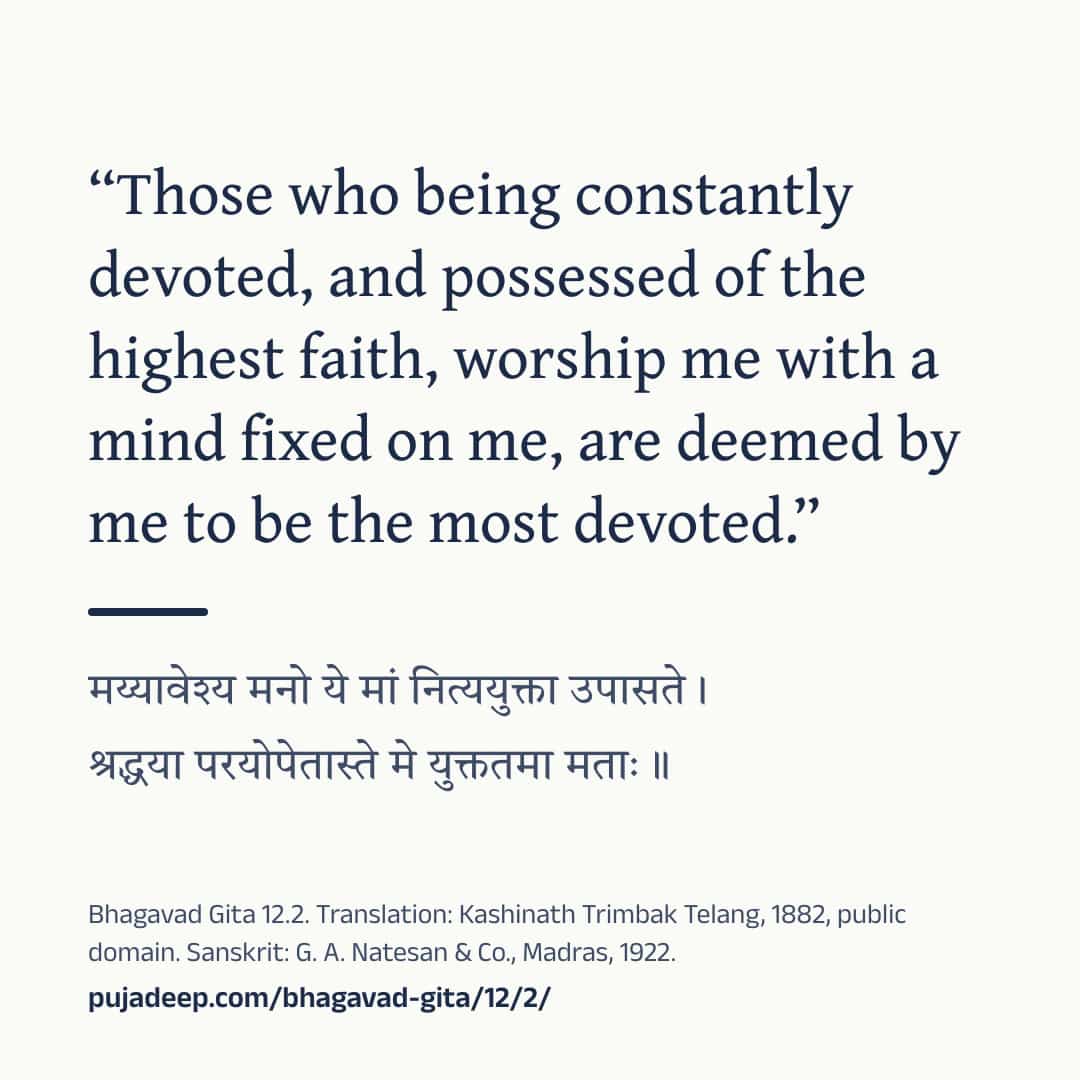
Drawing the picture
See the words
Bhagavad Gita 12.2

मय्यावेश्य मनो ये मां नित्ययुक्ता उपासते ।
श्रद्धया परयोपेतास्ते मे युक्ततमा मताः ॥

“Those who being constantly devoted, and possessed of the highest faith, worship me with a mind fixed on me, are deemed by me to be the most devoted.”
(K. T. Telang, The Bhagavadgîtâ (The Sacred Books of the East, vol. VIII, Oxford: Clarendon Press, 1882), p. 99, public domain)

“They who have fixed Manas on Me, and ever harmonised worship Me, with faith supreme endowed, these, in My opinion, are best in Yoga.”
(Annie Besant, The Bhagavad Gîtâ, or The Lord's Song (London: Theosophical Publishing Society, 1895), p. 118, public domain)

“Those who, fixing their mind on Me, worship Me, ever-steadfast, and endowed with Supreme Shraddhâ, they in My opinion are the best versed in Yoga.”
(Swami Swarupananda, Srimad-Bhagavad-Gita (Mayavati: Prabuddha Bharata Press, 1909; first printed in Prabuddha Bharata, 1907–1909), p. 243, public domain)

Sanskrit: G. A. Natesan & Co., Madras, 1922.
https://pujadeep.com/bhagavad-gita/12/2/ Nothing is sent from this site. Your own app sends it, to the chat you choose. The picture quotes the translation you chose on this page, with its name and year.
Sanskrit text: The Bhagavad-Gita, or The Lord's Song, with the text in Devanagari and an English translation, 1922. Meanings: written for Pujadeep and checked against the cited edition. Source and changes
Questions families ask
Who speaks Bhagavad Gita 12.2?
Krishna speaks this verse, in chapter 12 (Bhakti Yoga).
Where does the Sanskrit text come from?
Sanskrit text: The Bhagavad-Gita, or The Lord's Song, with the text in Devanagari and an English translation, 1922. Meanings: written for Pujadeep and checked against the cited edition. See the source
Is the meaning on this page a translation?
Explanation written for this site from the sources listed here, and checked against the cited edition. It is not a translation and not the only way to read the text. Free to quote with credit.
Source and licence
- Sanskrit text
- The Bhagavad-Gita, or The Lord's Song, with the text in Devanagari and an English translation (Annie Besant, G. A. Natesan & Co., Madras, 1922). Public domain. The Sanskrit on these pages was read from this printing’s page images.
- Translation
- The Bhagavadgîtâ with the Sanatsugâtîya and the Anugîtâ, translated by Kâshinâth Trimbak Telang (The Sacred Books of the East, vol. VIII, ed. F. Max Müller) (Kashinath Trimbak Telang, F. Max Müller, Clarendon Press, Oxford, 1882). Public domain. Shown verbatim, as printed.
- Translation
- The Bhagavad Gîtâ, or The Lord's Song, translated by Annie Besant (Annie Besant, Theosophical Publishing Society, London, 1895). Public domain. Shown verbatim, as printed.
- Translation
- Srimad-Bhagavad-Gita, with Sanskrit Text; Paraphrase with Word-by-word Literal Translation; English Rendering and Comments, Index, &c., by the Swami Swarupananda (Himalayan Series, No. XX) (Swami Swarupananda, The Editors and Publishers, Advaita Ashrama, Mayavati, Prabuddha Bharata Press, Mayavati, Almora, Himalayas, 1909). Public domain. Shown verbatim, as printed.
- Commentary
- The Bhagavad-Gita, with the commentary of Sri Sankaracharya, translated by A. Mahadeva Sastri (2nd ed., Mysore: G. T. A. Printing Works, 1901) (Public-domain scan, University of California Libraries). Summarised in our own words; none of its text is reproduced.
- Commentary
- Sri Bhagavad-Gita with Sri Ramanujacharya's Visishtadvaita commentary, translated by A. Govindacharya (Madras, 1898) (Scan uploaded to archive.org (folkscanomy collection)). Summarised in our own words; none of its text is reproduced.
- Commentary
- The Bhagavad-Gita: translation and commentaries in English according to Sri Madhwacharya's Bhashyas, by S. Subba Rau (Madras, 1906) (Scan uploaded to archive.org (folkscanomy collection)). Summarised in our own words; none of its text is reproduced.
- Common wording
- In this text, 32 words follow today's common wording, checked against sanskritdocuments.org; Sanskrit Wikisource; Gita Press, Gorakhpur; GRETIL, Göttingen and Bhaktivedanta Book Trust.
- Our explanation
- Explanation written for this site from the sources listed here, and checked against the cited edition. It is not a translation and not the only way to read the text. Free to quote with credit.
- Checked
- Checked against the cited edition, October 27, 2026.