Bhagavad Gita 12.6: meaning and translation
Chapter 12: Bhakti Yoga. Krishna says
Krishna turns back to those who worship him.
Click or tap a word for its meaning and its dictionary page.
Text and layers
Text and layers
These choices stay in this browser.
Bhagavad Gita 12.6
ये तु सर्वाणि कर्माणि मयि संन्यस्य मत्पराः ।अनन्येनैव योगेन मां ध्यायन्त उपासते ॥
Ye tu sarvani karmani mayi sannyasya matparahAnanyenaiva yogena mam dhyayanta upasate
ye tu sarvāṇi karmāṇi mayi saṃnyasya matparāḥ |ananyenaiva yogena māṃ dhyāyanta upāsate ||
Our explanation Krishna turns back to those who worship him. They offer all their actions to him, hold him as their highest goal, and worship him, meditating on him with a devotion that rests on nothing else (ananya yoga). The sentence continues in the next verse.
हिंदी अर्थ कृष्ण फिर उनकी बात करते हैं जो उनकी उपासना करते हैं। वे अपने सब कर्म उन्हें अर्पित करते हैं, उन्हें ही परम लक्ष्य मानते हैं, और अनन्य योग से, यानी किसी और पर नहीं केवल उन्हीं पर टिकी भक्ति से, उनका ध्यान करते हुए उपासना करते हैं। यह वाक्य अगले श्लोक में पूरा होता है।
Word by word
Every word, with its dictionary page
Word by word
- ये ye · those who (relative pronoun, nominative plural) Dictionary: yad, Monier-Williams 1899, p. 844, col. 2 “who, which, what, whichever, whatever, that”
- तु tu · but (indeclinable) Dictionary: 2. tu, Monier-Williams 1899, p. 449, col. 3 “but; and; or”
- सर्वाणि sarvāṇi · all (accusative plural (neuter)) Dictionary: sarva, Monier-Williams 1899, p. 1184, col. 3 “whole, entire, all, every”
- कर्माणि karmāṇi · actions (accusative plural) Dictionary: karman, Monier-Williams 1899, p. 258, col. 2 “act, action, performance, business”
- मयि mayi · in "me" (Krishna) (pronoun, locative singular) Dictionary: 1. mad, Monier-Williams 1899, p. 777, col. 2 “base of the first pers. pron. in the sg. number (esp. in comp.)”
- संन्यस्य saṃnyasya · having laid down, offering up (absolutive ('having done')) Dictionary: saṃ-ny-as, Monier-Williams 1899, p. 1148, col. 1 “to lay aside, give up, abandon, resign”
- मत्पराः matparāḥ · intent on "me" (Krishna) (compound, nominative plural) Dictionary: mat-para, Monier-Williams 1899, p. 777, col. 2 “devoted to me”
- अनन्येन ananyena · with no other (aim) (instrumental singular) Dictionary: an-anya, Monier-Williams 1899, p. 25, col. 2 “having no other (object), undistracted”
- एव eva · only (indeclinable) Dictionary: 1. eva, Monier-Williams 1899, p. 232, col. 2 “indeed, truly, really”
- योगेन yogena · with yoga, with devotion (instrumental singular) Dictionary: yoga, Monier-Williams 1899, p. 856, col. 2 “the act of yoking, joining, attaching”
- माम् mām · "me" (Krishna) (pronoun, accusative singular) Dictionary: 1. mad, Monier-Williams 1899, p. 777, col. 2 “base of the first pers. pron. in the sg. number (esp. in comp.)”
- ध्यायन्तः dhyāyantaḥ · meditating on (present participle, nominative plural) Dictionary: dhyai, Monier-Williams 1899, p. 521, col. 1 “to think of, imagine, contemplate, meditate on, call to mind, recollect”
- उपासते upāsate · worship (present, 3rd person plural) Dictionary: 3. upās, Monier-Williams 1899, p. 215, col. 1 “serve, honour, revere, respect, acknowledge, do homage, worship”
Old translations
Kashinath Trimbak Telang, 1882. Public domain. Page 100.
As to those, however, O son of Prithâ! who, dedicating all their actions to me, and (holding) me as their highest (goal), worship me, meditating on me with a devotion towards none besides me, and whose minds are fixed on me, I, without delay, come forward as their deliverer from the ocean of this world of death.
This sentence covers verses 12.6 to 12.7.
Compare 3 translations
Kashinath Trimbak Telang, 1882. Public domain. Page 100.
As to those, however, O son of Prithâ! who, dedicating all their actions to me, and (holding) me as their highest (goal), worship me, meditating on me with a devotion towards none besides me, and whose minds are fixed on me, I, without delay, come forward as their deliverer from the ocean of this world of death.
This sentence covers verses 12.6 to 12.7.
You are reading this one
Annie Besant, 1895. Public domain. Page 119.
Those verily who renounce all actions in Me and make Me supreme, who, worshipping, meditate on Me, with no other Yoga,
This sentence goes on in 12.7.
You are reading this one
Swami Swarupananda, 1909 (first printed 1907). Public domain. Page 245.
But those who worship Me, resigning all actions in Me, regarding Me as the Supreme Goal, meditating on Me with single-minded Yoga;—for these whose mind is set on Me, verily, I become ere long, O son of Prithá, the Saviour out of the ocean of the mortal Samsára.
This sentence covers verses 12.6 to 12.7.
You are reading this one
Cite this verse
The translation: K. T. Telang, The Bhagavadgîtâ (The Sacred Books of the East, vol. VIII, Oxford: Clarendon Press, 1882), p. 100. Bhagavad Gita 12.6–7.
The translation: Annie Besant, The Bhagavad Gîtâ, or The Lord's Song (London: Theosophical Publishing Society, 1895), p. 119. Bhagavad Gita 12.6.
The translation: Swami Swarupananda, Srimad-Bhagavad-Gita (Mayavati: Prabuddha Bharata Press, 1909; first printed in Prabuddha Bharata, 1907–1909), p. 245. Bhagavad Gita 12.6–7.
Our explanation: “Bhagavad Gita 12.6: meaning and translation.” Pujadeep. Updated October 27, 2026. https://pujadeep.com/bhagavad-gita/12/6/
Pujadeep’s explanations are free to quote with credit: name Pujadeep and link to the page. How to credit
Classical readings, by school
Each reading is named by its school. None is presented as the only meaning.
What Advaita, Vishishtadvaita and Dvaita teach, in short
Shankara Advaita
Shankara says these are the worshippers of the Lord (Īśvara) in the universal form, who have no other object of worship. “Exclusive yoga” means the steady concentration of the mind (samādhi) on him alone.
Source: The Bhagavad-Gita, with the commentary of Sri Sankaracharya, translated by A. Mahadeva Sastri (2nd ed., Mysore: G. T. A. Printing Works, 1901), commentary on 12.6–7, p. 269. Summarised in our own words; none of its text is reproduced.
Ramanuja Vishishtadvaita
Ramanuja says these devotees offer all their acts, worldly and religious, to the Lord as their only end. They worship him through meditation, offering flowers, bowing and praise, as if each act were itself the goal they love.
Source: Sri Bhagavad-Gita with Sri Ramanujacharya's Visishtadvaita commentary, translated by A. Govindacharya (Madras, 1898), commentary on 12.6–7, p. 384. Summarised in our own words; none of its text is reproduced.
Madhva Dvaita
Madhva reads 'giving up all actions in me' as knowing that Hari, who is fully independent, dwells within the worshippers and moves them, as doers under his control, to do the acts that make up his worship; so all duties are offered to him. 'With no other yoga' means the meditation turns to the Lord alone, not also to Lakṣmī or the other gods, knowing that they are not independent but under him and serve him. This worship, he says, needs less hard discipline than worship of the goddess.
Source: The Bhagavad-Gita: translation and commentaries in English according to Sri Madhwacharya's Bhashyas, by S. Subba Rau (Madras, 1906), commentary on 12.6–12.7, pp. 238–239 (leaves n236–n237). Summarised in our own words; none of its text is reproduced.
Share
Show the ways to share
Send one picture or the text to one chat. The picture names its source and the address of this page.
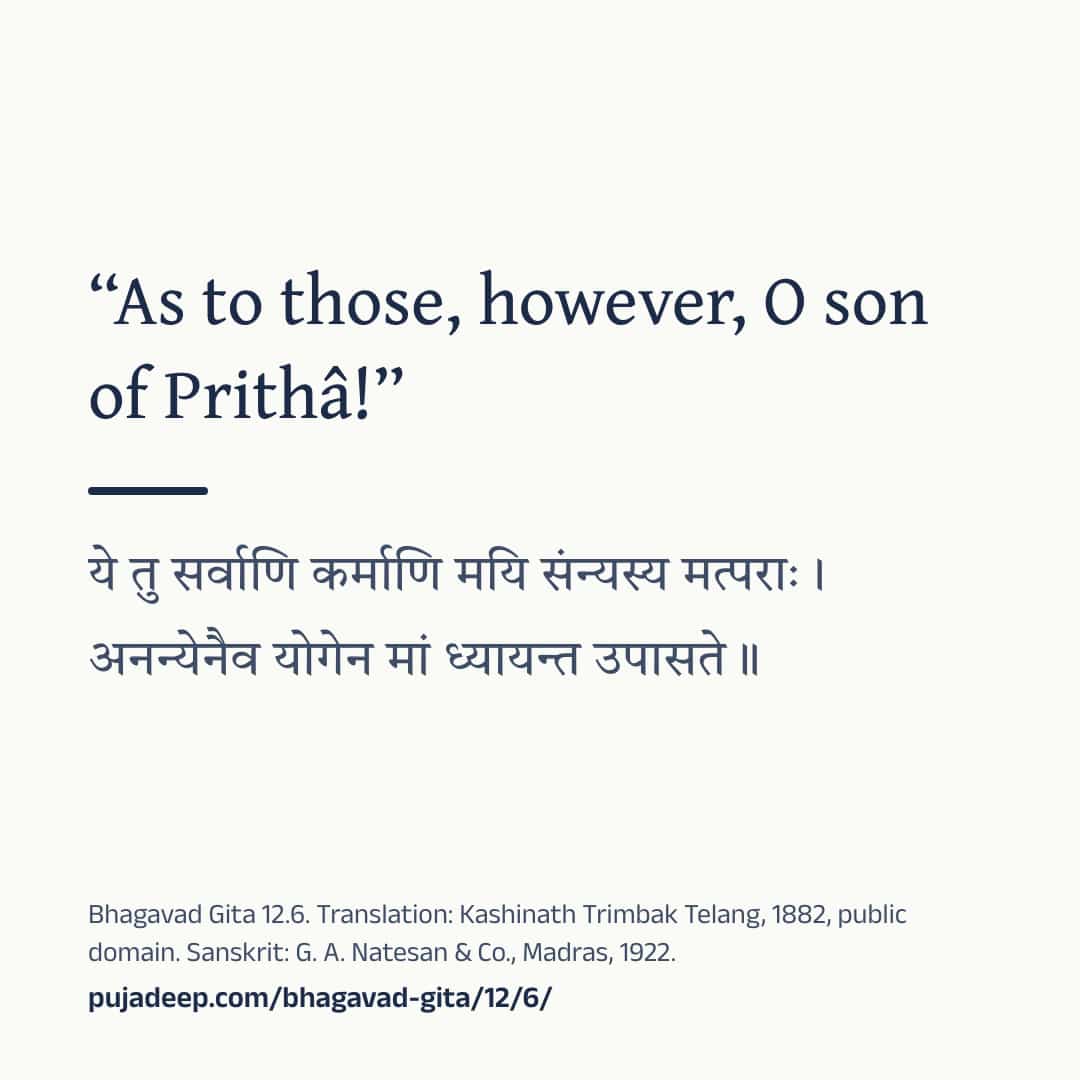
Drawing the picture
See the words
Bhagavad Gita 12.6

ये तु सर्वाणि कर्माणि मयि संन्यस्य मत्पराः ।
अनन्येनैव योगेन मां ध्यायन्त उपासते ॥

“As to those, however, O son of Prithâ! who, dedicating all their actions to me, and (holding) me as their highest (goal), worship me, meditating on me with a devotion towards none besides me, and whose minds are fixed on me, I, without delay, come forward as their deliverer from the ocean of this world of death.”
(K. T. Telang, The Bhagavadgîtâ (The Sacred Books of the East, vol. VIII, Oxford: Clarendon Press, 1882), p. 100, public domain)
This sentence covers verses 12.6 to 12.7.

“Those verily who renounce all actions in Me and make Me supreme, who, worshipping, meditate on Me, with no other Yoga,”
(Annie Besant, The Bhagavad Gîtâ, or The Lord's Song (London: Theosophical Publishing Society, 1895), p. 119, public domain)
This sentence goes on in 12.7.

“But those who worship Me, resigning all actions in Me, regarding Me as the Supreme Goal, meditating on Me with single-minded Yoga;—for these whose mind is set on Me, verily, I become ere long, O son of Prithá, the Saviour out of the ocean of the mortal Samsára.”
(Swami Swarupananda, Srimad-Bhagavad-Gita (Mayavati: Prabuddha Bharata Press, 1909; first printed in Prabuddha Bharata, 1907–1909), p. 245, public domain)
This sentence covers verses 12.6 to 12.7.

Sanskrit: G. A. Natesan & Co., Madras, 1922.
https://pujadeep.com/bhagavad-gita/12/6/ Nothing is sent from this site. Your own app sends it, to the chat you choose. The picture quotes the translation you chose on this page, with its name and year.
Sanskrit text: The Bhagavad-Gita, or The Lord's Song, with the text in Devanagari and an English translation, 1922. Meanings: written for Pujadeep and checked against the cited edition. Source and changes
Questions families ask
Who speaks Bhagavad Gita 12.6?
Krishna speaks this verse, in chapter 12 (Bhakti Yoga).
Where does the Sanskrit text come from?
Sanskrit text: The Bhagavad-Gita, or The Lord's Song, with the text in Devanagari and an English translation, 1922. Meanings: written for Pujadeep and checked against the cited edition. See the source
Is the meaning on this page a translation?
Explanation written for this site from the sources listed here, and checked against the cited edition. It is not a translation and not the only way to read the text. Free to quote with credit.
Source and licence
- Sanskrit text
- The Bhagavad-Gita, or The Lord's Song, with the text in Devanagari and an English translation (Annie Besant, G. A. Natesan & Co., Madras, 1922). Public domain. The Sanskrit on these pages was read from this printing’s page images.
- Translation
- The Bhagavadgîtâ with the Sanatsugâtîya and the Anugîtâ, translated by Kâshinâth Trimbak Telang (The Sacred Books of the East, vol. VIII, ed. F. Max Müller) (Kashinath Trimbak Telang, F. Max Müller, Clarendon Press, Oxford, 1882). Public domain. Shown verbatim, as printed.
- Translation
- The Bhagavad Gîtâ, or The Lord's Song, translated by Annie Besant (Annie Besant, Theosophical Publishing Society, London, 1895). Public domain. Shown verbatim, as printed.
- Translation
- Srimad-Bhagavad-Gita, with Sanskrit Text; Paraphrase with Word-by-word Literal Translation; English Rendering and Comments, Index, &c., by the Swami Swarupananda (Himalayan Series, No. XX) (Swami Swarupananda, The Editors and Publishers, Advaita Ashrama, Mayavati, Prabuddha Bharata Press, Mayavati, Almora, Himalayas, 1909). Public domain. Shown verbatim, as printed.
- Commentary
- The Bhagavad-Gita, with the commentary of Sri Sankaracharya, translated by A. Mahadeva Sastri (2nd ed., Mysore: G. T. A. Printing Works, 1901) (Public-domain scan, University of California Libraries). Summarised in our own words; none of its text is reproduced.
- Commentary
- Sri Bhagavad-Gita with Sri Ramanujacharya's Visishtadvaita commentary, translated by A. Govindacharya (Madras, 1898) (Scan uploaded to archive.org (folkscanomy collection)). Summarised in our own words; none of its text is reproduced.
- Commentary
- The Bhagavad-Gita: translation and commentaries in English according to Sri Madhwacharya's Bhashyas, by S. Subba Rau (Madras, 1906) (Scan uploaded to archive.org (folkscanomy collection)). Summarised in our own words; none of its text is reproduced.
- Common wording
- In this text, 32 words follow today's common wording, checked against sanskritdocuments.org; Sanskrit Wikisource; Gita Press, Gorakhpur; GRETIL, Göttingen and Bhaktivedanta Book Trust.
- Our explanation
- Explanation written for this site from the sources listed here, and checked against the cited edition. It is not a translation and not the only way to read the text. Free to quote with credit.
- Checked
- Checked against the cited edition, October 27, 2026.