Bhagavad Gita 12.13: meaning and translation
Chapter 12: Bhakti Yoga. Krishna says
From here to the end of the chapter, Krishna describes the devotee who is dear to him.
Click or tap a word for its meaning and its dictionary page.
Text and layers
Text and layers
These choices stay in this browser.
Bhagavad Gita 12.13
अद्वेष्टा सर्वभूतानां मैत्रः करुण एव च ।निर्ममो निरहङ्कारः समदुःखसुखः क्षमी ॥
Adveshta sarvabhutanam maitrah karuna eva chaNirmamo nirahankarah samaduhkhasukhah kshami
adveṣṭā sarvabhūtānāṃ maitraḥ karuṇa eva ca |nirmamo nirahaṅkāraḥ samaduḥkhasukhaḥ kṣamī ||
Our explanation From here to the end of the chapter, Krishna describes the devotee who is dear to him. Such a person hates no being, is friendly and compassionate, has no sense of “mine” and no ego, stays the same in pain and pleasure, and is forgiving. The sentence continues in the next verse.
हिंदी अर्थ यहाँ से अध्याय के अंत तक कृष्ण उस भक्त का वर्णन करते हैं जो उन्हें प्रिय है। ऐसा व्यक्ति किसी प्राणी से द्वेष नहीं करता, सबसे मित्रता और करुणा रखता है, ममता (“यह मेरा है” का भाव) और अहंकार से मुक्त है, सुख-दुःख में समान रहता है और क्षमाशील है। यह वाक्य अगले श्लोक में पूरा होता है।
Word by word
Every word, with its dictionary page
Word by word
- अद्वेष्टा adveṣṭā · one who hates none (nominative singular) Dictionary: adveṣṭṛ, Monier-Williams 1899, p. 19, col. 3 “not an enemy, a friend”
- सर्वभूतानाम् sarvabhūtānām · of all beings (compound, genitive plural) Dictionary: sarva, Monier-Williams 1899, p. 1184, col. 3 “whole, entire, all, every”; bhūta, Monier-Williams 1899, p. 761, col. 3 “that which is or exists, any living being (divine, human, animal, and even vegetable)”
- मैत्रः maitraḥ · friendly (nominative singular) Dictionary: maitra, Monier-Williams 1899, p. 834, col. 1 “friendly, amicable, benevolent, affectionate, kind”
- करुणः karuṇaḥ · compassionate (nominative singular) Dictionary: karuṇa, Monier-Williams 1899, p. 255, col. 2
- एव eva · indeed (indeclinable) Dictionary: 1. eva, Monier-Williams 1899, p. 232, col. 2 “indeed, truly, really”
- च ca · and (indeclinable) Dictionary: 2. ca, Monier-Williams 1899, p. 380, col. 1 “and, both, also, moreover, as well as”
- निर्ममः nirmamaḥ · free from "mine" (nominative singular) Dictionary: nir-mama, Monier-Williams 1899, p. 541, col. 3 “unselfish, disinterested, (esp.) free from all worldly connections”
- निरहङ्कारः nirahaṅkāraḥ · free from ego (nominative singular) Dictionary: nir-ahaṃkāra, Monier-Williams 1899, p. 540, col. 1 “free from egotism, unselfish, humble”
- समदुःखसुखः samaduḥkhasukhaḥ · the same in pain and pleasure (compound, nominative singular) Dictionary: 2. sama, Monier-Williams 1899, p. 1152, col. 1 “even, smooth, flat, plain, level; same, equal”; 1. duḥkha, Monier-Williams 1899, p. 483, col. 2 “uneasiness, pain, sorrow, trouble, difficulty”; sukha, Monier-Williams 1899, p. 1221, col. 1 “ease, easiness, comfort, prosperity, pleasure, happiness”
- क्षमी kṣamī · forgiving, patient (nominative singular) Dictionary: kṣamin, Monier-Williams 1899, p. 326, col. 3; kṣamitṛ, Monier-Williams 1899, p. 326, col. 3 “enduring, patient”
Old translations
Kashinath Trimbak Telang, 1882. Public domain. Page 101.
That devotee of mine, who hates no being, who is friendly and compassionate, who is free from egoism, and from (the idea that this or that is) mine, to whom happiness and misery are alike, who is forgiving, contented, constantly devoted, self-restrained, and firm in his determinations, and whose mind and understanding are devoted to me, he is dear to me.
This sentence covers verses 12.13 to 12.14.
Compare 3 translations
Kashinath Trimbak Telang, 1882. Public domain. Page 101.
That devotee of mine, who hates no being, who is friendly and compassionate, who is free from egoism, and from (the idea that this or that is) mine, to whom happiness and misery are alike, who is forgiving, contented, constantly devoted, self-restrained, and firm in his determinations, and whose mind and understanding are devoted to me, he is dear to me.
This sentence covers verses 12.13 to 12.14.
You are reading this one
Annie Besant, 1895. Public domain. Page 120.
He who without hatred of any being, friendly and showing mercy, without attachment and egoism, balanced in pleasure and pain, and enduring,
This sentence goes on in 12.14.
You are reading this one
Swami Swarupananda, 1909 (first printed 1907). Public domain. Page 249.
He who hates no creature, and is friendly and compassionate towards all, who is free from the feelings of me and mine, even-minded in pain and pleasure, and forbearing, ever content and steady in meditation, self-controlled, possessed of firm conviction, with mind and intellect fixed on Me,—he who is thus devoted to Me, is dear to Me.
This sentence covers verses 12.13 to 12.14.
You are reading this one
Cite this verse
The translation: K. T. Telang, The Bhagavadgîtâ (The Sacred Books of the East, vol. VIII, Oxford: Clarendon Press, 1882), p. 101. Bhagavad Gita 12.13–14.
The translation: Annie Besant, The Bhagavad Gîtâ, or The Lord's Song (London: Theosophical Publishing Society, 1895), p. 120. Bhagavad Gita 12.13.
The translation: Swami Swarupananda, Srimad-Bhagavad-Gita (Mayavati: Prabuddha Bharata Press, 1909; first printed in Prabuddha Bharata, 1907–1909), p. 249. Bhagavad Gita 12.13–14.
Our explanation: “Bhagavad Gita 12.13: meaning and translation.” Pujadeep. Updated October 27, 2026. https://pujadeep.com/bhagavad-gita/12/13/
Pujadeep’s explanations are free to quote with credit: name Pujadeep and link to the page. How to credit
Classical readings, by school
Each reading is named by its school. None is presented as the only meaning.
What Advaita, Vishishtadvaita and Dvaita teach, in short
Shankara Advaita
Shankara says the qualities listed from here to 12.19 belong to the renunciates (saṃnyāsins) who worship the Imperishable and are devoted to knowledge of the Self. They are the direct means to immortality.
Source: The Bhagavad-Gita, with the commentary of Sri Sankaracharya, translated by A. Mahadeva Sastri (2nd ed., Mysore: G. T. A. Printing Works, 1901), passage after 12.12 and commentary on 12.13–14, pp. 272–274. Summarised in our own words; none of its text is reproduced.
Ramanuja Vishishtadvaita
Ramanuja says these qualities belong to the person of 12.11–12 who works without desire for the fruit (the karma-yogin). Such a devotee, who worships the Lord through action, is dear to him.
Source: Sri Bhagavad-Gita with Sri Ramanujacharya's Visishtadvaita commentary, translated by A. Govindacharya (Madras, 1898), commentary on 12.12–14, pp. 388–390. Summarised in our own words; none of its text is reproduced.
This verse is on our page of well-known Gita verses, by theme
Share
Show the ways to share
Send one picture or the text to one chat. The picture names its source and the address of this page.
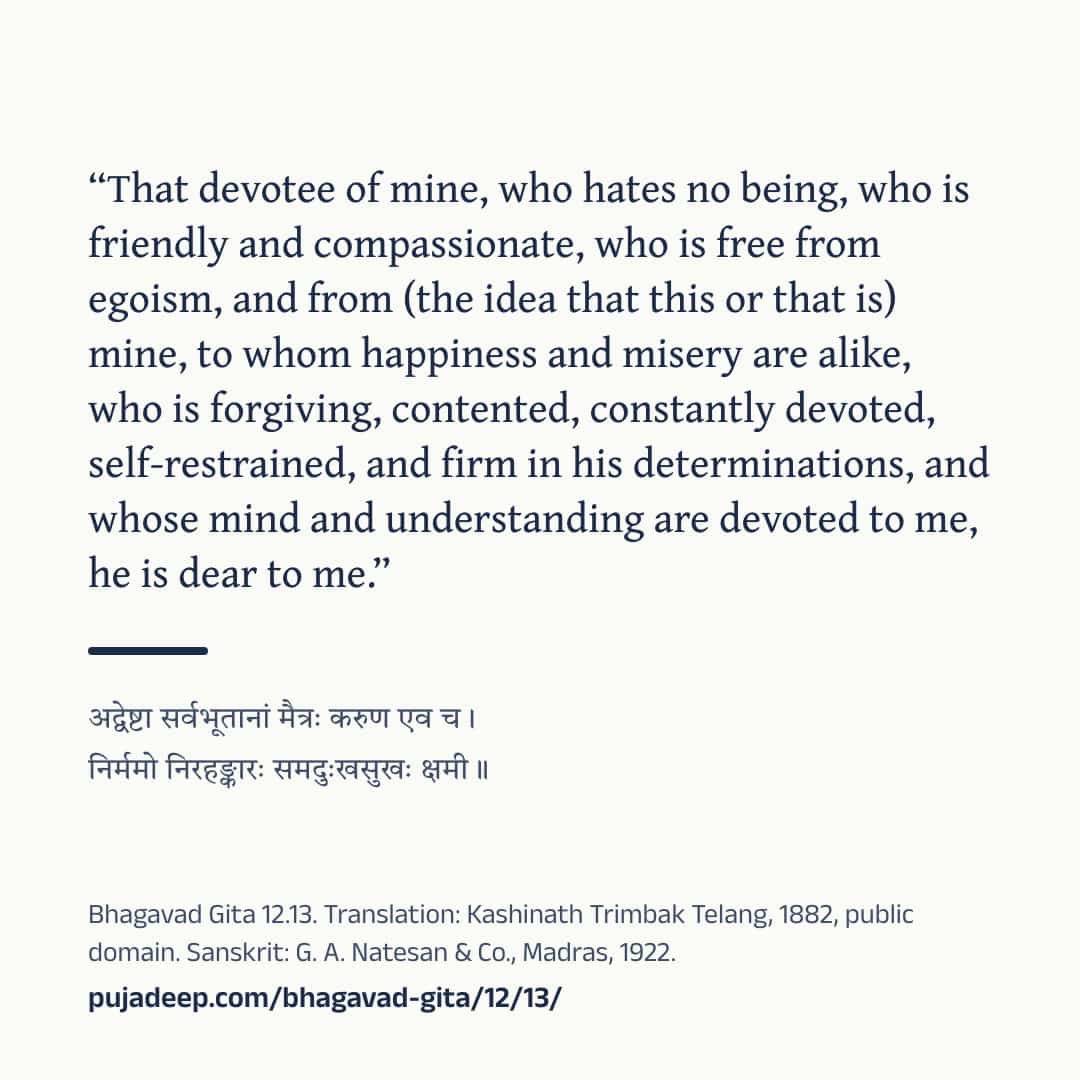
Drawing the picture
See the words
Bhagavad Gita 12.13

अद्वेष्टा सर्वभूतानां मैत्रः करुण एव च ।
निर्ममो निरहङ्कारः समदुःखसुखः क्षमी ॥

“That devotee of mine, who hates no being, who is friendly and compassionate, who is free from egoism, and from (the idea that this or that is) mine, to whom happiness and misery are alike, who is forgiving, contented, constantly devoted, self-restrained, and firm in his determinations, and whose mind and understanding are devoted to me, he is dear to me.”
(K. T. Telang, The Bhagavadgîtâ (The Sacred Books of the East, vol. VIII, Oxford: Clarendon Press, 1882), p. 101, public domain)
This sentence covers verses 12.13 to 12.14.

“He who without hatred of any being, friendly and showing mercy, without attachment and egoism, balanced in pleasure and pain, and enduring,”
(Annie Besant, The Bhagavad Gîtâ, or The Lord's Song (London: Theosophical Publishing Society, 1895), p. 120, public domain)
This sentence goes on in 12.14.

“He who hates no creature, and is friendly and compassionate towards all, who is free from the feelings of me and mine, even-minded in pain and pleasure, and forbearing, ever content and steady in meditation, self-controlled, possessed of firm conviction, with mind and intellect fixed on Me,—he who is thus devoted to Me, is dear to Me.”
(Swami Swarupananda, Srimad-Bhagavad-Gita (Mayavati: Prabuddha Bharata Press, 1909; first printed in Prabuddha Bharata, 1907–1909), p. 249, public domain)
This sentence covers verses 12.13 to 12.14.

Sanskrit: G. A. Natesan & Co., Madras, 1922.
https://pujadeep.com/bhagavad-gita/12/13/ Nothing is sent from this site. Your own app sends it, to the chat you choose. The picture quotes the translation you chose on this page, with its name and year.
Sanskrit text: The Bhagavad-Gita, or The Lord's Song, with the text in Devanagari and an English translation, 1922. Meanings: written for Pujadeep and checked against the cited edition. Source and changes
Questions families ask
Who speaks Bhagavad Gita 12.13?
Krishna speaks this verse, in chapter 12 (Bhakti Yoga).
Where does the Sanskrit text come from?
Sanskrit text: The Bhagavad-Gita, or The Lord's Song, with the text in Devanagari and an English translation, 1922. Meanings: written for Pujadeep and checked against the cited edition. See the source
Is the meaning on this page a translation?
Explanation written for this site from the sources listed here, and checked against the cited edition. It is not a translation and not the only way to read the text. Free to quote with credit.
Source and licence
- Sanskrit text
- The Bhagavad-Gita, or The Lord's Song, with the text in Devanagari and an English translation (Annie Besant, G. A. Natesan & Co., Madras, 1922). Public domain. The Sanskrit on these pages was read from this printing’s page images.
- Translation
- The Bhagavadgîtâ with the Sanatsugâtîya and the Anugîtâ, translated by Kâshinâth Trimbak Telang (The Sacred Books of the East, vol. VIII, ed. F. Max Müller) (Kashinath Trimbak Telang, F. Max Müller, Clarendon Press, Oxford, 1882). Public domain. Shown verbatim, as printed.
- Translation
- The Bhagavad Gîtâ, or The Lord's Song, translated by Annie Besant (Annie Besant, Theosophical Publishing Society, London, 1895). Public domain. Shown verbatim, as printed.
- Translation
- Srimad-Bhagavad-Gita, with Sanskrit Text; Paraphrase with Word-by-word Literal Translation; English Rendering and Comments, Index, &c., by the Swami Swarupananda (Himalayan Series, No. XX) (Swami Swarupananda, The Editors and Publishers, Advaita Ashrama, Mayavati, Prabuddha Bharata Press, Mayavati, Almora, Himalayas, 1909). Public domain. Shown verbatim, as printed.
- Commentary
- The Bhagavad-Gita, with the commentary of Sri Sankaracharya, translated by A. Mahadeva Sastri (2nd ed., Mysore: G. T. A. Printing Works, 1901) (Public-domain scan, University of California Libraries). Summarised in our own words; none of its text is reproduced.
- Commentary
- Sri Bhagavad-Gita with Sri Ramanujacharya's Visishtadvaita commentary, translated by A. Govindacharya (Madras, 1898) (Scan uploaded to archive.org (folkscanomy collection)). Summarised in our own words; none of its text is reproduced.
- Common wording
- In this text, 32 words follow today's common wording, checked against sanskritdocuments.org; Sanskrit Wikisource; Gita Press, Gorakhpur; GRETIL, Göttingen and Bhaktivedanta Book Trust.
- Our explanation
- Explanation written for this site from the sources listed here, and checked against the cited edition. It is not a translation and not the only way to read the text. Free to quote with credit.
- Checked
- Checked against the cited edition, October 27, 2026.