Bhagavad Gita 12.16: meaning and translation
Chapter 12: Bhakti Yoga. Krishna says
Krishna says that the devotee who wants nothing, who is pure and capable, impartial (udāsīna, one who sits apart), untroubled, and who has given up every undertaking (sarvārambha), is dear to him.
Click or tap a word for its meaning and its dictionary page.
Text and layers
Text and layers
These choices stay in this browser.
Bhagavad Gita 12.16
अनपेक्षः शुचिर्दक्ष उदासीनो गतव्यथः ।सर्वारम्भपरित्यागी यो मद्भक्तः स मे प्रियः ॥
Anapekshah shuchirdaksha udasino gatavyathahSarvarambhaparityagi yo madbhaktah sa me priyah
anapekṣaḥ śucirdakṣa udāsīno gatavyathaḥ |sarvārambhaparityāgī yo madbhaktaḥ sa me priyaḥ ||
Our explanation Krishna says that the devotee who wants nothing, who is pure and capable, impartial (udāsīna, one who sits apart), untroubled, and who has given up every undertaking (sarvārambha), is dear to him.
हिंदी अर्थ कृष्ण कहते हैं कि जो भक्त किसी चीज़ की अपेक्षा नहीं रखता, जो शुद्ध और दक्ष (कुशल) है, उदासीन (तटस्थ, किसी का पक्ष न लेने वाला) है, जिसे कोई व्यथा नहीं, और जिसने सब आरंभों (नए कामों की शुरुआत) का त्याग कर दिया है, वह उन्हें प्रिय है।
Word by word
Every word, with its dictionary page
Word by word
- अनपेक्षः anapekṣaḥ · free from wants (nominative singular) Dictionary: an-apekṣa, Monier-Williams 1899, p. 25, col. 3 “regardless, careless; indifferent; impartial”
- शुचिः śuciḥ · pure (nominative singular) Dictionary: śuci, Monier-Williams 1899, p. 1081, col. 1 “clear, clean, pure (lit. and fig.), holy, unsullied, undefiled, innocent, honest, virtuous”
- दक्षः dakṣaḥ · able, skilful (nominative singular) Dictionary: dakṣa, Monier-Williams 1899, p. 465, col. 1 “able, fit, adroit, expert, clever, dexterous, industrious, intelligent”
- उदासीनः udāsīnaḥ · unconcerned, impartial (nominative singular) Dictionary: ud-āsīna, Monier-Williams 1899, p. 185, col. 3 “sitting apart, indifferent, free from affection”
- गतव्यथः gatavyathaḥ · free from distress (compound, nominative singular) Dictionary: gata-vyatha, Monier-Williams 1899, p. 347, col. 2 “freed from pain, unanxious”
- सर्वारम्भपरित्यागी sarvārambhaparityāgī · who gives up all undertakings (compound, nominative singular) Dictionary: sarva, Monier-Williams 1899, p. 1184, col. 3 “whole, entire, all, every”; ā-rambha, Monier-Williams 1899, p. 150, col. 1 “undertaking, beginning”; pari-tyāgin, Monier-Williams 1899, p. 595, col. 2 “leaving, quitting, forsaking, renouncing (mostly ifc.)”
- यः yaḥ · who (relative pronoun, nominative singular) Dictionary: yad, Monier-Williams 1899, p. 844, col. 2 “who, which, what, whichever, whatever, that”
- मद्भक्तः madbhaktaḥ · devotee of "me" (Krishna) (compound, nominative singular) Dictionary: mad-bhakta, Monier-Williams 1899, p. 777, col. 2 “devoted to me”
- सः saḥ · he (pronoun, nominative singular) Dictionary: tad, Monier-Williams 1899, p. 434, col. 1 “m. he, f. she, n. it, that, this”
- मे me · to "me" (pronoun, genitive singular) Dictionary: 1. mad, Monier-Williams 1899, p. 777, col. 2 “base of the first pers. pron. in the sg. number (esp. in comp.)”
- प्रियः priyaḥ · dear (nominative singular) Dictionary: priya, Monier-Williams 1899, p. 710, col. 1 “beloved, dear to (gen., loc., dat. or comp.), liked, favourite”
1 printing differs
Edition differences. Another printing or text reads this place differently.
- The printed edition reads: अनपेक्षः शुचिर्दक्ष उदासीनो गतव्यथः
सर्वारम्भपरित्यागी यो मद्भक्तः स मे प्रियः ॥ The print has no danda (।) at the end of the first half-line (…गतव्यथः); added, because every other half-line in the edition ends with one and another digital text has it here.
Old translations
Kashinath Trimbak Telang, 1882. Public domain. Page 101.
That devotee of mine, who is unconcerned1, pure, assiduous2, impartial, free from distress3, who abandons all actions (for fruit4), he is dear to me.
Footnotes (the translator’s own) Compare 3 translations
Kashinath Trimbak Telang, 1882. Public domain. Page 101.
That devotee of mine, who is unconcerned1, pure, assiduous2, impartial, free from distress3, who abandons all actions (for fruit4), he is dear to me.
Footnotes (the translator’s own) You are reading this one
Annie Besant, 1895. Public domain. Page 120.
He who wants nothing, is pure, expert, passionless, untroubled, renouncing every undertaking, My devotee, he is dear to Me.
You are reading this one
Swami Swarupananda, 1909 (first printed 1907). Public domain. Page 249.
He who is free from dependence, who is pure, prompt, unconcerned, untroubled, renouncing every undertaking,—he who is thus devoted to Me, is dear to Me.
You are reading this one
Cite this verse
The translation: K. T. Telang, The Bhagavadgîtâ (The Sacred Books of the East, vol. VIII, Oxford: Clarendon Press, 1882), p. 101. Bhagavad Gita 12.16.
The translation: Annie Besant, The Bhagavad Gîtâ, or The Lord's Song (London: Theosophical Publishing Society, 1895), p. 120. Bhagavad Gita 12.16.
The translation: Swami Swarupananda, Srimad-Bhagavad-Gita (Mayavati: Prabuddha Bharata Press, 1909; first printed in Prabuddha Bharata, 1907–1909), p. 249. Bhagavad Gita 12.16.
Our explanation: “Bhagavad Gita 12.16: meaning and translation.” Pujadeep. Updated October 27, 2026. https://pujadeep.com/bhagavad-gita/12/16/
Pujadeep’s explanations are free to quote with credit: name Pujadeep and link to the page. How to credit
Classical readings, by school
Each reading is named by its school. None is presented as the only meaning.
What Advaita, Vishishtadvaita and Dvaita teach, in short
Madhva Dvaita
Madhva says the one who wants nothing wants nothing except the grace of God. Pure means pure within and without; able (dakṣa) means able to do the godly duties well; unconcerned means overlooking the good or harm that others may do; untroubled means not pained by others' ill will. Giving up every undertaking has four senses for him: giving up any undertaking that would not please Vishnu, giving up the pride of being its doer, giving up its fruit, and offering every undertaking to the Lord.
Source: The Bhagavad-Gita: translation and commentaries in English according to Sri Madhwacharya's Bhashyas, by S. Subba Rau (Madras, 1906), commentary on 12.16, p. 241 (leaf n239). Summarised in our own words; none of its text is reproduced.
Share
Show the ways to share
Send one picture or the text to one chat. The picture names its source and the address of this page.
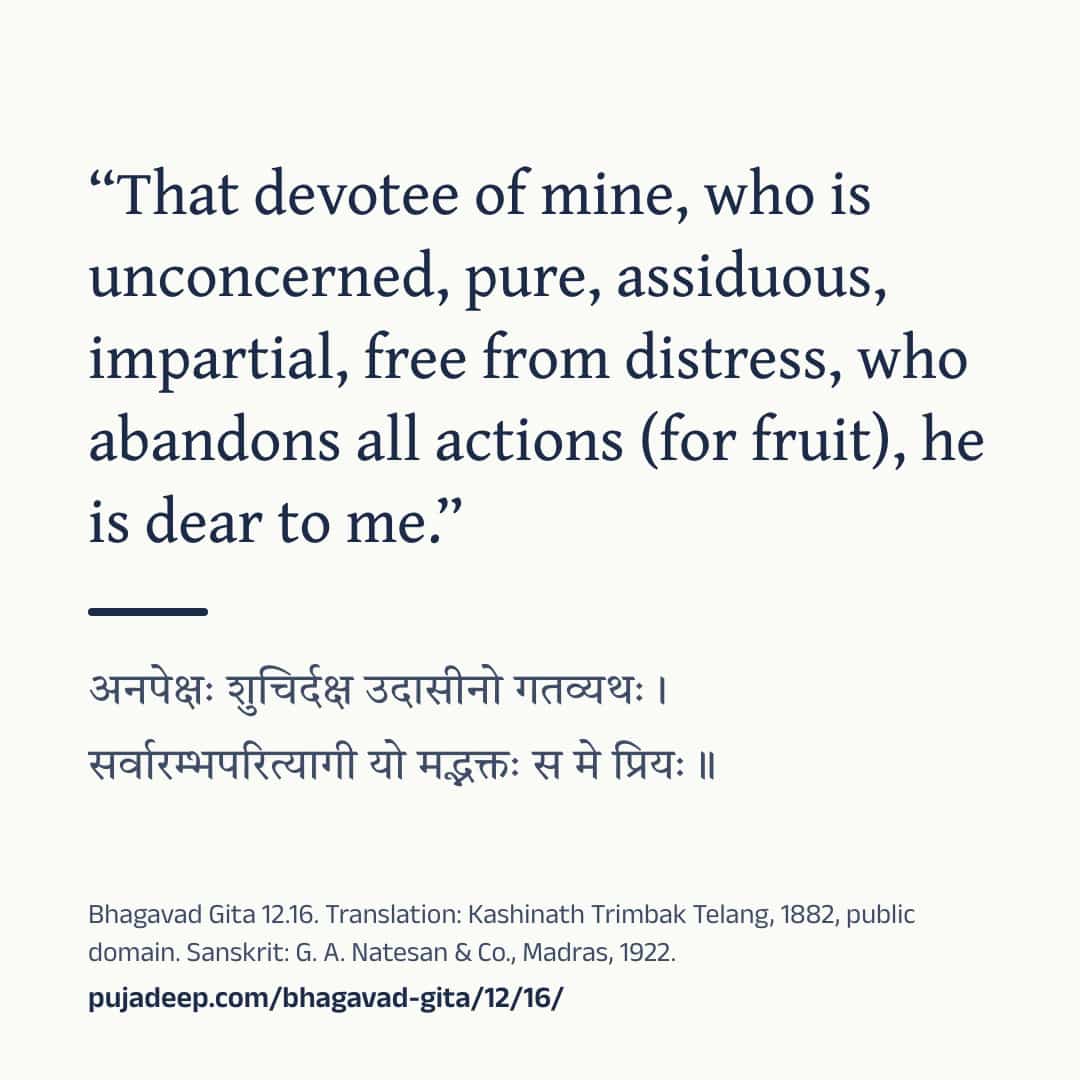
Drawing the picture
See the words
Bhagavad Gita 12.16

अनपेक्षः शुचिर्दक्ष उदासीनो गतव्यथः ।
सर्वारम्भपरित्यागी यो मद्भक्तः स मे प्रियः ॥

“That devotee of mine, who is unconcerned, pure, assiduous, impartial, free from distress, who abandons all actions (for fruit), he is dear to me.”
(K. T. Telang, The Bhagavadgîtâ (The Sacred Books of the East, vol. VIII, Oxford: Clarendon Press, 1882), p. 101, public domain)

“He who wants nothing, is pure, expert, passionless, untroubled, renouncing every undertaking, My devotee, he is dear to Me.”
(Annie Besant, The Bhagavad Gîtâ, or The Lord's Song (London: Theosophical Publishing Society, 1895), p. 120, public domain)

“He who is free from dependence, who is pure, prompt, unconcerned, untroubled, renouncing every undertaking,—he who is thus devoted to Me, is dear to Me.”
(Swami Swarupananda, Srimad-Bhagavad-Gita (Mayavati: Prabuddha Bharata Press, 1909; first printed in Prabuddha Bharata, 1907–1909), p. 249, public domain)

Sanskrit: G. A. Natesan & Co., Madras, 1922.
https://pujadeep.com/bhagavad-gita/12/16/ Nothing is sent from this site. Your own app sends it, to the chat you choose. The picture quotes the translation you chose on this page, with its name and year.
Sanskrit text: The Bhagavad-Gita, or The Lord's Song, with the text in Devanagari and an English translation, 1922. Meanings: written for Pujadeep and checked against the cited edition. Source and changes
Questions families ask
Who speaks Bhagavad Gita 12.16?
Krishna speaks this verse, in chapter 12 (Bhakti Yoga).
Where does the Sanskrit text come from?
Sanskrit text: The Bhagavad-Gita, or The Lord's Song, with the text in Devanagari and an English translation, 1922. Meanings: written for Pujadeep and checked against the cited edition. See the source
Is the meaning on this page a translation?
Explanation written for this site from the sources listed here, and checked against the cited edition. It is not a translation and not the only way to read the text. Free to quote with credit.
Source and licence
- Sanskrit text
- The Bhagavad-Gita, or The Lord's Song, with the text in Devanagari and an English translation (Annie Besant, G. A. Natesan & Co., Madras, 1922). Public domain. The Sanskrit on these pages was read from this printing’s page images.
- Translation
- The Bhagavadgîtâ with the Sanatsugâtîya and the Anugîtâ, translated by Kâshinâth Trimbak Telang (The Sacred Books of the East, vol. VIII, ed. F. Max Müller) (Kashinath Trimbak Telang, F. Max Müller, Clarendon Press, Oxford, 1882). Public domain. Shown verbatim, as printed.
- Translation
- The Bhagavad Gîtâ, or The Lord's Song, translated by Annie Besant (Annie Besant, Theosophical Publishing Society, London, 1895). Public domain. Shown verbatim, as printed.
- Translation
- Srimad-Bhagavad-Gita, with Sanskrit Text; Paraphrase with Word-by-word Literal Translation; English Rendering and Comments, Index, &c., by the Swami Swarupananda (Himalayan Series, No. XX) (Swami Swarupananda, The Editors and Publishers, Advaita Ashrama, Mayavati, Prabuddha Bharata Press, Mayavati, Almora, Himalayas, 1909). Public domain. Shown verbatim, as printed.
- Commentary
- The Bhagavad-Gita: translation and commentaries in English according to Sri Madhwacharya's Bhashyas, by S. Subba Rau (Madras, 1906) (Scan uploaded to archive.org (folkscanomy collection)). Summarised in our own words; none of its text is reproduced.
- Common wording
- In this text, 32 words follow today's common wording, checked against sanskritdocuments.org; Sanskrit Wikisource; Gita Press, Gorakhpur; GRETIL, Göttingen and Bhaktivedanta Book Trust.
- Our explanation
- Explanation written for this site from the sources listed here, and checked against the cited edition. It is not a translation and not the only way to read the text. Free to quote with credit.
- Checked
- Checked against the cited edition, October 27, 2026.