Bhagavad Gita 12.18: meaning and translation
Chapter 12: Bhakti Yoga. Krishna says
Krishna continues.
Click or tap a word for its meaning and its dictionary page.
Text and layers
Text and layers
These choices stay in this browser.
Bhagavad Gita 12.18
समः शत्रौ च मित्रे च तथा मानापमानयोः ।शीतोष्णसुखदुःखेषु समः सङ्गविवर्जितः ॥
Samah shatrau cha mitre cha tatha manapamanayohShitoshnasukhaduhkheshu samah sangavivarjitah
samaḥ śatrau ca mitre ca tathā mānāpamānayoḥ |śītoṣṇasukhaduḥkheṣu samaḥ saṅgavivarjitaḥ ||
Our explanation Krishna continues. Such a person is the same towards enemy and friend, in honour and dishonour, in cold and heat, in pleasure and pain, and is free from attachment. The sentence continues in the next verse.
हिंदी अर्थ कृष्ण आगे कहते हैं कि ऐसा व्यक्ति शत्रु और मित्र के प्रति, मान और अपमान में, सर्दी और गर्मी में, सुख और दुःख में समान रहता है, और आसक्ति से मुक्त है। यह वाक्य अगले श्लोक में पूरा होता है।
Word by word
Every word, with its dictionary page
Word by word
- समः samaḥ · the same, even (nominative singular) Dictionary: 2. sama, Monier-Williams 1899, p. 1152, col. 1 “even, smooth, flat, plain, level; same, equal”
- शत्रौ śatrau · to a foe (locative singular) Dictionary: śatru, Monier-Williams 1899, p. 1051, col. 1 “an enemy, foe, rival”
- च ca · and (indeclinable) Dictionary: 2. ca, Monier-Williams 1899, p. 380, col. 1 “and, both, also, moreover, as well as”
- मित्रे mitre · to a friend (locative singular) Dictionary: 1. mitra, Monier-Williams 1899, p. 816, col. 1 “a friend, companion, associate”
- च ca · and (indeclinable) Dictionary: 2. ca, Monier-Williams 1899, p. 380, col. 1 “and, both, also, moreover, as well as”
- तथा tathā · so too (indeclinable) Dictionary: tathā, Monier-Williams 1899, p. 433, col. 3 “in that manner, so, thus”
- मानापमानयोः mānāpamānayoḥ · in honour and dishonour (compound, locative dual) Dictionary: 1. māna, Monier-Williams 1899, p. 809, col. 1 “consideration, regard, respect, honour”; apa-māna, Monier-Williams 1899, p. 50, col. 2 “disrespect, contempt, disgrace”
- शीतोष्णसुखदुःखेषु śītoṣṇasukhaduḥkheṣu · in cold and heat, pleasure and pain (compound, locative plural) Dictionary: śītoṣṇa, Monier-Williams 1899, p. 1078, col. 1 “cold and heat”; sukha-duḥkha, Monier-Williams 1899, p. 1221, col. 1 “pleasure and pain, joy and sorrow”
- समः samaḥ · the same, even (nominative singular) Dictionary: 2. sama, Monier-Williams 1899, p. 1152, col. 1 “even, smooth, flat, plain, level; same, equal”
- सङ्गविवर्जितः saṅgavivarjitaḥ · free from attachment (compound, nominative singular) Dictionary: saṅga, Monier-Williams 1899, p. 1132, col. 3 “(esp.) worldly or selfish attachment or affection, desire”; vi-varjita, Monier-Williams 1899, p. 988, col. 3 “avoided, left, abandoned by, destitute or deprived of, free or exempt from”
2 printings differ
Edition differences. Another printing or text reads this place differently.
- The printed edition reads: समः शत्रौ च मित्रे च तथा मानपमानयोः ।
शीतोष्णसुखदुःखेषु समः सङ्गविवर्जितः ॥ The print reads मानपमानयोः, without the ā sign after न; read as a dropped vowel sign and restored, because māna + apamāna joins as mānāpamāna and both proofreading references read मानापमानयोः. - Spelling The 1922 Madras printing reads: समः शत्रौ च मित्रे च तथा मानपमानयोः The 1922 base printing (leaf n192) reads मानपमानयोः, a dropped vowel sign; see normalisations. The correction was decided on 12 Oct 2026 and is kept.
Old translations
Kashinath Trimbak Telang, 1882. Public domain. Page 101–102.
He who is alike to friend and foe, as also in honour and dishonour, who is alike in cold and heat, pleasure and pain, who is free from attachments, to whom praise and blame are alike, who is taciturn1, and contented with anything whatever (that comes), who is homeless2, and of a steady mind, and full of devotion, that man is dear to me.
This sentence covers verses 12.18 to 12.19.
Footnotes (the translator’s own) Compare 3 translations
Kashinath Trimbak Telang, 1882. Public domain. Page 101–102.
He who is alike to friend and foe, as also in honour and dishonour, who is alike in cold and heat, pleasure and pain, who is free from attachments, to whom praise and blame are alike, who is taciturn1, and contented with anything whatever (that comes), who is homeless2, and of a steady mind, and full of devotion, that man is dear to me.
This sentence covers verses 12.18 to 12.19.
Footnotes (the translator’s own) You are reading this one
Annie Besant, 1895. Public domain. Page 121.
He who is alike to foe and friend, and also in fame and ignominy, balanced in cold and heat, pleasures and pains, destitute of attachment,
This sentence goes on in 12.19.
You are reading this one
Swami Swarupananda, 1909 (first printed 1907). Public domain. Page 251.
He who is the same to friend and foe, and also in honour and dishonour: the same in heat and cold, in pleasure and pain; free from attachment; to whom censure and praise are equal; who is silent, content with anything, homeless, steady-minded, full of devotion;—that man is dear to Me.
This sentence covers verses 12.18 to 12.19.
You are reading this one
Cite this verse
The translation: K. T. Telang, The Bhagavadgîtâ (The Sacred Books of the East, vol. VIII, Oxford: Clarendon Press, 1882), pp. 101–102. Bhagavad Gita 12.18–19.
The translation: Annie Besant, The Bhagavad Gîtâ, or The Lord's Song (London: Theosophical Publishing Society, 1895), p. 121. Bhagavad Gita 12.18.
The translation: Swami Swarupananda, Srimad-Bhagavad-Gita (Mayavati: Prabuddha Bharata Press, 1909; first printed in Prabuddha Bharata, 1907–1909), p. 251. Bhagavad Gita 12.18–19.
Our explanation: “Bhagavad Gita 12.18: meaning and translation.” Pujadeep. Updated October 27, 2026. https://pujadeep.com/bhagavad-gita/12/18/
Pujadeep’s explanations are free to quote with credit: name Pujadeep and link to the page. How to credit
Classical readings, by school
Each reading is named by its school. None is presented as the only meaning.
What Advaita, Vishishtadvaita and Dvaita teach, in short
Madhva Dvaita
Madhva explains being the same in cold and heat as feeling neither elation nor gloom at the pleasures and pains that objects bring; and free from attachment as free from attachment to the fruit of action.
Source: The Bhagavad-Gita: translation and commentaries in English according to Sri Madhwacharya's Bhashyas, by S. Subba Rau (Madras, 1906), commentary on 12.18–12.19, p. 242 (leaf n240). Summarised in our own words; none of its text is reproduced.
Share
Show the ways to share
Send one picture or the text to one chat. The picture names its source and the address of this page.
Drawing the picture
See the words
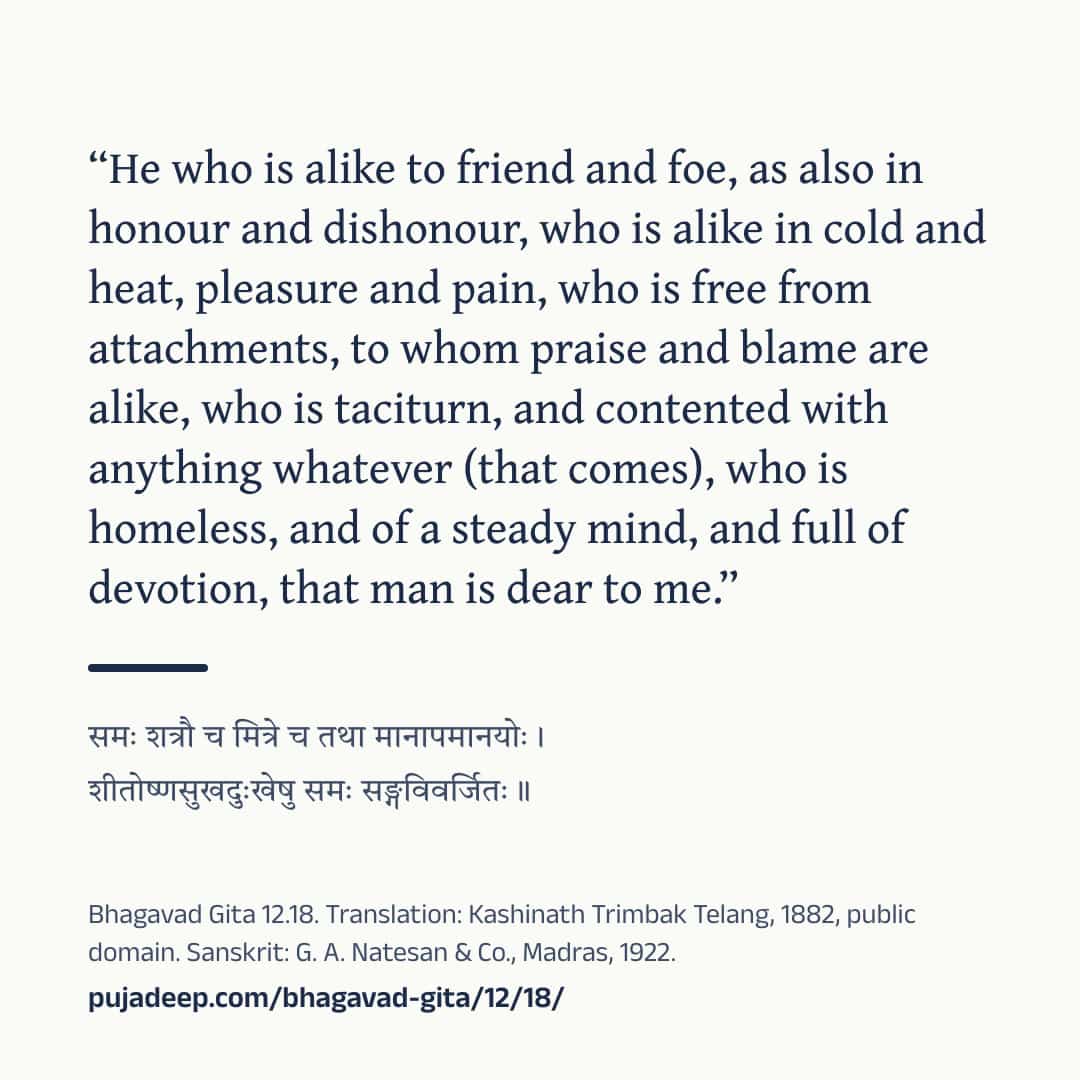
Bhagavad Gita 12.18

समः शत्रौ च मित्रे च तथा मानापमानयोः ।
शीतोष्णसुखदुःखेषु समः सङ्गविवर्जितः ॥

“He who is alike to friend and foe, as also in honour and dishonour, who is alike in cold and heat, pleasure and pain, who is free from attachments, to whom praise and blame are alike, who is taciturn, and contented with anything whatever (that comes), who is homeless, and of a steady mind, and full of devotion, that man is dear to me.”
(K. T. Telang, The Bhagavadgîtâ (The Sacred Books of the East, vol. VIII, Oxford: Clarendon Press, 1882), pp. 101–102, public domain)
This sentence covers verses 12.18 to 12.19.

“He who is alike to foe and friend, and also in fame and ignominy, balanced in cold and heat, pleasures and pains, destitute of attachment,”
(Annie Besant, The Bhagavad Gîtâ, or The Lord's Song (London: Theosophical Publishing Society, 1895), p. 121, public domain)
This sentence goes on in 12.19.

“He who is the same to friend and foe, and also in honour and dishonour: the same in heat and cold, in pleasure and pain; free from attachment; to whom censure and praise are equal; who is silent, content with anything, homeless, steady-minded, full of devotion;—that man is dear to Me.”
(Swami Swarupananda, Srimad-Bhagavad-Gita (Mayavati: Prabuddha Bharata Press, 1909; first printed in Prabuddha Bharata, 1907–1909), p. 251, public domain)
This sentence covers verses 12.18 to 12.19.

Sanskrit: G. A. Natesan & Co., Madras, 1922.
https://pujadeep.com/bhagavad-gita/12/18/ Nothing is sent from this site. Your own app sends it, to the chat you choose. The picture quotes the translation you chose on this page, with its name and year.
Sanskrit text: The Bhagavad-Gita, or The Lord's Song, with the text in Devanagari and an English translation, 1922. Meanings: written for Pujadeep and checked against the cited edition. Source and changes
Questions families ask
Who speaks Bhagavad Gita 12.18?
Krishna speaks this verse, in chapter 12 (Bhakti Yoga).
Where does the Sanskrit text come from?
Sanskrit text: The Bhagavad-Gita, or The Lord's Song, with the text in Devanagari and an English translation, 1922. Meanings: written for Pujadeep and checked against the cited edition. See the source
Is the meaning on this page a translation?
Explanation written for this site from the sources listed here, and checked against the cited edition. It is not a translation and not the only way to read the text. Free to quote with credit.
Source and licence
- Sanskrit text
- The Bhagavad-Gita, or The Lord's Song, with the text in Devanagari and an English translation (Annie Besant, G. A. Natesan & Co., Madras, 1922). Public domain. The Sanskrit on these pages was read from this printing’s page images.
- Translation
- The Bhagavadgîtâ with the Sanatsugâtîya and the Anugîtâ, translated by Kâshinâth Trimbak Telang (The Sacred Books of the East, vol. VIII, ed. F. Max Müller) (Kashinath Trimbak Telang, F. Max Müller, Clarendon Press, Oxford, 1882). Public domain. Shown verbatim, as printed.
- Translation
- The Bhagavad Gîtâ, or The Lord's Song, translated by Annie Besant (Annie Besant, Theosophical Publishing Society, London, 1895). Public domain. Shown verbatim, as printed.
- Translation
- Srimad-Bhagavad-Gita, with Sanskrit Text; Paraphrase with Word-by-word Literal Translation; English Rendering and Comments, Index, &c., by the Swami Swarupananda (Himalayan Series, No. XX) (Swami Swarupananda, The Editors and Publishers, Advaita Ashrama, Mayavati, Prabuddha Bharata Press, Mayavati, Almora, Himalayas, 1909). Public domain. Shown verbatim, as printed.
- Commentary
- The Bhagavad-Gita: translation and commentaries in English according to Sri Madhwacharya's Bhashyas, by S. Subba Rau (Madras, 1906) (Scan uploaded to archive.org (folkscanomy collection)). Summarised in our own words; none of its text is reproduced.
- Common wording
- In this text, 32 words follow today's common wording, checked against sanskritdocuments.org; Sanskrit Wikisource; Gita Press, Gorakhpur; GRETIL, Göttingen and Bhaktivedanta Book Trust.
- Our explanation
- Explanation written for this site from the sources listed here, and checked against the cited edition. It is not a translation and not the only way to read the text. Free to quote with credit.
- Checked
- Checked against the cited edition, October 27, 2026.