Bhagavad Gita 12.5: meaning and translation
Chapter 12: Bhakti Yoga. Krishna says
Krishna adds that those whose minds are set on the Unmanifest face greater difficulty, because embodied beings reach the unmanifest goal only with hardship.
Click or tap a word for its meaning and its dictionary page.
Text and layers
Text and layers
These choices stay in this browser.
Bhagavad Gita 12.5
क्लेशोऽधिकतरस्तेषामव्यक्तासक्तचेतसाम् ।अव्यक्ता हि गतिर्दुःखं देहवद्भिरवाप्यते ॥
KleshodhikatarasteshamavyaktasaktachetasamAvyakta hi gatirduhkham dehavadbhiravapyate
kleśo’dhikatarasteṣāmavyaktāsaktacetasām |avyaktā hi gatirduḥkhaṃ dehavadbhiravāpyate ||
Our explanation Krishna adds that those whose minds are set on the Unmanifest face greater difficulty, because embodied beings reach the unmanifest goal only with hardship.
हिंदी अर्थ कृष्ण आगे कहते हैं कि जिनका मन अव्यक्त में लगा है, उनका कष्ट अधिक है, क्योंकि देहधारी प्राणी अव्यक्त की गति (लक्ष्य) तक कठिनाई से ही पहुँचते हैं।
Word by word
Every word, with its dictionary page
Word by word
- क्लेशः kleśaḥ · trouble, toil (nominative singular) Dictionary: kleśa, Monier-Williams 1899, p. 324, col. 1 “pain, affliction, distress, pain from disease, anguish”
- अधिकतरः adhikataraḥ · greater (comparative, nominative singular) Dictionary: adhika, Monier-Williams 1899, p. 20, col. 2 “surpassing (in number or quantity or quality), superior”; 1. tara, Monier-Williams 1899, p. 438, col. 3 “an affix forming the compar. degree of adjectives”
- तेषाम् teṣām · of them (pronoun, genitive plural) Dictionary: tad, Monier-Williams 1899, p. 434, col. 1 “m. he, f. she, n. it, that, this”
- अव्यक्तासक्तचेतसाम् avyaktāsaktacetasām · whose minds cling to the Unmanifest (compound, genitive plural) Dictionary: a-vyakta, Monier-Williams 1899, p. 111, col. 2 “not manifest, unapparent, indistinct, invisible, imperceptible”; ā-sakta, Monier-Williams 1899, p. 160, col. 1 “fixed or fastened to; attached to”; cetas, Monier-Williams 1899, p. 398, col. 1 “consciousness, intelligence, thinking soul, heart, mind”
- अव्यक्ता avyaktā · the unmanifest (goal) (nominative singular (feminine)) Dictionary: a-vyakta, Monier-Williams 1899, p. 111, col. 2 “not manifest, unapparent, indistinct, invisible, imperceptible”
- हि hi · for, indeed (indeclinable) Dictionary: 2. hi, Monier-Williams 1899, p. 1297, col. 3 “for, because, on account of”
- गतिः gatiḥ · goal, path (nominative singular) Dictionary: gati, Monier-Williams 1899, p. 347, col. 3 “going, moving, gait, deportment, motion in general”
- दुःखम् duḥkham · with difficulty (adverb) Dictionary: 1. duḥkha, Monier-Williams 1899, p. 483, col. 2 “with difficulty, scarcely, hardly”
- देहवद्भिः dehavadbhiḥ · by the embodied (instrumental plural) Dictionary: deha-vat, Monier-Williams 1899, p. 497, col. 1 “furnished with a b°, embodied”
- अवाप्यते avāpyate · is reached (passive, present, 3rd person singular) Dictionary: avāp, Monier-Williams 1899, p. 107, col. 1 “to reach, attain, obtain, gain, get”
Old translations
Kashinath Trimbak Telang, 1882. Public domain. Page 100.
For those whose minds are attached to the unperceived, the trouble is much greater. Because the unperceived goal1 is obtained by embodied (beings) with difficulty.
Footnotes (the translator’s own) - Viz. the indestructible. ↩
Compare 3 translations
Kashinath Trimbak Telang, 1882. Public domain. Page 100.
For those whose minds are attached to the unperceived, the trouble is much greater. Because the unperceived goal1 is obtained by embodied (beings) with difficulty.
Footnotes (the translator’s own) - Viz. the indestructible. ↩
You are reading this one
Annie Besant, 1895. Public domain. Page 119.
The difficulty of those whose minds are set on the Unmanifested is greater; for the path of the Unmanifested is hard for the embodied to reach.
You are reading this one
Swami Swarupananda, 1909 (first printed 1907). Public domain. Page 244.
Greater is their trouble whose minds are set on the Unmanifested; for the goal of the Unmanifested is very hard for the embodied to reach.
You are reading this one
Cite this verse
The translation: K. T. Telang, The Bhagavadgîtâ (The Sacred Books of the East, vol. VIII, Oxford: Clarendon Press, 1882), p. 100. Bhagavad Gita 12.5.
The translation: Annie Besant, The Bhagavad Gîtâ, or The Lord's Song (London: Theosophical Publishing Society, 1895), p. 119. Bhagavad Gita 12.5.
The translation: Swami Swarupananda, Srimad-Bhagavad-Gita (Mayavati: Prabuddha Bharata Press, 1909; first printed in Prabuddha Bharata, 1907–1909), p. 244. Bhagavad Gita 12.5.
Our explanation: “Bhagavad Gita 12.5: meaning and translation.” Pujadeep. Updated October 27, 2026. https://pujadeep.com/bhagavad-gita/12/5/
Pujadeep’s explanations are free to quote with credit: name Pujadeep and link to the page. How to credit
Classical readings, by school
Each reading is named by its school. None is presented as the only meaning.
What Advaita, Vishishtadvaita and Dvaita teach, in short
Shankara Advaita
Shankara says the path of those who identify themselves with the Imperishable is harder, because they must give up all attachment to the body. Embodied beings, attached to the body, reach that goal only with great difficulty.
Source: The Bhagavad-Gita, with the commentary of Sri Sankaracharya, translated by A. Mahadeva Sastri (2nd ed., Mysore: G. T. A. Printing Works, 1901), commentary on 12.5, p. 268. Summarised in our own words; none of its text is reproduced.
Ramanuja Vishishtadvaita
Ramanuja says that keeping the mind on the individual self is hard for embodied beings, who are used to taking the body for the self.
Source: Sri Bhagavad-Gita with Sri Ramanujacharya's Visishtadvaita commentary, translated by A. Govindacharya (Madras, 1898), commentary on 12.3–5, p. 384. Summarised in our own words; none of its text is reproduced.
Madhva Dvaita
Madhva lists the hard steps on the path through the Unmanifest: great devotion and watchfulness, full control of all the senses, right regard for everything, and kindness and help to all beings. Without these the goddess does not give her grace; without her grace the Lord's grace is not won; and without his grace he is not reached. So the way to the Lord through her, he says, is very hard.
Source: The Bhagavad-Gita: translation and commentaries in English according to Sri Madhwacharya's Bhashyas, by S. Subba Rau (Madras, 1906), commentary on 12.5, pp. 237–238 (leaves n235–n236). Summarised in our own words; none of its text is reproduced.
Share
Show the ways to share
Send one picture or the text to one chat. The picture names its source and the address of this page.
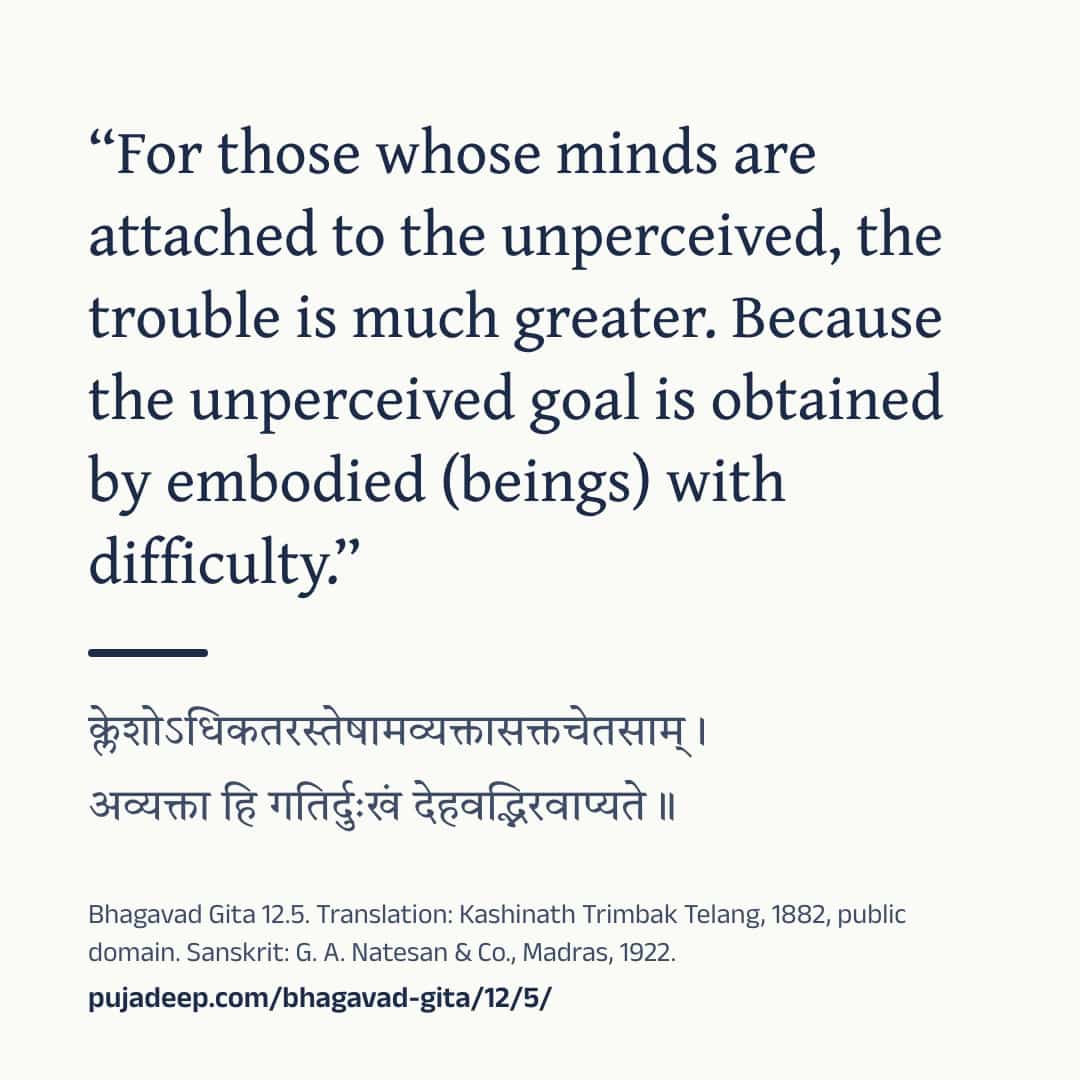
Drawing the picture
See the words
Bhagavad Gita 12.5

क्लेशोऽधिकतरस्तेषामव्यक्तासक्तचेतसाम् ।
अव्यक्ता हि गतिर्दुःखं देहवद्भिरवाप्यते ॥

“For those whose minds are attached to the unperceived, the trouble is much greater. Because the unperceived goal is obtained by embodied (beings) with difficulty.”
(K. T. Telang, The Bhagavadgîtâ (The Sacred Books of the East, vol. VIII, Oxford: Clarendon Press, 1882), p. 100, public domain)

“The difficulty of those whose minds are set on the Unmanifested is greater; for the path of the Unmanifested is hard for the embodied to reach.”
(Annie Besant, The Bhagavad Gîtâ, or The Lord's Song (London: Theosophical Publishing Society, 1895), p. 119, public domain)

“Greater is their trouble whose minds are set on the Unmanifested; for the goal of the Unmanifested is very hard for the embodied to reach.”
(Swami Swarupananda, Srimad-Bhagavad-Gita (Mayavati: Prabuddha Bharata Press, 1909; first printed in Prabuddha Bharata, 1907–1909), p. 244, public domain)

Sanskrit: G. A. Natesan & Co., Madras, 1922.
https://pujadeep.com/bhagavad-gita/12/5/ Nothing is sent from this site. Your own app sends it, to the chat you choose. The picture quotes the translation you chose on this page, with its name and year.
Sanskrit text: The Bhagavad-Gita, or The Lord's Song, with the text in Devanagari and an English translation, 1922. Meanings: written for Pujadeep and checked against the cited edition. Source and changes
Questions families ask
Who speaks Bhagavad Gita 12.5?
Krishna speaks this verse, in chapter 12 (Bhakti Yoga).
Where does the Sanskrit text come from?
Sanskrit text: The Bhagavad-Gita, or The Lord's Song, with the text in Devanagari and an English translation, 1922. Meanings: written for Pujadeep and checked against the cited edition. See the source
Is the meaning on this page a translation?
Explanation written for this site from the sources listed here, and checked against the cited edition. It is not a translation and not the only way to read the text. Free to quote with credit.
Source and licence
- Sanskrit text
- The Bhagavad-Gita, or The Lord's Song, with the text in Devanagari and an English translation (Annie Besant, G. A. Natesan & Co., Madras, 1922). Public domain. The Sanskrit on these pages was read from this printing’s page images.
- Translation
- The Bhagavadgîtâ with the Sanatsugâtîya and the Anugîtâ, translated by Kâshinâth Trimbak Telang (The Sacred Books of the East, vol. VIII, ed. F. Max Müller) (Kashinath Trimbak Telang, F. Max Müller, Clarendon Press, Oxford, 1882). Public domain. Shown verbatim, as printed.
- Translation
- The Bhagavad Gîtâ, or The Lord's Song, translated by Annie Besant (Annie Besant, Theosophical Publishing Society, London, 1895). Public domain. Shown verbatim, as printed.
- Translation
- Srimad-Bhagavad-Gita, with Sanskrit Text; Paraphrase with Word-by-word Literal Translation; English Rendering and Comments, Index, &c., by the Swami Swarupananda (Himalayan Series, No. XX) (Swami Swarupananda, The Editors and Publishers, Advaita Ashrama, Mayavati, Prabuddha Bharata Press, Mayavati, Almora, Himalayas, 1909). Public domain. Shown verbatim, as printed.
- Commentary
- The Bhagavad-Gita, with the commentary of Sri Sankaracharya, translated by A. Mahadeva Sastri (2nd ed., Mysore: G. T. A. Printing Works, 1901) (Public-domain scan, University of California Libraries). Summarised in our own words; none of its text is reproduced.
- Commentary
- Sri Bhagavad-Gita with Sri Ramanujacharya's Visishtadvaita commentary, translated by A. Govindacharya (Madras, 1898) (Scan uploaded to archive.org (folkscanomy collection)). Summarised in our own words; none of its text is reproduced.
- Commentary
- The Bhagavad-Gita: translation and commentaries in English according to Sri Madhwacharya's Bhashyas, by S. Subba Rau (Madras, 1906) (Scan uploaded to archive.org (folkscanomy collection)). Summarised in our own words; none of its text is reproduced.
- Common wording
- In this text, 32 words follow today's common wording, checked against sanskritdocuments.org; Sanskrit Wikisource; Gita Press, Gorakhpur; GRETIL, Göttingen and Bhaktivedanta Book Trust.
- Our explanation
- Explanation written for this site from the sources listed here, and checked against the cited edition. It is not a translation and not the only way to read the text. Free to quote with credit.
- Checked
- Checked against the cited edition, October 27, 2026.