Bhagavad Gita 1.46: meaning and translation
Chapter 1: Arjuna Vishada Yoga. Arjuna says
Arjuna: He says it would be better for him if the sons of Dhritarashtra, weapons in hand, killed him in battle while he stood unarmed and did not fight back.
Click or tap a word for its meaning and its dictionary page.
Text and layers
Text and layers
These choices stay in this browser.
Bhagavad Gita 1.46
यदि मामप्रतीकारमशस्त्रं शस्त्रपाणयः ।धार्तराष्ट्रा रणे हन्युस्तन्मे क्षेमतरं भवेत् ॥
Yadi mamapratikaramashastram shastrapanayahDhartarashtra rane hanyustanme kshemataram bhavet
yadi māmapratīkāramaśastraṃ śastrapāṇayaḥ |dhārtarāṣṭrā raṇe hanyustanme kṣemataraṃ bhavet ||
Our explanation He says it would be better for him if the sons of Dhritarashtra, weapons in hand, killed him in battle while he stood unarmed and did not fight back.
हिंदी अर्थ वे कहते हैं कि यदि धृतराष्ट्र के पुत्र हाथों में शस्त्र लेकर उन्हें युद्ध में मार दें, जबकि वे निहत्थे हों और सामना न करें, तो वह भी उनके लिए अधिक कल्याणकारी होगा।
Word by word
Every word, with its dictionary page
Word by word
- यदि yadi · if (indeclinable) Dictionary: yadi, Monier-Williams 1899, p. 844, col. 3 “if, in case that”
- माम् mām · "me" (pronoun, accusative singular) Dictionary: 1. mad, Monier-Williams 1899, p. 777, col. 2 “base of the first pers. pron. in the sg. number (esp. in comp.)”
- अप्रतीकारम् apratīkāram · not resisting (adjective (masculine), accusative singular) Dictionary: a-pratīkāra, Monier-Williams 1899, p. 57, col. 3; prati-kāra, Monier-Williams 1899, p. 664, col. 3 “opposition, counteraction”
- अशस्त्रम् aśastram · unarmed (adjective (masculine), accusative singular) Dictionary: 2. a-śastra, Monier-Williams 1899, p. 113, col. 1 “weaponless, unarmed”
- शस्त्रपाणयः śastrapāṇayaḥ · weapons in hand (compound (masculine), nominative plural) Dictionary: śastra-pāṇi, Monier-Williams 1899, p. 1061, col. 1 “‘weapon-handed,’ armed”
- धार्तराष्ट्राः dhārtarāṣṭrāḥ · the sons of Dhritarashtra (noun (masculine), nominative plural) Dictionary: dhārta-rāṣṭra, Monier-Williams 1899, p. 516, col. 1 “a son of Dhṛ°, a Kuru”
- रणे raṇe · in battle (noun (masculine), locative singular) Dictionary: 1. raṇa, Monier-Williams 1899, p. 863, col. 3 “war, combat, fight, conflict”
- हन्युः hanyuḥ · should kill (optative, 3rd person plural) Dictionary: 1. han, Monier-Williams 1899, p. 1287, col. 2 “to smite, slay, hit, kill, mar, destroy”
- तत् tat · that (pronoun (neuter), nominative singular) Dictionary: tad, Monier-Williams 1899, p. 434, col. 1 “m. he, f. she, n. it, that, this”
- मे me · "for me" (pronoun, dative singular) Dictionary: 1. mad, Monier-Williams 1899, p. 777, col. 2 “base of the first pers. pron. in the sg. number (esp. in comp.)”
- क्षेमतरम् kṣemataram · better, safer (adjective (neuter, comparative), nominative singular) Dictionary: kṣema-tara, Monier-Williams 1899, p. 332, col. 3 “a more comfortable state, greater happiness”
- भवेत् bhavet · would be (optative, 3rd person singular) Dictionary: 1. bhū, Monier-Williams 1899, p. 760, col. 2 “arise, come into being, exist”
Old translations
Kashinath Trimbak Telang, 1882. Public domain. Page 42.
If the sons of Dhritarâshtra, weapon in hand, should kill me in battle, me weaponless and not defending (myself), that would be better for me.
Compare 3 translations
Kashinath Trimbak Telang, 1882. Public domain. Page 42.
If the sons of Dhritarâshtra, weapon in hand, should kill me in battle, me weaponless and not defending (myself), that would be better for me.
You are reading this one
Annie Besant, 1895. Public domain. Page 22–23.
If the sons of Dhritarâshtra, weapon-in-hand, should slay me, unresisting, unarmed, in the battle, that would for me be the better.
You are reading this one
Swami Swarupananda, 1909 (first printed 1907). Public domain. Page 22.
Verily, if the sons of Dhritaráshtra, weapons in hand, were to slay me, unresisting and unarmed, in the battle, that would be better for me.
You are reading this one
Cite this verse
The translation: K. T. Telang, The Bhagavadgîtâ (The Sacred Books of the East, vol. VIII, Oxford: Clarendon Press, 1882), p. 42. Bhagavad Gita 1.46.
The translation: Annie Besant, The Bhagavad Gîtâ, or The Lord's Song (London: Theosophical Publishing Society, 1895), pp. 22–23. Bhagavad Gita 1.46.
The translation: Swami Swarupananda, Srimad-Bhagavad-Gita (Mayavati: Prabuddha Bharata Press, 1909; first printed in Prabuddha Bharata, 1907–1909), p. 22. Bhagavad Gita 1.46.
Our explanation: “Bhagavad Gita 1.46: meaning and translation.” Pujadeep. Updated October 25, 2026. https://pujadeep.com/bhagavad-gita/1/46/
Pujadeep’s explanations are free to quote with credit: name Pujadeep and link to the page. How to credit
Classical readings, by school
No readings by school on this verse yet.
Share
Show the ways to share
Send one picture or the text to one chat. The picture names its source and the address of this page.
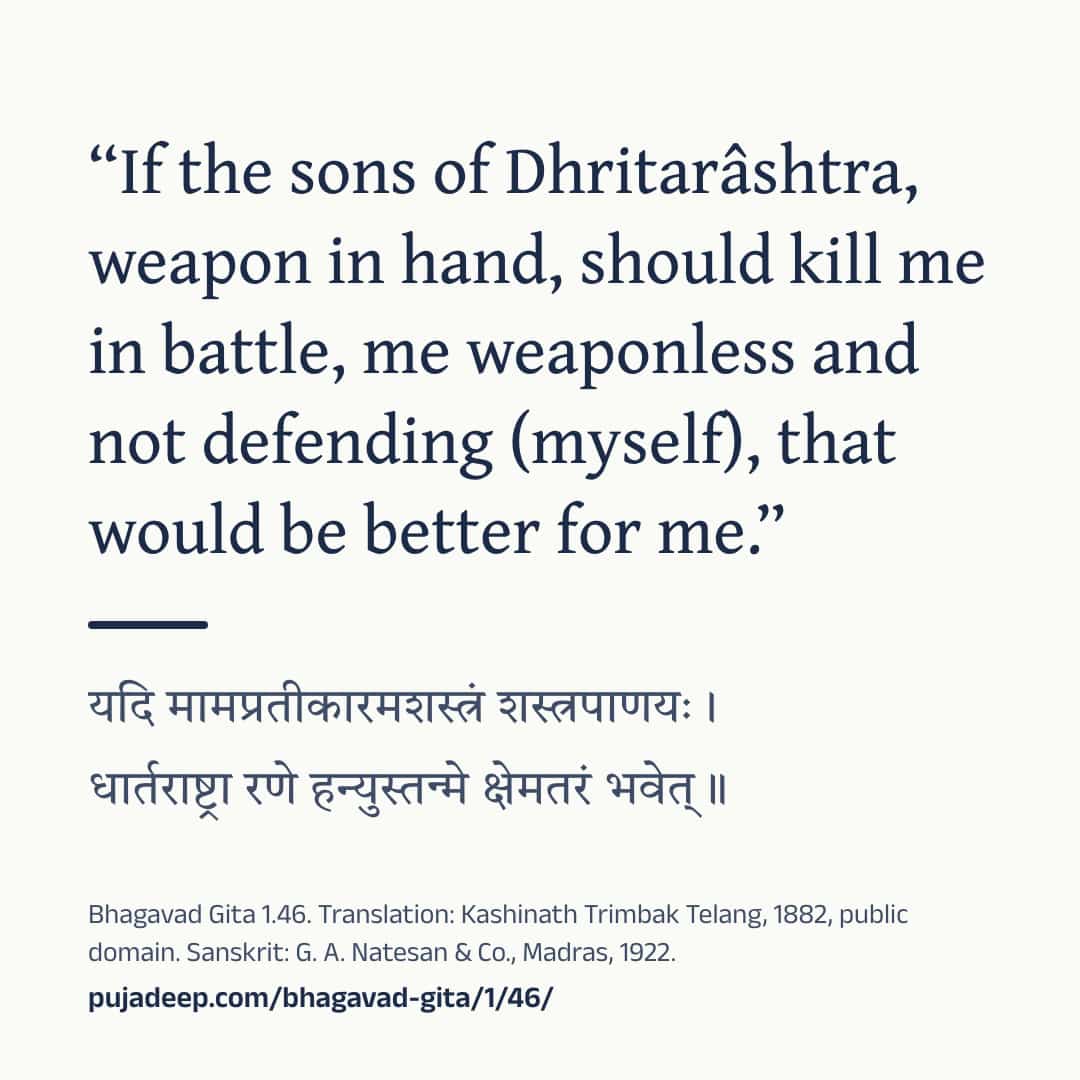
Drawing the picture
See the words
Bhagavad Gita 1.46

यदि मामप्रतीकारमशस्त्रं शस्त्रपाणयः ।
धार्तराष्ट्रा रणे हन्युस्तन्मे क्षेमतरं भवेत् ॥

“If the sons of Dhritarâshtra, weapon in hand, should kill me in battle, me weaponless and not defending (myself), that would be better for me.”
(K. T. Telang, The Bhagavadgîtâ (The Sacred Books of the East, vol. VIII, Oxford: Clarendon Press, 1882), p. 42, public domain)

“If the sons of Dhritarâshtra, weapon-in-hand, should slay me, unresisting, unarmed, in the battle, that would for me be the better.”
(Annie Besant, The Bhagavad Gîtâ, or The Lord's Song (London: Theosophical Publishing Society, 1895), pp. 22–23, public domain)

“Verily, if the sons of Dhritaráshtra, weapons in hand, were to slay me, unresisting and unarmed, in the battle, that would be better for me.”
(Swami Swarupananda, Srimad-Bhagavad-Gita (Mayavati: Prabuddha Bharata Press, 1909; first printed in Prabuddha Bharata, 1907–1909), p. 22, public domain)

Sanskrit: G. A. Natesan & Co., Madras, 1922.
https://pujadeep.com/bhagavad-gita/1/46/ Nothing is sent from this site. Your own app sends it, to the chat you choose. The picture quotes the translation you chose on this page, with its name and year.
Sanskrit text: The Bhagavad-Gita, or The Lord's Song, with the text in Devanagari and an English translation, 1922. Meanings: written for Pujadeep and checked against the cited edition. Source and changes
Questions families ask
Who speaks Bhagavad Gita 1.46?
Arjuna speaks this verse, in chapter 1 (Arjuna Vishada Yoga).
Where does the Sanskrit text come from?
Sanskrit text: The Bhagavad-Gita, or The Lord's Song, with the text in Devanagari and an English translation, 1922. Meanings: written for Pujadeep and checked against the cited edition. See the source
Is the meaning on this page a translation?
Explanation written for this site from the sources listed here, and checked against the cited edition. It is not a translation and not the only way to read the text. Free to quote with credit.
Source and licence
- Sanskrit text
- The Bhagavad-Gita, or The Lord's Song, with the text in Devanagari and an English translation (Annie Besant, G. A. Natesan & Co., Madras, 1922). Public domain. The Sanskrit on these pages was read from this printing’s page images.
- Translation
- The Bhagavadgîtâ with the Sanatsugâtîya and the Anugîtâ, translated by Kâshinâth Trimbak Telang (The Sacred Books of the East, vol. VIII, ed. F. Max Müller) (Kashinath Trimbak Telang, F. Max Müller, Clarendon Press, Oxford, 1882). Public domain. Shown verbatim, as printed.
- Translation
- The Bhagavad Gîtâ, or The Lord's Song, translated by Annie Besant (Annie Besant, Theosophical Publishing Society, London, 1895). Public domain. Shown verbatim, as printed.
- Translation
- Srimad-Bhagavad-Gita, with Sanskrit Text; Paraphrase with Word-by-word Literal Translation; English Rendering and Comments, Index, &c., by the Swami Swarupananda (Himalayan Series, No. XX) (Swami Swarupananda, The Editors and Publishers, Advaita Ashrama, Mayavati, Prabuddha Bharata Press, Mayavati, Almora, Himalayas, 1909). Public domain. Shown verbatim, as printed.
- Common wording
- In this text, 32 words follow today's common wording, checked against sanskritdocuments.org; Sanskrit Wikisource; Gita Press, Gorakhpur; GRETIL, Göttingen and Bhaktivedanta Book Trust.
- Our explanation
- Explanation written for this site from the sources listed here, and checked against the cited edition. It is not a translation and not the only way to read the text. Free to quote with credit.
- Checked
- Checked against the cited edition, October 15, 2026.
- Updated
- October 25, 2026