Bhagavad Gita 1.44: meaning and translation
Chapter 1: Arjuna Vishada Yoga. Arjuna says
Arjuna says he has heard that people whose family dharma is destroyed live in naraka (hell) for a time without limit.
Click or tap a word for its meaning and its dictionary page.
Text and layers
Text and layers
These choices stay in this browser.
Bhagavad Gita 1.44
उत्सन्नकुलधर्माणां मनुष्याणां जनार्दन ।नरकेऽनियतं वासो भवतीत्यनुशुश्रुम ॥
Utsannakuladharmanam manushyanam janardanaNarakeniyatam vaso bhavatityanushushruma
utsannakuladharmāṇāṃ manuṣyāṇāṃ janārdana |narake’niyataṃ vāso bhavatītyanuśuśruma ||
Our explanation Arjuna says he has heard that people whose family dharma is destroyed live in naraka (hell) for a time without limit. The 1922 printing reads "niyatam" here: they live in hell without fail. The verse ends with anuśuśruma, "so we have heard": he is repeating what tradition says. All these reasons come from his love for his family and from his grief.
हिंदी अर्थ अर्जुन कहते हैं कि उन्होंने सुना है कि जिनके कुलधर्म नष्ट हो जाते हैं, उन्हें अनिश्चित समय तक नरक में रहना पड़ता है। 1922 की छपाई में यहाँ “नियतं” है: उन्हें निश्चित रूप से नरक में रहना पड़ता है। श्लोक “अनुशुश्रुम” (ऐसा सुना है) पर समाप्त होता है: वे परंपरा से सुनी बात दोहरा रहे हैं। ये सब तर्क परिवार के प्रति उनके प्रेम और उनके शोक से निकले हैं।
Word by word
Every word, with its dictionary page
Word by word
- उत्सन्नकुलधर्माणाम् utsannakuladharmāṇām · whose family dharma is destroyed (compound (masculine), genitive plural) Dictionary: ut-sanna, Monier-Williams 1899, p. 182, col. 1 “vanished, abolished, decayed, destroyed”; kula-dharma, Monier-Williams 1899, p. 294, col. 3 “practice or observance peculiar to a tribe or family”
- मनुष्याणाम् manuṣyāṇām · of people (noun (masculine), genitive plural) Dictionary: manuṣya, Monier-Williams 1899, p. 784, col. 3 “a man, human being”
- जनार्दन janārdana · O Janardana (Krishna) (noun (masculine), vocative singular) Dictionary: janārdana, Monier-Williams 1899, p. 410, col. 3 “‘exciting or agitating men,’ Vishṇu or Kṛishṇa”
- नरके narake · in naraka (hell) (noun (masculine), locative singular) Dictionary: naraka, Monier-Williams 1899, p. 529, col. 3 “hell, place of torment”
- अनियतम् aniyatam · for a time not fixed (without limit) (adjective (masculine), nominative singular, with vāsaḥ) Dictionary: a-niyata, Monier-Williams 1899, p. 29, col. 3 “not regulated, uncontrolled, not fixed, uncertain”
- वासः vāsaḥ · dwelling (noun (masculine), nominative singular) Dictionary: 3. vāsa, Monier-Williams 1899, p. 947, col. 2 “abiding, dwelling, residence”
- भवति bhavati · is (present, 3rd person singular) Dictionary: 1. bhū, Monier-Williams 1899, p. 760, col. 2 “arise, come into being, exist”
- इति iti · so (closing the report) (indeclinable) Dictionary: 2. iti, Monier-Williams 1899, p. 165, col. 1 “in this manner, thus”
- अनुशुश्रुम anuśuśruma · we have heard (perfect, 1st person plural) Dictionary: anu-śru, Monier-Williams 1899, p. 39, col. 3 “to hear repeatedly (especially what is handed down in the Veda)”
3 printings differ
Edition differences. Another printing or text reads this place differently.
- The printed edition reads: उत्सन्नकुलधर्माणां मनुष्याणां जनार्दन ।
नरके नियतं वासो भवतीत्यनुशुश्रुम ॥ - Word The 1922 Madras printing reads: नरके नियतं वासो भवतीत्यनुशुश्रुम The 1922 base printing (leaf n25) reads नरके नियतं, 'a dwelling in hell, without fail'. Under decision 14 addendum c the display follows नरकेऽनियतं, 'a dwelling in hell for an unfixed (unlimited) time', printed by Gita Press (p. 32) and the Gita Supersite text (Sanskrit Wikisource); the Bhaktivedanta Book Trust prints नरके नियतं, and sanskritdocuments.org gives both. The translations stay as printed: Telang ('must necessarily live in hell') and Swarupananda ('inevitable is the dwelling in hell') translate नियतं; Besant ('the abode is everlastingly in hell') fits नरकेऽनियतं.
- Word A digital text reads Reads like the 1922 edition (नरके नियतं) and gives नरकेऽनियतं in brackets as an alternative, so it counts for neither reading. Another digital text (a copy of an older file of this site) reads narake niyataṃ. The independent keying of 12 Oct 2026 had नरकेऽनियतं.
Old translations
Kashinath Trimbak Telang, 1882. Public domain. Page 42.
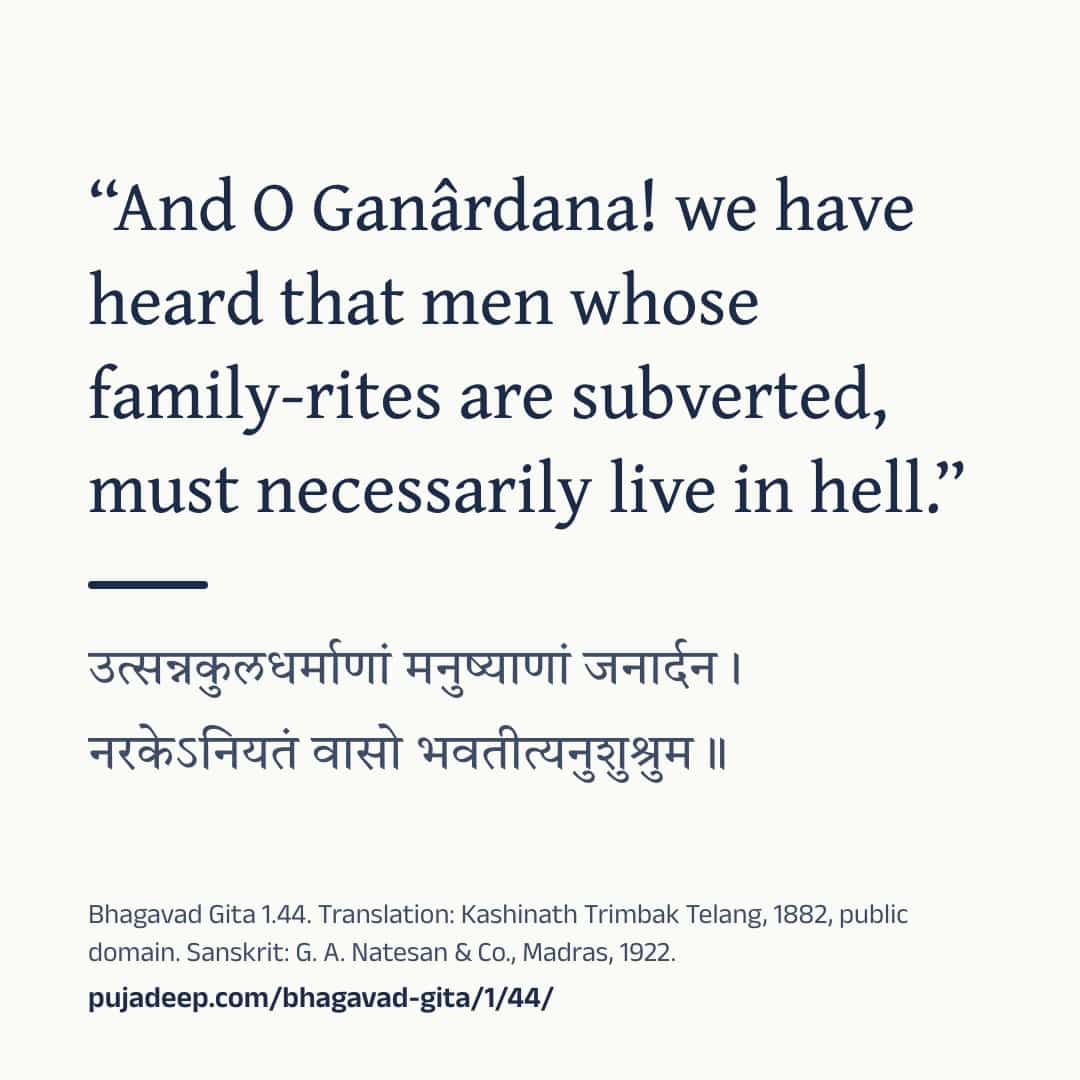
And O Ganârdana! we have heard that men whose family-rites are subverted, must necessarily live in hell.
Compare 3 translations
Kashinath Trimbak Telang, 1882. Public domain. Page 42.
And O Ganârdana! we have heard that men whose family-rites are subverted, must necessarily live in hell.
You are reading this one
Annie Besant, 1895. Public domain. Page 22.
Of the men whose family Dharma is extinguished, O Janârdana, the abode is everlastingly in hell. Thus have we heard.
You are reading this one
Swami Swarupananda, 1909 (first printed 1907). Public domain. Page 60.
We have heard, O Janàrdana, that inevitable is the dwelling in hell of those men in whose families religious practices have been destroyed.
You are reading this one
Cite this verse
The translation: K. T. Telang, The Bhagavadgîtâ (The Sacred Books of the East, vol. VIII, Oxford: Clarendon Press, 1882), p. 42. Bhagavad Gita 1.44.
The translation: Annie Besant, The Bhagavad Gîtâ, or The Lord's Song (London: Theosophical Publishing Society, 1895), p. 22. Bhagavad Gita 1.44.
The translation: Swami Swarupananda, Srimad-Bhagavad-Gita (Mayavati: Prabuddha Bharata Press, 1909; first printed in Prabuddha Bharata, 1907–1909), p. 60. Bhagavad Gita 1.44.
Our explanation: “Bhagavad Gita 1.44: meaning and translation.” Pujadeep. Updated October 25, 2026. https://pujadeep.com/bhagavad-gita/1/44/
Pujadeep’s explanations are free to quote with credit: name Pujadeep and link to the page. How to credit
Classical readings, by school
No readings by school on this verse yet.
Share
Show the ways to share
Send one picture or the text to one chat. The picture names its source and the address of this page.
Drawing the picture
See the words
Bhagavad Gita 1.44

उत्सन्नकुलधर्माणां मनुष्याणां जनार्दन ।
नरकेऽनियतं वासो भवतीत्यनुशुश्रुम ॥

“And O Ganârdana! we have heard that men whose family-rites are subverted, must necessarily live in hell.”
(K. T. Telang, The Bhagavadgîtâ (The Sacred Books of the East, vol. VIII, Oxford: Clarendon Press, 1882), p. 42, public domain)

“Of the men whose family Dharma is extinguished, O Janârdana, the abode is everlastingly in hell. Thus have we heard.”
(Annie Besant, The Bhagavad Gîtâ, or The Lord's Song (London: Theosophical Publishing Society, 1895), p. 22, public domain)

“We have heard, O Janàrdana, that inevitable is the dwelling in hell of those men in whose families religious practices have been destroyed.”
(Swami Swarupananda, Srimad-Bhagavad-Gita (Mayavati: Prabuddha Bharata Press, 1909; first printed in Prabuddha Bharata, 1907–1909), p. 60, public domain)

Sanskrit: G. A. Natesan & Co., Madras, 1922.
https://pujadeep.com/bhagavad-gita/1/44/ Nothing is sent from this site. Your own app sends it, to the chat you choose. The picture quotes the translation you chose on this page, with its name and year.
Sanskrit text: The Bhagavad-Gita, or The Lord's Song, with the text in Devanagari and an English translation, 1922. Meanings: written for Pujadeep and checked against the cited edition. Source and changes
Questions families ask
Who speaks Bhagavad Gita 1.44?
Arjuna speaks this verse, in chapter 1 (Arjuna Vishada Yoga).
Where does the Sanskrit text come from?
Sanskrit text: The Bhagavad-Gita, or The Lord's Song, with the text in Devanagari and an English translation, 1922. Meanings: written for Pujadeep and checked against the cited edition. See the source
Is the meaning on this page a translation?
Explanation written for this site from the sources listed here, and checked against the cited edition. It is not a translation and not the only way to read the text. Free to quote with credit.
Source and licence
- Sanskrit text
- The Bhagavad-Gita, or The Lord's Song, with the text in Devanagari and an English translation (Annie Besant, G. A. Natesan & Co., Madras, 1922). Public domain. The Sanskrit on these pages was read from this printing’s page images.
- Translation
- The Bhagavadgîtâ with the Sanatsugâtîya and the Anugîtâ, translated by Kâshinâth Trimbak Telang (The Sacred Books of the East, vol. VIII, ed. F. Max Müller) (Kashinath Trimbak Telang, F. Max Müller, Clarendon Press, Oxford, 1882). Public domain. Shown verbatim, as printed.
- Translation
- The Bhagavad Gîtâ, or The Lord's Song, translated by Annie Besant (Annie Besant, Theosophical Publishing Society, London, 1895). Public domain. Shown verbatim, as printed.
- Translation
- Srimad-Bhagavad-Gita, with Sanskrit Text; Paraphrase with Word-by-word Literal Translation; English Rendering and Comments, Index, &c., by the Swami Swarupananda (Himalayan Series, No. XX) (Swami Swarupananda, The Editors and Publishers, Advaita Ashrama, Mayavati, Prabuddha Bharata Press, Mayavati, Almora, Himalayas, 1909). Public domain. Shown verbatim, as printed.
- Common wording
- In this text, 32 words follow today's common wording, checked against sanskritdocuments.org; Sanskrit Wikisource; Gita Press, Gorakhpur; GRETIL, Göttingen and Bhaktivedanta Book Trust.
- Our explanation
- Explanation written for this site from the sources listed here, and checked against the cited edition. It is not a translation and not the only way to read the text. Free to quote with credit.
- Checked
- Checked against the cited edition, October 15, 2026.
- Updated
- October 25, 2026