Bhagavad Gita 1.39: meaning and translation
Chapter 1: Arjuna Vishada Yoga. Arjuna says
Arjuna: But, he asks Krishna (Janardana), why should those who can see the harm in destroying a family not turn away from this wrong?
Click or tap a word for its meaning and its dictionary page.
Text and layers
Text and layers
These choices stay in this browser.
Bhagavad Gita 1.39
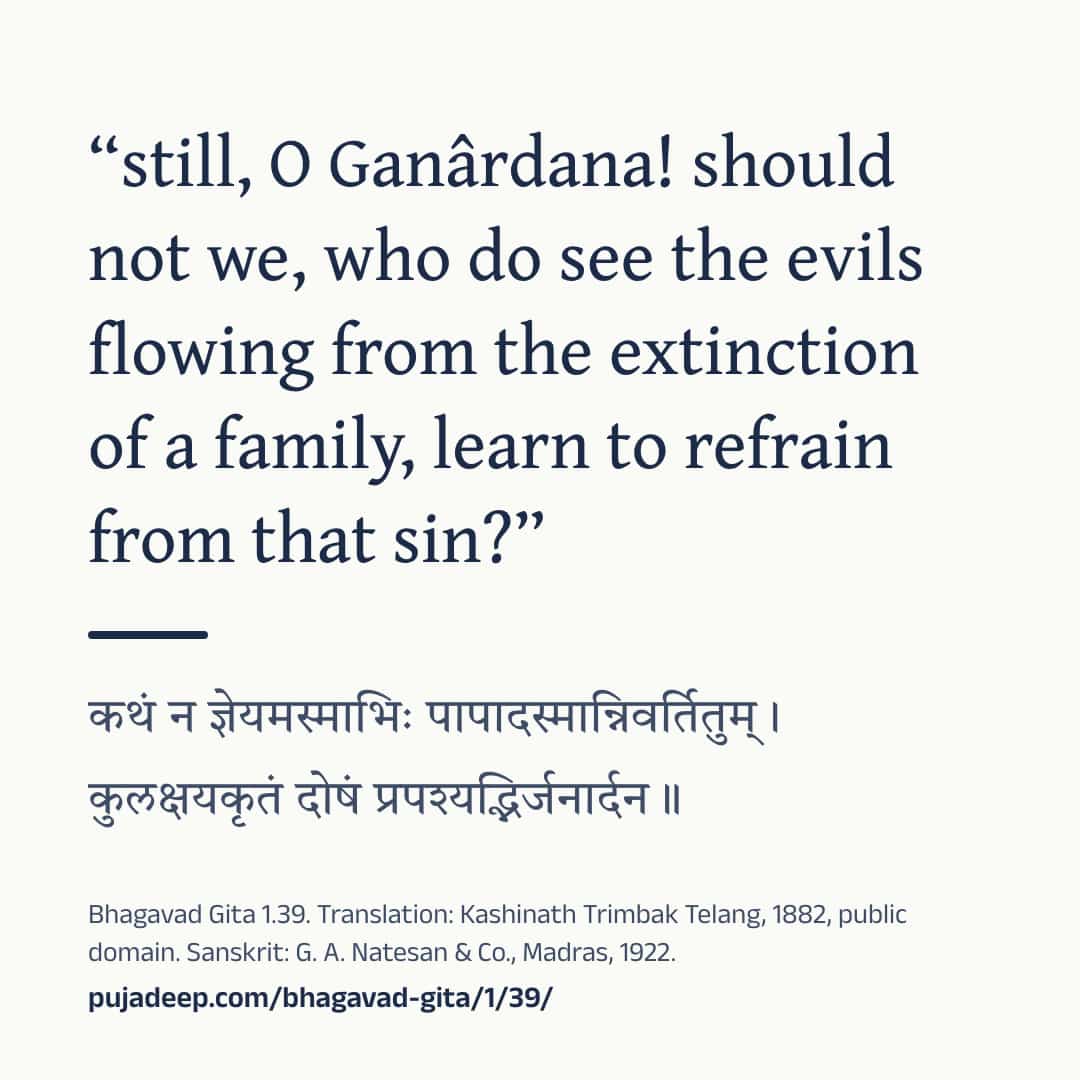
कथं न ज्ञेयमस्माभिः पापादस्मान्निवर्तितुम् ।कुलक्षयकृतं दोषं प्रपश्यद्भिर्जनार्दन ॥
Katham na jneyamasmabhih papadasmannivartitumKulakshayakritam dosham prapashyadbhirjanardana
kathaṃ na jñeyamasmābhiḥ pāpādasmānnivartitum |kulakṣayakṛtaṃ doṣaṃ prapaśyadbhirjanārdana ||
Our explanation But, he asks Krishna (Janardana), why should those who can see the harm in destroying a family not turn away from this wrong?
हिंदी अर्थ पर वे जनार्दन (कृष्ण) से पूछते हैं कि जो लोग कुल के नाश का दोष साफ़ देख रहे हैं, वे इस पाप से पीछे क्यों न हटें?
Word by word
Every word, with its dictionary page
Word by word
- कथम् katham · how (indeclinable) Dictionary: katham, Monier-Williams 1899, p. 247, col. 2 “how? in what manner?”
- न na · not (indeclinable) Dictionary: 2. na, Monier-Williams 1899, p. 523, col. 1 “ind. not, no, nor, neither”
- ज्ञेयम् jñeyam · should be known (gerundive (to be done) (neuter), nominative singular) Dictionary: 1. jñā, Monier-Williams 1899, p. 425, col. 3 “to know, have knowledge, become acquainted with”
- अस्माभिः asmābhiḥ · by us (pronoun, instrumental plural) Dictionary: asmad, Monier-Williams 1899, p. 123, col. 2 “base of the first person plur., as used in comp.”
- पापात् pāpāt · from sin (noun (neuter), ablative singular) Dictionary: pāpa, Monier-Williams 1899, p. 618, col. 2 “sin, vice, crime, guilt”
- अस्मात् asmāt · this (pronoun (neuter), ablative singular) Dictionary: 1. idam, Monier-Williams 1899, p. 165, col. 2 “this, this here, referring to something near the speaker”
- निवर्तितुम् nivartitum · to turn away (infinitive (to do)) Dictionary: ni-vṛt, Monier-Williams 1899, p. 560, col. 1 “to turn back, stop”
- कुलक्षयकृतम् kulakṣayakṛtam · caused by destroying a family (compound (masculine), accusative singular) Dictionary: kula-kṣaya, Monier-Williams 1899, p. 294, col. 3 “decay of a race or family”; 1. kṛta, Monier-Williams 1899, p. 301, col. 3 “done, made, accomplished, performed”
- दोषम् doṣam · wrong, fault (noun (masculine), accusative singular) Dictionary: 2. doṣa, Monier-Williams 1899, p. 498, col. 2 “fault, vice, deficiency, want”
- प्रपश्यद्भिः prapaśyadbhiḥ · (by us) who see clearly (present participle (masculine), instrumental plural) Dictionary: pra-paś, Monier-Williams 1899, p. 682, col. 2 “look at, observe, behold”
- जनार्दन janārdana · O Janardana (Krishna) (noun (masculine), vocative singular) Dictionary: janārdana, Monier-Williams 1899, p. 410, col. 3 “‘exciting or agitating men,’ Vishṇu or Kṛishṇa”
Old translations
Kashinath Trimbak Telang, 1882. Public domain. Page 41.
still, O Ganârdana! should not we, who do see the evils flowing from the extinction of a family, learn to refrain from that sin?
This sentence begins in 1.38.
Compare 3 translations
Kashinath Trimbak Telang, 1882. Public domain. Page 41.
still, O Ganârdana! should not we, who do see the evils flowing from the extinction of a family, learn to refrain from that sin?
This sentence begins in 1.38.
You are reading this one
Annie Besant, 1895. Public domain. Page 21.
Why should we not learn to turn away from such a sin, O Janârdana, seeing the evils in the destruction of a family?
This sentence begins in 1.38.
You are reading this one
Swami Swarupananda, 1909 (first printed 1907). Public domain.
Swarupananda renders verses 38–39 together; see 1.38. Read it at 1.38
You are reading this one
Cite this verse
The translation: K. T. Telang, The Bhagavadgîtâ (The Sacred Books of the East, vol. VIII, Oxford: Clarendon Press, 1882), p. 41. Bhagavad Gita 1.39.
The translation: Annie Besant, The Bhagavad Gîtâ, or The Lord's Song (London: Theosophical Publishing Society, 1895), p. 21. Bhagavad Gita 1.39.
The translation: Swami Swarupananda, Srimad-Bhagavad-Gita (Mayavati: Prabuddha Bharata Press, 1909; first printed in Prabuddha Bharata, 1907–1909), p. 19. Bhagavad Gita 1.38–39.
Our explanation: “Bhagavad Gita 1.39: meaning and translation.” Pujadeep. Updated October 25, 2026. https://pujadeep.com/bhagavad-gita/1/39/
Pujadeep’s explanations are free to quote with credit: name Pujadeep and link to the page. How to credit
Classical readings, by school
No readings by school on this verse yet.
Share
Show the ways to share
Send one picture or the text to one chat. The picture names its source and the address of this page.
Drawing the picture
See the words
Bhagavad Gita 1.39

कथं न ज्ञेयमस्माभिः पापादस्मान्निवर्तितुम् ।
कुलक्षयकृतं दोषं प्रपश्यद्भिर्जनार्दन ॥

“still, O Ganârdana! should not we, who do see the evils flowing from the extinction of a family, learn to refrain from that sin?”
(K. T. Telang, The Bhagavadgîtâ (The Sacred Books of the East, vol. VIII, Oxford: Clarendon Press, 1882), p. 41, public domain)
This sentence begins in 1.38.

“Why should we not learn to turn away from such a sin, O Janârdana, seeing the evils in the destruction of a family?”
(Annie Besant, The Bhagavad Gîtâ, or The Lord's Song (London: Theosophical Publishing Society, 1895), p. 21, public domain)
This sentence begins in 1.38.

Sanskrit: G. A. Natesan & Co., Madras, 1922.
https://pujadeep.com/bhagavad-gita/1/39/ Nothing is sent from this site. Your own app sends it, to the chat you choose. The picture quotes the translation you chose on this page, with its name and year.
Sanskrit text: The Bhagavad-Gita, or The Lord's Song, with the text in Devanagari and an English translation, 1922. Meanings: written for Pujadeep and checked against the cited edition. Source and changes
Questions families ask
Who speaks Bhagavad Gita 1.39?
Arjuna speaks this verse, in chapter 1 (Arjuna Vishada Yoga).
Where does the Sanskrit text come from?
Sanskrit text: The Bhagavad-Gita, or The Lord's Song, with the text in Devanagari and an English translation, 1922. Meanings: written for Pujadeep and checked against the cited edition. See the source
Is the meaning on this page a translation?
Explanation written for this site from the sources listed here, and checked against the cited edition. It is not a translation and not the only way to read the text. Free to quote with credit.
Source and licence
- Sanskrit text
- The Bhagavad-Gita, or The Lord's Song, with the text in Devanagari and an English translation (Annie Besant, G. A. Natesan & Co., Madras, 1922). Public domain. The Sanskrit on these pages was read from this printing’s page images.
- Translation
- The Bhagavadgîtâ with the Sanatsugâtîya and the Anugîtâ, translated by Kâshinâth Trimbak Telang (The Sacred Books of the East, vol. VIII, ed. F. Max Müller) (Kashinath Trimbak Telang, F. Max Müller, Clarendon Press, Oxford, 1882). Public domain. Shown verbatim, as printed.
- Translation
- The Bhagavad Gîtâ, or The Lord's Song, translated by Annie Besant (Annie Besant, Theosophical Publishing Society, London, 1895). Public domain. Shown verbatim, as printed.
- Translation
- Srimad-Bhagavad-Gita, with Sanskrit Text; Paraphrase with Word-by-word Literal Translation; English Rendering and Comments, Index, &c., by the Swami Swarupananda (Himalayan Series, No. XX) (Swami Swarupananda, The Editors and Publishers, Advaita Ashrama, Mayavati, Prabuddha Bharata Press, Mayavati, Almora, Himalayas, 1909). Public domain. Shown verbatim, as printed.
- Common wording
- In this text, 32 words follow today's common wording, checked against sanskritdocuments.org; Sanskrit Wikisource; Gita Press, Gorakhpur; GRETIL, Göttingen and Bhaktivedanta Book Trust.
- Our explanation
- Explanation written for this site from the sources listed here, and checked against the cited edition. It is not a translation and not the only way to read the text. Free to quote with credit.
- Checked
- Checked against the cited edition, October 15, 2026.
- Updated
- October 25, 2026