Bhagavad Gita 1.43: meaning and translation
Chapter 1: Arjuna Vishada Yoga. Arjuna says
Arjuna goes on.
Click or tap a word for its meaning and its dictionary page.
Text and layers
Text and layers
These choices stay in this browser.
Bhagavad Gita 1.43
दोषैरेतैः कुलघ्नानां वर्णसङ्करकारकैः ।उत्साद्यन्ते जातिधर्माः कुलधर्माश्च शाश्वताः ॥
Doshairetaih kulaghnanam varnasankarakarakaihUtsadyante jatidharmah kuladharmashcha shashvatah
doṣairetaiḥ kulaghnānāṃ varṇasaṅkarakārakaiḥ |utsādyante jātidharmāḥ kuladharmāśca śāśvatāḥ ||
Our explanation Arjuna goes on. Through these wrongs of those who destroy families, which cause the mixing of varṇas, he says, the lasting dharma of the community (jāti-dharma) and of the family (kula-dharma) is uprooted.
हिंदी अर्थ अर्जुन आगे कहते हैं कि कुल का नाश करने वालों के इन दोषों से, जो वर्णसंकर पैदा करते हैं, सनातन जातिधर्म और कुलधर्म नष्ट हो जाते हैं।
Word by word
Every word, with its dictionary page
Word by word
- दोषैः doṣaiḥ · through the wrongs (noun (masculine), instrumental plural) Dictionary: 2. doṣa, Monier-Williams 1899, p. 498, col. 2 “fault, vice, deficiency, want”
- एतैः etaiḥ · these (pronoun (masculine), instrumental plural) Dictionary: etad, Monier-Williams 1899, p. 231, col. 2 “this, this here, here”
- कुलघ्नानाम् kulaghnānām · of the destroyers of the family (compound (masculine), genitive plural) Dictionary: kula, Monier-Williams 1899, p. 294, col. 2 “a race, family, community”; ghna, Monier-Williams 1899, p. 379, col. 3 “killing, killer, murderer”
- वर्णसङ्करकारकैः varṇasaṅkarakārakaiḥ · causing the mixing of varṇas (compound (masculine), instrumental plural) Dictionary: varṇa-saṃkara, Monier-Williams 1899, p. 925, col. 1 “mixture or confusion of castes through intermarriage”; 1. kāraka, Monier-Williams 1899, p. 274, col. 2 “making, doing, acting, who or what does or produces or creates”
- उत्साद्यन्ते utsādyante · are uprooted (present passive, 3rd person plural) Dictionary: ut-sad, Monier-Williams 1899, p. 182, col. 1 “abolish, destroy, annihilate”
- जातिधर्माः jātidharmāḥ · the dharmas of the community (jāti) (compound (masculine), nominative plural) Dictionary: jāti-dharma, Monier-Williams 1899, p. 418, col. 1 “caste, duty”
- कुलधर्माः kuladharmāḥ · family dharmas (compound (masculine), nominative plural) Dictionary: kula-dharma, Monier-Williams 1899, p. 294, col. 3 “practice or observance peculiar to a tribe or family”
- च ca · and (indeclinable) Dictionary: 2. ca, Monier-Williams 1899, p. 380, col. 1 “ind. and, both, also, moreover, as well as”
- शाश्वताः śāśvatāḥ · lasting (adjective (masculine), nominative plural) Dictionary: śāśvata, Monier-Williams 1899, p. 1068, col. 3 “eternal, constant, perpetual”
Old translations
Kashinath Trimbak Telang, 1882. Public domain. Page 41–42.
By these transgressions of the destroyers of families, which occasion interminglings of castes, the eternal rites of castes and rites of families are subverted.
Compare 3 translations
Kashinath Trimbak Telang, 1882. Public domain. Page 41–42.
By these transgressions of the destroyers of families, which occasion interminglings of castes, the eternal rites of castes and rites of families are subverted.
You are reading this one
Annie Besant, 1895. Public domain. Page 22.
By these caste-confusing misdeeds of the family-slaughterers, the eternal caste Dharma and family Dharma are abolished.
You are reading this one
Swami Swarupananda, 1909 (first printed 1907). Public domain. Page 60.
By these misdeeds of the destroyers of the family, bringing about confusion of castes, are the immemorial religious rites of the caste and the family destroyed.
You are reading this one
Cite this verse
The translation: K. T. Telang, The Bhagavadgîtâ (The Sacred Books of the East, vol. VIII, Oxford: Clarendon Press, 1882), pp. 41–42. Bhagavad Gita 1.43.
The translation: Annie Besant, The Bhagavad Gîtâ, or The Lord's Song (London: Theosophical Publishing Society, 1895), p. 22. Bhagavad Gita 1.43.
The translation: Swami Swarupananda, Srimad-Bhagavad-Gita (Mayavati: Prabuddha Bharata Press, 1909; first printed in Prabuddha Bharata, 1907–1909), p. 60. Bhagavad Gita 1.43.
Our explanation: “Bhagavad Gita 1.43: meaning and translation.” Pujadeep. Updated October 25, 2026. https://pujadeep.com/bhagavad-gita/1/43/
Pujadeep’s explanations are free to quote with credit: name Pujadeep and link to the page. How to credit
Classical readings, by school
No readings by school on this verse yet.
Share
Show the ways to share
Send one picture or the text to one chat. The picture names its source and the address of this page.
Drawing the picture
See the words
Bhagavad Gita 1.43

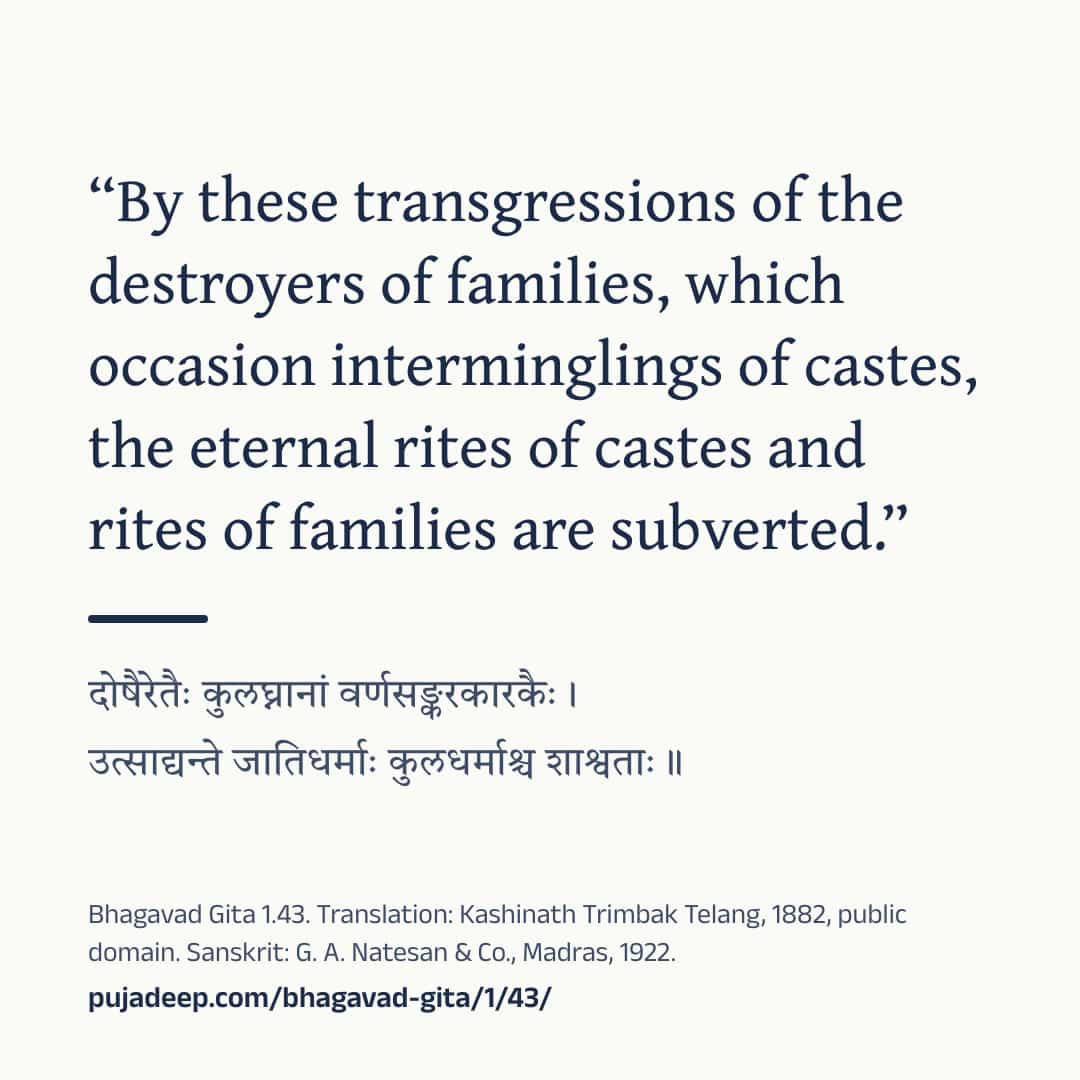
दोषैरेतैः कुलघ्नानां वर्णसङ्करकारकैः ।
उत्साद्यन्ते जातिधर्माः कुलधर्माश्च शाश्वताः ॥

“By these transgressions of the destroyers of families, which occasion interminglings of castes, the eternal rites of castes and rites of families are subverted.”
(K. T. Telang, The Bhagavadgîtâ (The Sacred Books of the East, vol. VIII, Oxford: Clarendon Press, 1882), pp. 41–42, public domain)

“By these caste-confusing misdeeds of the family-slaughterers, the eternal caste Dharma and family Dharma are abolished.”
(Annie Besant, The Bhagavad Gîtâ, or The Lord's Song (London: Theosophical Publishing Society, 1895), p. 22, public domain)

“By these misdeeds of the destroyers of the family, bringing about confusion of castes, are the immemorial religious rites of the caste and the family destroyed.”
(Swami Swarupananda, Srimad-Bhagavad-Gita (Mayavati: Prabuddha Bharata Press, 1909; first printed in Prabuddha Bharata, 1907–1909), p. 60, public domain)

Sanskrit: G. A. Natesan & Co., Madras, 1922.
https://pujadeep.com/bhagavad-gita/1/43/ Nothing is sent from this site. Your own app sends it, to the chat you choose. The picture quotes the translation you chose on this page, with its name and year.
Sanskrit text: The Bhagavad-Gita, or The Lord's Song, with the text in Devanagari and an English translation, 1922. Meanings: written for Pujadeep and checked against the cited edition. Source and changes
Questions families ask
Who speaks Bhagavad Gita 1.43?
Arjuna speaks this verse, in chapter 1 (Arjuna Vishada Yoga).
Where does the Sanskrit text come from?
Sanskrit text: The Bhagavad-Gita, or The Lord's Song, with the text in Devanagari and an English translation, 1922. Meanings: written for Pujadeep and checked against the cited edition. See the source
Is the meaning on this page a translation?
Explanation written for this site from the sources listed here, and checked against the cited edition. It is not a translation and not the only way to read the text. Free to quote with credit.
Source and licence
- Sanskrit text
- The Bhagavad-Gita, or The Lord's Song, with the text in Devanagari and an English translation (Annie Besant, G. A. Natesan & Co., Madras, 1922). Public domain. The Sanskrit on these pages was read from this printing’s page images.
- Translation
- The Bhagavadgîtâ with the Sanatsugâtîya and the Anugîtâ, translated by Kâshinâth Trimbak Telang (The Sacred Books of the East, vol. VIII, ed. F. Max Müller) (Kashinath Trimbak Telang, F. Max Müller, Clarendon Press, Oxford, 1882). Public domain. Shown verbatim, as printed.
- Translation
- The Bhagavad Gîtâ, or The Lord's Song, translated by Annie Besant (Annie Besant, Theosophical Publishing Society, London, 1895). Public domain. Shown verbatim, as printed.
- Translation
- Srimad-Bhagavad-Gita, with Sanskrit Text; Paraphrase with Word-by-word Literal Translation; English Rendering and Comments, Index, &c., by the Swami Swarupananda (Himalayan Series, No. XX) (Swami Swarupananda, The Editors and Publishers, Advaita Ashrama, Mayavati, Prabuddha Bharata Press, Mayavati, Almora, Himalayas, 1909). Public domain. Shown verbatim, as printed.
- Common wording
- In this text, 32 words follow today's common wording, checked against sanskritdocuments.org; Sanskrit Wikisource; Gita Press, Gorakhpur; GRETIL, Göttingen and Bhaktivedanta Book Trust.
- Our explanation
- Explanation written for this site from the sources listed here, and checked against the cited edition. It is not a translation and not the only way to read the text. Free to quote with credit.
- Checked
- Checked against the cited edition, October 15, 2026.
- Updated
- October 25, 2026