Bhagavad Gita 1.45: meaning and translation
Chapter 1: Arjuna Vishada Yoga. Arjuna says
Arjuna cries out in sorrow: out of greed for the pleasures of a kingdom, they are getting ready to kill their own people, and so to do a great wrong.
Click or tap a word for its meaning and its dictionary page.
Text and layers
Text and layers
These choices stay in this browser.
Bhagavad Gita 1.45
अहो बत महत्पापं कर्तुं व्यवसिता वयम् ।यद्राज्यसुखलोभेन हन्तुं स्वजनमुद्यताः ॥
Aho bata mahatpapam kartum vyavasita vayamYadrajyasukhalobhena hantum svajanamudyatah
aho bata mahatpāpaṃ kartuṃ vyavasitā vayam |yadrājyasukhalobhena hantuṃ svajanamudyatāḥ ||
Our explanation Arjuna cries out in sorrow: out of greed for the pleasures of a kingdom, they are getting ready to kill their own people, and so to do a great wrong.
हिंदी अर्थ अर्जुन दुःख से कह उठते हैं: हाय! राज्य के सुख के लोभ में वे अपने ही लोगों को मारने को तैयार हो गए हैं, और इस तरह एक बड़ा पाप करने चले हैं।
Word by word
Every word, with its dictionary page
Word by word
- अहो aho · alas (indeclinable) Dictionary: 2. aho, Monier-Williams 1899, p. 126, col. 1 “a particle (implying joyful or painful surprise)”
- बत bata · alas (indeclinable) Dictionary: 1. bata, Monier-Williams 1899, p. 719, col. 3 “an interjection expressing astonishment or regret”
- महत् mahat · great (adjective (neuter), accusative singular) Dictionary: mahat, Monier-Williams 1899, p. 794, col. 2 “great (in space, time, quantity or degree)”
- पापम् pāpam · sin (noun (neuter), accusative singular) Dictionary: pāpa, Monier-Williams 1899, p. 618, col. 2 “sin, vice, crime, guilt”
- कर्तुम् kartum · to do (infinitive (to do)) Dictionary: 1. kṛ, Monier-Williams 1899, p. 301, col. 1 “to do, make, perform, accomplish, cause, effect”
- व्यवसिताः vyavasitāḥ · resolved (past participle (masculine), nominative plural) Dictionary: vy-avasita, Monier-Williams 1899, p. 1033, col. 3 “decided, determined, resolved, undertaken”
- वयम् vayam · we (pronoun, nominative plural) Dictionary: vayam, Monier-Williams 1899, p. 920, col. 2 “nom. pl. of 1. pers. pron., we”
- यत् yat · in that (indeclinable) Dictionary: yad, Monier-Williams 1899, p. 844, col. 2 “who, which, what, whichever, whatever, that”
- राज्यसुखलोभेन rājyasukhalobhena · through greed for the pleasures of a kingdom (compound (masculine), instrumental singular) Dictionary: rājya, Monier-Williams 1899, p. 875, col. 1 “kingdom, country, realm”; sukha, Monier-Williams 1899, p. 1221, col. 1 “ease, easiness, comfort, prosperity, pleasure, happiness”; lobha, Monier-Williams 1899, p. 905, col. 1 “covetousness, cupidity, avarice”
- हन्तुम् hantum · to kill (infinitive (to do)) Dictionary: 1. han, Monier-Williams 1899, p. 1287, col. 2 “to smite, slay, hit, kill, mar, destroy”
- स्वजनम् svajanam · own people (compound (masculine), accusative singular) Dictionary: 1. sva, Monier-Williams 1899, p. 1275, col. 1 “own, one's own, my own, thy own, his own, her own, our own, their own &c.”; jana, Monier-Williams 1899, p. 410, col. 1 “creature, living being, man, person, race”
- उद्यताः udyatāḥ · ready (past participle (masculine), nominative plural) Dictionary: ud-yata, Monier-Williams 1899, p. 190, col. 3 “ready or eager for; prepared, intent on”
Old translations
Kashinath Trimbak Telang, 1882. Public domain. Page 42.
Alas! we are engaged in committing a heinous sin, seeing that we are making efforts for killing our own kinsmen out of greed of the pleasures of sovereignty.
Compare 3 translations
Kashinath Trimbak Telang, 1882. Public domain. Page 42.
Alas! we are engaged in committing a heinous sin, seeing that we are making efforts for killing our own kinsmen out of greed of the pleasures of sovereignty.
You are reading this one
Annie Besant, 1895. Public domain. Page 22.
Alas! in committing a great sin are we engaged, we who are endeavouring to kill our kindred from greed of the pleasures of kingship.
You are reading this one
Swami Swarupananda, 1909 (first printed 1907). Public domain. Page 22.
Alas, we are involved in a great sin, in that we are prepared to slay our kinsmen, from greed of the pleasures of a kingdom!
You are reading this one
Cite this verse
The translation: K. T. Telang, The Bhagavadgîtâ (The Sacred Books of the East, vol. VIII, Oxford: Clarendon Press, 1882), p. 42. Bhagavad Gita 1.45.
The translation: Annie Besant, The Bhagavad Gîtâ, or The Lord's Song (London: Theosophical Publishing Society, 1895), p. 22. Bhagavad Gita 1.45.
The translation: Swami Swarupananda, Srimad-Bhagavad-Gita (Mayavati: Prabuddha Bharata Press, 1909; first printed in Prabuddha Bharata, 1907–1909), p. 22. Bhagavad Gita 1.45.
Our explanation: “Bhagavad Gita 1.45: meaning and translation.” Pujadeep. Updated October 25, 2026. https://pujadeep.com/bhagavad-gita/1/45/
Pujadeep’s explanations are free to quote with credit: name Pujadeep and link to the page. How to credit
Classical readings, by school
No readings by school on this verse yet.
Share
Show the ways to share
Send one picture or the text to one chat. The picture names its source and the address of this page.
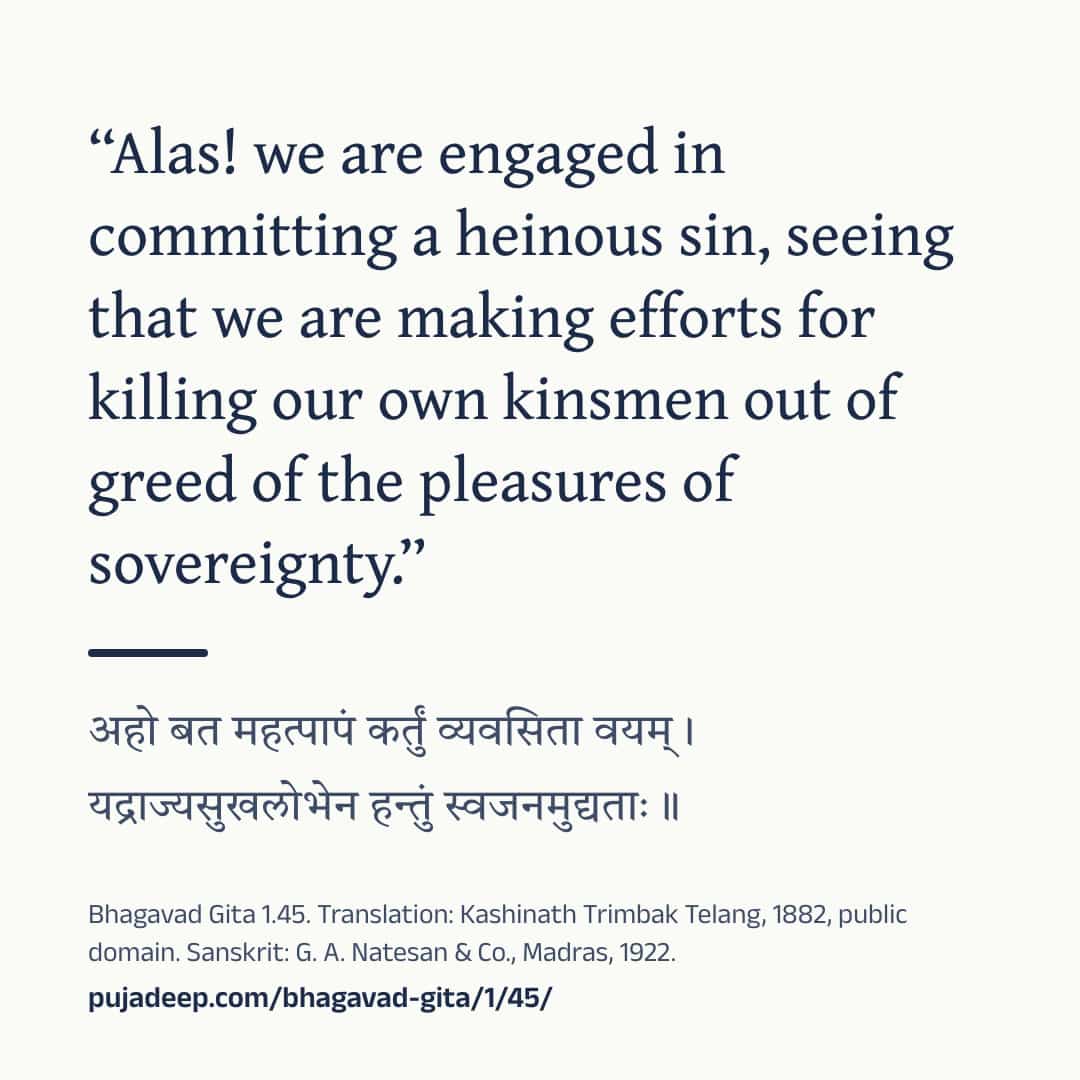
Drawing the picture
See the words
Bhagavad Gita 1.45

अहो बत महत्पापं कर्तुं व्यवसिता वयम् ।
यद्राज्यसुखलोभेन हन्तुं स्वजनमुद्यताः ॥

“Alas! we are engaged in committing a heinous sin, seeing that we are making efforts for killing our own kinsmen out of greed of the pleasures of sovereignty.”
(K. T. Telang, The Bhagavadgîtâ (The Sacred Books of the East, vol. VIII, Oxford: Clarendon Press, 1882), p. 42, public domain)

“Alas! in committing a great sin are we engaged, we who are endeavouring to kill our kindred from greed of the pleasures of kingship.”
(Annie Besant, The Bhagavad Gîtâ, or The Lord's Song (London: Theosophical Publishing Society, 1895), p. 22, public domain)

“Alas, we are involved in a great sin, in that we are prepared to slay our kinsmen, from greed of the pleasures of a kingdom!”
(Swami Swarupananda, Srimad-Bhagavad-Gita (Mayavati: Prabuddha Bharata Press, 1909; first printed in Prabuddha Bharata, 1907–1909), p. 22, public domain)

Sanskrit: G. A. Natesan & Co., Madras, 1922.
https://pujadeep.com/bhagavad-gita/1/45/ Nothing is sent from this site. Your own app sends it, to the chat you choose. The picture quotes the translation you chose on this page, with its name and year.
Sanskrit text: The Bhagavad-Gita, or The Lord's Song, with the text in Devanagari and an English translation, 1922. Meanings: written for Pujadeep and checked against the cited edition. Source and changes
Questions families ask
Who speaks Bhagavad Gita 1.45?
Arjuna speaks this verse, in chapter 1 (Arjuna Vishada Yoga).
Where does the Sanskrit text come from?
Sanskrit text: The Bhagavad-Gita, or The Lord's Song, with the text in Devanagari and an English translation, 1922. Meanings: written for Pujadeep and checked against the cited edition. See the source
Is the meaning on this page a translation?
Explanation written for this site from the sources listed here, and checked against the cited edition. It is not a translation and not the only way to read the text. Free to quote with credit.
Source and licence
- Sanskrit text
- The Bhagavad-Gita, or The Lord's Song, with the text in Devanagari and an English translation (Annie Besant, G. A. Natesan & Co., Madras, 1922). Public domain. The Sanskrit on these pages was read from this printing’s page images.
- Translation
- The Bhagavadgîtâ with the Sanatsugâtîya and the Anugîtâ, translated by Kâshinâth Trimbak Telang (The Sacred Books of the East, vol. VIII, ed. F. Max Müller) (Kashinath Trimbak Telang, F. Max Müller, Clarendon Press, Oxford, 1882). Public domain. Shown verbatim, as printed.
- Translation
- The Bhagavad Gîtâ, or The Lord's Song, translated by Annie Besant (Annie Besant, Theosophical Publishing Society, London, 1895). Public domain. Shown verbatim, as printed.
- Translation
- Srimad-Bhagavad-Gita, with Sanskrit Text; Paraphrase with Word-by-word Literal Translation; English Rendering and Comments, Index, &c., by the Swami Swarupananda (Himalayan Series, No. XX) (Swami Swarupananda, The Editors and Publishers, Advaita Ashrama, Mayavati, Prabuddha Bharata Press, Mayavati, Almora, Himalayas, 1909). Public domain. Shown verbatim, as printed.
- Common wording
- In this text, 32 words follow today's common wording, checked against sanskritdocuments.org; Sanskrit Wikisource; Gita Press, Gorakhpur; GRETIL, Göttingen and Bhaktivedanta Book Trust.
- Our explanation
- Explanation written for this site from the sources listed here, and checked against the cited edition. It is not a translation and not the only way to read the text. Free to quote with credit.
- Checked
- Checked against the cited edition, October 15, 2026.
- Updated
- October 25, 2026