Bhagavad Gita 1.35: meaning and translation
Chapter 1: Arjuna Vishada Yoga. Arjuna says
Arjuna says he does not want to kill them, even if they kill him: not even to rule the three worlds, let alone for this earth.
Click or tap a word for its meaning and its dictionary page.
Text and layers
Text and layers
These choices stay in this browser.
Bhagavad Gita 1.35
एतान्न हन्तुमिच्छामि घ्नतोऽपि मधुसूदन ।अपि त्रैलोक्यराज्यस्य हेतोः किं नु महीकृते ॥
Etanna hantumichchhami ghnatopi madhusudanaApi trailokyarajyasya hetoh kim nu mahikrite
etānna hantumicchāmi ghnato’pi madhusūdana |api trailokyarājyasya hetoḥ kiṃ nu mahīkṛte ||
Our explanation Arjuna says he does not want to kill them, even if they kill him: not even to rule the three worlds, let alone for this earth. He calls Krishna Madhusudana (slayer of the demon Madhu).
हिंदी अर्थ अर्जुन कहते हैं कि वे इन्हें मारना नहीं चाहते, चाहे ये उन्हें मार ही क्यों न दें: तीनों लोकों के राज्य के लिए भी नहीं, फिर इस धरती के लिए तो बात ही क्या। वे कृष्ण को मधुसूदन (मधु नाम के असुर को मारने वाले) कहते हैं।
Word by word
Every word, with its dictionary page
Word by word
- एतान् etān · these (pronoun (masculine), accusative plural) Dictionary: etad, Monier-Williams 1899, p. 231, col. 2 “this, this here, here”
- न na · not (indeclinable) Dictionary: 2. na, Monier-Williams 1899, p. 523, col. 1 “ind. not, no, nor, neither”
- हन्तुम् hantum · to kill (infinitive (to do)) Dictionary: 1. han, Monier-Williams 1899, p. 1287, col. 2 “to smite, slay, hit, kill, mar, destroy”
- इच्छामि icchāmi · "I wish" (present, 1st person singular) Dictionary: 3. iṣ, Monier-Williams 1899, p. 169, col. 1 “to endeavour to obtain, strive, seek for”
- घ्नतः ghnataḥ · though they kill (present participle (masculine), accusative plural) Dictionary: 1. han, Monier-Williams 1899, p. 1287, col. 2 “to smite, slay, hit, kill, mar, destroy”
- अपि api · even (indeclinable) Dictionary: api, Monier-Williams 1899, p. 55, col. 1 “in the sense of even, also, very”
- मधुसूदन madhusūdana · O Madhusudana (Krishna) (noun (masculine), vocative singular) Dictionary: madhu-sūdana, Monier-Williams 1899, p. 780, col. 3 “destroyer of the demon Madhu”
- अपि api · even (indeclinable) Dictionary: api, Monier-Williams 1899, p. 55, col. 1 “in the sense of even, also, very”
- त्रैलोक्यराज्यस्य trailokyarājyasya · of rule over the three worlds (compound (neuter), genitive singular) Dictionary: trai-lokya, Monier-Williams 1899, p. 462, col. 2 “the 3 Lokas or worlds”; rājya, Monier-Williams 1899, p. 875, col. 1 “kingdom, country, realm”
- हेतोः hetoḥ · for the sake of (noun (masculine), genitive singular) Dictionary: hetu, Monier-Williams 1899, p. 1303, col. 3 “motive, cause, cause of, reason for”
- किम् kim · how then (indeclinable) Dictionary: kim, Monier-Williams 1899, p. 282, col. 2 “what? how? whence? wherefore? why?”
- नु nu · indeed, then (indeclinable) Dictionary: 1. nu, Monier-Williams 1899, p. 567, col. 1 “now, still, just, at once”
- महीकृते mahīkṛte · for the earth (compound, adverb (for the sake of)) Dictionary: 1. mahī, Monier-Williams 1899, p. 803, col. 2 “the earth”; kṛte, Monier-Williams 1899, p. 301, col. 3 “on account of, for the sake of, for”
Old translations
Kashinath Trimbak Telang, 1882. Public domain. Page 40–41.
These I do not wish to kill, though they kill (me), O destroyer of Madhu1! even for the sake of sovereignty over the three worlds, how much less then for this earth (alone)?
Footnotes (the translator’s own) - A demon of this name. ↩
Compare 3 translations
Kashinath Trimbak Telang, 1882. Public domain. Page 40–41.
These I do not wish to kill, though they kill (me), O destroyer of Madhu1! even for the sake of sovereignty over the three worlds, how much less then for this earth (alone)?
Footnotes (the translator’s own) - A demon of this name. ↩
You are reading this one
Annie Besant, 1895. Public domain. Page 20.
These I do not wish to kill, though [myself] slain, O Madhusûdana,1 even for the sake of the kingship of the three worlds; how then for earth!
Footnotes (the translator’s own) - The slayer of Madhu, a demon, ↩
You are reading this one
Swami Swarupananda, 1909 (first printed 1907). Public domain. Page 58.
Even though these were to kill me, O slayer of Madhu, I could not wish to kill them,—not even for the sake of dominion over the three worlds, how much less for the sake of the earth!
You are reading this one
Cite this verse
The translation: K. T. Telang, The Bhagavadgîtâ (The Sacred Books of the East, vol. VIII, Oxford: Clarendon Press, 1882), pp. 40–41. Bhagavad Gita 1.35.
The translation: Annie Besant, The Bhagavad Gîtâ, or The Lord's Song (London: Theosophical Publishing Society, 1895), p. 20. Bhagavad Gita 1.35.
The translation: Swami Swarupananda, Srimad-Bhagavad-Gita (Mayavati: Prabuddha Bharata Press, 1909; first printed in Prabuddha Bharata, 1907–1909), p. 58. Bhagavad Gita 1.35.
Our explanation: “Bhagavad Gita 1.35: meaning and translation.” Pujadeep. Updated October 25, 2026. https://pujadeep.com/bhagavad-gita/1/35/
Pujadeep’s explanations are free to quote with credit: name Pujadeep and link to the page. How to credit
Classical readings, by school
No readings by school on this verse yet.
Share
Show the ways to share
Send one picture or the text to one chat. The picture names its source and the address of this page.
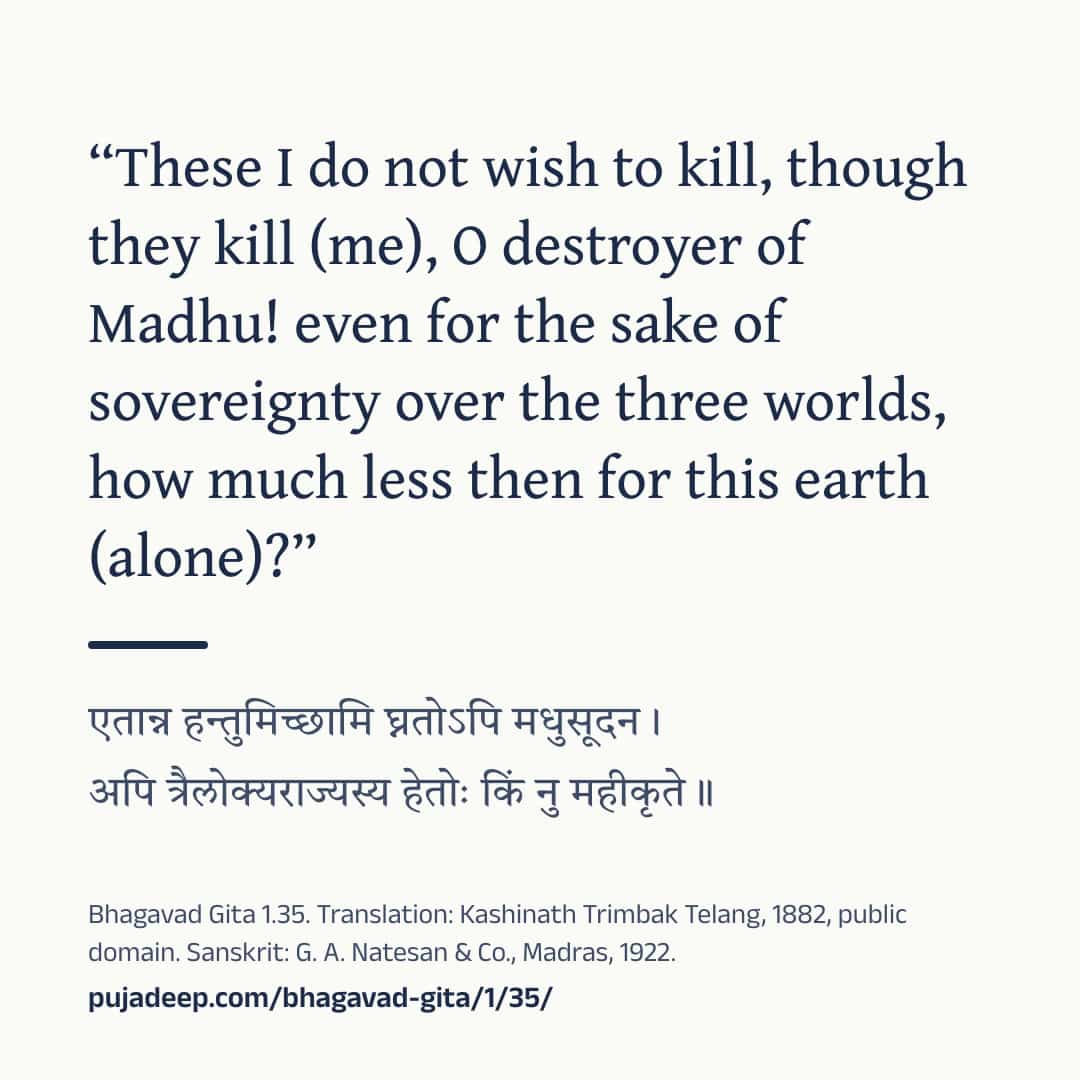
Drawing the picture
See the words
Bhagavad Gita 1.35

एतान्न हन्तुमिच्छामि घ्नतोऽपि मधुसूदन ।
अपि त्रैलोक्यराज्यस्य हेतोः किं नु महीकृते ॥

“These I do not wish to kill, though they kill (me), O destroyer of Madhu! even for the sake of sovereignty over the three worlds, how much less then for this earth (alone)?”
(K. T. Telang, The Bhagavadgîtâ (The Sacred Books of the East, vol. VIII, Oxford: Clarendon Press, 1882), pp. 40–41, public domain)

“These I do not wish to kill, though [myself] slain, O Madhusûdana, even for the sake of the kingship of the three worlds; how then for earth!”
(Annie Besant, The Bhagavad Gîtâ, or The Lord's Song (London: Theosophical Publishing Society, 1895), p. 20, public domain)

“Even though these were to kill me, O slayer of Madhu, I could not wish to kill them,—not even for the sake of dominion over the three worlds, how much less for the sake of the earth!”
(Swami Swarupananda, Srimad-Bhagavad-Gita (Mayavati: Prabuddha Bharata Press, 1909; first printed in Prabuddha Bharata, 1907–1909), p. 58, public domain)

Sanskrit: G. A. Natesan & Co., Madras, 1922.
https://pujadeep.com/bhagavad-gita/1/35/ Nothing is sent from this site. Your own app sends it, to the chat you choose. The picture quotes the translation you chose on this page, with its name and year.
Sanskrit text: The Bhagavad-Gita, or The Lord's Song, with the text in Devanagari and an English translation, 1922. Meanings: written for Pujadeep and checked against the cited edition. Source and changes
Questions families ask
Who speaks Bhagavad Gita 1.35?
Arjuna speaks this verse, in chapter 1 (Arjuna Vishada Yoga).
Where does the Sanskrit text come from?
Sanskrit text: The Bhagavad-Gita, or The Lord's Song, with the text in Devanagari and an English translation, 1922. Meanings: written for Pujadeep and checked against the cited edition. See the source
Is the meaning on this page a translation?
Explanation written for this site from the sources listed here, and checked against the cited edition. It is not a translation and not the only way to read the text. Free to quote with credit.
Source and licence
- Sanskrit text
- The Bhagavad-Gita, or The Lord's Song, with the text in Devanagari and an English translation (Annie Besant, G. A. Natesan & Co., Madras, 1922). Public domain. The Sanskrit on these pages was read from this printing’s page images.
- Translation
- The Bhagavadgîtâ with the Sanatsugâtîya and the Anugîtâ, translated by Kâshinâth Trimbak Telang (The Sacred Books of the East, vol. VIII, ed. F. Max Müller) (Kashinath Trimbak Telang, F. Max Müller, Clarendon Press, Oxford, 1882). Public domain. Shown verbatim, as printed.
- Translation
- The Bhagavad Gîtâ, or The Lord's Song, translated by Annie Besant (Annie Besant, Theosophical Publishing Society, London, 1895). Public domain. Shown verbatim, as printed.
- Translation
- Srimad-Bhagavad-Gita, with Sanskrit Text; Paraphrase with Word-by-word Literal Translation; English Rendering and Comments, Index, &c., by the Swami Swarupananda (Himalayan Series, No. XX) (Swami Swarupananda, The Editors and Publishers, Advaita Ashrama, Mayavati, Prabuddha Bharata Press, Mayavati, Almora, Himalayas, 1909). Public domain. Shown verbatim, as printed.
- Common wording
- In this text, 32 words follow today's common wording, checked against sanskritdocuments.org; Sanskrit Wikisource; Gita Press, Gorakhpur; GRETIL, Göttingen and Bhaktivedanta Book Trust.
- Our explanation
- Explanation written for this site from the sources listed here, and checked against the cited edition. It is not a translation and not the only way to read the text. Free to quote with credit.
- Checked
- Checked against the cited edition, October 15, 2026.
- Updated
- October 25, 2026