Bhagavad Gita 1.25: meaning and translation
Chapter 1: Arjuna Vishada Yoga. Sanjaya says
Sanjaya: Krishna places the chariot in front of Bhishma, Drona and all the kings, and says: "Partha (son of Pritha), look at these Kurus gathered here."
Click or tap a word for its meaning and its dictionary page.
Text and layers
Text and layers
These choices stay in this browser.
Bhagavad Gita 1.25
भीष्मद्रोणप्रमुखतः सर्वेषां च महीक्षिताम् ।उवाच पार्थ पश्यैतान्समवेतान्कुरूनिति ॥
Bhishmadronapramukhatah sarvesham cha mahikshitamUvacha partha pashyaitansamavetankuruniti
bhīṣmadroṇapramukhataḥ sarveṣāṃ ca mahīkṣitām |uvāca pārtha paśyaitānsamavetānkurūniti ||
Our explanation Krishna places the chariot in front of Bhishma, Drona and all the kings, and says: "Partha (son of Pritha), look at these Kurus gathered here."
हिंदी अर्थ कृष्ण रथ को भीष्म, द्रोण और सब राजाओं के सामने खड़ा करके कहते हैं: “हे पार्थ (पृथा अर्थात कुन्ती के पुत्र), यहाँ इकट्ठे हुए इन कौरवों को देखो।”
Word by word
Every word, with its dictionary page
Word by word
- भीष्मद्रोणप्रमुखतः bhīṣmadroṇapramukhataḥ · in front of Bhishma and Drona (compound, adverb (in front of)) Dictionary: bhīṣma, Monier-Williams 1899, p. 758, col. 3 “N. of a son of Śāṃtanu and Gaṅgā”; droṇa, Monier-Williams 1899, p. 503, col. 1 “the military preceptor of both the Kuru and Pāṇḍu princes”; pra-mukha, Monier-Williams 1899, p. 686, col. 3 “in front of, before”
- सर्वेषाम् sarveṣām · of all (pronoun (masculine), genitive plural) Dictionary: sarva, Monier-Williams 1899, p. 1184, col. 3 “whole, entire, all, every”
- च ca · and (indeclinable) Dictionary: 2. ca, Monier-Williams 1899, p. 380, col. 1 “ind. and, both, also, moreover, as well as”
- महीक्षिताम् mahīkṣitām · of the kings (noun (masculine), genitive plural) Dictionary: mahī-kṣit, Monier-Williams 1899, p. 803, col. 2 “‘earth-ruler,’ a king, prince”
- उवाच uvāca · said (perfect, 3rd person singular) Dictionary: vac, Monier-Williams 1899, p. 912, col. 1 “to speak, say, tell, utter, announce”
- पार्थ pārtha · O Partha (son of Pritha) (noun (masculine), vocative singular) Dictionary: 2. pārtha, Monier-Williams 1899, p. 621, col. 3 “metron. of Yudhi-shṭhira or Bhīma-sena or Arjuna”
- पश्य paśya · see (imperative, 2nd person singular) Dictionary: 1. paś, Monier-Williams 1899, p. 611, col. 2 “behold, look at, observe, perceive, notice”
- एतान् etān · these (pronoun (masculine), accusative plural) Dictionary: etad, Monier-Williams 1899, p. 231, col. 2 “this, this here, here”
- समवेतान् samavetān · gathered (past participle (masculine), accusative plural) Dictionary: sam-aveta, Monier-Williams 1899, p. 1158, col. 1 “come together, met, assembled”
- कुरून् kurūn · the Kurus (noun (masculine), accusative plural) Dictionary: kuru, Monier-Williams 1899, p. 294, col. 1 “N. of a people of India and of their country”
- इति iti · thus (closing the words) (indeclinable) Dictionary: 2. iti, Monier-Williams 1899, p. 165, col. 1 “in this manner, thus”
Old translations
Kashinath Trimbak Telang, 1882. Public domain. Page 39–40.
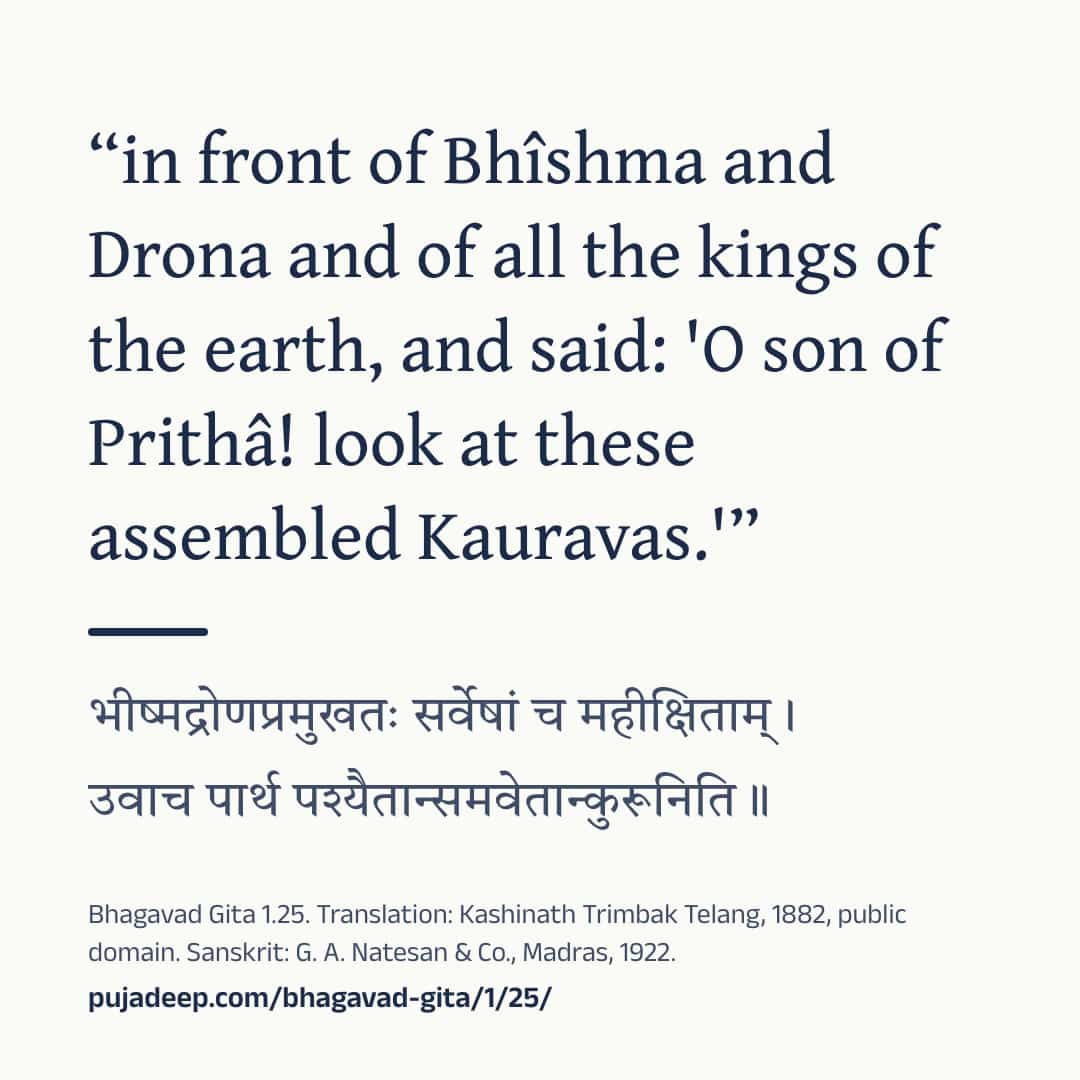
in front of Bhîshma and Drona and of all the kings of the earth, and said: 'O son of Prithâ! look at these assembled Kauravas.'
This sentence begins in 1.24.
Compare 3 translations
Kashinath Trimbak Telang, 1882. Public domain. Page 39–40.
in front of Bhîshma and Drona and of all the kings of the earth, and said: 'O son of Prithâ! look at these assembled Kauravas.'
This sentence begins in 1.24.
You are reading this one
Annie Besant, 1895. Public domain. Page 18–19.
Over against Bhîshma, Drona and all the rulers of the world, and said: "O Pârtha, behold these Kurus gathered together."
This sentence begins in 1.24.
You are reading this one
Swami Swarupananda, 1909 (first printed 1907). Public domain.
Swarupananda renders verses 24–25 together; see 1.24. Read it at 1.24
You are reading this one
Cite this verse
The translation: K. T. Telang, The Bhagavadgîtâ (The Sacred Books of the East, vol. VIII, Oxford: Clarendon Press, 1882), pp. 39–40. Bhagavad Gita 1.25.
The translation: Annie Besant, The Bhagavad Gîtâ, or The Lord's Song (London: Theosophical Publishing Society, 1895), pp. 18–19. Bhagavad Gita 1.25.
The translation: Swami Swarupananda, Srimad-Bhagavad-Gita (Mayavati: Prabuddha Bharata Press, 1909; first printed in Prabuddha Bharata, 1907–1909), p. 13. Bhagavad Gita 1.24–25.
Our explanation: “Bhagavad Gita 1.25: meaning and translation.” Pujadeep. Updated October 25, 2026. https://pujadeep.com/bhagavad-gita/1/25/
Pujadeep’s explanations are free to quote with credit: name Pujadeep and link to the page. How to credit
Classical readings, by school
No readings by school on this verse yet.
Share
Show the ways to share
Send one picture or the text to one chat. The picture names its source and the address of this page.
Drawing the picture
See the words
Bhagavad Gita 1.25

भीष्मद्रोणप्रमुखतः सर्वेषां च महीक्षिताम् ।
उवाच पार्थ पश्यैतान्समवेतान्कुरूनिति ॥

“in front of Bhîshma and Drona and of all the kings of the earth, and said: 'O son of Prithâ! look at these assembled Kauravas.'”
(K. T. Telang, The Bhagavadgîtâ (The Sacred Books of the East, vol. VIII, Oxford: Clarendon Press, 1882), pp. 39–40, public domain)
This sentence begins in 1.24.

“Over against Bhîshma, Drona and all the rulers of the world, and said: "O Pârtha, behold these Kurus gathered together."”
(Annie Besant, The Bhagavad Gîtâ, or The Lord's Song (London: Theosophical Publishing Society, 1895), pp. 18–19, public domain)
This sentence begins in 1.24.

Sanskrit: G. A. Natesan & Co., Madras, 1922.
https://pujadeep.com/bhagavad-gita/1/25/ Nothing is sent from this site. Your own app sends it, to the chat you choose. The picture quotes the translation you chose on this page, with its name and year.
Sanskrit text: The Bhagavad-Gita, or The Lord's Song, with the text in Devanagari and an English translation, 1922. Meanings: written for Pujadeep and checked against the cited edition. Source and changes
Questions families ask
Who speaks Bhagavad Gita 1.25?
Sanjaya speaks this verse, in chapter 1 (Arjuna Vishada Yoga).
Where does the Sanskrit text come from?
Sanskrit text: The Bhagavad-Gita, or The Lord's Song, with the text in Devanagari and an English translation, 1922. Meanings: written for Pujadeep and checked against the cited edition. See the source
Is the meaning on this page a translation?
Explanation written for this site from the sources listed here, and checked against the cited edition. It is not a translation and not the only way to read the text. Free to quote with credit.
Source and licence
- Sanskrit text
- The Bhagavad-Gita, or The Lord's Song, with the text in Devanagari and an English translation (Annie Besant, G. A. Natesan & Co., Madras, 1922). Public domain. The Sanskrit on these pages was read from this printing’s page images.
- Translation
- The Bhagavadgîtâ with the Sanatsugâtîya and the Anugîtâ, translated by Kâshinâth Trimbak Telang (The Sacred Books of the East, vol. VIII, ed. F. Max Müller) (Kashinath Trimbak Telang, F. Max Müller, Clarendon Press, Oxford, 1882). Public domain. Shown verbatim, as printed.
- Translation
- The Bhagavad Gîtâ, or The Lord's Song, translated by Annie Besant (Annie Besant, Theosophical Publishing Society, London, 1895). Public domain. Shown verbatim, as printed.
- Translation
- Srimad-Bhagavad-Gita, with Sanskrit Text; Paraphrase with Word-by-word Literal Translation; English Rendering and Comments, Index, &c., by the Swami Swarupananda (Himalayan Series, No. XX) (Swami Swarupananda, The Editors and Publishers, Advaita Ashrama, Mayavati, Prabuddha Bharata Press, Mayavati, Almora, Himalayas, 1909). Public domain. Shown verbatim, as printed.
- Common wording
- In this text, 32 words follow today's common wording, checked against sanskritdocuments.org; Sanskrit Wikisource; Gita Press, Gorakhpur; GRETIL, Göttingen and Bhaktivedanta Book Trust.
- Our explanation
- Explanation written for this site from the sources listed here, and checked against the cited edition. It is not a translation and not the only way to read the text. Free to quote with credit.
- Checked
- Checked against the cited edition, October 15, 2026.
- Updated
- October 25, 2026