Bhagavad Gita 1.17: meaning and translation
Chapter 1: Arjuna Vishada Yoga. Sanjaya says
Sanjaya: On the Pandava side, conches are also blown by the king of Kashi, a great archer; Shikhandi (a son of Drupada), a great chariot-warrior; Dhrishtadyumna; Virata; and the unconquered Satyaki.
Click or tap a word for its meaning and its dictionary page.
Text and layers
Text and layers
These choices stay in this browser.
Bhagavad Gita 1.17
काश्यश्च परमेष्वासः शिखण्डी च महारथः ।धृष्टद्युम्नो विराटश्च सात्यकिश्चापराजितः ॥
Kashyashcha parameshvasah shikhandi cha maharathahDhrishtadyumno viratashcha satyakishchaparajitah
kāśyaśca parameṣvāsaḥ śikhaṇḍī ca mahārathaḥ |dhṛṣṭadyumno virāṭaśca sātyakiścāparājitaḥ ||
Our explanation On the Pandava side, conches are also blown by the king of Kashi, a great archer; Shikhandi (a son of Drupada), a great chariot-warrior; Dhrishtadyumna; Virata; and the unconquered Satyaki.
हिंदी अर्थ पाण्डवों की ओर से श्रेष्ठ धनुर्धर काशिराज, महारथी शिखण्डी (द्रुपद के पुत्र), धृष्टद्युम्न, विराट और कभी न हारने वाले सात्यकि भी शंख बजाते हैं।
Word by word
Every word, with its dictionary page
Word by word
- काश्यः kāśyaḥ · the king of Kashi (noun (masculine), nominative singular) Dictionary: 1. kāśya, Monier-Williams 1899, p. 280, col. 3 “a king of Kāśi”
- च ca · and (indeclinable) Dictionary: 2. ca, Monier-Williams 1899, p. 380, col. 1 “ind. and, both, also, moreover, as well as”
- परमेष्वासः parameṣvāsaḥ · a supreme archer (compound (masculine), nominative singular) Dictionary: parama, Monier-Williams 1899, p. 588, col. 1 “chief, highest, primary, most prominent or conspicuous”; iṣv-āsa, Monier-Williams 1899, p. 169, col. 1 “an archer”
- शिखण्डी śikhaṇḍī · Shikhandi (noun (masculine), nominative singular) Dictionary: śikhaṇḍin, Monier-Williams 1899, p. 1070, col. 2 “of a son of Drupada”
- च ca · and (indeclinable) Dictionary: 2. ca, Monier-Williams 1899, p. 380, col. 1 “ind. and, both, also, moreover, as well as”
- महारथः mahārathaḥ · a great chariot-warrior (compound (masculine), nominative singular) Dictionary: mahā-ratha, Monier-Williams 1899, p. 799, col. 2 “a gr° warrior”
- धृष्टद्युम्नः dhṛṣṭadyumnaḥ · Dhrishtadyumna (noun (masculine), nominative singular) Dictionary: dhṛṣṭa-dyumna, Monier-Williams 1899, p. 520, col. 1 “N. of a son of Dru-pada”
- विराटः virāṭaḥ · Virata (noun (masculine), nominative singular) Dictionary: virāṭa, Monier-Williams 1899, p. 983, col. 1 “N. of an ancient king of a particular district in India”
- च ca · and (indeclinable) Dictionary: 2. ca, Monier-Williams 1899, p. 380, col. 1 “ind. and, both, also, moreover, as well as”
- सात्यकिः sātyakiḥ · Satyaki (noun (masculine), nominative singular) Dictionary: sātyaki, Monier-Williams 1899, p. 1200, col. 2 “patr. of Yuyudhāna”
- च ca · and (indeclinable) Dictionary: 2. ca, Monier-Williams 1899, p. 380, col. 1 “ind. and, both, also, moreover, as well as”
- अपराजितः aparājitaḥ · unconquered (past participle (masculine), nominative singular) Dictionary: a-parājita, Monier-Williams 1899, p. 51, col. 1 “unconquered, unsurpassed”
Old translations
Kashinath Trimbak Telang, 1882. Public domain. Page 39.
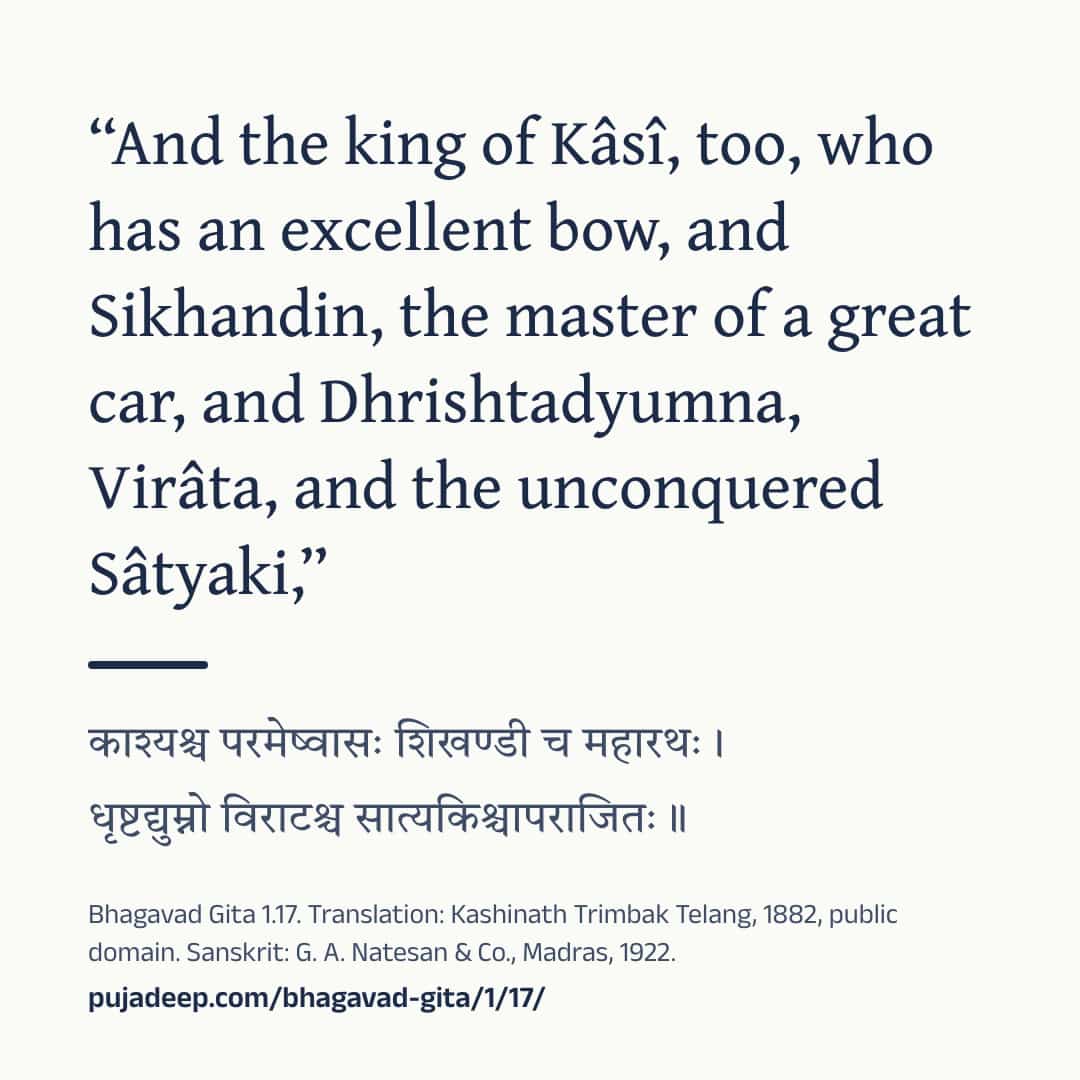
And the king of Kâsî, too, who has an excellent bow, and Sikhandin, the master of a great car, and Dhrishtadyumna, Virâta, and the unconquered Sâtyaki,
This sentence goes on in 1.18.
Compare 3 translations
Kashinath Trimbak Telang, 1882. Public domain. Page 39.
And the king of Kâsî, too, who has an excellent bow, and Sikhandin, the master of a great car, and Dhrishtadyumna, Virâta, and the unconquered Sâtyaki,
This sentence goes on in 1.18.
You are reading this one
Annie Besant, 1895. Public domain. Page 17.
And Kâshya1, chief of bowmen, and Shikandin of the great car, Drishtadyumna and Virâta and Sâtyaki, the unconquered,
This sentence goes on in 1.18.
Footnotes (the translator’s own) - The king of Kâshî, the modern Benares. ↩
You are reading this one
Swami Swarupananda, 1909 (first printed 1907). Public domain. Page 9.
The expert bowman, king of Kàshi, and the great warrior Shikhandi, Dhrishtadyumna and Viràta and the unconquered Sàtyaki;
This sentence goes on in 1.18.
You are reading this one
Cite this verse
The translation: K. T. Telang, The Bhagavadgîtâ (The Sacred Books of the East, vol. VIII, Oxford: Clarendon Press, 1882), p. 39. Bhagavad Gita 1.17.
The translation: Annie Besant, The Bhagavad Gîtâ, or The Lord's Song (London: Theosophical Publishing Society, 1895), p. 17. Bhagavad Gita 1.17.
The translation: Swami Swarupananda, Srimad-Bhagavad-Gita (Mayavati: Prabuddha Bharata Press, 1909; first printed in Prabuddha Bharata, 1907–1909), p. 9. Bhagavad Gita 1.17.
Our explanation: “Bhagavad Gita 1.17: meaning and translation.” Pujadeep. Updated October 25, 2026. https://pujadeep.com/bhagavad-gita/1/17/
Pujadeep’s explanations are free to quote with credit: name Pujadeep and link to the page. How to credit
Classical readings, by school
No readings by school on this verse yet.
Share
Show the ways to share
Send one picture or the text to one chat. The picture names its source and the address of this page.
Drawing the picture
See the words
Bhagavad Gita 1.17

काश्यश्च परमेष्वासः शिखण्डी च महारथः ।
धृष्टद्युम्नो विराटश्च सात्यकिश्चापराजितः ॥

“And the king of Kâsî, too, who has an excellent bow, and Sikhandin, the master of a great car, and Dhrishtadyumna, Virâta, and the unconquered Sâtyaki,”
(K. T. Telang, The Bhagavadgîtâ (The Sacred Books of the East, vol. VIII, Oxford: Clarendon Press, 1882), p. 39, public domain)
This sentence goes on in 1.18.

“And Kâshya, chief of bowmen, and Shikandin of the great car, Drishtadyumna and Virâta and Sâtyaki, the unconquered,”
(Annie Besant, The Bhagavad Gîtâ, or The Lord's Song (London: Theosophical Publishing Society, 1895), p. 17, public domain)
This sentence goes on in 1.18.

“The expert bowman, king of Kàshi, and the great warrior Shikhandi, Dhrishtadyumna and Viràta and the unconquered Sàtyaki;”
(Swami Swarupananda, Srimad-Bhagavad-Gita (Mayavati: Prabuddha Bharata Press, 1909; first printed in Prabuddha Bharata, 1907–1909), p. 9, public domain)
This sentence goes on in 1.18.

Sanskrit: G. A. Natesan & Co., Madras, 1922.
https://pujadeep.com/bhagavad-gita/1/17/ Nothing is sent from this site. Your own app sends it, to the chat you choose. The picture quotes the translation you chose on this page, with its name and year.
Sanskrit text: The Bhagavad-Gita, or The Lord's Song, with the text in Devanagari and an English translation, 1922. Meanings: written for Pujadeep and checked against the cited edition. Source and changes
Questions families ask
Who speaks Bhagavad Gita 1.17?
Sanjaya speaks this verse, in chapter 1 (Arjuna Vishada Yoga).
Where does the Sanskrit text come from?
Sanskrit text: The Bhagavad-Gita, or The Lord's Song, with the text in Devanagari and an English translation, 1922. Meanings: written for Pujadeep and checked against the cited edition. See the source
Is the meaning on this page a translation?
Explanation written for this site from the sources listed here, and checked against the cited edition. It is not a translation and not the only way to read the text. Free to quote with credit.
Source and licence
- Sanskrit text
- The Bhagavad-Gita, or The Lord's Song, with the text in Devanagari and an English translation (Annie Besant, G. A. Natesan & Co., Madras, 1922). Public domain. The Sanskrit on these pages was read from this printing’s page images.
- Translation
- The Bhagavadgîtâ with the Sanatsugâtîya and the Anugîtâ, translated by Kâshinâth Trimbak Telang (The Sacred Books of the East, vol. VIII, ed. F. Max Müller) (Kashinath Trimbak Telang, F. Max Müller, Clarendon Press, Oxford, 1882). Public domain. Shown verbatim, as printed.
- Translation
- The Bhagavad Gîtâ, or The Lord's Song, translated by Annie Besant (Annie Besant, Theosophical Publishing Society, London, 1895). Public domain. Shown verbatim, as printed.
- Translation
- Srimad-Bhagavad-Gita, with Sanskrit Text; Paraphrase with Word-by-word Literal Translation; English Rendering and Comments, Index, &c., by the Swami Swarupananda (Himalayan Series, No. XX) (Swami Swarupananda, The Editors and Publishers, Advaita Ashrama, Mayavati, Prabuddha Bharata Press, Mayavati, Almora, Himalayas, 1909). Public domain. Shown verbatim, as printed.
- Common wording
- In this text, 32 words follow today's common wording, checked against sanskritdocuments.org; Sanskrit Wikisource; Gita Press, Gorakhpur; GRETIL, Göttingen and Bhaktivedanta Book Trust.
- Our explanation
- Explanation written for this site from the sources listed here, and checked against the cited edition. It is not a translation and not the only way to read the text. Free to quote with credit.
- Checked
- Checked against the cited edition, October 15, 2026.
- Updated
- October 25, 2026